THE BEATLES-WHITE ALBUM-UK 2LP-STEREO-MALAYSIA No 06399
£
56
$
74


Favourite Auctions
To save auctions to your favourites, please login
If you don't have an account, please register
Description
TITLE: THE BEATLES-WHITE ALBUM
Label: PARLOPHONE RECORDS
Catalogue number: PCS 7067/PCS 7068
The matrices: YEX 709-1
YEX 710-1
YEX 711-1
YEX 712-1
Year : 1968
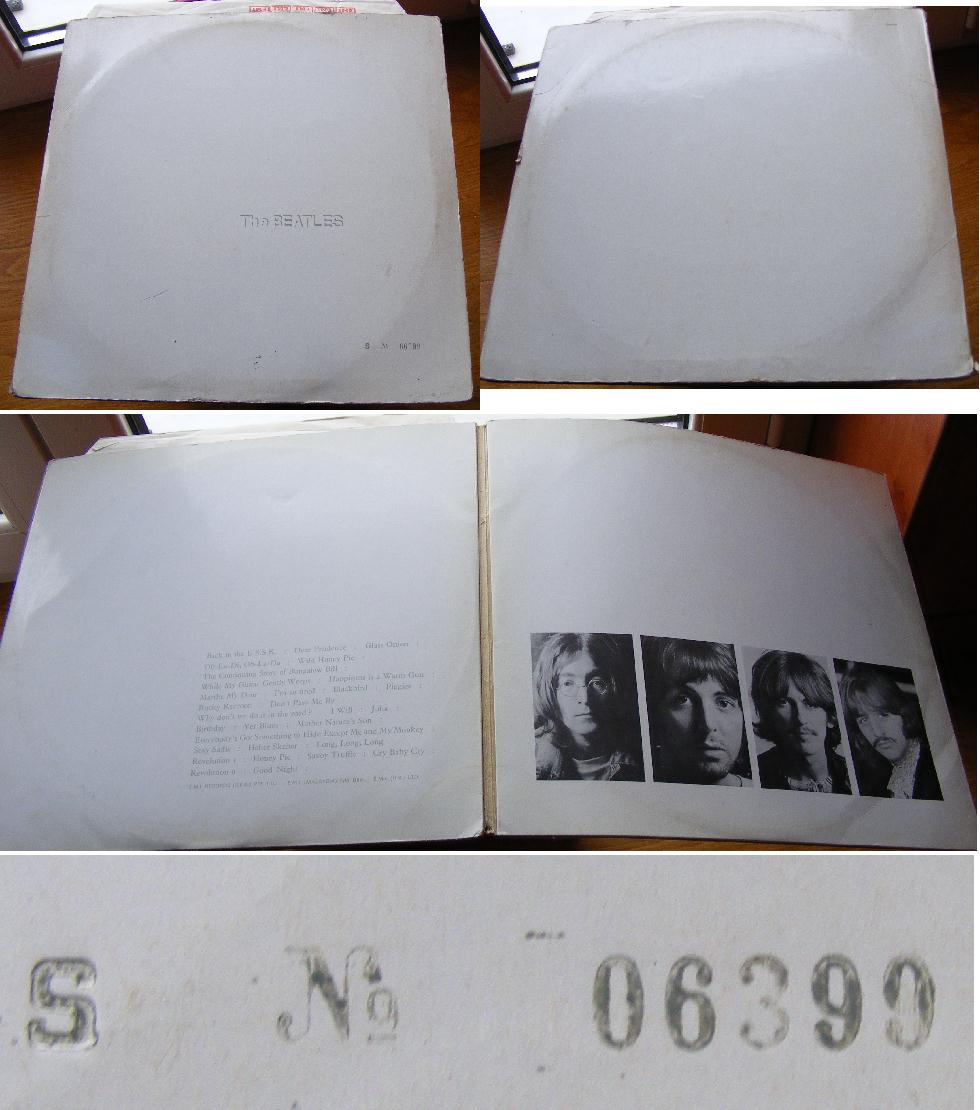
Details of the specific copy: Complet copy, TOP opening 1960's issue. no 06390
condition: (VISUAL GRADING most of times)
The Sleeve : EXCELLENT
-
Front Side : light creasing and light edgewear. Otherise nice, not any crwriting or cut
light yellowing sign, not any writing. rare variation Top Opening Printed and not
empossed THE beatles and numbered!!!!.
-
Back Side : Just beautioful, not any writing, nolight edgewear, light yelowing and creasing.
-
Inners Side: Just perfect, not any writing, not any wear, or yelowing or creasing.
-
Spine: Clear solid and nice , light edgewear, no bends , fully readbale.
-
Edges; Light edgewear.
The Labels: All labels are prefct;y clear with no spindle marks or writing or creasing.
The Vinyls : Both vinyls looks EXCELLENT at least.
A side: EXCELLENT PLUS Very few papers scuffs only, jet black shiny not any single scratch.
B Side: EXCELLENT PLUSVery few papers scuffs only,couple of thin line scrathes jet black shiny
C side: EXCELLENT PLUSVery few papers scuffs only,couple of thin line scrathes jet black shiny
D Side: EXCELLENT PLUS Very few papers scuffs only, jet black shiny not any single scratch.
The inner sleeves: ORIGINAL EMI MALAYSIA Inner sleeves.
The Poster: -
The Photos: set of 4 pictures PHOTOCOPIED in HIGH quality PHoto Paper.
The separator: -
I m not Using GOLDMINE OR RC systems. Word have ltterall meaning. VERY GOOD IS VERY GOOD , and EXCELLENT IS EXCELLENT.
I do offer money guarantee….IF FOR ANY REASON YOU ARE NOT COMPLETELY SATISFIED WITH THE ITEM YOU WON , And You think The Description was not correct, WE GIVE YOU A FULL REFUND ON YOUR MONEY WITHIN 48 HOURS OF ITEM RETURN. I DO NOT REFUND BEFORE ITEM IS BACK. THE ITEM SHOULD HAVE BEEN RETURNED WITHIN 5 Weeks of the auction END , later I cannot cancl the auction. NO EXCEPTIONS ON THIS RULE.
THE HISTORY:
The Beatles (album)
From Wikipedia, the free encyclopedia
(Redirected from White album) "The White Album" redirects here. For other uses, see The White Album (disambiguation). The Beatles Studio album by The Beatles Released 22 November 1968 Recorded 30 May – 14 October 1968,Abbey Road Studios and Trident Studios, London, England Genre Rock Length 93:35 Language English Label Apple, Parlophone, EMI Producer George Martin Professional reviews- Allmusic link
- BBC link
- Blender link
- NME link
- Pitchfork Media (10.0/10.0) 2009
- PopMatters link
- Rolling Stone [1]
- Slant Magazine link
(1967) The Beatles
(1968) Yellow Submarine
(1969) Singles from The Beatles
- "Ob-La-Di, Ob-La-Da"/"Julia"
Released: 8 November 1976 (US)
The Beatles is the ninth official British album and the fifteenth American album by The Beatles, a double album released in 1968. It is commonly known as The White Album as it has no graphics or text other than the band's name (and, on the early LP and CD releases, a serial number) on its plain white sleeve. The album was the first The Beatles undertook following the death of their manager, Brian Epstein (Magical Mystery Tour is listed as a movie soundtrack). Originally entitled A Doll's House, the title was changed when the British progressive rock band Family released the similarly titled Music in a Doll's House earlier that year.
The Beatles was written and recorded during a period of turmoil for the group. After visiting the Maharishi Mahesh Yogi in India and having a particularly productive songwriting session in early 1968, the group returned to the studio for recording from May to October 1968, only to have conflict and dissent drive the group members apart. Drummer Ringo Starr quit the band for a brief time, leaving bassist Paul McCartney to perform drums on some of the album's songs.
Upon release in November 1968, the album received mixed to positive reviews and reached the #1 spot on the charts in the United Kingdom and United States. The album is notable for the eclectic nature of its songs, which has divided critics in evaluating the album's legacy. Still, The Beatles is regarded as one of the greatest albums in rock history. In 2003, the album was ranked number 10 on Rolling Stone magazine's list of "The 500 Greatest Albums of All Time".
[edit]Recording
Beatles was recorded between 30 May 1968 and 14 October 1968, largely at Abbey Road Studios, with some sessions at Trident Studios. Although productive, the sessions were reportedly undisciplined and sometimes fractious, and they took place at a time when tensions were growing within the group.[citation needed] Concurrent with the recording of this album, The Beatles were launching their new multimedia business corporation Apple Corps, an enterprise that proved to be a source of significant stress for the band.[citation needed]
The sessions for The Beatles marked the first appearance in the studio of Lennon's new girlfriend and artistic partner, Yoko Ono, who would thereafter be a more or less constant presence at all Beatles sessions.[9] Prior to Ono's appearance on the scene, the individual Beatles had been very insular during recording sessions, with influence from outsiders strictly limited. McCartney's girlfriend at the time, Francie Schwartz, was also present at some of the recording sessions.[10]
Author Mark Lewisohn reports that The Beatles held their first and only 24-hour recording/producing session near the end of the creation of The Beatles, during which occurred the final mixing and sequencing for the album. The session was attended by Lennon, McCartney, and producer George Martin.[11]
[edit][edit]Other musicians
Eric Clapton played lead guitar on Harrison's "While My Guitar Gently Weeps".[14] Harrison explains in The Beatles Anthology that Clapton's presence temporarily alleviated the studio tension and that all band members were on their best behaviour during his time with the band in the studio.[13] Harrison, who had invited Clapton to the sessions, soon reciprocated by collaborating with Clapton on the song "Badge" forCream's last album Goodbye.
Clapton was not the only outside musician to sit in on the sessions. Nicky Hopkins provided electric piano for the single cut of "Revolution" (recorded during these sessions); Hopkins also provided acoustic piano on a number of tracks. Several horns were also recorded on the album version of "Revolution".[citation needed] "Savoy Truffle" also features the horn section. Jack Fallon played a bluegrass fiddle on "Don't Pass Me By",[15]and a team of orchestral players and background singers appeared on "Good Night" (which was Beatle-free except for Ringo's vocal).
[edit]Technical advances
The sessions for The Beatles were notable for the band's formal transition from 4-track to 8-track recording. As work on the album began, Abbey Road Studios possessed, but had yet to install, an 8-track machine that had supposedly been sitting in a storage room for months. This was in accordance with EMI's policy of testing and customising new gear, sometimes for months, before putting it into use in the studios. The Beatles recorded "Hey Jude" and "Dear Prudence" at Trident Studios in central London, which had an 8-track recorder.[11] When they learned about EMI's 8-track recorder, they insisted on using it, and engineers Ken Scott and Dave Harries took the machine (without authorisation from the studio chiefs) into the Number 2 recording studio at Abbey Road for the band's use.[11]
[edit]Songs
Although most of the songs on any given Beatles album are usually credited to the Lennon/McCartney songwriting team, that description is often misleading, and rarely more so than on The Beatles. With this album, each of the four band members began to showcase the range and depth of his individual songwriting talents, and to display styles that would be carried over to his eventual solo career. Indeed, some songs that the individual Beatles were working on during this period eventually were released on solo albums.[citation needed] These include Lennon's "Look at Me" and "Child of Nature", eventually reworked as "Jealous Guy"; McCartney's "Junk" and "Teddy Boy"; and Harrison's "Not Guilty" and "Circles".[citation needed]
Many of the songs on the album display experimentation with unlikely musical genres, borrowing directly from such sources as 1930s dance-hall music (in "Honey Pie"), classical chamber music (in "Piggies"), theavant-garde sensibilities of Yoko Ono and John Cage (in "Revolution 9"), and the sentimentality of elevator music (in "Good Night"). Such diversity was quite unprecedented in global pop music in 1968, and the album's sprawling approach provoked (and continues to provoke) both praise and criticism from observers.[16] "Revolution 9", in particular, a densely layered eight-minute-and-thirteen-second sound collage, has attracted bewilderment and disapproval from both fans and music critics over the years.
The only western instrument available to the group during their Indian visit was the acoustic guitar, and thus most of the songs on The Beatles were written and first performed on that instrument.[citation needed] Some of these songs remained acoustic on The Beatles (notably "Rocky Raccoon", "Blackbird", "I Will" and "Mother Nature's Son") and were recorded in the studio either solo, or by only part of the group.
[edit][edit]Mono version
The Beatles was the last Beatles album to be released with a unique, alternate mono mix, albeit one issued only in the UK. Twenty-eight of the album's 30 tracks ("Revolution 1" and "Revolution 9" being the only exceptions) exist in official alternate mono mixes.
Beatles' albums after The Beatles (except Yellow Submarine in the UK) occasionally had mono pressings in certain countries (such as Brazil), but these editions—Yellow Submarine, Abbey Road and Let It Be—were in each case mono fold-downs from the regular stereo mixes.
In the US, mono records were already being phased out; the US release of The Beatles was the first Beatles LP to be issued in stereo only.
The mono version of The Beatles was made available worldwide (including the US) on 9 September 2009, as part of the Beatles in Mono CD box set.
[edit]Sleeve
A vintage circa-1970 pressing ofThe Beatles. Note the serial number and the embossed, rather than printed, album title.The album's sleeve was designed by Richard Hamilton, a notable pop artist who had organised a Marcel Duchamp retrospective at the Tate Gallery the previous year. Hamilton's design was in stark contrast to Peter Blake's vivid cover art for Sgt. Pepper's Lonely Hearts Club Band, and consisted of a plain white sleeve. The band's name was discreetly embossed slightly below the middle of the album's right side, and the cover also featured a unique stamped serial number, "to create," in Hamilton's words, "the ironic situation of a numbered edition of something like five million copies."[citation needed] Indeed, the artist intended the cover to resemble the "look" of conceptual art, an emerging movement in contemporary art at the time. Later vinyl record releases in the US showed the title in grey printed (rather than embossed) letters. Early copies on compact disc were also numbered. Later CD releases rendered the album's title in black or grey. The 30th anniversary CD release was done to look like the original album sleeve, with an embossed title and serial number, including a small reproduction of the poster and pictures (see re-issues).
The album's inside packaging included a poster, the lyrics to the songs, and a set of photographs taken by John Kelly[19] during the autumn of 1968 that have themselves become iconic. This is the only sleeve of a Beatles studio album not to show the members of the band on the front.
Tape versions of the album did not feature a white cover. Instead, cassette, reel-to-reel, and 8-track versions (first issued on two cartridges in early 1969) contained cover artwork that featured a black and white (with no grey) version of the four Kelly photographs.[20] In both the cassette and 8-track versions of the album, the two tapes were sold in a black slip-cover box that bore the title, "The BEATLES" in gold lettering along the front.[21] This departure from the LP's design not only made it difficult for less-informed fans to identify the tape in record stores, but it also led some fans at the time to jokingly refer to the 8-track or cassette not as the "white album" but as the "black tape." In 1988, Capitol/EMI re-issued the 2-cassette version of the album, still with the same cover artwork as the original cassettes — but without the black slip-cover box.
[edit][edit]Sales
As it was their first studio album in almost eighteen months (and coming after the blockbuster success of Sgt. Pepper's Lonely Hearts Club Band) expectations were high at time of release of The Beatles. The album debuted straight at #1 in the UK on 1 December 1968,[40] (becoming their third album to do so, after Help! and Revolver). It spent seven weeks at the top of the UK charts (including the entire competitive Christmasseason), until it was replaced by The Seekers' Best of the Seekers on 25 January 1969, dropping to number two. However, the album returned to the top spot the next week, spending an eighth and final week at #1. Then, it spent another four weeks on the Top 10, and then dropped the charts quicker than Sgt. Pepper. The White Album was particularly notable for blocking the Beatles follow-up album, Yellow Submarine, which debuted (and peaked at) #3 on 8 February 1969, the same week The White Album was dominating the second position on the charts. In all, The Beatles spent 24 weeks on the UK charts (a far cry comparison to the over 200 weeks spent by Sgt. Pepper's).
In the United States, the album was received with huge commercial success. It debuted at #11, then reached #2, and finally peaked at #1 in its third week, spending a total of nine weeks at the top. In all, The Beatlesspent 155 weeks on the Billboard 200. According to the Recording Industry Association of America, The Beatles is The Beatles' best-selling album at 19-times platinum and the tenth-best-selling album of all time in the United States.
[edit]Re-issues
Two re-issues in 1978 (one by Capitol Records, the other by Parlophone) saw the album pressed on white vinyl, completing the look of the "white" album. In 1985, EMI Electrola released a DMM (direct metal mastering) white vinyl pressing of the album in Germany, which was imported to the United States in large numbers. Another popular white vinyl pressing was manufactured in France. The 1978 Parlophone white vinyl export pressing and the German DMM pressing are considered by many to be the best-sounding versions of the album.[citation needed] This is due to the use of the famed Neumann lathe on the 1978 export pressing and the use of the DMM process on the 1985 pressing.
On 7 January 1982, Mobile Fidelity Sound Lab (MFSL) released the album in a non-embossed unnumbered version of cover with the ORIGINAL MASTER RECORDING banner at the top. Neither the poster nor portraits were included. The labels to the discs are white with primarily black text and the Capitol dome logo at three o'clock. The MFSL discs were made with Super Vinyl, a heavy and hard compound that that provides an extraordinary quiet playing surface. Although MFSL leased the album from Capitol and used the company's sub-master, many fans believe they sound superior to the standard British and American pressings. The discs were stored in "rice paper" static-free, dust-free inner sleeves enclosed in an off-white gatefold reinforced stiff board that fit into the custom fabricated album jacket.
The album was first released on CD on 25 August 1987.
In 1998, a 30th anniversary reissue of the album was released on a two-disc compact disc version in the United Kingdom. The packaging of this release is virtually identical to its vinyl counterpart. It has the same pure white gatefold cover, complete with the title The BEATLES in a slightly raised, embossed graphic at a slight angle. It also included the now-classic sequentially numbered serial number on the front of this cover, thus making this one a real limited edition. The interior of this cover features the song titles on the left-hand side, and the four black-and-white photos of the group members on the right. This version of the cover even accurately mimics the original British vinyl pressing from 1968, with the openings for the discs at the top rather than the sides. There are miniatures of the four full-colour glossy portrait photos included, as well as an exact replica of the poster with the photo collage on one side, and the album's complete song lyrics on the opposite side. The CDs are housed in black sleeves, which were also used for the original British album. This commemorative double CD album is housed in a clear plastic slipcase.
On 9 September 2009, new remasters of all The Beatles studio albums were released. For this new release, the slipcover holding the CD digipak is embossed in much the same style as the original sleeve (though lacking a serial number).
[edit]Track listing
All songs written and composed by Lennon/McCartney, except where noted.
Side one # Title Lead vocals[37] Length 1. "Back in the U.S.S.R." McCartney 2:43 2. "Dear Prudence" Lennon 3:56 3. "Glass Onion" Lennon 2:17 4. "Ob-La-Di, Ob-La-Da" McCartney 3:08 5. "Wild Honey Pie" McCartney 0:53 6. "The Continuing Story of Bungalow Bill" Lennon 3:14 7. "While My Guitar Gently Weeps" (George Harrison) Harrison 4:45 8. "Happiness Is a Warm Gun" Lennon 2:43 Side two # Title Lead vocals[37] Length 1. "Martha My Dear" McCartney 2:28 2. "I'm So Tired" Lennon 2:03 3. "Blackbird" McCartney 2:18 4. "Piggies" (Harrison) Harrison 2:04 5. "Rocky Raccoon" McCartney 3:32 6. "Don't Pass Me By" (Richard Starkey) Starr 3:50 7. "Why Don't We Do It in the Road?" McCartney 1:41 8. "I Will" McCartney 1:46 9. "Julia" Lennon 2:54 Side three # Title Lead vocals[37] Length 1. "Birthday" McCartney with Lennon 2:42 2. "Yer Blues" Lennon 4:01 3. "Mother Nature's Son" McCartney 2:48 4. "Everybody's Got Something to Hide Except Me and My Monkey" Lennon 2:24 5. "Sexy Sadie" Lennon 3:15 6. "Helter Skelter" McCartney 4:29 7. "Long, Long, Long" (Harrison) Harrison 3:04 Side four # Title Lead vocals[37] Length 1. "Revolution 1" Lennon 4:15 2. "Honey Pie" McCartney 2:41 3. "Savoy Truffle" (Harrison) Harrison 2:54 4. "Cry Baby Cry" Lennon, with McCartney 3:01 5. "Revolution 9" 8:22 6. "Good Night" Starr 3:11[edit]Personnel
The Beatles- George Harrison – lead, harmony and background vocals; lead and rhythm (electric and acoustic) guitars, four- and six-string bass guitar; Hammond organ; drums and assorted percussion (tambourine, hand shake bell, handclaps and vocal percussion) and sound effects[11]
- John Lennon – lead, harmony and background vocals; lead and rhythm (electric and acoustic) guitars, 4 and 6-string bass guitar; pianos (electric and acoustic), Hammond organ, harmonium, mellotron; drums and assorted percussion (tambourine, maracas, thumping on the back of an acoustic guitar, handclaps and vocal percussion); harmonica, saxophone and whistling; tapes, tape loops and sound effects (electronic and home-made)[11]
- Paul McCartney – lead, harmony and background vocals; lead and rhythm (electric and acoustic) guitars, 4 and 6-string bass guitar; pianos (electric and acoustic), Hammond organ, drums, timpani and assorted percussion (tambourine, handclaps and vocal percussion; drums on "Back in the U.S.S.R." and "Dear Prudence"); recorder, flugelhorn and sound effects[11]
- Ringo Starr – drums and assorted percussion (tambourine, bongos, cymbals, maracas, vocal percussion); lead vocals, electric piano and sleigh bell (on "Don't Pass Me By") , lead vocals (on "Don't Pass Me By" and "Good Night") and backing vocals ("The Continuing Story of Bungalow Bill")[11]
- Eric Clapton – lead guitar on "While my Guitar Gently Weeps"
- Mal Evans – backing vocals and handclaps on "Dear Prudence","The Continuing Story of Bungalow Bill" and "Birthday", saxophone and sound effects on "Helter Skelter"
- Jack Fallon – violin on "Don't Pass Me By"
- Pattie Harrison – backing vocals on "Birthday"
- Jackie Lomax – backing vocals and handclaps on "Dear Prudence"
- Jimmy Scott – congas on "Ob-La-Di-Ob-La-Da"
- Maureen Starkey – backing vocals on "The Continuing Story of Bungalow Bill"
- Yoko Ono – backing vocals and handclaps on "The Continuing Story of Bungalow Bill" and tapes and sound effects on "Revolution 9", backing vocals on "Birthday"
- Ted Barker – trombone on "Martha My Dear"
- Leon Calvert – trumpet and flugelhorn on "Martha My Dear"
- Henry Datyner, Eric Bowie, Norman Lederman, Ronald Thomas (all on "Glass Onion"), Bernard Miller, Dennis McConnell, Lou Soufier and Les Maddox (all on "Martha My Dear") – violins
- Reginald Kilby (on "Glass Onion" and "Martha My Dear"), Eldon Fox (on "Glass Onion") and Frederick Alexander (on "Martha My Dear") – cellos
- Harry Klein – clarinet on "Honey Pie", saxophone on "Savoy Truffle"
- Alf Reece – tuba on "Martha My Dear"
- The Mike Sammes Singers – backing vocals on "Good Night"
- Stanley Reynolds and Ronnie Hughes – trumpet (all on "Martha My Dear")
- Tony Tunstall – French horn on "Martha My Dear"
- John Underwood, Keith Cummings (all on "Glass Onion"), Leo Birnbaum and Henry Myerscough (all on "Martha My Dear") – violas
- Geoff Emerick – engineer, vocal on "Revolution #1" ("Take 2")
- George Martin – record producer and mixer; string, brass, clarinet, orchestral arrangements and conducting; piano on "Rocky Raccoon"
- Ken Scott – engineer and mixer
- Chris Thomas – producer; mellotron on "The Continuing Story of Bungalow Bill", harpsichord on "Piggies" and piano on "Long, Long, Long"
All Items Are shipped from ATHENS Greece not from UK.
S&H to UK is 5.5 GBP for the first LP, 6.5 GBP for 2 LP sets of 2 LPs, and 2.5 GBP for each LP after.
S&H to the rest of the World is 6.2 GBP for the first LP, 8.5 GBP for 2 LP sets of 2 LPs, and 2.5 GBP for each LP after.
s&h to Greece is 4 GBP fro any order size!!!
Items that cost more than 50 GBp must be shipped with insurrance that is 3.5 GBp more. Please Do not pay before you receive our invoice. Thanks!
S&h to GREECE : 4GBP or any order Size, ??? ???????????? ? ?????????. ??? ??? ????????? >price rating