Yesterday And Today MONO: Capitol Records T 2553 - Second State Butcher EX copy
$
800
Favourite Auctions
To save auctions to your favourites, please login
If you don't have an account, please register
Description
This is a serious investment, and my intention is to give all the conditional information of this specific album.
Up for sale is a Second State Butcher cover.
This cover and record are amazingly well preserved for 55 years old.
I am disclosing every detail that I can possibly describe and identify, so please take time to read this listing from top to bottom and please confirm the information that I have listed.
This is a 100% legitimate Second State cover.
Then you can make your decision whether you are going to scoop up this spectacularly clean Second State butcher album.
Please ask me for more photos or any questions on this album.
DISCLOSURE
· This is a rare Second State version, MONO pressing from the Los Angeles plant.
· The Matrix numbers are identical to the known confirmed copies.
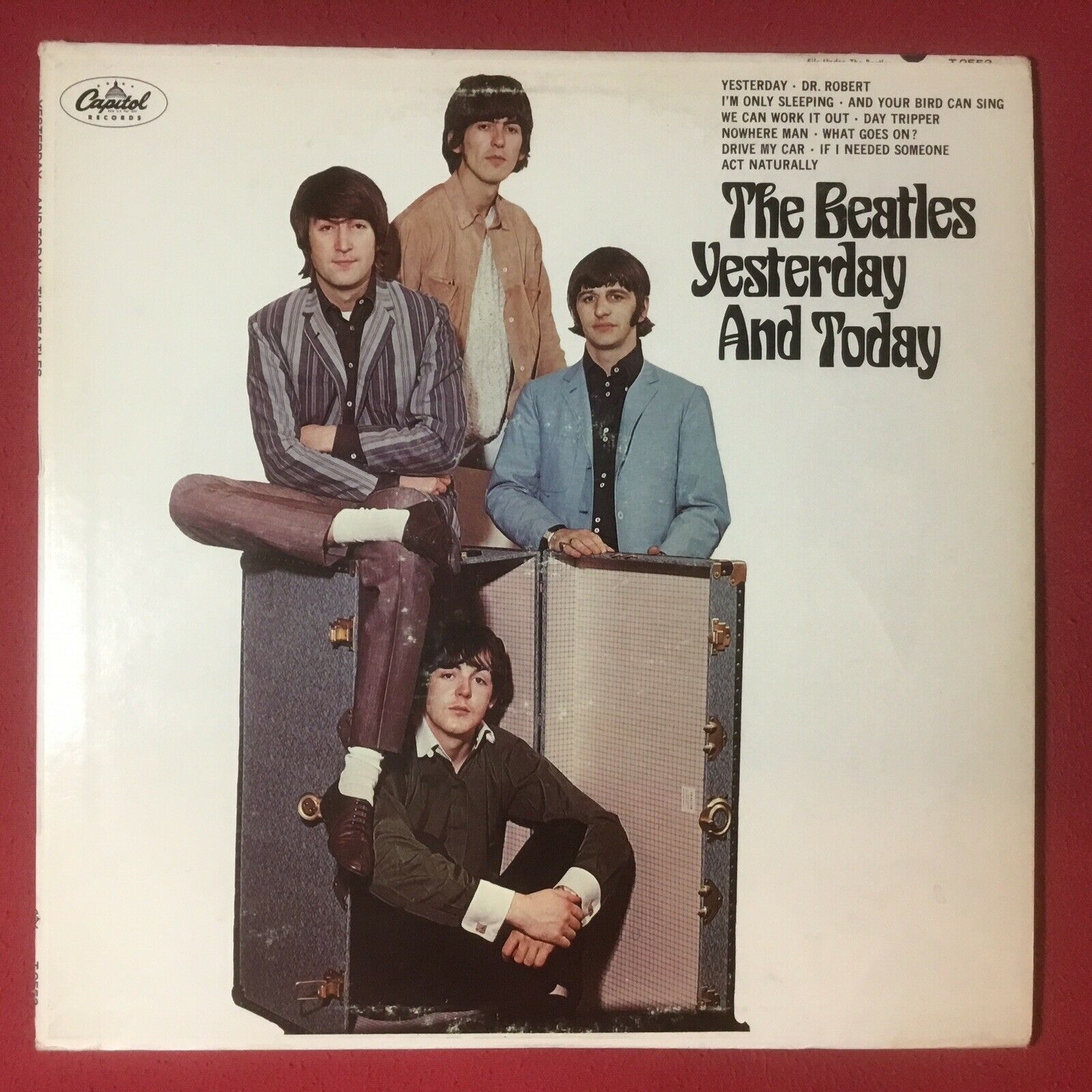
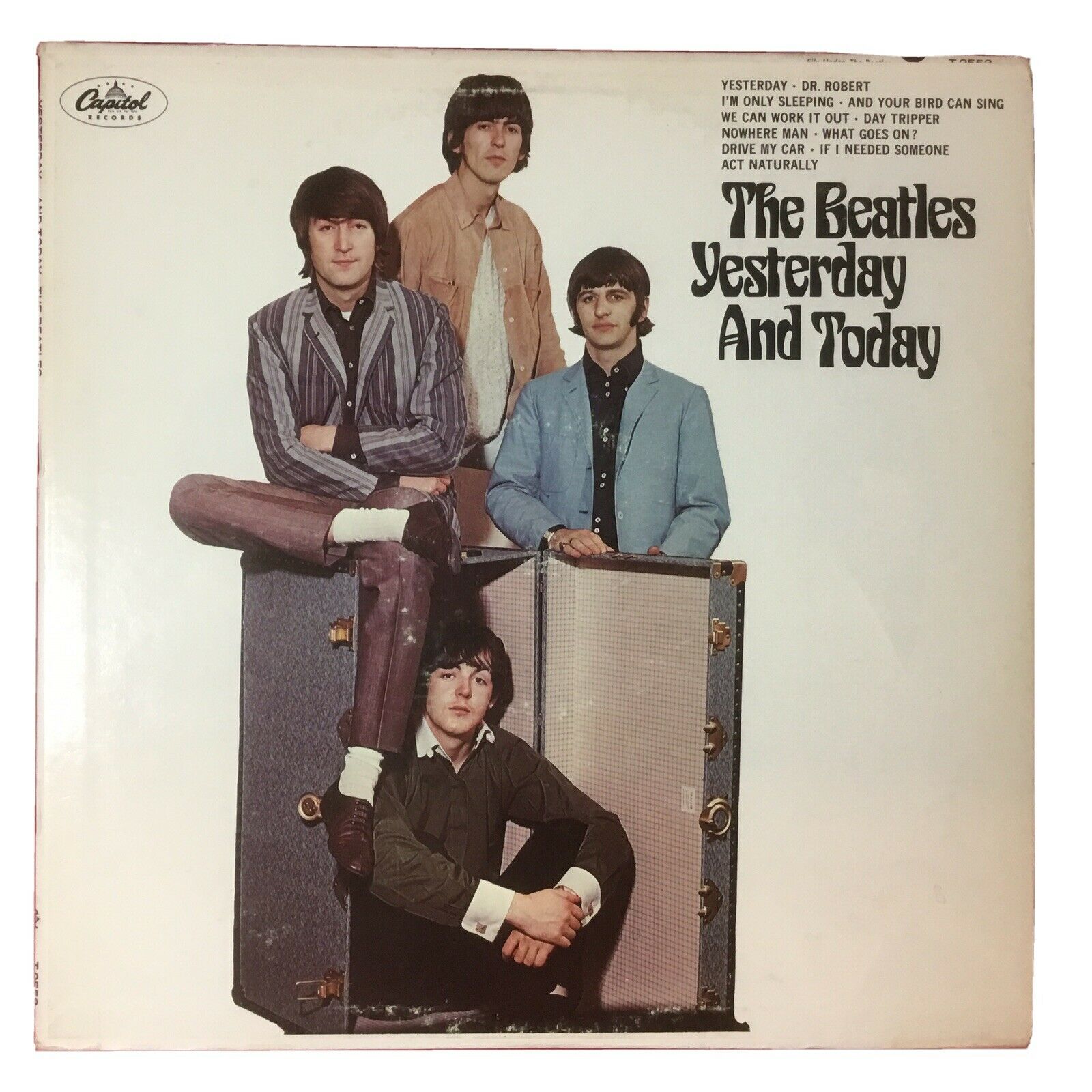
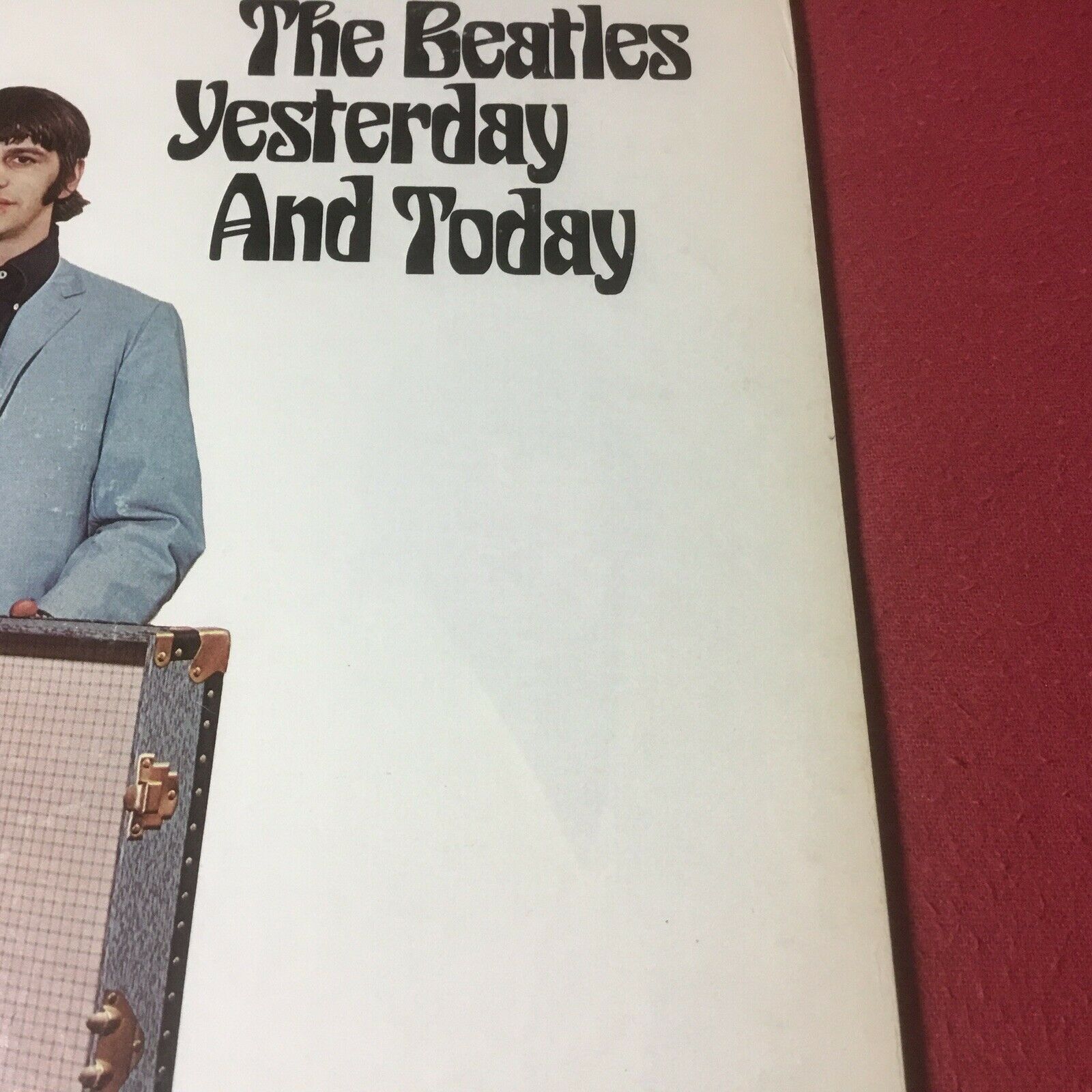
· You can clearly see Ringo’s black turtleneck through the clean white cover.
· The original inner sleeve is present with a 2” split on the bottom and each side where the record has cut through. (quite common) It is remarkably is crisp clean colorful condition.
· There is an extremely small stain on the front lower R/H region. (see pics)
· The front cover is remarkably clean, even as clean as a sealed one with the only wear mark is on the top on Georges forehead. You see this even with sealed copies.
· The spine is intact, and all the lettering is clearly legible showing clean edge.
· The top seam is showing slight wear, the paper is still visible on the edge, it is just showing a slight bit of shelf wear until you get to the spine corner where it is ever so starting to wear .
· The seam has no wear until you get to the spine corner where it is ever so starting to wear .
· The two corners on the spine in relation to the top and bottom seams have is ever so starting to wear – See pics.
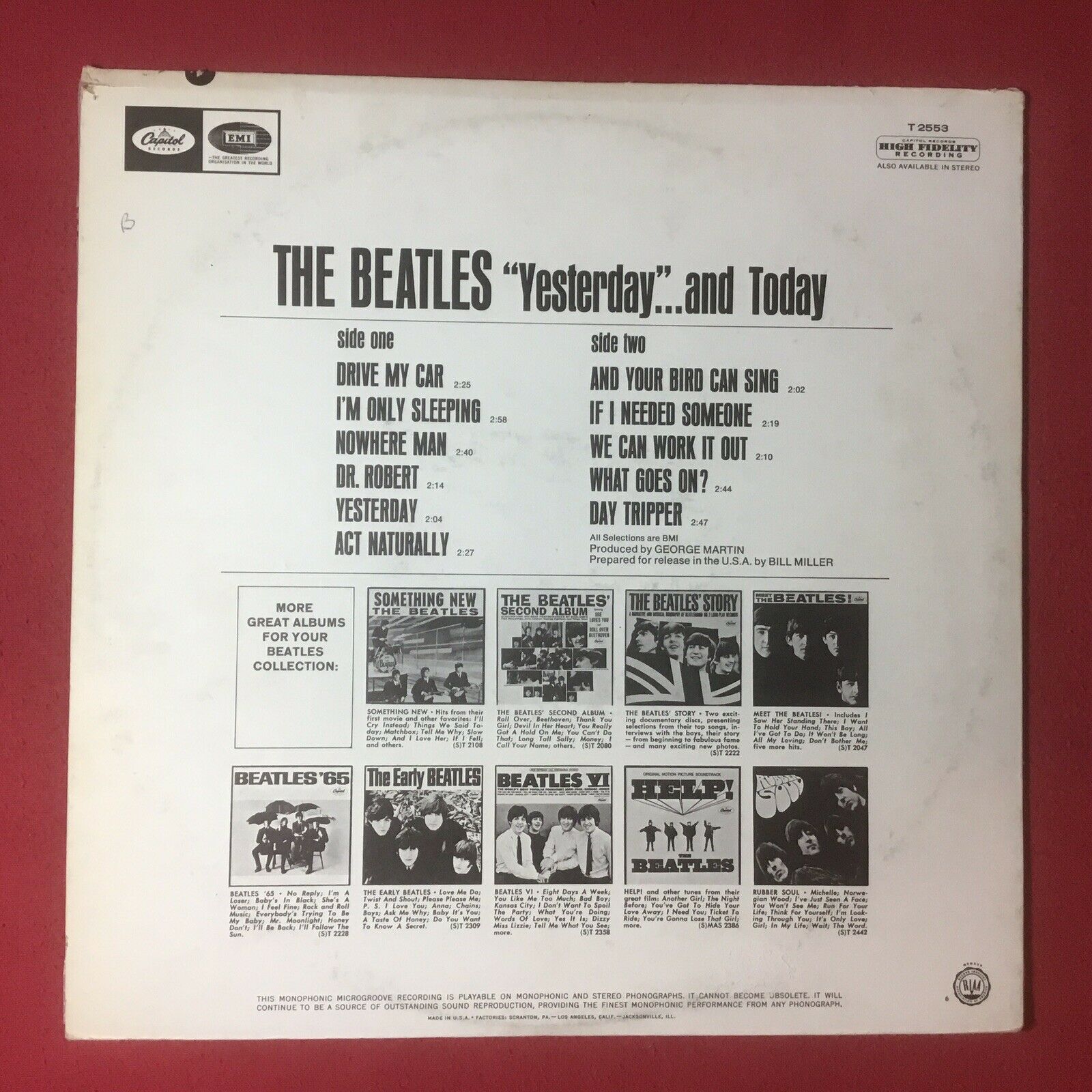
· The back cover shows very light ring wear for a record 55 years old.
· The back cover has the letter “B” written on the top L/H corner.
· On the back-bottom center / right hand side the cover has a light scuff that can be seen under close inspection. My thought is that it rubbed against something. (see pics)
· The top L/H corner on the back cover shows the cover peeling back where the top print meets the folded jacket. (see pics)
· The print on the back cover is crisp, clear, and legible.
· The Los Angeles pressing plant ID # 6 is on the back lower R/H corner.
· The vinyl grades: EX- (much better than VG+ yet not pristine enough to grade EX+)
· The Matrix and * Los Angeles stamp is confirmed and verified
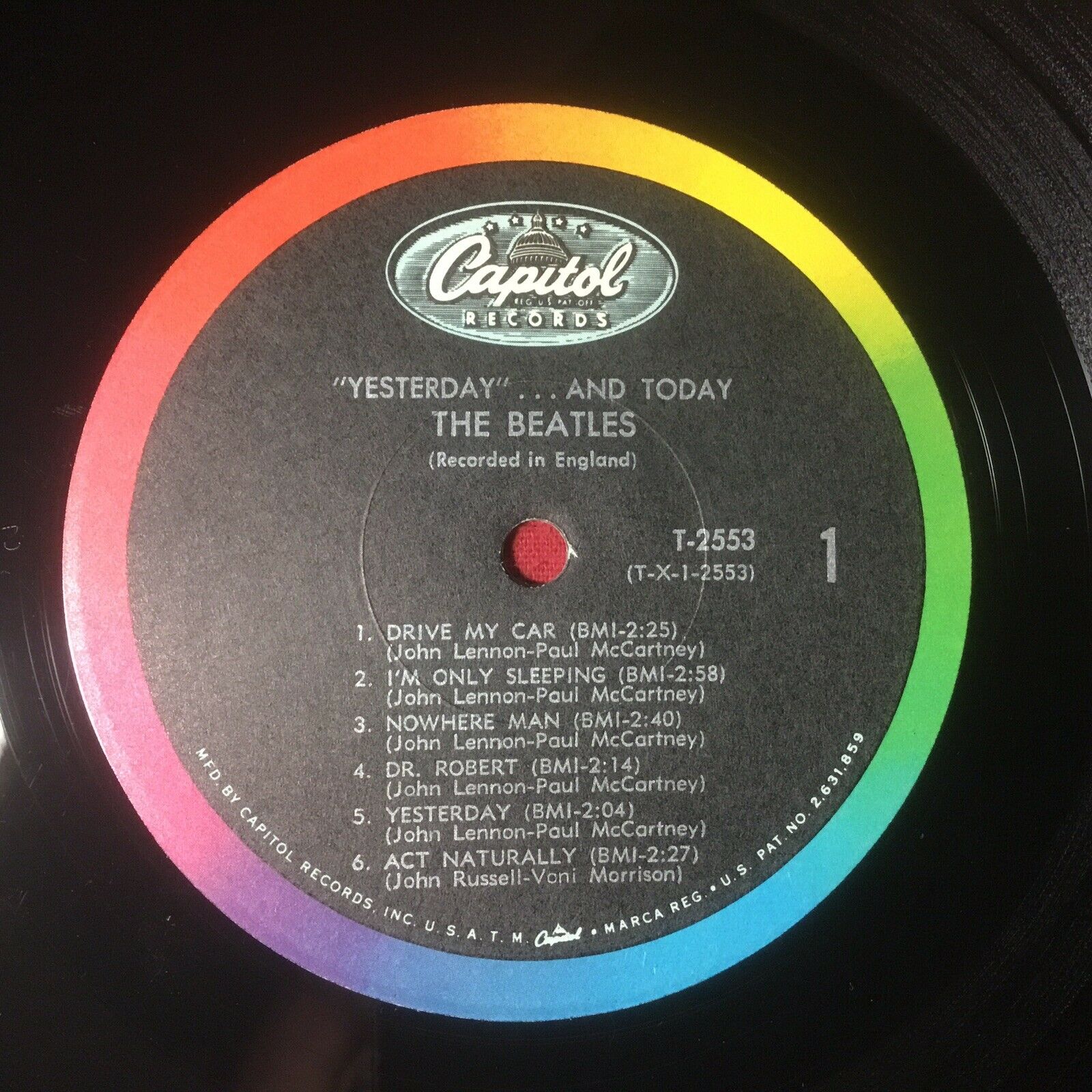
· The labels on the vinyl are clean. (see pics)
The “B” written on the back and the slight wear on the corners, the slight ring wear, and the top L/H corner peeling are shown in pics.
It is priced based on a new sealed copy (second state) would bring a around $2500, and is an extreme rarity, and you may never see one for sale outside of a professional collectors auction.
All versions of the Butcher cover are collectible, and collectors are interested in owning all three versions in the best possible condition. All three are relatively uncommon, and the First State versions are quite rare.
Second State Butcher covers are significantly harder to find a half a century later. Over time, many of these albums have ended up in the trash, as albums often do, and quite a few of them were likely owned and eventually discarded by people who had no idea that they owned a version of the Butcher cover.
Even among surviving examples of Butcher covers, Second State Butcher covers have become more rare over time, as many people have peeled them to reveal the original Butcher cover underneath, often with varying degrees of success.
Because of peeling and general attrition, Second State Butcher covers are somewhat scarce today. As with First State issues, Second State Butcher covers are significantly more common in mono than they are in stereo.
Second State versions, however, are becoming increasingly rare, as many thousands of them have been peeled over the years. As these records were sold when new as Second State issues, they have value to collectors “as-is”, that is, in their original unpeeled state.
If your Second State version is in pristine condition, be it still sealed or perhaps still in the original shrink wrap, or even in mint condition, you should probably leave it alone. It’s worth the most it’s ever going to be worth in its current condition.
Keep in mind that Second State Butcher covers are collectible in their own right, as that is the way the album was sold when it was first released to the public. Every time someone peels one, there is one less Second State Butcher cover left in the world. As time goes on, they are becoming increasingly rare.
HERE ARE THE SPECIFIC PRESSING INFORMATION FOR THIS ALBUM:
The Beatles ?– Yesterday And Today
Label: Capitol Records ?– T 2553, Capitol Records ?– T-2553
Format: Vinyl, LP, Album, Mono, Second State - Butcher Cover
Country: US
Released: 20 Jun 1966
Genre: Rock
Style: Beat, Pop Rock
Tracklist
A1
Drive My Car
Written-By – John Lennon-Paul McCartney*
2:25
A2
I'm Only Sleeping
Written-By – John Lennon-Paul McCartney*
2:58
A3
Nowhere Man
Written-By – John Lennon-Paul McCartney*
2:40
A4
Dr. Robert
Written-By – John Lennon-Paul McCartney*
2:14
A5
Yesterday
Written-By – John Lennon-Paul McCartney*
2:04
A6
Act Naturally
Written-By – John Russell*, Voni Morrison
2:27
B1
And Your Bird Can Sing
Written-By – John Lennon-Paul McCartney*
2:02
B2
If I Needed Someone
Written-By – George Harrison
2:19
B3
We Can Work It Out
Written-By – John Lennon-Paul McCartney*
2:10
B4
What Goes On?
Written-By – Lennon-McCartney, Starkey*
2:44
B5
Day Tripper
Written-By – John Lennon-Paul McCartney*
2:47
Companies, etc.
- Pressed By – Capitol Records Pressing Plant, Los Angeles
Credits
- Producer – George Martin
Notes
Underneath the regular cover in the picture shown is the so-called ''butcher'' cover of this release which induced such an outrage that the album was recalled, and new artwork was created from an earlier Beatles photoshoot. A small number of copies escaped and appeared on the market, nonetheless. These are known as ''first state'' butcher covers. Not wanting to lose time with waiting until the new covers were ready, Capitol decided to first use the new front slicks and glue them over the original artwork, to hide its offensive picture from the public eye. The (not too many) copies of this that came onto the market are known as ''second state'' butcher covers. These are discernible by checking the cover in the middle on the right hand side. If the ''butcher'' artwork is underneath, a dark triangle (of Ringo's turtleneck) shines through (see ''more images''). If the pasted slick is removed and the original artwork thus restored the release is known as a ''third state'' butcher cover. All three states are known in stereo too. This entry in Discogs is the second state cover version.
Released on a black Capitol label with rainbow rim.
On the label the cat. no. appears as T-2553, on the cover as T 2553.
Barcode and Other Identifiers
- Matrix / Runout (Side 1): T2-2553-F3 #3
- Matrix / Runout (Side 2): T2-2553-F7
- Barcode (Label Side 1 (Under Cat. #)): T-X-1-2553
- Barcode (Label Side 2 (Under Car. #)): T-X-2-2553
- Other (Dead Wax Area): Triangle w/ IANM inside
- Other (Jacket Back (Lower Right)): RIAA Emblem with a 6
- Matrix / Runout (Variant 1, side A): T1-2553-G8
- Matrix / Runout (Variant 1, side B): T2-2553-F5
- Matrix / Runout (Variant 2, side A etched, stamped): T-1-2553-G-22 2 ?
- Matrix / Runout (Variant 2, side B etched, stamped): T-2-2553-G-18 2 ?
Identifying A Butcher Cover
Closeup of a Second State Butcher cover. Ringo’s collar can be seen as indicated.
It would seem pretty straightforward to identify a Butcher cover; after all, it has that photo on the front, right? That is true of First State issues, which are easily identifiable as
Butcher covers. It is also true of Third State versions, as the trunk cover has been peeled to reveal the Butcher cover slick underneath.
Once you know how to tell the difference, it becomes quite obvious.
Parts of the artwork on the original cover were black, while large portions of the trunk cover are white. On Second State issues, there is one part of the cover in particular where the original Butcher cover can be seen through the white part of the trunk cover slick.
In the original Butcher cover photo, Ringo Starr was wearing a black turtleneck sweater underneath his white butcher smock and the part of the turtleneck that appears in that photo is triangular in shape. On Second State issues, the part of the trunk cover slick that is directly above that black triangular area is all white.
On Second State covers, this black triangle is always visible through the trunk cover, and it appears about 2 1/4” below the letters “oda” in the word “Today” in the album’s title. Assuming that you are in a room with good light or outside in sunlight, the triangular area will be plainly visible. You will not have to strain or struggle to see it; if you can’t see it, then you’re holding a later trunk cover version of the album.
From January 1964, when Capitol Records released Meet the Beatles in America, through the August, 1966, release of Revolver, the Beatles’ American albums differed in content, and sometimes in cover art and title, from their British counterparts. This was mostly due to different industry practices within those two countries.
In Britain, albums usually contained fourteen songs, and ordinarily did not contain songs that had been previously released as singles. The reasoning for this was that the public might not be interested in buying expensive albums that contained songs that they had previously purchased as singles.
In America, albums usually contained twelve songs, and it was quite common for albums to contain songs that had previously been released as singles.
In Britain, the Beatles, and their record company, Parlophone, carefully planned out their releases, choosing songs that were intended to be released as singles while assigning others to albums. In the United States, Capitol Records, spurred on by the tidal wave of Beatlemania, was interested in releasing as many albums as possible, with twelve tracks, of course, rather than the fourteen used in Britain.
Fewer tracks meant greater profits and fewer royalties to pay, as the price of the album would be the same, regardless of how many songs were on it.
These independent decisions led to significant differences in the Beatles’ catalog in the two countries, with far more albums being released in the United States than in Britain. By putting singles and their B-sides on albums and by cutting the number of tracks from fourteen to twelve, Capitol occasionally found themselves with enough tracks left over from various projects to release a unique album to be released only in the United States and Canada. One of these albums was Yesterday and Today, which Capitol scheduled for release on June 20, 1966.
Yesterday and Today was an album planned by the American record company alone and was compiled with little, if any, input from the Beatles themselves. The tracks were taken from a variety of sources:
“Act Naturally” and “Yesterday” were originally on the UK version of the 1965 LP Help!, but had been omitted from the U.S. Version.
“Drive My Car”, “If I Needed Someone”, “Nowhere Man” and “What Goes On” were taken from the UK version of the 1965 LP Rubber Soul and had been left off of the American version of the album.
“Day Tripper” and “We Can Work It Out” had been released as a single in both the U.S. and in the UK, where those two songs had not been intended to appear on an album.
“And Your Bird Can Sing”, “Doctor Robert”, and “I’m Only Sleeping” were tracks intended for the then-unreleased Revolver album, which wouldn’t be released until August 1966.
The completed track lineup is listed below. The album was given the title “Yesterday and Today” to take advantage of the song “Yesterday”, which had reached #1 on the American charts in October 1965.
The Beatles were reportedly unhappy with the way that Capitol records reconfigured their intended releases but were unable to do anything about it. This was eventually resolved when the group signed a new contract in 1967, and all releases from that time forward were identical in both the U.S. and the UK, as per the Beatles’ wishes.
As for Yesterday and Today, the Beatles likely knew as little as the American public about the content of the album prior to its release.
The back cover for all versions of Yesterday and Today
The back cover for all versions of Yesterday and Today
Song Listings
Side One
“Drive My Car” – 2:25
“I’m Only Sleeping” – 2:58
“Nowhere Man” – 2:40
“Doctor Robert” – 2:14
“Yesterday” – 2:04
“Act Naturally” – 2:27
Side Two
“And Your Bird Can Sing” – 2:02
“If I Needed Someone” – 2:19
“We Can Work It Out” – 2:10
“What Goes On” – 2:44
“Day Tripper” – 2:47
With the track listings for Yesterday and Today all set, the only thing left for Capitol to do was come up with a cover design for the album.
The Original Cover Design – The Butcher Cover
As Yesterday and Today was intended to be a North American-only release (it would also be released in Canada), Capitol had not received artwork from Parlophone, and requested that the band’s management provided them with suitable artwork for the album cover.
The photos supplied came from a photo shoot that the band had done in March 1966 with photographer Robert Whitaker, which were originally intended to be used for a piece of conceptual art called “A Somnambulant Adventure.” For these photos, the Beatles were dressed in butcher smocks and sat on or stood around a bench while surrounded with parts from plastic dolls and raw meat.
Though these photos were not taken with the intention of using them for an album cover, the band’s management submitted them to Capitol, and one of the photos was chosen to be used for the cover of the Yesterday and Today album. Whitaker had no idea that he’d inadvertently created the Butcher cover.
Butcher Covers Are Shipped And Withdrawn
butcher cover recall letter
A copy of the letter Capitol sent to reviewers asking for the albums to be returned.
As Beatles albums had continued to sell well since their arrival in America in early 1964, Capitol had high hopes for sales of Yesterday and Today. In anticipation of this, the company printed some 750,000 covers at their three pressing plants – Los Angeles, California, Scranton, Pennsylvania, and Jacksonville, Illinois.
The front cover slicks for the cover were printed on a special paper with a slightly rough texture, and the photo used was given a slightly grainy appearance in order to make the finished cover look somewhat as though it had been painted on canvas.
At the time of the release of Yesterday and Today, record companies in America were still pressing records in both stereo and mono, as stereo records were playable only on stereo equipment and most buyers only had mono record players. Because of this, approximately 80%-90% of the finished covers were in mono, with the remainder in stereo.
Several hundred copies of the finished Yesterday and Today album were shipped to radio stations and reviewers in order to help the album receive press attention prior to release. Most of the remaining copies were shipped to distributors around the country.
Due to the controversial image depicted on the cover, reaction to the album from the few people who received advance copies was predictably hostile, and distributors and retailers expressed concern about the cover art. As the album’s release date approached, Sir Joseph Lockwood, the chairman of EMI, the company that owned Capitol Records, made the decision to recall the album.
Distributors and reviewers were asked to return all copies of the album to Capitol Records, as described in an article in a contemporaneous article in Billboard magazine about the struggles of distributors to return the albums with the Butcher cover to the record company.
Capitol quickly came up with a replacement cover design; this one was much more innocuous and depicted the band surrounding a steamer trunk. This image may have been considered for use as the original cover of the album, and several different prototype cover slicks exist with slight variations on this image.
The decision then needed to be made as to what to do about the returned albums, that had the design that would soon be known as the “Butcher cover.” The decision regarding what to do about the covers may have been made at the corporate level or by individual plant managers.
At the Jacksonville, Illinois, plant, all of the returned copies had the records removed and the covers were reportedly taken to a landfill, where they were dumped into a hole that was then filled with water.
At the Los Angeles and Scranton plants, a different decision was reached – the cover slicks with the new artwork would be pasted over the existing “Butcher cover” slicks.
This process proved to be less expensive than reprinting the covers completely, but was also more time consuming. Not only was the process of precisely aligning a new slick over the old one a difficult task, but the finished covers also had to be trimmed at the mouth (the right edge) to account for any misalignment at the opening of the cover.
Once the covers were either reprinted (Jacksonville) or modified (Los Angeles and Scranton), the albums were again shipped to distributors for their June 20, 1966 release date.
It has been estimated that the cost (in 1966 dollars) of Capitol’s recall of Yesterday and Today cost the company some $250,000, and effectively wiped out any profits the company was likely to see from the album in the foreseeable future.
It’s worth noting that the Butcher cover was released in the United States only in the vinyl format. Reel to reel tape and 8 track tape versions of the album were not issued until about a month after the record. By this time, the decision to use the second cover had already been made.
Cassette copies of Yesterday and Today were not released until two years later and all of them were issued with the later trunk cover photo.
Despite the problems with the cover, the album was released as scheduled, and promptly went to #1 on the American Billboard album charts, where it remained for five weeks. The album was soon certified gold for amassing more than $1 million in gross sales.
On the day of release, the album that most buyers saw in the stores was the second cover with the steamer trunk photo. Probably half of those actually had Butcher cover slicks underneath them. A small handful of original copies with the exposed Butcher cover slick were sold at retail, though it has been estimated that only a few hundred copies were sold this way.
There have been a couple of copies offered for sale on the market over the years that still had both the original shrink wrap and price sticker intact, demonstrating that at least a few copies of the withdrawn original cover did reach store shelves.
The fact that the original covers for Yesterday and Today were withdrawn and replaced wasn’t a secret, and the public soon discovered that many of them had purchased albums that had a cover with a second cover underneath.
Not only that, but it was fairly easy to see the old cover under the new one on most copies, as the new cover was mostly white, and the cover underneath was quite a bit darker.
In addition, due to the haste with which the new slicks were applied to the old covers, many covers had trunk slicks that were slightly misaligned, making it even more obvious that there was another cover underneath the trunk cover.
A few enterprising individuals discovered that steam from a tea kettle could be carefully applied to the cover, which allowed the trunk slick to be removed and the Butcher cover underneath to be exposed.
With time, the glue used to attach the trunk cover slicks became pretty secure, and attempts to peel the covers using steam became less successful, resulting in thousands of badly damaged and largely useless Butcher covers.
Within a few months, all of the “paste over” copies of Yesterday and Today had been sold, and by the end of 1966, all of the copies seen in stores were copies that had been manufactured with the trunk cover only.
Butcher Cover Terminology
By January 1967, four distinctly different versions of Yesterday and Today were in existence. These were the original issues with the “Butcher cover” photo, the second version of the album, with the trunk cover slick pasted over the Butcher cover, the buyer-created “peeled” versions with the trunk cover removed, and the fourth version, which was manufactured with the trunk cover slick.
While all versions of the album are currently sought out by collectors, the first issues are unquestionably the most prized and the most valuable. The second issue is also quite valuable, and the third issue may or may not be, depending on condition. The fourth version is of interest only to hard-core Beatles collectors and people who simply like the Yesterday and Today album, which, the opinion of the Beatles themselves notwithstanding, is a pretty good collection of songs.
First State Butcher Covers
first state butcher cover
A rare stereo First State Butcher cover.
The original issues of Yesterday and Today, which never had the trunk slick pasted over them, are among the most valuable and sought out albums in all of record collecting.
While 750,000 of them were printed, most were either destroyed or had trunk cover slicks pasted over them. In the end, only a few hundred examples of these first issues survive today.
Among collectors, this version of Yesterday and Today is known as a “First State” issue. These First State issues exist in both stereo and mono, as do all later versions of the Yesterday and Today album pressed through early 1968. After that, the album was available in stereo only (with the trunk cover, of course.)
First State stereo issues of the Butcher cover are much rarer than their mono counterparts and outnumber them by a ratio of roughly 10:1.
The copies of Yesterday and Today that were shipped to stores with trunk cover slick pasted over the Butcher cover slick (and still have them attached) are known as Second State Butcher covers.
Second State issues are much more common than First State issues, as several hundred thousand copies were probably shipped to distributors and retailers in 1966.
While Second State Butcher covers were common in 1966, they are significantly harder to find a half a century later. Over time, many of these albums have ended up in the trash, as albums often do, and quite a few of them were likely owned and eventually discarded by people who had no idea that they owned a version of the Butcher cover.
Even among surviving examples of Butcher covers, Second State Butcher covers have become more rare over time, as many people have peeled them to reveal the original Butcher cover underneath, often with varying degrees of success.
Because of peeling and general attrition, Second State Butcher covers are somewhat scarce today. As with First State issues, Second State Butcher covers are significantly more common in mono than they are in stereo.
The term “Third State Butcher cover” refers to a Second State cover that has had the trunk cover removed. Third State copies of Yesterday and Today tend to come in the broadest range of conditions of all the variations of the album.
Third State versions that have been professionally peeled often appear, at first glance, to be First State issues. On the other hand, Third State copies that have been badly peeled by amateurs are frequently in horrible condition, and we’ve seen examples where parts of both slicks were removed, leaving bare cardboard in places that were originally covered by the Butcher cover slick.
On the plus side, poorly-peeled Third State examples of the Butcher cover are often the most affordable variation for collectors, as poorly-peeled examples might sell for less than 10% of the price of a professionally peeled Third State cover.
The Yesterday and Today Trunk Covers
yesterday and today
The final version of Yesterday and Today with the Trunk cover.
The final version, which is not referred to as a “Fourth State” version of Yesterday and Today, is simply known as the “Trunk Cover.” These are the versions of the album that were printed after all of the Second State copies had been shipped. Trunk cover versions of Yesterday and Today have only one slick attached to the front cover and never had the original Butcher cover slick mounted underneath.
The photos used for the trunk cover were from a photo shoot that was taken shortly after the shoot that produced the original Butcher cover photos. Capitol printed test slicks of several variations of the trunk cover before settling on one that had an all white background.
This cover was used on all copies of Yesterday and Today from June, 1966 until the late 1980s, when the album was deleted by Capitol as part of the company’s move to unify the American and British Beatles catalog.
It would seem pretty straightforward to identify a Butcher cover; after all, it has that photo on the front, right? That is true of First State issues, which are easily identifiable as Butcher covers. It’s also true of Third State versions, as the trunk cover has been peeled to reveal the Butcher cover slick underneath.
On the other hand, it can be difficult to distinguish a Second State Butcher cover from a later trunk cover issue, and we’ve seen numerous trunk cover copies offered for sale over the years by unsure sellers who listed it for sale with the phrase “may be a Butcher cover.”
Once you know how to tell the difference, it becomes quite obvious.
Parts of the artwork on the original cover were black, while large portions of the trunk cover are white. On Second State issues, there is one part of the cover in particular where the original Butcher cover can be seen through the white part of the trunk cover slick.
In the original Butcher cover photo, Ringo Starr was wearing a black turtleneck sweater underneath his white butcher smock and the part of the turtleneck that appears in that photo is triangular in shape. On Second State issues, the part of the trunk cover slick that is directly above that black triangular area is all white.
On Second State covers, this black triangle is always visible through the trunk cover, and it appears about 2 1/4” below the letters “oda” in the word “Today” in the album’s title. Assuming that you’re in a room with good light or outside in sunlight, the triangular area will be plainly visible. You won’t have to strain or struggle to see it; if you can’t see it, then you’re holding a later trunk cover version of the album.
Many later trunk cover issues of Yesterday and Today have a red emblem in this same location, indicating that the album received a gold record award from the Recording Industry Association of America for achieving more than $1 million in sales. If this emblem appears on the cover, then the album in question is NOT a Second State Butcher cover.
If you do find that you’re holding a Second State Butcher cover, it’s also possible to tell which pressing plant made the album. If you examine the lower right-hand corner of the back cover, you will see a small logo for the RIAA. Next to this logo is a number. The number will identify the pressing plant.
2 – A stereo cover that came from the pressing plant in Scranton, Pennsylvania.
3 – A mono cover that came from the pressing plant in Scranton, Pennsylvania.
4 – (Jacksonville, Illinois)
5 – A stereo cover that came from the pressing plant in Los Angeles, California.
6 – A mono cover that came from the pressing plant in Los Angeles, California.
A Butcher cover from the Jacksonville, Illinois, pressing plant would have the number 4 on the back cover, but all but a handful of First State issues from the Jacksonville plant are believed to have been destroyed, meaning that there are no Second State Butcher cover issues from that particular pressing plant. If there were, they would have a number 4 on the back cover.
Is It a First State or a Good Peel?
While many Second State Butcher covers have been peeled by amateurs using steam or other methods, these results are often unreliable and can result in badly damaged covers. There are, however, a few people who have found nondestructive methods for peeling Second State issues that can result in a finished product that is virtually indistinguishable from a First State issue.
The difference in price in the collector’s market between a First State issue in exceptional condition and a Third State issue in similar condition can be many thousands of dollars. How can one tell the difference?
There are several ways to tell if you’re looking at a true First State Butcher cover or are instead looking at a Third State version where someone has done an exceptional job of removing the trunk cover slick.
Most covers that have had the trunk cover slick removed will have a some glue residue on them. Under bright light or sunlight, this glue residue can be seen in the form of streaks or rings on the cover. These streaks or rings may be faint, but they can usually be seen under strong light.
Another way to check is to get a piece of tissue paper and lightly moisten it (don’t get it too wet!.) Place the damp tissue on the cover and allow it to dry. Once it’s dry, try to remove it. If the tissue sticks or offers resistance when you try to remove it, then the cover in question is a peeled Third State issue. If it removes easily or can be removed by simply blowing on it, then you may, indeed, have a First State issue.
All Second State versions of the Butcher cover were trimmed prior to being shrink wrapped. Because of this trimming, which was done to address alignment issues at the right side, or mouth, of the cover, a Second State Butcher cover will not be quite as wide as a First State cover. First State covers will be about 1/8” wider than Second State covers.
Should you not have a First State cover handy for comparison, and few of us do, you could also compare the cover in question to other Beatles albums of the same period. At the moment, we happen to have a Second State cover on hand, and it measures 12 1/4” wide. A copy of The Beatles Second Album that we have on the shelf measures about 12 3/8” wide in comparison.
As we’ve mentioned the difference in price between a First State issue and a nice Third State issue can be $10,000 or more. Be sure you know what you’re buying before you buy.
In 1966, it was often possible to turn a Second State Butcher cover into a very presentable Third State version by simply using steam from a tea kettle to remove the trunk slick from the cover. We’ve seen copies where this was done that looked nearly identical to First State issues.
Those days are long gone; some fifty years of aging has pretty much rendered the adhesive impervious to steam. If you try that method today, you’re likely to end up with a soggy mess and a ruined Butcher cover.
Short version: Don’t attempt to peel a Butcher cover yourself! Period. Don’t do it.
We’ve seen numerous horrible examples of covers that were ruined by amateurs who were attempting to peel their cover themselves. Consider this – a really nice Third State cover in stereo can sell for as much as several thousand dollars.
A ruined one might sell for $0.
There are individuals who have developed methods of removing the top slick using various chemicals. These processes usually work quite well, and the results are often nearly indistinguishable from First State issues. Of course, these people who can peel a Beatles Butcher cover using these methods are professionals, and they charge a fee for the service.
Still, if you own a Second State Butcher cover, it may (or may not; read on) be worthwhile to consider having it professionally peeled. Obviously, such a decision must lie with the individual, but there are several factors to take into consideration when considering whether or not to peel a Second State issue.
All versions of the Butcher cover are collectible, and collectors are interested in owning all three versions in the best possible condition. All three are relatively uncommon, and the First State versions are quite rare.
Second State versions, however, are becoming increasingly rare, as many thousands of them have been peeled over the years. As these records were sold when new as Second State issues, they have value to collectors “as-is”, that is, in their original unpeeled state.
If your Second State version is in pristine condition, be it still sealed or perhaps still in the original shrink wrap, or even in mint condition, you should probably leave it alone. It’s worth the most it’s ever going to be worth in its current condition.
Keep in mind that Second State Butcher covers are collectible in their own right, as that’s the way the album was sold when it was first released to the public. Every time someone peels one, there’s one less Second State Butcher cover left in the world. As time goes on, they’re becoming increasingly rare.
On the other hand, if there are any problems at all with the front cover, it may well be beneficial to have it professionally peeled. Such problems might include either excessive front cover wear or perhaps writing on the cover. Another example would be excessive foxing, which is an age-related deterioration of the paper that causes brownish spots or blotches to appear on the cover. Foxing is most commonly seen on white paper, so it shows up often on Second State Butcher covers that have been improperly stored.
Again, the decision is up to you. Collectors are paying surprisingly high prices for Second State issues in better than average condition these days. If your Second State Butcher cover is in exceptional condition, you won’t increase its value in any way by having it peeled.
If it has problems, however, you can turn a so-so Second State issue into a very nice and more valuable Third State issue by having it professionally peeled.
If in doubt, you might want to consult with someone who peels them professionally. They can make a recommendation, and the pros will tell you if you have an example that would be best left alone.
(**IMPORTANT-- SEE GRADING SCALE BELOW DESCRIPTION). * CLEANED / RESTORED UTILIZING A VPI RECORD CLEANER.
* Cleaned on a VPI using the disc doctors restoration method. * Indubitably makes all the difference increasing record quality: > Cleans all grooves deeply with specific restoration chemicals designed for vinyl. > Removes all oils and contaminants from previous handling. > Music depth is brought back from even years of neglect.
Jacket Grades: VG++ (to) EX
(**IMPORTANT-- SEE GRADING SCALE BELOW DESCRIPTION). ____________________________________________________________________________________________
**IMPORTANT > GRADING SCALE: My grading is conservative (subjected to opinion) for your benefit, not mine. If you feel that I have erred > please contact me for resolution to your satisfaction. Up to and including 100% money back guaranteed (see below for criteria). (-) is used if it is at lower end of specific category. (++) is used if it is at higher end of specific category. Please note: I may use two grades for a record: eg VG (to) VG+ This means that each side has a variation (I am not side specific).
M (Mint): Never been played or item still sealed. Cover and any extra items such as lyric sheet, booklet or poster (ie contents) are in sealed condition (which exterior can vary - see description)
Nm (Near Mint): In brand new condition with no surface marks or deterioration in sound quality. Cover and contents have been opened and are nearly close to perfect.
Ex (Excellent): Shows some signs of being played, light marks, but there is very little lessening in sound quality. Cover and contents might have slight wear and /or nominal creasing.
VG+ (Very Good Plus): Better than Very Good: Obviously been played but no significant deterioration in sound quality despite some surface marks and light scratches. Some wear and tear on cover and contents, as in corner/edge/ring wear, with names or initials / prices tags on cover.
VG (Very Good): Obviously been played many times, some deterioration in sound quality, despite noticeable surface marks and light scratches. Wear and tear on cover or contents, including more severe corner/edge/ring wear, including a split spine & rips in seams up to 6" / including heavy marking of initials and names on cover. Tape on seams or spines (no masking tape)
Gd+ (Good Plus): Better than Good: Sound quality has deteriorated with surface noise heard. Some scratches and occasional more noticeable scratches that can be felt. Cover and contents suffer from peeling or discoloration, entire spine & split seams / including heavy drawing or marking of initials and names on cover. Tape on seams or spines - including masking tape.
Gd (Good): Sound quality has noticeably deteriorated, perhaps with continual surface noises. Scratches and marks are noticeable, yet record plays without skipping. Cover and contents suffer from more severe peeling or discoloration, entire spine & split seams. Tape on cover that has aged or is obvious.
F (Fair): Playable but has not been cared for properly and displays considerable surface noise - it may even skip due to scratches and marks . Cover and contents will be severely torn, stained and / or defaced, yet will still house an album.
P (Poor): Very poor sound due to scratches, bad surface noise, potential skips, deeper marks and scratches etc.... Cover and contents will be badly damaged or partly missing. This grading is pro-dominantly used for jacket cover grading (I will not sell any vinyl of this poor quality)
_______________________________________________________
I consistently deliver outstanding customer service with the Top RatedBuy with confidence.
Look at my feed back
I strive to described accurately
Records shipped outside of jacket
Well packaged, with corner stiffener protection - (see my feed back).
I have been a record collector for over 50 years of experience.
These records are all from my personal collection over the last 50 years.
I know you're concerns and my records are accurately described - (see my feed back).
When differences occur - I will resolve any differences in opinion's within reasonable resolution.
Money back - 100% guaranteed
> Once album(s) are returned > (unless other terms have been negotiated)
> Please do not leave negative feedback with out communication first.
> As human's - I can make a mistake - I will resolve all legitimate claims
*****************************************
Combined shipping available $1 per additional record / CD / Cassette purchased, after initial purchase.If Immediate payment is required I will promptly refund your PayPal account once you have indicted that you have completed your multiple purchases.
If buying multiple items - Please add them to your cart, and notify me when your are done > I will send an invoice reflecting combined shipping. If you are having issues with this function >> then rest assured that I will promptly refund your PayPal account once you have indicted that you have completed your multiple purchases.
Thank you for your interest in my music collection.
price rating