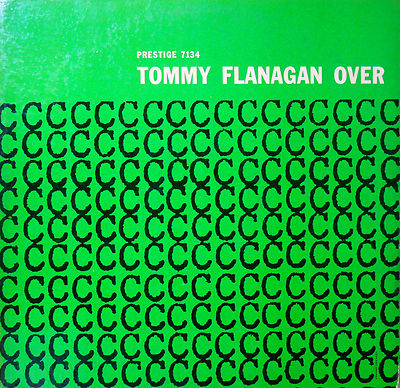
Tommy Flanagan Trio Overseas, Excellent Original Mono Prestige 7134
$
2,146


Favourite Auctions
To save auctions to your favourites, please login
If you don't have an account, please register
Description
Tommy Flanagan Trio--Overseas, Mono Prestige 7134. Tommy Flanagan (p), Wilbur Little (b), Elvin Jones (d). Recorded in Sweden (hence the name) August 15, 1957. DG label, 50th Street address, Van Gelder stamp on both side of the dead wax.
Reserve Price: Has been set at a very reasonable level--the average price of the last five copies sold (May 2010-March 2011)--(despite the fact that this copy is substantially better than most of them). I have not included in the calculation the most recent copy sold--As you may be aware, a copy of this album sold for $3,216.66 on July 29, 2012. Starting Price: Has been set at 0.55, in honor of the upcoming 55th anniversary of this great album.
(Note: This record was down for a couple of hours due to a technical glitch. I apologize for that and, unfortunately, we have to start over from the top.)
Sound Quality: NM … Outstanding sound-quality--crisp, clean, with real presence. And the sounds of the instruments are extremely accurate (or “realistic”) as well as beautifully balanced between the three players, a real exemplar of engineering excellence from the great RVG.
Vinyl: Excellent .... In detail: A-Side: Plays beautifully with only one audible but low-volume click. There are also one or two barely-audible ticks (but honestly, unless you are listening for them, as I unfortunately must do, chances are very slight that you will notice them at all). There may be two or three seconds of surface noise on the last cut... it was so close to imperceptible that I really wasn't certain whether I heard it or not... B-Side: Perhaps three tiny ticks and one slightly more audible but very low-volume click. Just the most minor of imperfections. Visually: The record appears to have been moderately but not excessively played. There are marks on the vinyl but they are truly superficial and will not affect play-back now or in the future (see note on visual grading at the bottom of the page). One significant test of the possible damage done by improper play or handling is whether there is any detectable surface noise between cuts. This copy passes that test with perfection—dead silence between the cuts. The vinyl retains much of its original luster. The labels are in excellent condition. Overall: A top-notch copy of this rare classic.
Covers: VG++ ... There is a slight bit of fraying on two corners, a touch or rubbing on a third corner, and some age-related discoloration on the back cover (and actually, the photo exaggerates the markings on the back quite a bit). Otherwise quite fine with no seam-splits or edge-wear and no ring-wear at all. The laminated front cover is in very good shape--glossy, bright and fresh-looking. The signature on the back cover is that of a highly-respected (if not well-known) veteran jazz pianist (who happened to be the classmate at Plainfield N.J. High School and Southeastern Louisiana College of another highly-regarded jazz pianist).
Packaging includes new audiophile inner sleeves, new outer sleeves, cardboard padding, bubble-wrap and a thick cardboard record box. Insurance is provided at no cost to the purchaser.
Note on Visual Grading vs Play-Testing A personal and non-professional opinion
It disturbs me that record buyers do not to insist on, or even seem to prefer, play-testing to visual grading. I believe that visual grading (although necessary) is totally insufficient for grading a record.
Why Visual Grading...Some dealers insist that they can do it very accurately (after years of experience, etc)... But I don't believe it. The fact is that play-testing is very time-consuming. It involves not just the actual playing of the record but the preliminary cleaning, which is crucial and time-consuming in itself. For large-scale dealers this is an insurmountable obstacle. Hence the best thing, from their point of view, is to foster the myth that visual grading is fine. It also has the very important added benefit of protecting the seller since if a record looks nice but is full of ticks the seller has a defense—it looked NM- so I graded it NM-.
Why Visual Grading Doesn't Work... One reason visual grading in general can't work is that the quality of the vinyl is invisible to the naked eye. And there was a steady deterioration in the quality of vinyl used from the 1950s to the late 1970s. Instead of pure new vinyl, by the end of the LP era, record producers were using recycled vinyl, old tires or anything else that could be re-processed. Most new records from the 1970s have ticks baked into the vinyl, sometimes a whole lot of them... (In addition, vinyl records became exceedingly thin in the passing years, another problem).
Another Reason Why Visual Grading Doesn't Work... Scratches on the vinyl are, of course, visible and cause consecutive clicks or pops. But low-volume ticks and slight background noise are, by far, the most common defects and it is very, very hard to determine whether a light mark on the vinyl will affect the play-back without listening to the record.
What Marks on the Vinyl Mean and What Buyers Need to Understand...If a seller says that there are various marks on the vinyl but they do not affect play, most buyers immediately downgrade the record. The only conceivable reason for this is that they believe that somehow, with additional playing, the very superficial hairline scratch will become deeper and start to cause clicks. I have seen no evidence to support this view. If one uses a properly-calibrated good-quality cartridge/stylus (set at less than 2 grams) I do not believe that non-sounding marks can “become” clicks or background noise, for the simple reason that the stylus is below the level of the surface defect.
Lack of Information Should Not Be Rewarded ... I have seen this time and again: A visual grader will say “Just superficial paper scuffs” grade it NM- or VG++ and this copy will be preferred to that of the seller who also grades it VG++ but says it plays with occasional ticks and a couple of seconds of low-volume background noise. To me this is pure nonsense. Buyers are paying a premium to a seller for withholding information. The fact is that almost every used record plays with some ticks (and quite a few brand new ones, too). Not knowing that (by not listening to the record) should not be a reason for paying significantly more to a seller.
The Wonderful World of Visual Grading ... Most of the terminology used by visual graders has very little specific meaning. Here is an example from a clearly honest seller, but what could it possibly mean?... “RECORD CONDITION: VG (LIGHT SLEEVE MARKS).” (This record sold for $100 on 17 bids.) On the other hand, you can find innumerable examples of the following: “RECORD CONDITION: NM- (LIGHT SLEEVE MARKS).” What does this imply?
I suppose it implies Caveat Emptor. Comments are welcome...