The Beatles - Record Label For First Recording - 1958
£
63
$
83


Favourite Auctions
To save auctions to your favourites, please login
If you don't have an account, please register
Description
Percy Phillips was born in March 1896, in Warrington, Lancashire. He started selling bicycles and motorbikes in a small shop in Brunswick Street, in the Kensington Fields area of Liverpool after the First World War. He began selling and recharging batteries in 1925, opening a shop in the front room of his family's three-storey Georgian terraced house, called Phillips’ Battery Charging Depot, and had to install large accumulators in the cellar. Phillips ran the business for 30 years, even during WWII, but due to a decline in demand for batteries in the early 1950s (most people having electricity by then) he started selling household electrical goods. By late 1954, the shop was only selling records and record players; customers would buy recordings of American Country and Western, and Big Band music. As Phillips had supplied batteries to the Burtonwood air base during the war, he could buy and sell the latest records from America via his contacts there.
The Studio
Percy Phillips' shop and home at 38 Kensington, LiverpoolIn 1955, several customers asked if Phillips could make demo discs, so he bought a 1/4 inch tape recorder (replaced in 1963 with a Vortexion portable), a MSS (Master Sound Systems) disc cutting machine, an amplifier, a 4-track mixer, three microphones (a Reslo, an HMV ribbon microphone, and an AKG), and three pairs of headphones for £400, while on a trip to London to visit his son Frank, who was there for a sound recording course with EMI Electronics.
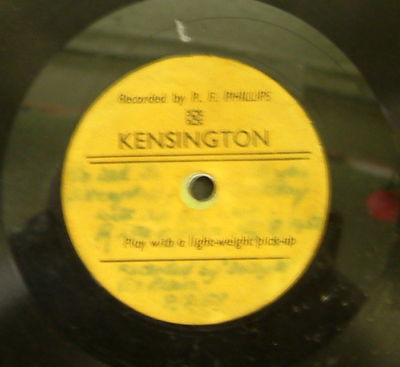
When he returned to Liverpool, Phillips set up the equipment behind the record shop in the (12 square feet) middle living room, with a piano and an overturned tin bath in the cellar (a speaker and microphone was linked to the studio above) as a reverb chamber. The recordings would normally be on tape, and then transferred to disc. The tape was recorded over again at the next session. Because of trams, trucks, and horses going up and down Kensington, Phillips had to hang heavy blankets over the studio door and rear window to minimise the noise. Phillips' first recording was of himself singing "Bonnie Marie of Argyle", (unaccompanied) and a few days later he recorded "Unchained Melody", with local dance band singer Betty Roy. The first disc he cut in the studio was on 7 August 1955, with his eight-year-old daughter, Carol, singing, "Mr Sandman". All the discs had "Play with a light-weight pick-up" on the label, as this would increase the life of the disc which would eventually wear out.
Phillips advertised the studio as Phillips' Sound Recording Services (also advertised as P. F. Phillips' Professional Tape & Disc Recording Service) and his business cards read, "PF Phillips, 38 Kensington, Liverpool, 7. Television and Battery Service. Gramophone Record Dealer. Professional Tape and Disc Recording Studio." He started cutting discs for members of the public, as well as for actors from the Liverpool Playhouse, who often stayed in the first-floor boarding rooms above the studio, and who were asked by Phillips to record monologues and poems. As the record shop and studio took over the business, he had a brass plate made which he put on the wall just outside the front door, and had labels made for the discs, but changed the design of the disc label every year. By 1957, Phillips was recording more and more groups of young men with guitars, basses, washboards and drums, who played skiffle.
Ron Wycherly (a.k.a. Billy Fury) recorded several songs onto disc in the studio and his mother sent the songs to impressario Larry Parnes, which started her son's singing career.
The Quarrymen recording
Side two of The Quarrymen's record: "In Spite of All the Danger" (running time 3.25)Johnny 'Guitar' Byrne (from Rory Storm and The Hurricanes) and singer Paul Murphy recorded a version of "Butterfly" and "She’s Got it" in the studio on 22 June 1957, and Byrne later played the recording to George Harrison. On 12 July 1958, a local skiffle group, The Quarrymen (Lennon, McCartney, Harrison, Lowe and Hanton) visited Phillips’ studio to record two songs, although the date has been disputed.
The group were surprised to see how small and technically basic the studio was, with only one microphone in the centre of the room. Phillips demanded that they pay for the recording before they set up the equipment, so each member paid 3 shillings and 6 pence, but he then asked for an extra surcharge (£1) to cover the cost of transferring the tape recording to acetate disc. As this was too expensive, Phillips said that for a cut-rate price they would not be taped first, but record directly to vinyl.
The first song they recorded was "That‘ll Be The Day" (sung by Lennon with harmonies by McCartney). Phillips wanted them to immediately record the next song, but Lennon and McCartney could not decide on a song for the B-side of the disc. McCartney suggested the doo-wop ballad, "In Spite of All the Danger" (by McCartney and Harrison, but sung by Lennon) even though Lowe and Hanton had never heard it before. They asked for some time to rehearse, but Phillips refused, saying, "For seventeen and six 17/6d you're not here all day".
Lowe and Hanton busked through the song, which was cut short by Phillips waving his hands to indicate that the cutting needle was getting close to the centre of the acetate. He then handed the band a fragile 78rpm 10-inch acetate record. It was later lost until Lowe rediscovered it in 1981, and planned to put it up for auction at Sotheby's, but sold it to McCartney for an undisclosed amount. McCartney later had the two songs digitally re-mastered and pressed 50 copies, giving them to friends as a Christmas present, although the two songs were released on 21 November 1995, as part of The Beatles Anthology (Anthology 1). McCartney later said, "The strangest thing for me, listening to it, is that it's like drowning, it's like your life flashing by in front of you. From the earliest things by me and John when we used to sag off school and the earliest demo tape we ever made, to the first little record we made which was a version of John singing "That'll Be The Day", and a little song of mine [and Harrison] on the other side that's never been released before."
Now, this is nothing to do with The Beatles but it does carry the same record label as the very first recording by The Quarrymen, described and illustrated above. It is a seven inch acetate from that recording studio with a label on both sides. Faded writing appears on each of those labels suggesting that the actual recording on the acetate is somebody called Dolly at the piano playing a few tunes including "Happy Birthday" It is quite worn with some missing vinyl at the edges and includes a date on the label of 8/8/58 which is less than a month after the date for the Quarrymen recording which is mentioned above. A rare chance to obtain a piece of Merseybeat memorabilia with such a strong connection to the early Beatles. The overall condition of the record is not that good but this item is really being listed for memorabilia reasons. A charge for recorded delivery in respect of items over £30 and special delivery for items in excess of £100 will be added to the stated UK postage and packing costs. Items sent abroad will incur an additional charge of £4.25 to cover insurance if the value exceeds £39. This is a requirement of Paypal. If more than one item is being sent at the same time postage costs will be recalculated.
price rating