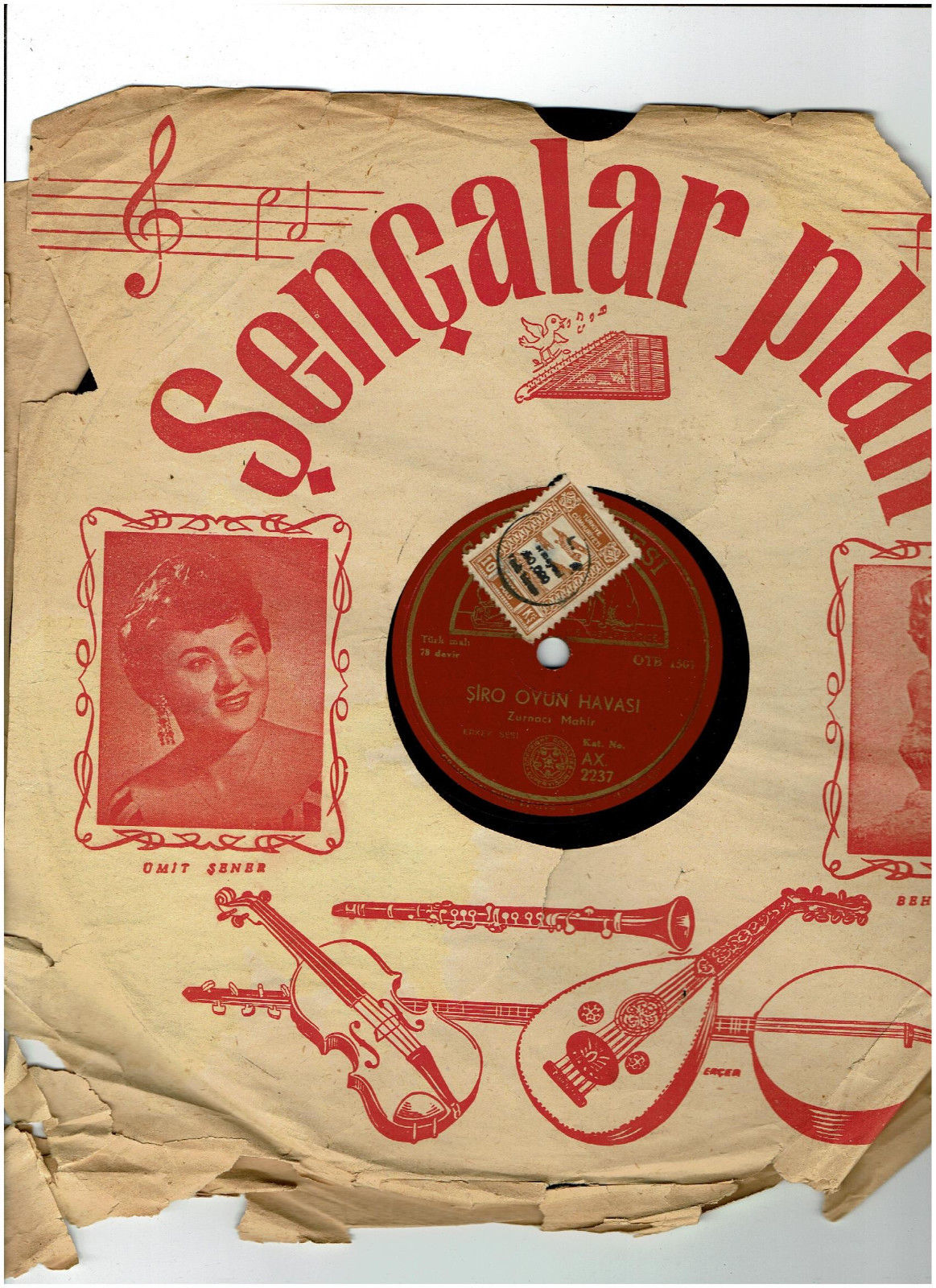
SAHIBININ SESI Turkish 78 RPM Record AX2237 Zurnachi Mahir “Siro Halayi”
$
20


Favourite Auctions
To save auctions to your favourites, please login
If you don't have an account, please register
Description
SAHIBININ SESI Turkish 78 RPM Record AX2237 Zurnachi Mahir “Siro Halayi” / “ Siro Oyun Havasii” + tattered Sengalar Plak sleeve. E to E+ Visible Condition, beautiful disc. Very cool tax stamp attached to label – with 1930s aeroplanes. Sleeve has 2 beautiful women artist as advertising Behiyb Aksoy & Umit Sener. I cannot read Turkish so I have no idea what the titles are. The music is quite good, odd to my ear, but catchy – sounds like a single oboe/kazoo (pan flute??) player-gone-wild with warpath drums and cymbals accompaniment. Would fit well in an Indiana Jones or Charlie Chan 1930s movie in Istanbul.
The Phonograph, which is an invention of T.A. Edison, had become to be known in Istanbul by 1895. The simplicity of recording and of its use propelled interest and demand about the instrument. Artists such as Hafiz Sami, Hafiz Osman and others, had increased their prominence by recording their voice to phonograph. There were also recordings of several marching bands of the Ottoman Army and comedic monologues of "Karagöz" (shadow puppet theater) artists. Also Tamburi Cemil Bey, commonly known for his 78-rpm recordings, had recordings on phonograph cylinders.
Turkish recording history started properly with 78-rpm discs. Because the 78-rpm discs had many more advantages over phonograph cylinders with a view to serial production, marketing , repertory and artist selection, record producers were marketing their products emphasizing their superiority. They had realized that the Ottoman Empire would be a good market and Istanbul was chosen its center much like Moscow, Cairo, Milano, Madrid, Athens, Paris, Berlin, and London. The pioneer recording teams simultaneously visited Istanbul with those cities.
In 1900, the first gramophone disc recordings were done in Istanbul. These recordings were made with the help of technicians from E.Berliner's Gramophone Company and other German companies. Naturally these discs had been recorded first by the afore mentioned artists on phonographs. Because of religious restrictions, Muslim Turkish women were not able to record until 1926 -27, after the proclamation of the Turkish Republic. Hence, the first female singers were Jewish, Armenian, Greek and Gypsy-origin Ottoman citizens. No such obstacles existed for male singers and ensembles. Soon enough the royal band at the service of Sultan called "Mizika -i Humayun" recorded several of their famous marches.
As the Ottoman Empire reigned over a large geographical area inhabited by different ethnic and religious communities, these differences were reflected in the recordings as well. Thus Turkish 78-rpm records have built a Turkish recording repertory that represents a rich heritage, with many samples of ethnic music, reflecting changing musical trends, including comical (stand-up like) monologues and dialogues, local folk music and many more. Turkish 78-rpm repertory contains song - sarki, gazel, intro-taksim, instrumentals, fasil-chapter records, operetta, tango, easy listening, parodies and monologues, Karagöz records etc.
The Blumenthal family that had started to market its records in Istanbul, acted as Turkey?s representative for Disc Pour Zonophone and Odeon companies. Hundreds of considerable recordings were made in this period. E Berliner's Gramophone Co. had entered the Turkish market in 1907/08. This company represented by Sigmund Weinberg, who previously represented Pathe, also brought cinema to Turkey.
In the same years, a considerable number of records had been produced by the German company called Favorite Record. Ahmet Sükrü Bey, the Turkish representative of Favorite Record, signed agreements with the most noticed artists of that period. In 1912, the Blumenthal Family had establish the first Turkish recording factory and studio called Orfeon Record.This German-patented factory made recordings for about 11-12 years, including during the WWI years.
A big milestone in Turkish Recording History, like all over the world, had started by recording with electric microphones. The Blumenthal Family sold its factory to Columbia and became a representative of this company in Turkey as well, which continued until the 1970s.
Another Jewish family called Grünberg, had been a representator for Odeon. Odeon had been sending the recordings to Germany and the record discs are copied there and posted back to Turkey. Armenian family Gesaryan, had got the representation of the Gramophone Co. that from now on called as His Master's Voice. Between 1927 and 28, this company had established a new-technology based factory in Istanbul.
The scratches on the left of every photo are my broken glass on scanner – not on item. Images of artists etc. are for information only and not included in auction, record & sleeve only.
If possible we gladly combine shipping items to lessen postage. PLEASE don’t use eBay auto pay. I will invoice you for general shipping costs which will be easier and cheaper for you: insurance added for all items $10+ or at your request. We will pack securely – but are not responsible for shipping company damage if uninsured.
1 record - $4.70 – Add $1 for each additional record (+ insurance if required). (USA ONLY) (Int’l use eBay calculator and I will adjust to get cheapest rate)
More of all the types of records listed: Odd tunes, Political, Blues, Hot Jazz, Hillbilly, Odd labels, Doo-Wop, etc. More of all the types of records listed: Odd tunes, Political, Blues, Hot Jazz, Hillbilly, Odd labels, Doo-Wop, etc.
E++, Visibly nearly new with no visible signs of wear or damage.
E+, Looks and plays like new with only few signs of handling and play.
E Still very shiny, near new looking, with slight visible signs of wear and a few nearly inaudible scuffs and scratches
E- Still shiny but without the luster of a new record, few scuffs that have little or no effect on play, some light scratches.
E- - Mostly shiny but with even less of the luster of an E- record, more scuffs than E-that have little or no effect on play, light scratches with some light noise.
VG+, Slightly above average condition 78 in which scuffs and general use has dulled the finish somewhat. Wear is moderate but playing is generally free from distortion. Surface noise not overly pronounced.
VG, An average condition 78 - moderate wear throughout, but still very playable and enjoyable. Surface somewhat dull with noise and scratches audible but not intrusive.
VG-, Quite playable still, but with some distortion and may have some graying in loud passages. Music remains loud in most passages. Surface noise and scratches well below music level.
VG- - Quite playable still, but with distortion and most have some graying in loud passages. Music remains loud in most passages. Surface noise and scratches noticeable and may be loud at times.
G+ Quite worn and scratched, but music level is still higher than surface noise. Grey may be throughout but still serviceable. Music begins to sound muffled.
G Not so good. Wear and scratch damage extensive. Listening can become uncomfortable as music and surface noise probably blending. Lowest level music can be understood.
G-, Music barely audible over surface noise & listening is uncomfortable. Record is borderline unplayable.
P Used only for high dollar space fillers like Black Patti, Okeh blues, etc. Music covered by surface noise, scratches, and needle digs, label may be trashed, & listening is almost if not definitely impossible. Record is basically unplayable. What you keep because you can’t bear to toss – while you look for that E+ copy of Robert Johnson on Vocalion at the local flea markets for $1 (Good Luck!)
See Description, A wildcard grade that can be used when standard grading does not apply or when a record (or item) has special attributes (or defects) that can affect how the item is assigned a grade.
price rating




![J. COLE The Fall Off Black Vinyl LP The Stealth Edition [SHIPS NOW ]](https://www.popsike.com/php/thumbnail.php?url=https://www.popsike.pics/pix/20260221/127697178950.jpg)


![Lee Perry And Friends Give Me Power 1988 [TRLS 254] Vinyl Reggae](https://www.popsike.com/php/thumbnail.php?url=https://www.popsike.pics/pix/20200109/174150467758.jpg)