PHILIP GLASS MUSIC IN FIFTHS PRIVATE 1973 CHATHAM LP
$
30


Favourite Auctions
To save auctions to your favourites, please login
If you don't have an account, please register
Description
cdzingg Store
PHILIP GLASS
"MUSIC IN FIFTHS"
PRIVATE 1973 CHATHAM LP!
MINT!
During the late '60s, Philip Glass undertook a series of pieces that together constitute a kind of "research and development" phase for his subsequent minimalist style. These pieces come across as extremely austere and focused, as if Glass were conducting a set of controlled experiments, each one having a distinct purpose. Composed in 1969, Music in Fifths is one of Glass' unrelentingly obsessive and procedural works, exploring as it does Glass' emerging "additive/subtractive" compositional technique within a rigidly limited collection of pitches that are organized in a very limited number of ways. The tight control of pitch materials, unchanging texture, and uninterrupted rhythmic flow draw the listener's attention almost exclusively to the expansions and contractions of line taking place within the static modal space. The work utilizes the same collection of pitches used in Glass' Two Pages, with one minor modification: instead of the wide-rising diad G to C, which was followed in Two Pages by a scalar ascent D to E flat to F, the G is shifted to the top of the collection to create a simple rising and falling scalar collection akin to a pianist's warm-up figure. As the title suggests, however, this contour is replicated below, beginning on the F and following in exact parallel motion. (The addition of lines moving together in this fashion would be explored later the same year by Glass in Music in Similar Motion). The full scalar figuration, consisting of simple up and down motion in balanced groups of four eighth notes, stands as the kind of "normative" melodic cell on which the piece is based. The piece does not begin with this figure, however, but rather eventually arrives at it before expanding beyond it. At the piece's opening, the general contour is presented in a kind of stilted version that rises along the scalar incline, but can't seem to find its way back down, resulting in a constant shift of metrical emphasis. Several different configurations of the ascending/descending gesture are attempted before finally arriving at the metrically stable and modally filled-out "normative" cell. Subsequently, each half of the cell is gradually augmented through the repetition of small constituent segments (two or three notes at a time), until the figure spans several measures. By the end of the work, the pitches and sonorities become nearly invisible while the unpredictable shifts of meter, direction, and contour become increasingly unsettling.
By the end of the twentieth century, minimalist music was one of the most pervasive influences in American musical culture. Only a few decades earlier, however, it was considered an austere, aesthetically challenging experiment. During the 1960s, Philip Glass, the composer among the downtown New York minimalists who would ultimately achieve the greatest commercial success developed one of the most streamlined and obsessively Spartan approaches; this stage in Glass' development is exemplified in the stark economy but rich sonority of his ensemble work from late 1969, Music in Similar Motion. Consisting of simple melodic cells subjected to continual formulas of expansion and contraction within an uncomplicated diatonic field, the piece represents the height of Glass' initial fixation on the extrapolation of large-scale form from simple procedural applications, as well as his emerging interest in applying his simple procedures to increasingly involved harmonic schemes. Music in Similar Motion may be seen as representing the breaking point of Glass' early formalist obsessions; during the early '70s, while still infusing his compositions with additive procedures and blocks of harmonic stasis, Glass focused his attention less on the rigor of his processes than on the expressive possibilities that they created within dramatic structures. At the core of the piece is a set of five pitches, initially arranged into a melodic curve eight notes long. The figure, consisting of two rising gestures and a short descent in steady eighth notes, is expanded and contracted into lines as long as 41 notes and as short as four. The segmentation of the figure and expansion of its constituent two- and three-note parts affords a surprising amount of variety; although the pool of pitches remains the same, they likewise remain unpredictable, as the irregularity of segment lengths creates a constantly unstable metric terrain. Likewise, the focus of attention gradually shifts from one part of the melodic module to another, creating subtle emphases of certain pitch areas. Most of the first half of the piece, for example, consists of reiterations of the initial ascending figures, with only occasional descents; likewise, while the appearance of the fifth and lowest note in the set serves in the beginning of the work to mark off the ends of melodic strings, the last section of the work compulsively hammers at the lower notes while almost entirely avoiding the upper pitches. Certainly, within some other context, these melodic inflections would be unremarkable; within the microscopic music world into which Glass pulls the listener, however, such tiny changes become major events. Of course, the element that lends the work its strongest sense of shape and trajectory, as well as its title, is the gradual introduction of voices moving at different pitch levels but along the same contours as the main line. The first additional voice to depart from the unison line outlines the same descents and ascents at a remove of a perfect fourth; a bass line is eventually added below and the work finally culminates in a sonorous parallel-motion chordal texture. -- All Music Guide
BOTH PIECES COMPOSED IN 1969 AND PERFORMED HERE FOR LP IN 1973.
THIS VERY LIMITED PRIVATE PRESSING IS IN MINT CONDITION INSIDE AND OUT!
CLEAN AND STRONG SEAMS ON ALL SIDES.
VINYL SPARKLES WITH NEWNESS!!
PLEASE READ CAREFULLY:
Winning bidders will be notified within 3 days of the end of the auction and are expected to remit payment within 7 days.
YES, we ship to Japan!
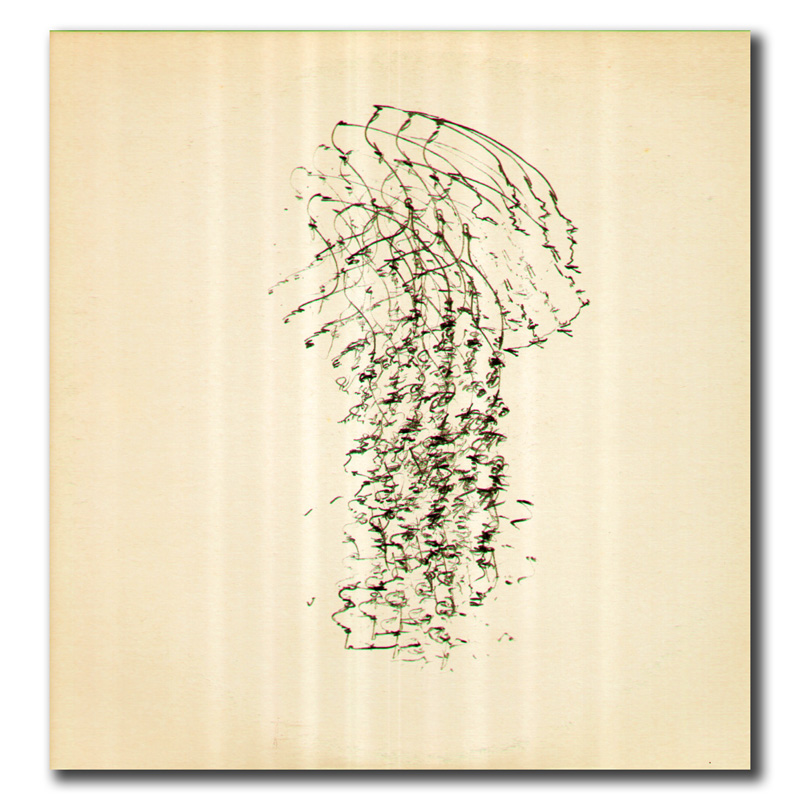
The image included with the auction is a scan of the actual item but, due to size limitations of the scanner, the edges of the item may have been cropped.
Within the US, insurance is $2 and is optional although In Your Ear! will not be held responsible for lost or damaged deliveries which are uninsured, nor will we be held responsible for packages which are signed for by roommates, neighbors, friends, etc.
When paying with PayPal, we will only ship parcels to the buyer's registered PayPal address.
Please be advised that In Your Ear ships overseas at buyer's risk. We cannot and will not refund payment for damaged or missing items when shipping outside the US. International eBay shipments with values over $100.00 MUST be shipped via registered mail. Registered mail without insurance costs $11.00 in addition to airmail postage. Full value insurance is extra based on value and country. Please request insurance if desired.
DUE TO OVERSEAS POSTAGE SLOWDOWNS, ALL FOREIGN CUSTOMERS MUST AGREE TO WAIT 2 MONTHS BEFORE FILING A LOST PACKAGE CLAIM.
If you request regular airmail without registered or insured service, you agree that we are not responsible for lost or mis-directed shipments.
Shipping and handling fees are non-refundable.
PLEASE NOTE: We have set our shipping prices to cover costs on an average basis. You may be charged slightly more - or less - than the actual cost of postage; Priority postage varies according to destination, records and jackets vary in weight, all of which makes it impossible to set an exact "correct" price for all customers, especially internationally. We ship all LP's in new (unused) custom LP mailers. We pack records with filler pads, placing the disc in an inner sleeve outside the cover to prevent seam splitting in transit. Part of our postage fee covers the cost of the mailer and pads (which currently costs us up to a dollar per).
BY BIDDING ON AN ITEM, YOU ARE AGREEING TO IN YOUR EAR'S POLICIES.
DO NOT BID UNLESS YOU INTEND ON BUYING; WE WILL PLACE NEGATIVE FEEDBACK FOR NON-PAYERS.
When sending payment, always include your real name and address, your email address as well as your eBay name. If you have questions, BEFORE you buy, email us.
In Your Ear has been selling music to the masses since 1982. We carry new and used LPs, CDs, DVDs, 45s, 12" singles, posters and who-knows-what-else! In addition to our online RI store, we have 2 physical locations in Massachusetts:
957 Commonwealth Avenue, Boston, MA. 02215
72 Mt. Auburn Street, Cambridge, MA. 02138
RECORD GRADING POLICY
MINT = like new or near new with only one or two small insignificant defects, a 9 or better on a 1-10 scale
EXCELLENT = Would be Near Mint, except for a couple of light hairlines or scuffs, which do not affect play
VG++ = still a very nice record with all or nearly all of its original gloss but may have a few more light, surface marks, hairlines, needle tracks or the like which should not materially affect play
VG+ = a nice, but used record that may have a series of light scuffs or scratches. It probably plays with a few pops, but has no serious problems.
VG = a well-used record that still should sound OK when played, but may have moderate surface noise, pops, etc.
VG- = a very well-worn record that plays through without skipping, but will do until a better copy comes along.
Good = not actually good at all but probably will play through but with much in the way of surface noise, pops, crackles, etc. Still, will have no cracks, chips or the like
Fair = you’re getting this record just to own but not to play
Poor = the sky’s the limit, generally I will discard a record this bad (and sell the cover, jacket or sleeve alone) unless the label holds some particular interest
For listings for our Boston/Cambridge stores, CLICK HERE.
For additional listings for our Rhode Island store, CLICK HERE.
Don't forget to visit our "About Me" page to find out lots more about our online and retail stores!
Bid with confidence at In Your Ear! Check out our customer feedback. CLICK HERE!
price rating