MACK PRIVATE PRESSING LP MACK001: Beethoven Sym 5 etc.- Weingartner - OOP USA NM
$
300


$ 300
Sold For
Apr 17, 2014
Sold Date
Aug 16, 2011
Start Date
1
Number Of Bids
Canada
Country Of Seller
eBay
Sold at
Favourite Auctions
To save auctions to your favourites, please login
If you don't have an account, please register
Description
****Welcome to our eBay listing, thanks very much for looking!
****Free Shipping to the USA and/or CANADA - all other locations are subject to a reasonable shipping fee.
****Please check out our other eBay store listings and eBay auctions for more great LPs and CDs - new items added daily!
****To access our eBay store either click on the little red door at the top right section of any of our eBay listings or, click on -
http://stores.ebay.com/Hear-The-Difference
Background on this eBay item -
Paul Felix von Weingartner, Edler von Münzberg (2 June 1863 – 7 May 1942) was an Austrian conductor, composer and pianist. He was born in Zara, Dalmatia, Austria–Hungary (now Zadar, Croatia), to Austrian parents, and the family moved to Graz in 1868. His father died that same year. He studied with Wilhelm Mayer (who used the pseudonym of W. A. Rémy and also taught Ferruccio Busoni).
Felix Weingartner, who did much to shape the modern art of conducting, studied piano and composition in Graz, Austria. On the recommendation of Hanslick, he received a stipend from the state, and in 1881 he went on to study philosophy at Leipzig University, later attending the Leipzig Conservatory where he made the acquaintance of Liszt. Liszt persuaded him to become a conductor and helped to produce Weingartner's first opera, Sakuntala, at Weimar in 1884. In the same year he began his conducting career in Königsberg.
Thereafter, Weingartner was constantly on the move: Danzig (1885-1887); as Hans von Bülow's assistant in Hamburg (1887-1889); Mannheim (1889-91); Berlin's Kaim Royal Opera Orchestra (1891-1898); the Vienna Opera, where he succeeded Mahler (1898-1903); Hamburg again (1912-14); Darmstadt (1914-1919); Vienna Volksoper and the Vienna Philharmonic Orchestra (1919-1927). Over the same period, he toured Europe, making his first visits to London in 1898 and to the U.S. in 1905, where he conducted the Boston Opera Company for its 1912-1913 season. From 1927 to 1933, he was director of the Conservatory and Symphony Orchestra in Basel, Switzerland, and returned tp the Vienna State Opera from 1935-1936. In his second period with the Vienna Opera he appeared tired, and resigned at the end of the season. In 1939, Weingartner was awarded the Gold Medal of the Royal Philharmonic Society in London.
As a conductor, Weingartner was the first to make commercial recordings of all nine Beethoven symphonies. In 1935 he conducted the world premiere of Georges Bizet's Symphony in C. His style of conducting was unlike those of many of his contemporaries; in contrast to Wilhelm Furtwängler, who conducted music in what is now considered a very "subjective" manner, with severe tempo fluctuations, Weingartner was more like Arturo Toscanini in insisting that his orchestras play the music as written. His 1935 recording of Beethoven's Symphony No. 9 sounds much more like Toscanini's later, 1952 recording than like any of Furtwängler's.
Weingartner was among the first great conductors to insist on a meticulous interpretation of the composer's score and steady, moderate tempi. While in Hamburg, he clashed with Hans von Bülow, whom he criticized for romantic exaggeration and wayward performances. In 1895, Weingartner wrote a book, On Conducting, in which he accused von Bülow of "wanting to divert the attention of the audience from the music to himself."
His baton technique was refined and simple. The English critic Neville Cardus wrote this of his podium style: "Weingartner does not use the familiar gestures of the modern 'dictator' conductors; he retains the old fashioned belief that an instrumentalist understands how to play his notes correctly, and does not need illumination in the form of arts that scarcely belong to a conductor -- the arts of Terpsichore and declamation. His gestures are quiet; he is always dignified.... He belongs to the cultured epoch of music, the epoch of good manners, good taste and scholarship."
Weingartner's activities were not confined to conducting: he was also a prolific composer. His output includes eight operas, six symphonies, two concertos, chamber music and songs, though none of his works had more than a brief success. Together with Charles Malherbe, he edited the complete works of Berlioz and was one of the first to bring that composer's works back into public favor. Weingartner's arrangement of Weber's Invitation to the Dance was recorded four times by him, and he also recorded his own orchestral arrangement of Beethoven's "Hammerklavier" piano sonata, Op. 106, with the Royal Philharmonic Orchestra.
Weingartner made his first recordings in 1910 with the American soprano Lucille Marcel, who became the third of his five wives. He recorded all the Beethoven symphonies, some several times, most famously with the Vienna Philharmonic Orchestra in the 1930s. In Japan, his Beethoven "Choral" Symphony sold over 100,000 copies, a remarkable achievement. Weingartner's immense reputation was obscured by the rise of the high-profile, much-recorded conductors of the 1950s and 1960s. However, CD transfers have been made of some of his finest Beethoven performances.
-
MACK (Private Recording / Pressing) RECORDS LP item - BLACK record labels with SILVER lettering.
-
Record Made in the USA
-
Pressing is in MONO
-
Record Speed: 33 1/3 rpm
-
Long out of print
-
Record Made / issued in ??? - limited edition, on heavy vinyl, private pressing with insert.
-
Record Catalog Number: MACK 001
Music Featured on this item:
Beethoven
Music on this LP Title:
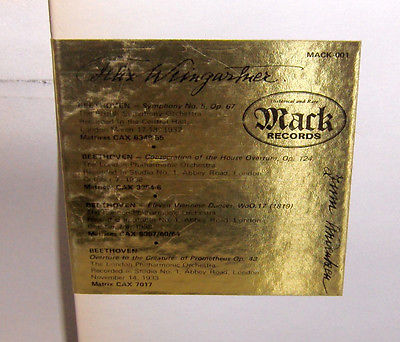
Symphony No. 5, Op. 67 -
The British Symphony Orchestra, Recorded in the Central Hall, London, March 17-18, 1932 - Matrices CAX 6348-55
Consecration of the House Overture, Op. 124 -
The London Philharmonic Orchestra, Recorded in Studio No. 1, Abbey Road, London, October 7, 1938 - 1Matrices CAX 3354-6
Eleven Viennese Dances, WoO. 17 (1819) -
The London Philharmonic Orchestra, Recorded in Studio No. 1, Abbey Road, London, October 7-8. 1938 - Matrices CAX 8357-60-64
Overture to the Creatures of Prometheus, Op. 43 -
The London Philharmonic Orchestra, Recorded in Studio No. 1, Abbey Road, London, November 14, 1933 - Matrices CAX 7017
Performed By -Felix Weingartner, conductor
CONDITION Details:
LP JACKET:-
The LP jacket is in Near MINT minus condition! - superb condition - plain white cardboard stock with gold sticker detailing the performances recorded!!
-
The jacket is completely intact with NO seam splits. The jacket shows some very minor shelf wear, primarily light weakening at the corners and seams. Have a close look at the pictures and you will better see the condition of this item.
-
The jacket has NO drill holes or saw marks of any kind.
-
There is NO hand writing on either side of the jacket.
-
The cover has clean and sharp colors - see pictures with this listing for more detail.
-
Even for new records, the vinyl should always get a thorough cleaning before playing!!
-
The LP is in NEAR MINT minus condition. - A finer copy of this vintage LP would be very difficult to find.
The LP retains much of the original gloss and sheen - just a bit of dust and a finger print may be on it!
-
The record has NO serious marks on it, obviously well taken care of.
-
The record labels have NO significant spindle marks on them - just a couple of light ones.
-
This is the superb copy you have always wanted in your collection - any super picky audiophile should be happy with this one!
-
This LP may have some light marks (spider marks mostly) which are caused by sliding the LP in and out of the inner sleeve and are usually not audible on most audio systems - as for any record, even brand new ones, for best results we recommend a thorough record cleaning before playing!
A Short Note About LP GRADING -
- Mint = Only used for sealed items.
- Near Mint = Virtually flawless in every way.
- Near Mint Minus = Item has some minor imperfections, some audible.
- Excellent = Item obviously played and enjoyed with some noise.
- Very Good Plus = Many more imperfections which are noticeable and obtrusive.
We now have our own website with lots of out of print LPs and CDs! You can check it out at -
hearthedifference.net