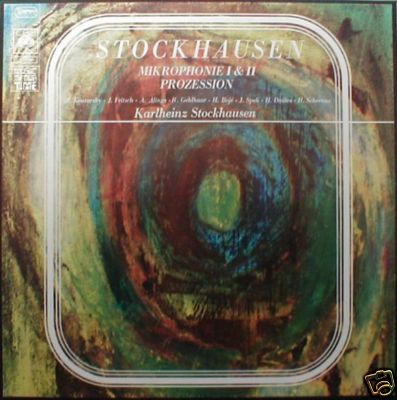
KARLHEINZ STOCKHAUSEN+HUGH DAVIES 2-LP BOX ELECTRONIC
€
59
$
69


Favourite Auctions
To save auctions to your favourites, please login
If you don't have an account, please register
Description
KARLHEINZ STOCKHAUSEN
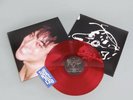
MIKROPHONIE I+II / PROZESSION 2-LP BOXSET
CBS Disques
with booklet
Rare french boxset released on CBS including 60's works of Karlheinz Stockhausen for live electronics and various experimental techniques.
Some info on the release: Very rare french pressing boxset of 3 of Karlheinz Stockhausen most important works for experimental techniques and electronic mediums. Contains the works Mikrophonie I (1964) pour tam-tam, 2 microphones, 2 filtres et potentiomètres Mikrophonie for Tam-tam, 2 microphones, 2 filters and potentiometers), Mikrophonie II (1965) pour choeurs, orgue Hammond et modulateurs en anneau (for chorus, Hammond organ and ringmodulators) and Prozession (1967) pour tam-tam, alto, elektronium, piano, filtres et potentiometers. Please notice that the version of Prozession presented here is the original 1967 version (and not the 1971 version appearing in the DGG recording with that name). One of the scarce recordings of Hugh Davies (electronics on Mikrophonie).
Karlheinz Stockhausen (22 August 1928 – 5 December 2007) was a German composer, widely acknowledged by critics as one of the most important but also controversial composers of the twentieth and early twenty-first centuries. Another critic calls him "one of the great visionaries of 20th-century music" (Hewett 2007). He is known for his ground-breaking work in electronic music, aleatory (controlled chance) in serial composition, and musical spatialization. He was educated at the Hochschule für Musik Köln and the University of Cologne, and later studied with Olivier Messiaen in Paris, and with Werner Meyer-Eppler at the University of Bonn. One of the leading figures of the Darmstadt School, his compositions and theories were and remain widely influential, not only on composers of art music, but also on jazz and popular-music artists. His works, composed over a period of nearly sixty years, eschew traditional forms. In addition to electronic music—both with and without live performers—they range from miniatures for musical boxes through works for solo instruments, songs, chamber music, choral and orchestral music, to a cycle of seven full-length operas.
Stockhausen met the Belgian composer Karel Goeyvaerts, who had just completed studies with Olivier Messiaen (analysis) and Darius Milhaud (composition) in Paris, and Stockhausen resolved to do likewise. He arrived in Paris on 8 January 1952 and began attending Messiaen's courses in aesthetics and analysis, as well as Milhaud's composition classes. He continued with Messiaen for a year, but was disappointed with Milhaud and abandoned his lessons after a few weeks. In March 1953, he left Paris to take up a position as assistant to Herbert Eimert at the newly established Electronic Music Studio of Nordwestdeutscher Rundfunk (NWDR) (from 1 January 1955, Westdeutscher Rundfunk, or WDR) in Cologne (Kurtz 1992, 56–57). In 1962, he would succeeded Eimert as director of the studio (Morawska-Büngeler 1988, 19). From 1954 to 1956, he studied phonetics, acoustics, and information theory with Werner Meyer-Eppler at the University of Bonn (Kurtz 1992, 68–72). Together with Eimert, Stockhausen edited the influential journal Die Reihe from 1955 to 1962. Stockhausen's two early Electronic Studies (especially the second) had a powerful influence on the subsequent development of electronic music in the 1950s and 1960s, particularly in the work of the Italian Franco Evangelisti and the Poles Andrzej Dobrowolski and W?odzimierz Koto?ski. French composer Jean-Claude Éloy regards Stockhausen as the most important composer of the second half of the twentieth century, and cites virtually "all his catalog of works" as "a powerful discoveration, and a true revelation". Dutch composer Louis Andriessen acknowledged the influence of Stockhausen's Momente in his pivotal work Contra tempus of 1968. German composer Wolfgang Rihm, who studied with Stockhausen, was influenced by Momente, Hymnen, and Inori. Jazz musicians such as Miles Davis, Cecil Taylor, Charles Mingus, Herbie Hancock, Yusef Lateef, and Anthony Braxton cite Stockhausen as an influence.
Stockhausen was influential within pop and rock music as well. Frank Zappa acknowledges Stockhausen in the liner notes of Freak Out!, his 1966 debut with the Mothers of Invention. Rick Wright and Roger Waters of Pink Floyd also acknowledge Stockhausen as an influence. San Francisco psychedelic groups Jefferson Airplane and the Grateful Dead are vaguely said to have done the same, though Stockhausen himself merely says the former band included students of Luciano Berio and both were "well orientated toward new music". Founding members of Cologne-based experimental band Can, Irmin Schmidt and Holger Czukay, state they studied with Stockhausen, and this is confirmed to have been from 1963 to 1966 at the Cologne Courses for New Music. German electronic pioneers Kraftwerk also say they studied with Stockhausen, and Icelandic vocalist Björk has acknowledged Stockhausen's influence. He's also mentioned in the Nurse with wound list of influences. Stockhausen was a contemporary with Luigi Nono, Gyorgy Ligeti, Frederic Rzewski, Mauricio Kagel and Henri Pousseur, Hans Otte, Dieter Schnebel, Josef-Anton Riedl and Giacinto Scelsi, Morton Fedlman, Helmut Lachenmann and Bernd Alois Zimmermann, Bruno Madernia, Jani Christou, Iannis Xenakis and of course Penderecki, John Cage.
Condition: Vinyls lie in excellent condition, quite well preserved, to be more precise side C: and D: look mint, while side B: shows a small mark at the beggining, but overall impression in excellent. Cover lies in vg+ condition, with a mold stain & small tear at the bottom right corner. The accompanying booklet lies in only good condition (mold stained).
Tracklist
A Mikrophonie I 26:20 Electronics [Filters] - Hugh Davies , Jaap Spek , Karlheinz StockhausenElectronics [Microphone] - Harald Boje , Johannes G. Fritsch
Percussion [Tam-tam] - Alfred Alings , Aloys Kontarsky B Mikrophonie II 15:00 Chorus - Kölner Studiochor Für Neue Musik , Les Membres Du Choeur De La Radio De Cologne
Conductor - Herbert Schernus
Organ [Hammond] - Aloys Kontarsky
Technician [Timer] - Johannes G. Fritsch C Prozession 27:10 Electronics [Filters, Potentiometers] - Karlheinz Stockhausen
Percussion [Tam-tam] - Alfred Alings , Rolf Gehlhaar
Piano - Aloys Kontarsky
Synthesizer [Elektronium] - Harald Boje
Viola - Johannes G. Fritsch D Prozession 21:45 Electronics [Filters, Potentiometers] - Karlheinz Stockhausen
Percussion [Tam-tam] - Alfred Alings , Rolf Gehlhaar
Piano - Aloys Kontarsky
Synthesizer [Elektronium] - Harald Boje
Viola - Johannes G. Fritsch
FRAIS DE PORT & PAIEMENT (SHIPPING & PAYMENT)
Frais de Port / Shipping: Frais de port sont 12 euros en prioritaire pour l'Europe / 14,50 pour le reste du monde (Shipping for this 2LP box is 12 euros airmail in Europe / 14,50 euros for the rest of the world)
Recommende / Registered mail: +4 euros
Assurance / Insurance: optionelle / optional
Envoi des plusieurs articles / Combined shipping: Grandes promotions / BIG discounts
Paiement / Payment: Paypal
Emballage / Packaging: Je suis un collectioneur aussi et je suis assez sensible / I am a collector too and i know
Créé par eBay Turbo Lister
L'outil de mise en vente gratuit. Mettez vos objets en vente rapidement et en toute simplicité, et gérez vos annonces en cours.
price rating




![LIBERACION - DIRECTO AL CORAZON [LP VINYL] DISA MEXICO 1993](https://www.popsike.com/php/thumbnail.php?url=https://www.popsike.pics/pix/20210131/324470279369.jpg)