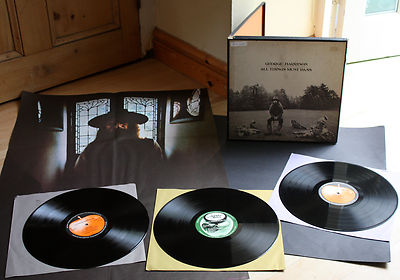
George Harrison (BEATLES ) APPLE 3 ALBUM BOXSET "All things must pass"
£
25
$
33


Favourite Auctions
To save auctions to your favourites, please login
If you don't have an account, please register
Description
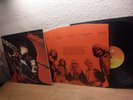
THE CLASSIC COLLECTABLE TRIPLE ALBUM BOXSET CONDITION OF VINYL EXCELLENT SOME WEAR TO COVER SCAN ACCURATE COMPLETE SMALL DENT~
All Things Must Pass
From Wikipedia, the free encyclopedia Jump to: navigation, search This article is about the album. For the song, see All Things Must Pass (song). "I Dig Love" redirects here. For the Asha Puthli cover version, see Asha Puthli. All Things Must Pass Studio album by George Harrison Released 27 November 1970 (1970-11-27) (US)30 November 1970 (1970-11-30) (UK) Recorded 26 May 1970 – September 1970
Abbey Road Studios, London; Trident Studios, London Genre Rock Length 105:59 Label Apple Producer George Harrison, Phil Spector George Harrison chronology Electronic Sound
(1969) All Things Must Pass
(1970) The Concert for Bangladesh
(1971) Singles from All Things Must Pass
- "My Sweet Lord"
Released: 23 November 1970 (US); 15 January 1971 (UK) - "What Is Life"
Released: 15 February 1971 (US)
All Things Must Pass is a triple album by George Harrison. Recorded and released in 1970, the album was Harrison's first solo work since the break-up of The Beatles in April that year. The original vinyl release featured two LPs of rock songs as well as Apple Jam, a third disc of informal jams.[1] Often credited as rock's first triple album,[2][3][4] it was in fact the first by a single act, the multi-artist Woodstock live set having preceded it by six months.[5]
In regards to the album's size, Harrison stated: "I didn't have many tunes on Beatles records, so doing an album like All Things Must Pass was like going to the bathroom and letting it out."[6]
The album was critically acclaimed and, with long stays at number 1 in both the US and the UK, commercially successful. It was certified 6x platinum by the Recording Industry Association of America in 2001.[7]
Background
Harrison had been accumulating the songs he recorded for the album as far back as 1966; the composition of both "Art of Dying"[8] and "Isn't It a Pity"[9] dates from that year. He picked up several more songs in late 1968 while visiting Bob Dylan and The Band in Woodstock, New York. Harrison and Dylan co-wrote "I'd Have You Anytime" and "Nowhere to Go" (also known as "When Everybody Comes to Town") at this time, and Dylan showed him "I Don't Want to Do It".[10] All three songs were attempted at some point in the sessions for All Things Must Pass, but only "I'd Have You Anytime" was included in the album.
The January 1969 Get Back sessions saw early appearances of several other songs that would be considered for All Things Must Pass, including the title track, "Hear Me Lord", "Isn't It a Pity", "Let It Down" and "Window, Window",[11] but nothing came of them at the time. The tense atmosphere fuelled another song, "Wah-Wah", which Harrison wrote in the wake of his temporary departure from the band.[12] He began writing "My Sweet Lord" while touring with Delaney & Bonnie in late 1969,[13] and would later utilize their backing group "Friends" as an important part of the All Things Must Pass sound. He made one last detour before beginning work on All Things Must Pass, visiting Dylan while the latter was starting sessions for New Morning in May 1970, learning "If Not for You" and participating in a now-bootlegged session.[14]
Production
Harrison recorded the album from May to August 1970 at Abbey Road Studios, and then further recorded and mixed it at Trident Studios from August to September 1970. Harrison enlisted the aid of Phil Spector to co-produce the album, giving All Things Must Pass a heavy and reverb-oriented sound, typical for a 1960s/'70s Spector production — a sound Harrison would subsequently regret with the passage of time. In the electronic press kit that accompanies the 30th Anniversary reissue, Harrison is asked what he thinks of the album 30 years later; he replied: "Too much echo."
In late May, just before recording got under way, Harrison sat in a studio with Spector and ran through 15 songs on guitar, with occasional support from an unknown bass player. These demos (eventually bootlegged as Beware of ABKCO! due to an altered line in his performance of "Beware of Darkness") showed him in the process of weighing up his material, as eight of the songs would either be substantially reworked or not appear on the finished album. Among these early outtakes, three have been officially released in one form or another: "Everybody, Nobody" was an early version of "Ballad of Sir Frankie Crisp", "Beautiful Girl" would be finished for 1976's Thirty Three & 1/3, and "I Don't Want to Do It" would wait 15 years until being revisited for the soundtrack of Porky's Revenge. Five other songs ? "Cosmic Empire", "Mother Divine", "Nowhere to Go", "Tell Me What Has Happened With You" and "Window, Window" ? have not seen official release,[15] along with other tracks such as "Gopala Krishna" and "Dehradun" that likewise did not make the final cut.[16] Two demos of songs that did make the album, "Beware of Darkness" and "Let It Down", would eventually be released on the remastered All Things Must Pass in 2001, the second of these tracks with recent overdubs recorded by Harrison at Friar Park.
Full discs of electric outtakes from the recording sessions would also leak onto bootlegs in later years, and two of those tracks were also included in the remaster. Multiple takes of songs from the album appear on a bootleg three-disc box set titled The Making of All Things Must Pass and on other unofficial releases.[17]
Musicians involved in the recording were numerous and the precise line-up is still the subject of much conjecture.[18] They included Eric Clapton, Bobby Whitlock, Jim Gordon and Carl Radle, all of whom had recently toured with Delaney & Bonnie and would morph into the short-lived Derek and the Dominos during these sessions;[5] German bassist Klaus Voormann, a friend since The Beatles' Hamburg days; future Yes drummer Alan White;[19] Ringo Starr; all four members of Badfinger; keyboard players Billy Preston, Gary Brooker and Gary Wright; Nashville pedal steel player Pete Drake; and the former Delaney & Bonnie (now Rolling Stones) horn section of Bobby Keys and Jim Price.[20] Orchestral arranger John Barham also sat in on the sessions, occasionally contributing on harmonium and vibraphone.[21] A young, pre-Genesis Phil Collins played congas on "Art of Dying", but was not credited on the original release (an oversight that was fixed on the 2001 remaster).[22]
Bob Dylan, a close friend of Harrison, co-wrote "I'd Have You Anytime" with him, while Harrison covered Dylan's "If Not For You", which would be released on Dylan's concurrent album, New Morning. Alan White stated that John Lennon may have played on "If Not For You".[23] Maurice Gibb was also present during the All Things Must Pass sessions, having been a friend of Starr's, and is said to have played keyboards on "Isn't It a Pity", although there is no definitive evidence as to which version.[24] In an 18 October 2009 BBC Radio 2 interview, tape op John Leckie claimed that Richard Wright of Pink Floyd contributed organ, but he receives no acknowledgment on the album either.[citation needed] In addition to these unconfirmed participants, author Simon Leng, having consulted the likes of Voormann and Barham for his study of the making of All Things Must Pass, credits Tony Ashton as one of the keyboard players on both versions of "Isn't It a Pity".[25]
Release
The album was released on 27 November 1970 in the United States, and on 30 November 1970 in the UK, with the rare distinction of having the same Apple catalogue number (STCH 639) in both countries.[26][27] "My Sweet Lord" was issued as the first single, and was highly successful, topping national singles charts all around the world during the first few months of 1971.[28]
The album itself was number 1 in the UK for eight weeks, although it would take decades before this was officially acknowledged. (Due to a two-month postal strike in Britain over the winter of 1970?71, and the resultant delay in receiving sales data from record retailers, All Things Must Pass was originally listed as having reached number 4. It was only in 2006 that the Official UK Charts Company changed its records to show that Harrison's was the top-selling album throughout that time.[29])
In America, All Things Must Pass spent seven weeks at number 1 on the Billboard 200, from 2 January 1971 until 20 February, part of which coincided with "My Sweet Lord" holding the top spot on the singles chart.[30] Not only was Harrison the first Beatle to achieve the prestigious double ? holding the top positions on Billboard's albums and singles listings during the same week(s) ? but it was a feat that none of the others would equal for another two-and-a-half years, when Paul McCartney & Wings repeated the achievement. All Things Must Pass was awarded a gold disc on 17 December 1970[31] and has since been certified six times platinum, making it Harrison's most commercially successful album.
Reception
Professional ratings Review scores Source Rating Allmusic [32] Blender [33] Robert Christgau C[34] MusicHound [35] NME (favourable)[36] PopMatters [37] Rolling Stone (1971) (favourable)[19] Rolling Stone (2000) [38] Rolling Stone (2001) (extremely favourable) [39] Zagat Survey [40]All Things Must Pass received, and continues to receive, almost universal critical acclaim ? as much for the music and lyrical content as for the fact that, of all the former Beatles, it was the work of supposed junior partner George Harrison.[41][42][43] Most reviewers tended to discount the third disc of studio jams, this being a "free" addition to justify the set's high retail price.[44][45]
On release, Ben Gerson of Rolling Stone magazine deemed All Things Must Pass "both an intensely personal statement and a grandiose gesture, a triumph over artistic modesty" and referenced the three-record set as an "extravaganza of piety and sacrifice and joy, whose sheer magnitude and ambition may dub it the War and Peace of rock and roll".[19] Gerson also lauded the album's production as being "of classic Spectorian proportions, Wagnerian, Brucknerian, the music of mountain tops and vast horizons".[19]
Melody Maker's Richard Williams summed up the surprise many felt at the so-called "quiet" Beatle's transformation: All Things Must Pass, he said, provided "the rock equivalent of the shock felt by pre-war moviegoers when Garbo first opened her mouth in a talkie: Garbo talks! ? Harrison sings!"[41] In another review, for The Times, Williams opined that, of all Beatles' solo releases thus far, Harrison's album "makes far and away the best listening, perhaps because it is the one which most nearly continues the tradition they began eight years ago".[43]
Robert Christgau was less enthusiastic, however; he considered the album to be "featureless" and bemoaned the "anonymity" of Harrison's vocals.[34] The NME's Roy Carr and Tony Tyler were likewise lukewarm in their assessment a few years later, highlighting "the homogeneity of the production and the lugubrious nature of Harrison's composing".[46]
More recently, Allmusic views All Things Must Pass as "his best ... a very moving work",[32] while MusicHound describes the set as "epic and audacious".[35] Film-maker Martin Scorsese has written of the "powerful sense of the ritualistic on the album ... I remember feeling that it had the grandeur of liturgical music, of the bells used in Tibetan Buddhist ceremonies."[47] Rolling Stone's Greg Kot describes this same grandeur as an "echo-laden cathedral of rock in excelsis" where the "real stars" are Harrison's songs;[48] in the same publication, Mikal Gilmore calls the album "the finest solo work any ex-Beatle ever produced".[49] John Bergstrom of PopMatters describes All Things Must Pass as "the sound of Harrison exhaling", noting: "He was quite possibly the only Beatle who was completely satisfied with the Beatles being gone."[50] Bergstrom also credits the album for heavily influencing the likes of ELO, My Morning Jacket, Fleet Foxes and Grizzly Bear, as well as helping bring about the dream pop phenomenon.[50]
In 1999, All Things Must Pass appeared at number 9 on The Guardian's "Alternative Top 100 Albums" list, where the editor stated that the album was the "best, mellowest and most sophisticated" of The Beatles' solo efforts.[51] In 2012, All Things Must Pass was voted 433rd on Rolling Stone magazine's list of the "500 Greatest Albums of All Time".[52]
Album artwork
Being the first boxed triple album in popular music, the packaging for All Things Must Pass became a talking point in its own right.[2][53] Apple insider Tony Bramwell later recalled: "It was a bloody big thing ... You needed arms like an orang-utan to carry half a dozen."[4]
The stark black-and-white cover photo was taken on the main lawn at Friar Park[28] by Barry Feinstein. Its composition ? Harrison seated in the centre of, and towering over, four comical-looking garden gnomes ? is often thought to represent his removal from The Beatles' collective identity, if not a degree of superiority over it.[4][54][55] Ever competitive, and noticeably negative about his former bandmates' solo work around this time (especially McCartney's),[27][2] John Lennon is said to have taken particular offence at the apparent message in Harrison's album cover[56][2] (notwithstanding his own declaration regarding The Beatles in his concurrent song "God"). Lennon sniped that Harrison looked like "an asthmatic Leon Russell" in the photo;[2] biographer Alan Clayson describes him as "a spaced-out Farmer Giles".[54] The inclusion of the gnomes was the photographer's idea, in fact, but the symbolism was quite deliberate, according to Feinsten: "What else could it be? ... it was over with The Beatles, right? And that title ? All Things Must Pass. Very symbolic."[4]
~ ..Check out my other items! ~WE WILL COMBINE POSTAGE~~NO RESERVE~~~~~~~ALSO TAKE A LOOK AT OUR EXCITING NEW WEBSITE: WWW.GREASERECORDS.CO.UKTAKE A PEEP SOME BARGAINS HERE............................................
Once I have sent your item (and have obtained my proof of postage), it is the responsibility of the Royal Mail to get it to you safe and undamaged. If this is not the case and you are unhappy with the service of the delivery to you, I would be happy to help you with any claims against the Royal Mail. But, please be aware that I personally would not reimburse you for any loss or damage that has incurred during its time in transit. For goods over £30 I would recommend taking out postal insurance. Please email me and I will happily sort it out for you...Thank you.
price rating