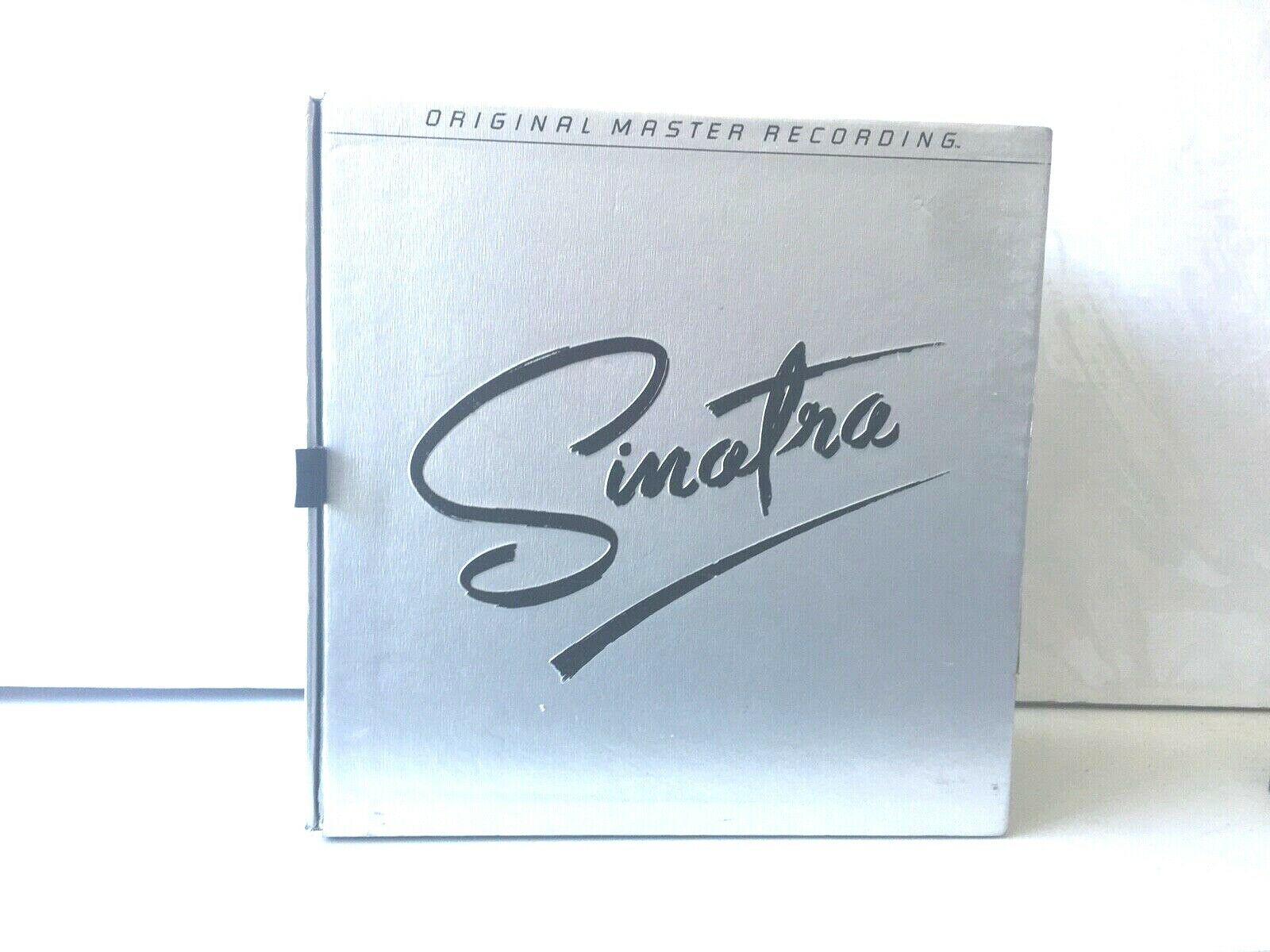
Frank Sinatra SINATRA Original Master Recordings 14 LP Box Capitol MFSL SC-1
$
380
Favourite Auctions
To save auctions to your favourites, please login
If you don't have an account, please register
Description
Label: Capitol Records ?– SC-1, Mobile Fidelity Sound Lab ?– SC-1 Series: Original Master Recording – Format: Box Set, Compilation, Limited Edition, Numbered
14 × Vinyl, LP, Album, Reissue, Remastered, Translucent
Country: US Released: 1983 Genre: Jazz, Pop Style: Vocal, Ballad, Swing
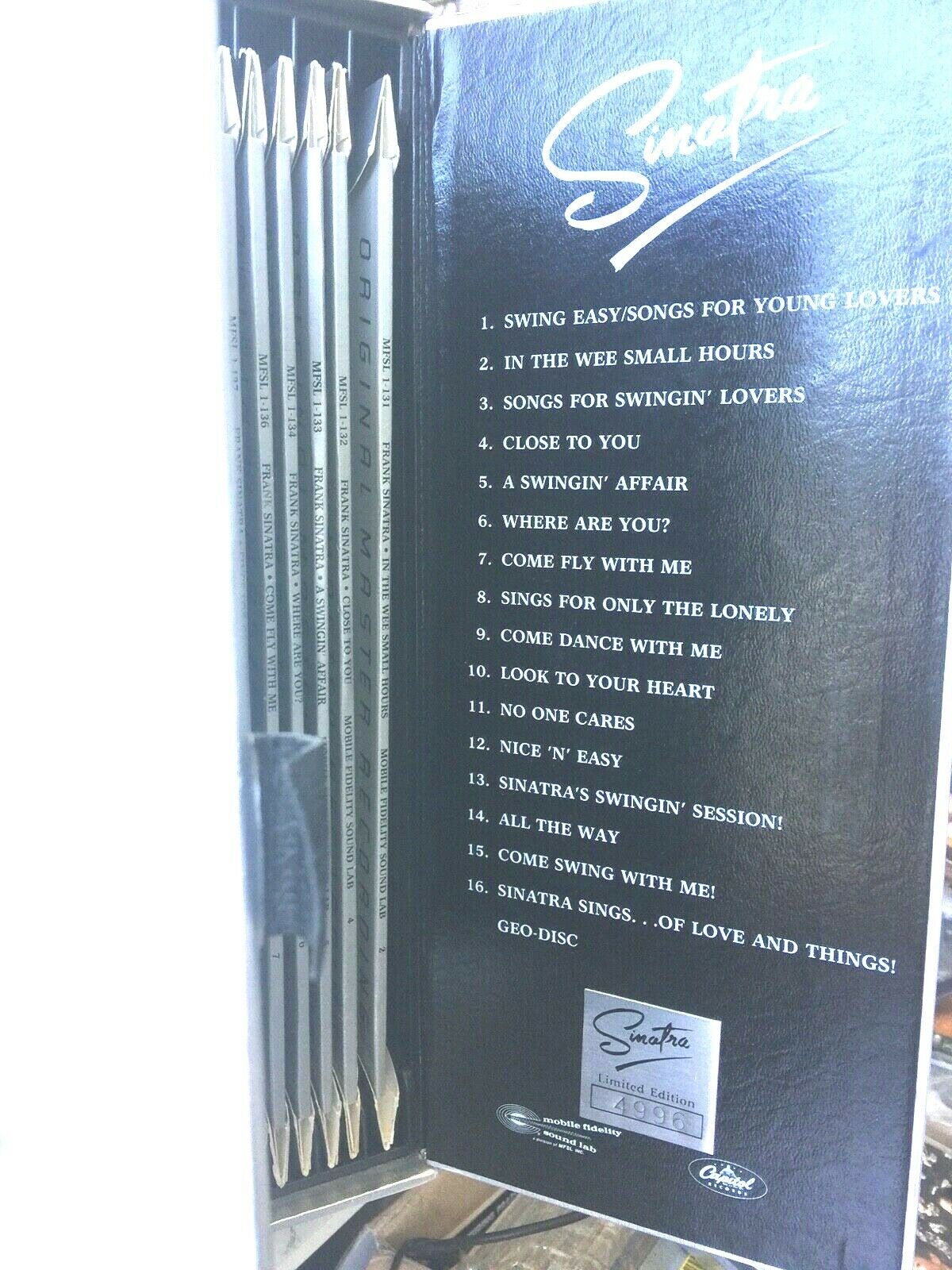
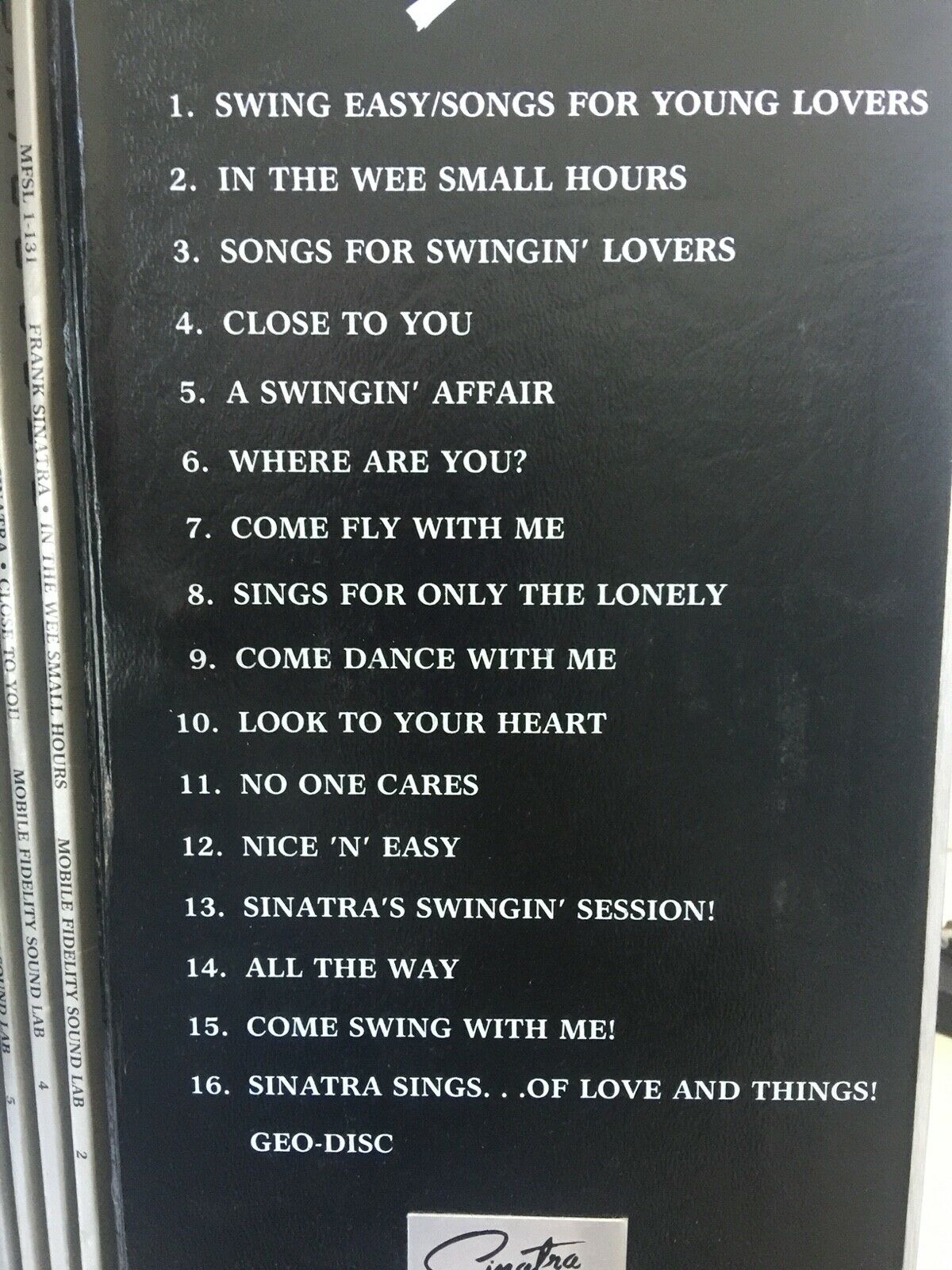
This listing is for a 14 LP box set. The original release had 16 LPS.
The Vinyl LPs entitled #1. Swing Easy/ Songs for Young Lovers and #3. Songs for Swinging Lovers are not included. The Geo-disc is also not included. This box set compilation is numbered 4996.
The 14 LPs are in excellent condition. Japan Pressing.
This is a 1983 limited edition mobile fidelity box set containing 16 half-speed mastered audiophile pressed super vinyl LP's and a "GEO DISC" LPs included are as follows: 1. SWING EASY / SONGS FOR YOUNG LOVERS 2. IN THE WEE SMALL HOURS 3. SONGS FOR SWINGIN' LOVERS 4. CLOSE TO YOU 5. A SWINGIN' AFFAIR 6. WHERE ARE YOU? 7. COME FLY WITH ME 8. SINGS FOR ONLY THE LONELY 9. COME DANCE WITH ME 10. LOOK TO YOUR HEART 11. NO ONE CARES 12. NICE N' EASY 13. SINATRA'S SWINGIN' SESSION! 14. ALL THE WAY 15. COME SWING WITH ME! 16. SINATRA SINGS...OF LOVE AND THINGS!
- Vinyl
- Original Release Date: 1983
- Number of Discs: 14
- Format: Box set, Original recording remastered, Special Limited Edition, HiFi Sound
- Label: Mobile Fidelity Sound Lab
- Run Time: 600 minutes
- ASIN: B00QF6PPVM
What distinguishes an Original master Recording LP from any other record?
1. Original Master Recordings are exclusively transferred from the original stereo master tape that the musicians recorded in the studio (not from a second, third, or fourth generation copy of that master tape).
2. Each Original Master Recording employs Mobile Fidelity Sound lab's exclusive half-speed mastering process, thus capturing every nuance of sound from the master tape.
3. Quality, not quantity, is the overwhelming consideration in the creation of each Original Master Recording. The number of pressings is strictly controlled. These limited editions assure you that the quality of the last pressing matches the quality of the first.
4. Original Master recordings are custom pressed overseas by the Victor Company of Japan (JVC). Super Vinyl, an exclusive compound far superior to even so-called 100% virgin vinyl, is utilized to achieve maximum clarity and startling quietness.... Super Vinyl also bestows unsurpassed durability to each Original Master Recording LP, achieving a "playing lifespan" at least five times longer than mass- produced records.
5. Each Original Master Recording is ultra-packaged to maintain flatness and prevent warpage.
VINTAGE SINATRA IN AN EXPENSIVE PACKAGE
By JOHN ROCKWELL
Published: October 16, 1983, NY Times
Mobile Fidelity Sound Lab, the Southern California concern that last year favored us with a 14-disk, $325 boxed collection of the complete Beatles British albums, all of them half-speed-mastered and pressed in Japan on special vinyl, is at it again. This year, also on its Original Master Recording label, it has just released a 16-disk, $350 set called Sinatra.
Frank Sinatra might not at first seem the hippest possible subject for such a compilation. He hardly espouses the latest now sounds; his politics have drifted into the curmudgeonly, and his public image blends stiff dignity with vulgarity.
But he is also a great singer, the word ''great'' invoked with no serious qualification at all. He defined an era of popular song and singing, exercising an enormous influence on other singers. His achievement sheds new light on the increasingly shadowy distinctions between rock-and- roll and other forms of American popular song. And now, with the surprising commercial success of Linda Ronstadt's ''What's New,'' an album directly inspired by his songs, singing and arrangements, Mr. Sinatra seems more timely than ever.
What we have here are most of Mr. Sinatra's Capitol albums from 1953 to 1962; not present are a couple of compilations, two sound tracks, a Christmas album and ''Point of No Return,'' omitted either because they didn't fit thematically, according to Mobile Fidelity's president, Herb Belkin, or because of technical deficiencies. Still, there is plenty of Sinatra left.
Those who have collected the offerings of Mobile Fidelity and other audiophile repackagers know by now that on a purely sonic level, these records sound very good indeed. The pressings are largely free from crackle and pop, and the sound - while not an entirely new experience - is simply clearer, fuller and brighter than it was before.
Of these disks, the best-sounding records are the early ones, in monaural sound. When stereo first arrived around 1957, pop producers felt impelled to dramatize the potential of the new medium by exaggerating the stereo separation - the splitting up of the left-to-right spectrum. Their work may have sounded punchy on a cheap home stereo system then, but on a modern set now it seems tinny and gimmicky.
Another complaint has to do with the clumsiness of the packaging. The set comes in a big silver box with slots that hold two each of the individual albums. The box has too many slots, one of which is filled with a ''Geo-Disc'' for cartridge alignment - the Beatles set had one, too - that seems unnecessary. A lavish booklet discussing Mr. Sinatra's career at some length, with ample illustrations, would have made more sense. In addition, the cardboard sleeves for the separate LP's are clumsily designed.
The disks themselves, however, are presented with laudable completeness. With a few of the albums, Capitol deleted songs when the original mono LP's were reissued in stereo; here, they are complete, with some songs appearing in stereo for the first time.
Of course, ''completeness'' in a project like this is an illusion. Not only did Mr. Sinatra record some songs during this period that are not included here, but he had and has an extensive recording career that precedes and postdates the Capitol period. There were Brunswick and Columbia recordings with Harry James, Victor disks with Tommy Dorsey, the whole Bobby Soxer frenzy and early solo career on Columbia, from 1943 to 1952, and then the Warner-Reprise years from 1960 to the present.
But there is a reason to box the Capitol albums, quite apart from the fact that Mobile Fidelity obtained the rights to them (and the extensive cooperation of the late David Cavanaugh, a Capitol vice president). These are the albums that marked the apex of Mr. Sinatra's record-sales success, and defined his mature artistry.
As a singer, Mr. Sinatra offered - and offers still; he remains a technical paragon - an easily produced pop baritone. It reaches up into a low-tenor lightness without ever really being suitable for topnote belting. And it can go down for the occasional cavernous bass effect.
But for the most part, Mr. Sinatra keeps the tessitura, or average range, precisely where he feels the most comfortable. His voice rides easily on the breath, as classical terminology would have it: never forced, flexible within its limits, supple and expressive. In fact, the classical and popular vocal expert Henry Plesants, in his book ''The Great American Popular Singers,'' argues that Mr. Sinatra's technique is closer to the principles of the 17th- century Italian originators of bel canto than is that of present-day opera singers, who, he feels, have distorted the declamatory purity of the original bel-canto style in pursuit of tonal brilliance and volume.
If his singing thus represents a model for classical vocalists, it also derived much from jazz. Mr. Sinatra has always credited Mr. Dorsey's trombone as having inspired his phrasing. By the time of these Capitol albums, he had learned to phrase with an easy authority that lifts even banal songs into memorability. As such, he accomplished as significant an infusion of musical traits associated with American blacks into the white mainstream as did the rock generation later on.
No matter what the material, Mr. Sinatra manages to make something personal from it. In the rock era, ''singer-songwriters'' take forever with their albums, struggling to compose songs that voice their truest inner feelings. Pop singers of Mr. Sinatra's time, like country singers today, turned out albums much more frequently, combing through the available sheet music and at their best bending it through force of personality into an expression of self.
The albums in this set alternate, for the most part, between Mr. Sinatra's ''swinging'' and ''lonely'' modes - in other words, between uptempo jazzish jaunts in which Mr. Sinatra projects an image of insouciant, footloose sexuality, and deeply, painfully vulnerable ballads. Fully five of the LP's here actually contain some variant of the word ''swing'' in the title, and most fall into a predominantly breezy or torchy pattern.
If two LP's had to be picked to embody these tendencies, they would be ''Songs for Swingin' Lovers,'' a No. 2 album in Billboard magazine from 1956, and ''Only the Lonely,'' which reached No. 1 in 1958 and stayed on the chart for 120 weeks. ''Only the Lonely'' should be of special interest today, since it was probably Mr. Sinatra's own best-selling album and since it contains three songs re-recorded by Miss Ronstadt on ''What's New.''
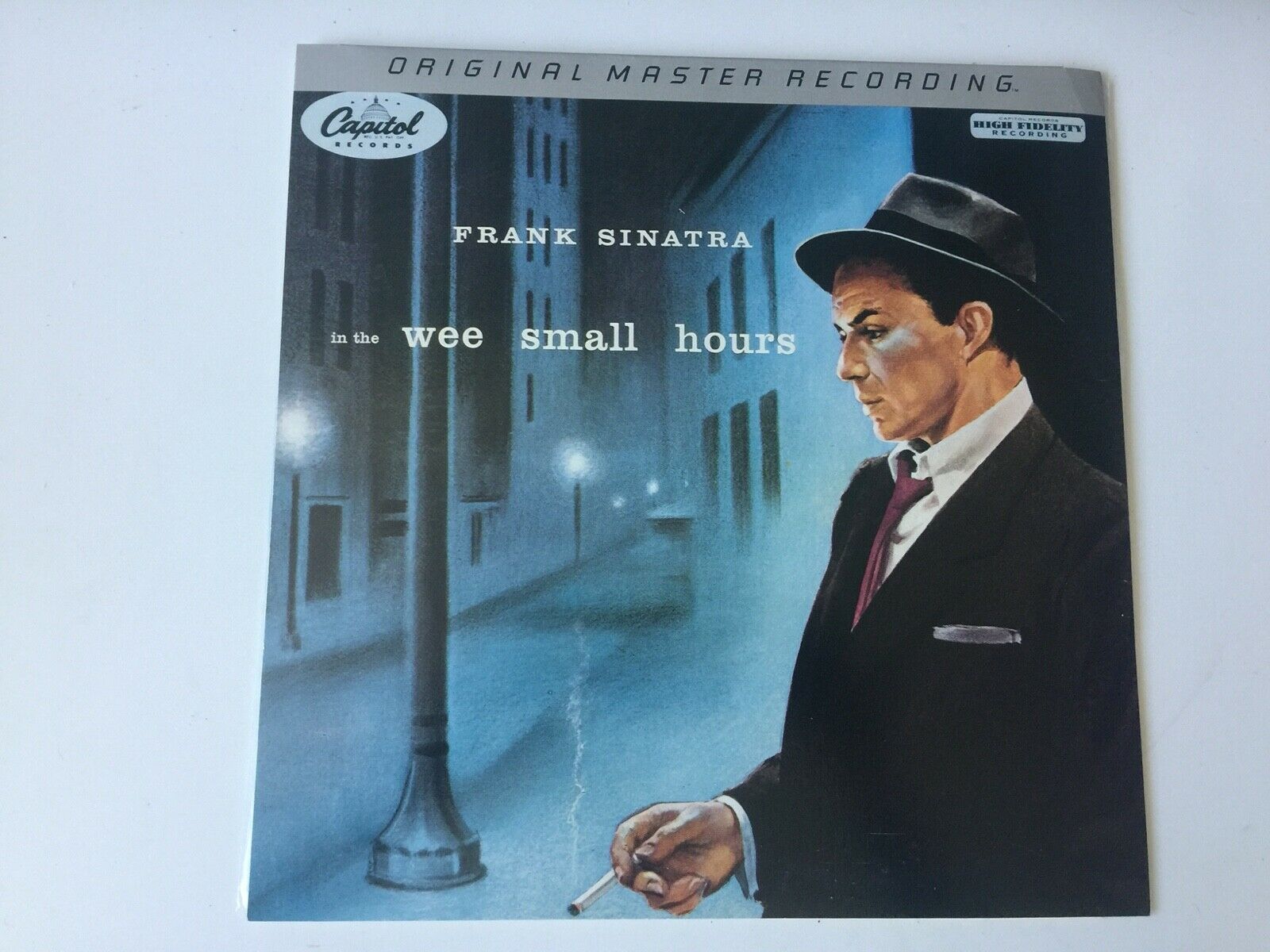
Scattered through this box are other superb albums, of course, among them such Sinatra classics as ''Songs for Young Lovers,'' ''In the Wee Small Hours,'' ''Come Fly With Me'' and ''No One Cares,'' where Mr. Sinatra's singing reaches a peak of frail sensitivity.
But not all the songs attain the high level epitomized by these disks. Partly because toward the end Capitol fell back on compilation reissues, since Mr. Sinatra was already releasing albums on Reprise, this box as a whole seems to depict the steady decline of Tin Pan Alley songwriting from the peak of Irving Berlin and George Gershwin into the mire of present-day middle-of-the-road and novelty schlock. Indeed, the level of song quality is so variable that the merely curious - as opposed to committed Sinatra fans - might be advised to wait a year or two and get the best individual albums as Mobile Fidelity releases them singly; ''Nice 'n' Easy'' has already been so released.
The subject matter of American popular song broadened and diversified in the rock era. But love remains at the core of all popular song, and Mr. Sinatra's obsession with the varieties of the romantic dream, as the paramount answer to all of life's problems, tells us much about the country as a whole during the 1950's. After that, it became increasingly difficult to sustain such an innocent fairy tale, and those songwriters who tried to do so ran the risk of pandering to sentimentality at its crassest.
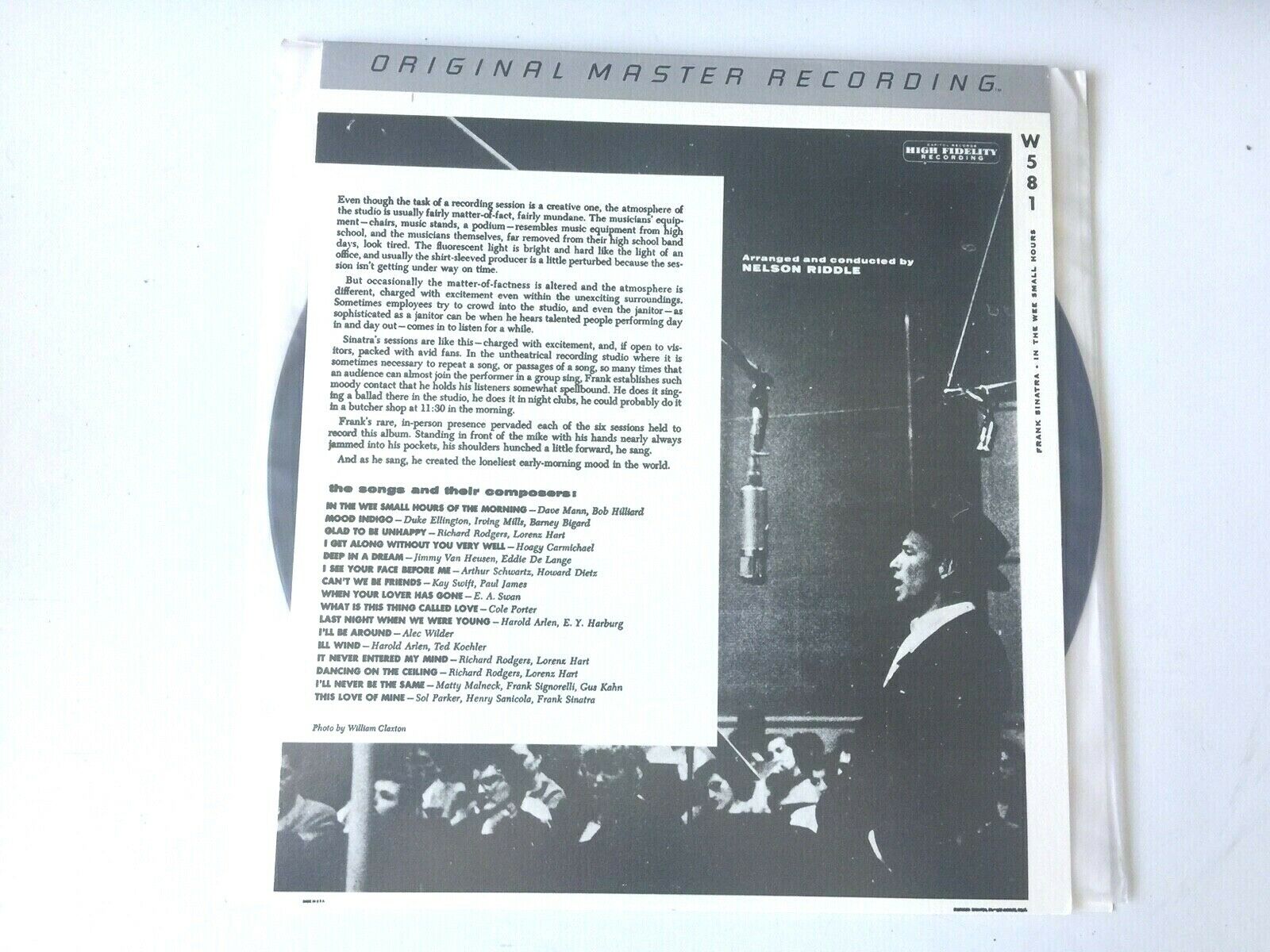
Still, the singing here remains superior no matter what the songs, and the arrangements are at the same high level (a few embarrassing experiments with female and boy choruses aside). Most of the arranging was by Nelson Riddle, who is also responsible for Miss Ronstadt's record. But Gordon Jenkins and Billy May also do their share, the former more romantically heavy-handed than the subtler Mr. Riddle, the latter more overtly jazzish for some of the ''swinging'' albums. And the musicians are the finest the studios of New York and Hollywood had to offer; the prestigious Hollywood String Quartet even appears under its own name - its members play separately on nearly all the Los Angeles records - on ''Close to You.''
Even if not every song is up the highest level, these records should still be of interest to anyone concerned with the evolution of American popular music. Most of these disks appeared after the supposedly watershed year of 1955, when rock-and-roll seemed to sweep aside all other forms of pop music. Several of them proved to be huge commercial successes, too, well into the post-Presley era.
Mr. Sinatra has never been comfortable with music that is overtly rock or even folk-rock oriented. But he remains a commanding figure in our popular culture. That tells us that our musical landscape was never as scarred by as crude and absolute a territorial division between pre-rock and rock as some polemicists would have us believe. Mr. Sinatra's songs and singing style reached their peak after rock had been born, and they live on for us today. They live in his actual person, of course. But they live, too, in this documentary album, and anyone who wishes to hear Frank Sinatra, or indeed his kind of American singing and songs, should invest in this set.
price rating