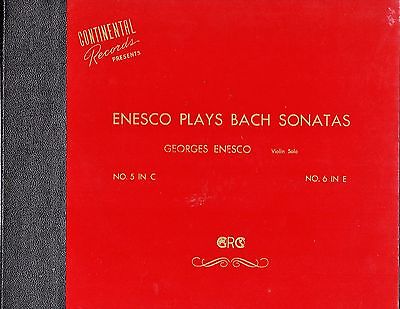
ENESCO, Georges. BACH. Sonata 3; Partita 3. Continental CLP-106 E?E+
$
1,799


Favourite Auctions
To save auctions to your favourites, please login
If you don't have an account, please register
Description
Bach, Johann Sebatian
Sonata for Violin alone No. 3 in C
Partita for Violin alone No. 3 in E
Identified here as Sonatas 5 and 6
Georges Enesco, violin
These were recorded by Continental Records owner Don Gabor sometime during 1949. 66 years later, they are among the major icons of classical record collecting. Though the Remington Records internet site says they were made on lacquer discs, dubbed to tape and then edited. I believe they were mastered onto and edited completely on tape. They share audible recording characteristics with the Starker Kodaly Sonata issued on Period, recorded on tape at about the same time.
Reproduced properly in mono, these original Continental pressings have remarkable fidelity, presence and room tone. Careful listening reveals some non-musical close-up sounds of the instrument being played including fingerboard thumps as well as studio and outside traffic sounds and an occasional splice point. I suspect, but can’t prove, that Peter Bartok was the recording engineer for these as he certainly was on the Kodaly.
The master numbers for this disc are TA-20 and TA-21. This, the original release was issued as part of a boxed set on Gabor’s “Continental” label, CLP 104, 105 and 106. They were once available, however briefly, as individual records, since two such examples are what I’m offering, I cannot find any printed source that indicates a solo release except for the first one, reviewed as such in Billboard, August 26, 1950, an example of which recently sold on Ebay. The first listing in Schwann in May, 1950 was as set, not as singles. They were still listed there in February 1952 but were deleted the following month. One sixth was replaced in March by the Bach Second Sonata, drawn from this set and released on a 10 inch Remington, PL-1-149, another Gabor-owned label.
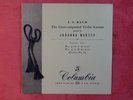
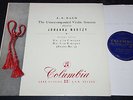
The same style long box was used for all four packages, the three LP set and one each for the three individual discs. The content was printed in gold on red flocked velvet and used for all four packages: The covers for the individual issues each list two works, that for the set, all six. The notes were the same, a single page with a blank reverse, stapled to a dowel affixed vertically inside the rear of the box.
The 3 LP set has sold on eBay perhaps 15 to 20 times in the last ten years. The first instance I could trace any individually-packaged disc in the original long box being offered on Ebay was last year (sold for $ 2,560.) Here I’m offering the others individually in the same super-scarce edition. (I was not the seller of the first one.)
Continental CLP-106
Condition.
Record: Side one has a long paper mark in the 2d movement that does not sound here. It extends over the band to the very start of the third movement and makes no sound there either though, without the audio signal to mask it, there are some ticks in the “silent” band as well as low level groove noise. Side two has a short scratch cluster in the 3d mvt., about 6 clicks and a bit of thumping thereafter.
No matter how good a copy looks, there are noises common to all of these first edition pressings, issued in 1950 during the early years of LP manufacturing technology. There are maybe a dozen small pressing bubbles on each side that sound and also maker an occasional louder tick. Pressing bubbles are a problem with all early Continental and Remington LPs. Some may see what I call pressing bubbles as scratches or needle drops. I don’t feel most of these are flaws from being played but a trait common to Mr. Gabor’s products from this period. They are flaws nonetheless and I’m noting them.
I tested these using a Shure M-44, with a 1.1 mil elliptical stylus, into a KAB Souvenir EQS Mark 2, using the Columbia LP curve and the mono/stereo button set to mono. I did not engage a rumble filter.
All sides look better than the description might lead one to think. I believe some noise problems originate at the lacquer disc and/or metal part production end.
Box. There are a couple of scuffs on the velvet front, insignificant rubs to the exposed edges and a bit of fading to a word or so. The spines are intact and supple, not cracked or dried out. Considering how frequently these boxes turn up damaged, these examples are a grade just below magnificent. The scan of the spines above includes both records I'm offering . This listing is for No. 106 only.
Shipping to the U.S. is $ 4.00; elsewhere calcualted by mailing address.