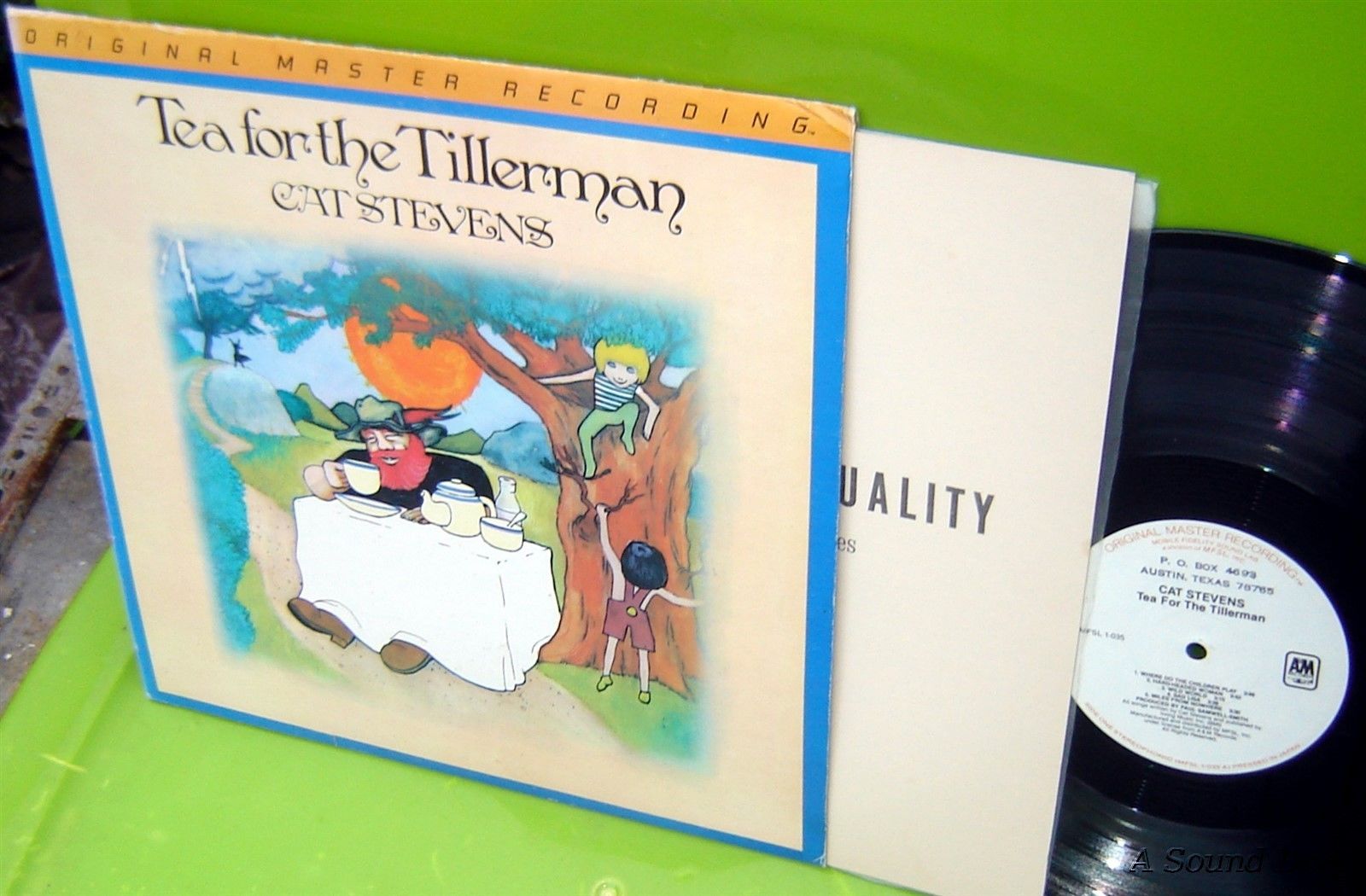
CAT STEVENS Tea for the Tillerman LP EX Audiophile MFSL Japan HEAR
$
30


Favourite Auctions
To save auctions to your favourites, please login
If you don't have an account, please register
Description
Record: Excellent (EX) Cover: Very Good (VG) Labels: Address stamps on labels Cat Stevens Tea For The Tillerman 1970 United States MFSL 12" Stereo LP SB-15889
Cat Stevens
Tea For The Tillerman
1970 United States MFSL LP
Audiophile half-speed master (pressed in Japan) in rice paper inner as issued. Includes heavy wrap-around MFSL insert, survey and warranty form. Excellent quality play copy!
Condition
Vinyl: Excellent (EX)
Sleeve: Very Good (VG)
See Item Specifics section above for additional details
(clickable images enlarge)
Tracks:
Cat Stevens ?– Tea For The Tillerman Label: Mobile Fidelity Sound Lab ?– MFSL 1-035 Format: Vinyl, LP, Half Speed Mastered from Original Master Tapes Country: US Released: Nov 1980 Genre: Rock Style: Folk Rock, Pop Rock Tracklist A1 Where Do The Children Play? 3:48 A2 Hard Headed Woman 3:42 A3 Wild World 3:15 A4 Sad Lisa 3:39 A5 Miles From Nowhere 3:30 B1 But I Might Die Tonight 1:51 B2 Longer Boats 3:07 B3 Into White 3:23 B4 On The Road To Find Out 5:07 B5 Father & Son 3:36 B6 Tea For The Tillerman 1:00 Companies etc Distributed By – MFSL, Inc. Manufactured By – MFSL, Inc. Pressed By – Victor Company Of Japan, Ltd. Mastered At – Victor Company Of Japan, Ltd. Credits Arranged By [Strings] – Del Newman Bass – John Ryan Drums – Harvey Burns Guitar [2nd Guitar] – Alun Davies Guitar, Keyboards, Written-By, Illustration [Front] – Cat Stevens Producer – Paul Samwell-Smith Violin [Solo] – John Rostein* Notes All songs by Cat Stevens. Originally released in 1970. MSFL INC. Edition, Under License From A&M. Original Master Recording, Pressed In Japan
CAT STEVENS Tea for the Tillerman LP EX Audiophile MFSL Japan HEAR Yusuf Islam (born Steven Demetre Georgiou; 21 July 1948), commonly known by his former stage name Cat Stevens, is a British singer-songwriter, multi-instrumentalist, humanitarian, and education philanthropist.[4] His 1967 debut album reached the top 10 in the UK, and the album's title song "Matthew and Son" charted at number 2 on the UK Singles Chart. His albums Tea for the Tillerman (1970) and Teaser and the Firecat (1971) were both certified triple platinum in the US by the RIAA.[5] His 1972 album Catch Bull at Four spent three weeks at number one on the Billboard 200, and fifteen weeks at number one in the Australian ARIA Charts.[6][7] He earned two ASCAP songwriting awards in 2005 and 2006 for "The First Cut Is the Deepest", and the song has been a hit for four different artists.[8] His other hit songs include "Father and Son", "Wild World", "Peace Train", "Moonshadow", and "Morning Has Broken". In 2007 he received the British Academy's Ivor Novello Award for Outstanding Song Collection.[9] In December 1977, Stevens converted to Islam[10] and adopted the name Yusuf Islam the following year. In 1979, he auctioned all his guitars for charity[11] and left his music career to devote himself to educational and philanthropic causes in the Muslim community. He was embroiled in a long-running controversy regarding comments he made in 1989 about the death fatwa on author Salman Rushdie. He has received two honorary doctorates and awards for promoting peace from two organisations founded by Mikhail Gorbachev. In 2006, he returned to pop music – releasing his first album of new pop songs in 28 years, titled An Other Cup.[12][13] With that release and for subsequent ones, he dropped the surname "Islam" from the album cover art – using the stage name "Yusuf" as a mononym.[13] In 2009, he released the album Roadsinger, and in 2014, he released the album Tell 'Em I'm Gone, and began his first US tour since 1978.[14] He was inducted into the Rock and Roll Hall of Fame in 2014.[15] Early life (1948–65) Steven Georgiou, born on 21 July 1948 in the Marylebone area of London,[16] was the third child of a Greek Cypriot father, Stavros Georgiou (b. 1900),[17] and a Swedish mother, Ingrid Wickman (b. 1915).[18] He had an older sister, Anita, and a brother, David.[16] The family lived above the Moulin Rouge, a restaurant that his parents operated on the north end of Shaftesbury Avenue which was a short walk from Piccadilly Circus in the Soho theatre district of London. All family members worked in the restaurant.[16] His parents divorced when he was about eight years old, but they continued to maintain the family restaurant and live above it. Although his father was Greek Orthodox and his mother a Swedish Baptist, Georgiou was sent to St. Joseph Roman Catholic Primary School, Macklin Street, which was closer to his father's business on Drury Lane.[19] Georgiou developed an interest in piano at a fairly young age, eventually using the family baby grand piano to work out the chords, since no one else there played well enough to teach him.[20] Inspired by the popularity of The Beatles, at 15 he extended his interest to the guitar,[10] persuaded his father to pay £8 for his first instrument, and began playing it and writing songs.[20] He would escape at times from his family responsibilities to the rooftop above their home, and listen to the tunes of the musicals drifting from just around the corner[16] from Denmark Street, which was then the centre of the British music industry.[10] Stevens emphasised that the advent of West Side Story in particular affected him, giving him a "different view of life".[21] With interests in both art and music, he and his mother moved to Gävle, Sweden, where he attended primary school (Solängsskolan) and started developing his drawing skills after being influenced by his uncle Hugo Wickman, a painter. They subsequently returned to England.[22] He attended other local West End schools, where he says he was constantly in trouble, and did poorly in everything but art. He was called "the artist boy" and mentions that "I was beat up, but I was noticed".[23] He went on to take a one-year course of study at Hammersmith School of Art,[24] as he considered a career as a cartoonist. Though he enjoyed art (his later record albums would feature his original artwork on his album covers),[23] he wanted to establish a musical career and began to perform originally under the stage name "Steve Adams" in 1965 while at Hammersmith.[24][25] At that point, his goal was to become a songwriter. As well as the Beatles, other musicians who influenced him were the Kinks,[26] Bob Dylan, Nina Simone, blues artists Lead Belly and Muddy Waters,[27] Biff Rose (particularly Rose's first album), Leo Kottke,[23] and Paul Simon.[28] He also wanted to emulate composers who wrote musicals, like Ira Gershwin and Leonard Bernstein. In 1965 he signed a publishing deal with Ardmore & Beechwood and recorded several demos, including "The First Cut Is the Deepest".[29] Musical career (1966–70) Early musical career Georgiou began to perform his songs in London coffee houses and pubs. At first he tried forming a band, but soon realised he preferred performing solo.[20] Thinking that his given name might not be memorable to prospective fans, he chose a stage name Cat Stevens, in part because a girlfriend said he had eyes like a cat, but mainly because he said, "I couldn't imagine anyone going to the record store and asking for 'that Steven Demetre Georgiou album'. And in England, and I was sure in America, they loved animals."[30] In 1966, at age 18, he impressed manager/producer Mike Hurst, formerly of British vocal group the Springfields, with his songs and Hurst arranged for him to record a demo and then helped him get a record deal. The first singles were hits. "I Love My Dog", charting on the UK Singles Chart at number 28, and "Matthew and Son", the title song from his debut album, went to number 2 in the UK.[31] "I'm Gonna Get Me a Gun" was his second UK top 10, reaching number 6, and the album Matthew and Son reached number 7 on the UK Albums Chart.[32] The original version of the Tremeloes' hit "Here Comes My Baby" was written and recorded by Stevens. "The First Cut is the Deepest" (1967) Menu 0:00 Sample of "The First Cut is the Deepest", performed by Cat Stevens. Appears on New Masters. Problems playing this file? See media help. Over the next two years, Stevens recorded and toured with an eclectic group of artists ranging from Jimi Hendrix to Engelbert Humperdinck. Stevens was considered a fresh-faced teen star, placing several single releases in the British pop music charts.[33] Some of that success was attributed to the pirate radio station Wonderful Radio London, which gained him fans by playing his records. In August 1967, he went on the air with other recording artists who had benefited from the station to mourn its closure.[34] His December 1967 album New Masters failed to chart in the United Kingdom. The album is now most notable for his song "The First Cut Is the Deepest", a song he sold for £30 to P. P. Arnold that was to become a massive hit for her,[35] and an international hit for Keith Hampshire, Rod Stewart, James Morrison, and Sheryl Crow. Forty years after he recorded the first demo of the song, it earned him two back-to-back ASCAP "Songwriter of the Year" awards, in 2005 and 2006.[36][37] Rock Progressive/Art Rock,Rock 'n' Roll MFSL,Remastered,With Insert 33 RPM Height of popularity Stevens performing in Boeblingen, Germany in 1976 Around this time, Stevens had a catalogue of new songs that reflected his new perspective on what he wanted to bring to the world with his music. His previous work had sold at home in the UK, but Stevens was still relatively unknown by the public across the Atlantic. To rectify this, after signing with Island Records in 1970, an American distribution deal was arranged with A&M Records' Jerry Moss in North America. Stevens began work on Mona Bone Jakon, a folk rock based album. Producer Paul Samwell-Smith paired Stevens with guitarist Alun Davies, who was at that time working as a session musician. Davies was the more experienced veteran of two albums which already had begun to explore the emerging genres of skiffle and folk rock music. Davies was also thought a perfect fit with Stevens in particular for his "fingerwork" on the guitar, harmonising and his backing vocals. They originally met just to record Mona Bone Jakon,[41] but developed a fast friendship. Davies, like Stevens, was a perfectionist,[42] appearing at all sound checks to be sure that all the equipment and sound were prepared for each concert.[43] He collaborated with Stevens on all but two of the succeeding albums Stevens released, and performed and recorded with him until Stevens' retirement. Their friendship continued, however, and when Stevens re-emerged as Yusuf Islam after 27 years, Davies appeared again performing at his side, and has remained there. "Father and Son" (1970) Menu 0:00 Sample of "Father and Son", performed by Cat Stevens. Appears on Tea for the Tillerman. Problems playing this file? See media help. The first single released from Mona Bone Jakon was "Lady D'Arbanville", which Stevens wrote about his young American girlfriend Patti D'Arbanville. The record, with a madrigal sound unlike most music played on pop radio, with sounds of djembes and bass in addition to Stevens' and Davies' guitars, reached number 8 in the UK.[32] It was the first of his hits to get real airplay in the US.[31] It sold over one million copies, and was awarded a gold record in 1971.[44] Other songs written for D'Arbanville included "Maybe You're Right", and "Just Another Night".[45] In addition, the song "Pop Star", about his experience as a teen star, and "Katmandu", featuring Genesis frontman Peter Gabriel playing flute, were featured. Mona Bone Jakon was an early example of the solo singer-songwriter album format that was becoming popular for other artists as well. Rolling Stone magazine compared its popularity with that of Elton John's Tumbleweed Connection, saying it was played "across the board, across radio formats".[46] Mona Bone Jakon was the precursor for Stevens' international breakthrough album, Tea for the Tillerman, which became a Top 10 Billboard hit. Within six months of its release, it had sold over 500,000 copies, attaining gold record status in the United Kingdom and the United States. The combination of Stevens' new folk rock style and accessible lyrics which spoke of everyday situations and problems, mixed with the beginning of spiritual questions about life, would remain in his music from then on. The album features the Top 20 single "Wild World"; a parting song after D'Arbanville moved on. "Wild World" has been credited as the song that gave Tea for the Tillerman 'enough kick' to get it played on FM radio; and the head of Island Records, Chris Blackwell, was quoted as calling it "the best album we've ever released".[28] Other album tracks include "Hard-Headed Woman", and "Father and Son", a song sung both in baritone and tenor, about the struggle between fathers and their sons who are faced with their own personal choices in life. In 2001, this album was certified by the RIAA as a Multi-Platinum record, having sold 3 million copies in the United States at that time.[47] It is ranked at No. 206 in the 2003 list of "Rolling Stone's 500 Greatest Albums of All Time".[48] After the end of his relationship with D'Arbanville, Stevens noted the effect it had on writing his music, saying, "Everything I wrote while I was away was in a transitional period and reflects that. Like Patti. A year ago we split; I had been with her for two years. What I write about Patti and my family ... when I sing the songs now, I learn strange things. I learn the meanings of my songs late ..."[48] Stevens performing in Waikiki Shell, Oahu, Hawaii, 1974. The stage decor reflects his song, "Boy with a Moon & Star on His Head" from Catch Bull at Four Having established a signature sound, Stevens enjoyed a string of successes over the following years. 1971's Teaser and the Firecat album reached number two and achieved gold record status within three weeks of its release in the United States. It yielded several hits, including "Peace Train", "Morning Has Broken", and "Moonshadow". This album was also certified by the RIAA as a Multi-Platinum record in 2001, with over three million sold in the United States through that time. When interviewed on a Boston radio station, Stevens said about Teaser and the Firecat: I get the tune and then I just keep on singing the tune until the words come out from the tune. It's kind of a hypnotic state that you reach after a while when you keep on playing it where words just evolve from it. So you take those words and just let them go whichever way they want ...'Moonshadow'? Funny, that was in Spain, I went there alone, completely alone, to get away from a few things. And I was dancin' on the rocks there ... right on the rocks where the waves were, like, blowin' and splashin'. Really, it was so fantastic. And the moon was bright, ya know, and I started dancin' and singin' and I sang that song and it stayed. It's just the kind of moment that you want to find when you're writin' songs.[49] For seven months from 1971 to 1972 Stevens was romantically linked to popular singer Carly Simon while both were produced by Samwell-Smith. During that time both wrote songs for and about one another. Simon wrote and recorded at least two Top 50 songs, "Legend in Your Own Time" and "Anticipation" about Stevens. He reciprocated in his song to her, after their romance, titled, "Sweet Scarlet".[50][51][52] His next album, Catch Bull at Four, released in 1972, was his most rapidly successful album in the United States, reaching gold record status in 15 days, and holding the number-one position on the Billboard charts for three weeks. This album continued the introspective and spiritual lyrics that he was known for, combined with a rougher-edged voice and a less acoustic sound than his previous records, using synthesisers and other instruments. Although the sales of the album indicated Stevens' popularity, the album did not produce any real hits, with the exception of the single "Sitting", which charted at number 16. Catch Bull at Four was Platinum certified in 2001. Movie and television soundtracks In July 1970, Stevens recorded one of his songs, "But I Might Die Tonight", for the Jerzy Skolimowski film, Deep End.[53] In 1971, Stevens provided nine songs to the soundtrack of the black comedy Harold and Maude which became a popular cult film celebrating the free spirit, and brought Stevens' music to a wider audience, continuing to do so long after he stopped recording in the late 1970s. Among the songs were "Where Do the Children Play?", "Trouble", and "I Think I See the Light". Two of the songs, "Don't Be Shy" and "If You Want to Sing Out, Sing Out", were not released on any album until their inclusion in 1984 on a second "greatest hits" collection, Footsteps in the Dark: Greatest Hits, Vol. 2. After his religious conversion in the late 1970s, Stevens stopped granting permission for his songs to be used in films. However, almost twenty years later, in 1997, the movie Rushmore received his permission to use his songs "Here Comes My Baby" and "The Wind", showing a new willingness on his part to release his music from his Western "pop star" days.[21] This was followed in 2000 by the inclusion of "Peace Train" in the movie Remember the Titans,[54] in 2000 by the use in Almost Famous of the song "The Wind",[55] and in 2006 the inclusion of "Peace Train" on the soundtrack to We Are Marshall.[56] Since then, permission has been given for Cat Stevens songs to be used in the soundtracks for several movies and tv shows, including the song "Tea for The Tillerman" used as the theme tune for the Ricky Gervais BBC-HBO sitcom Extras. A Christmas-season television commercial for gift-giving by the diamond industry aired in 2006 with Cat Power's cover of "How Can I Tell You". In 2014, "Cat and the Dog Trap" (from the Tell 'Em I'm Gone album released as Yusuf) was used on an episode of the CBS television series Elementary. Cat Stevens Tea For The Tillerman 1970 United States MFSL 12" LP Cover: Very Good (VG) Record: Excellent (EX) Labels: Address stamps on labels SB-15889
This exquisite slice of retro music history is a vinyl sound recording (not a CD). Please reference Item Specifics above for additional detail. Strict Goldmine grading -- Over 17 years on Ebay! Combine Items to Save $$$!
©A Sound Deal
price rating