*TODD RUNDGREN- 1st unreleased early songs on Worlds label, unknown LP by NAZZ
$
27


Favourite Auctions
To save auctions to your favourites, please login
If you don't have an account, please register
Description
PLEASE TAKE A LOOK AT MY OTHER eBAY AUCTIONS - ALWAYS EXPECT THE UNEXPECTED
CHECK OUT MY NEWLY LISTED RARE & OBSCURE LP's & 45'S - SOUL, 60s PSYCH & GARAGE, ROCKABILLY, SMALL LABEL AND PRIVATE PRESSINGS, INDIE AND ALTERNATIVE AND MORE
10 DAY LISTING
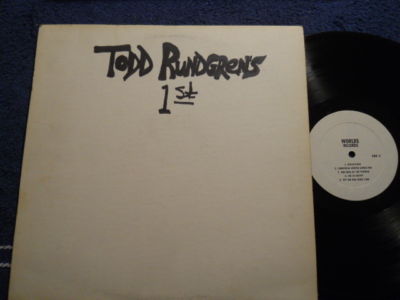
TODD RUNDGREN - "Todd Rundgren's 1st" on Worlds Records (no #). I cannot find out anything about this album. As you can see it comes in a plain white jacket and someone hand wrote the title on the jacket. The label however is printed, nothing but 'Worlds Records', the song titles and Side 1 and Side 2. However, not only are the sides reversed (Side 2 as the intro at the beginning) but the song titles listed below do not correspond to the songs on the album. THE INTRO BEGINS WITH A BIT OF INSTRUMENTAL JAMMING, ABOUT 20 SECONDS, AND THEN TODD SAYS 'HI, WE'RE THE NAZZ FROM PHILADELPHIA'. After a bit more instrumental intro, the band starts into a heavy psych version of Open My Eyes. I'm not that familiar with the Nazz albums but I'm familiar enough to know that the sound and style is very different than what you hear on any of their 3 LP's. Absent is the British influence. The music for the most part is over the top hard psych with a swagger. Besides guitar licks by Todd, there's strong bass, organ and drums.
Also, even though Todd announces the name of his band at the start of the LP (side 2 as it turns out), there is no sign of crowd noise anywhere on the recording. This could have been recorded live in a studio; because the sound quality is excellent, far better than you'd get from a bootleg live recording.
THIS IS A FANTASTIC RECORDING, SUPERB EARLY EARLY NAZZ, NOT SURE IF IT'S AVAILABLE ELSEWHERE. I CAN'T GIVE YOU ANY MORE INFORMATION ABOUT THE TRACK LIST EXCEPT I'M POSITIVE THAT THE TRACKS LISTED ON THE LABEL ARE NOT THE ACTUAL SONGS ON THE ALBUM. WITHOUT A DOUBT, THIS WAS RECORDED BEFORE (FAR BEFORE?) THE NAZZ DEBUT ALBUM, MOST LIKELY IN 1967. THE SONGS PLAY LOUD AND HEAVY AND COMBINE ELEMENTS OF PSYCH AND GARAGE.
This album was purchased in Tennessee from a former radio station executive (not a d.j.) who accumulated a large and eclectic variety of records (45's and LP's) spanning the early 1960's through the 1980's. Many if not most are promotional copies and there are some real oddities and rarities in the collection. I am in the process of listing the records as time permits. The listings will appear over a period of several months.
If anyone has any information about these records or knows about this album, please let me know.
SONG TITLES AS LISTED ON THE LABEL, SIDE 1 AND 2 (#6 below is actually Open My Eyes). However, these are not the actual song titles; I am unable to identify the other songs except one track could be called "There's Only One Winner".
1. Looking Back
2. Night People
3. Shake It
4. Everybody Will Be Happy
5. In the Middle
6. Hallelujah
7. Something Worth Living For
8. The Cool of the Evening
9. I'm So Happy
10. Try Me One More Time
Cover Grade: N.A., generic cover
Labels: White and black, the words 'Todd Rundgren's First' written in pencil on the Side 1 label
ABOUT THE ARTIST:
Todd Rundgren's best-known songs -- the Carole King pastiche "I Saw the Light," the ballads "Hello, It's Me" and "Can We Still Be Friends," and the goofy novelty "Bang on the Drum All Day" -- suggest that he is a talented pop craftsman, but nothing more than that. On one level, that perception is true since he is undoubtedly a gifted pop songwriter, but at his core, Rundgren is a rock & roll maverick. Once he had a taste of success with his 1972 masterwork Something/Anything?, Rundgren chose to abandon stardom and, with it, conventional pop music. He began a course through uncharted musical territory, becoming a pioneer not only in electronic music and prog rock, but in music video, computer software, and Internet music delivery as well.
As his career wound into its third decade, Rundgren concentrated on behind-the-scenes innovations, but during the '70s and '80s he maintained a relentless work schedule. He released up to two albums a year either as a solo artist or with his band Utopia, while producing acclaimed, successful records for artists as diverse as Badfinger, Meat Loaf, Grand Funk Railroad, the New York Dolls, and XTC. Given such an extensive catalog, it's not surprising that there's a vast variety of styles within Rundgren's music -- which is either rewarding or frustrating, depending on the album. Also, more often than not, the singles from each record do not offer an accurate indication of what the remainder of the album sounds like. Such an approach severely curtailed his mass appeal, but it helped him cultivate a ferociously dedicated cult audience.
During the '70s, his records were underground favorites, and his albums continued to chart until 1991, nearly 20 years after his commercial peak. In those 20 years, Rundgren may have existed largely on the fringes of pop music, but he produced a body of work that ranks as one of the most intriguing in rock & roll. A native of Upper Darby, Pennsylvania -- a suburb of Philadelphia -- Rundgren learned how to play guitar as a child, teaching himself after his initial round of lessons ceased. As a teenager, he absorbed pop music from Motown to Liverpool and formed Money, his first band, when he was 16. Following his high-school graduation, he moved to the resort town of Wildwood, NJ, where he regularly sat in with a number of bands. Eventually, he became a member of the blues group Woody's Truck Stop, which soon became based in Philadelphia.
Rundgren stayed with the band for several months, but when the group began to move toward hippie psychedelia, he and Carson Van Osten bailed to form the Nazz in 1967. Taking their name from an obscure Yardbirds song and inspired by a variety of British Invasion groups, from the omnipresent Beatles to the cult favorites the Move, the Nazz were arguably the first Anglophiles in rock history. There had been many groups that drew inspiration from the Beatles and the Stones, but none had been so self-consciously reverent as the Nazz. Playing lead guitar and bass, respectively, Rundgren and Van Osten were joined by drummer Thom Mooney (formerly of the Munchkins) and lead vocalist/keyboardist Stewkey (born Robert Antoni). By September 1967, the group received some financial support from local record store Bartoff & Warfield, who also put them in touch with John Kurland, a record promoter who was looking for a guitar pop band. Kurland took a shine to the Nazz and signed on as their manager.
Kurland and his associate, Michael Friedman, had the Nazz sign with SGC Records -- an offshoot of Atlantic Records and Columbia-Screen Gems -- in the summer of 1968. Their debut album, Nazz, appeared in October, supported by the single "Hello, It's Me." Although the song would later become a major hit for Rundgren as a solo artist, the dirgey original version barely scraped the national charts. Despite the lack of success, the record -- particularly the Nazz's self-production of "Open My Eyes" and "Hello, It's Me" -- attracted some good notices. Taking these as a cue, the group began work on an ambitious, self-produced double album, named Fungo Bat. By the time it was released in April 1969, it was trimmed to a single album, Nazz Nazz. In the process of editing, much of Rundgren's newer, Laura Nyro-influenced material -- which he had sung himself -- was left on the shelves. Neither the management nor his bandmates gave Rundgren much encouragement to sing, nor was his new introspective direction warmly received by his colleagues. Faced with a no-win situation, Rundgren left the group not long after their summer 1969 tour. Stewkey took control of the Nazz, erased Rundgren's vocals from the album sitting in the vaults, and replaced them with his own. The result was released as Nazz 3 in 1970, but it stiffed.
Rundgren, meanwhile, became an in-house producer and engineer for former Bob Dylan manager Albert Grossman's fledgling studio and label, Bearsville Records. Around the same time, Rundgren formed a band called Runt. In reality, Runt was little more than a front for his burgeoning solo career. He played all of the instruments except drums and bass, which were usually handled by brothers Hunt and Tony Sales. Runt -- either Runt's first album or Rundgren's first solo album, depending on your point of view -- was released on Ampex Records in the fall of 1970. The album slowly earned an audience, with the single "We Gotta Get You a Woman" climbing into the Top 20 in early 1971. His modest success was enough to convince Grossman to sign Rundgren to a long-term contract with Bearsville.
Apart from a re-release of Runt, the first Rundgren album to appear on Bearsville was Runt's final record, The Ballad of Todd Rundgren, a record that was reminiscent of such melodic singer/songwriter peers as King and Nyro, yet it had a subtly bizarre sensibility and quirky sense of humor that gave it a distinctive character. As he pursued his solo career, Rundgren quickly earned a reputation as a talented producer/engineer. His first production was for American Dream, but he quickly graduated to the big leagues thanks to his association with Grossman. In 1970, he engineered the Band's Stage Fright and Jesse Winchester's acclaimed eponymous debut. These two productions set the stage for Rundgren to take the production seat that George Harrison left vacant; the result was Badfinger's Straight Up, which gave him a huge hit with "Baby Blue." It wasn't long until Rundgren had a huge hit of his own. He abandoned the Runt concept before beginning his third album, deciding to record the entire record himself.
The result was Something/Anything?, a double-album set that cemented Rundgren's reputation as a near-genius producer and gifted songwriter. Apart from the fourth side, which was constructed as a tongue-in-cheek operetta about a bar band, he played every instrument, sang every part, and produced the entire album. Hailed in the rock press as some sort of masterpiece upon its early 1972 release, it also won Rundgren a wide audience. The King tribute "I Saw the Light" reached number 16, and while its follow-up (the terrific power pop classic "Couldn't I Just Tell You") stiffed, the third single, a superior re-recording of the Nazz's semi-hit "Hello, It's Me," climbed all the way to number five. In all, Something/Anything? reached number 29 and went gold, spending nearly a full year on the charts. Stardom was handed to him with Something/Anything?, but Rundgren rejected it. He would later state that he had mastered pop songcraft and had no interest to simply repeat himself through endless recyclings of "I Saw the Light" or "Hello, It's Me." That's certainly not what he delivered with A Wizard, a True Star, his 1973 follow-up to Something/Anything? A weird sonic collage encompassing everything from psychedelia and Philly soul to Disney show tunes and vaudeville, the record may not have been an intentional move to shed his mainstream audience, but that was the ultimate effect.
As the legions of listeners who loved "Hello, It's Me" departed, Rundgren's cult following -- the fans who did consider him "a Wizard, a True Star" -- intensified. Rundgren played the role to the hilt, dyeing his hair in a rainbow of colors and turning in extravagant concert performances. His appearance may have flirted with glam or glitter, but his music was getting increasingly progressive. His next album, 1974's Todd, may have had the occasional full-fledged pop song, such as the near-hit "A Dream Goes on Forever," but it had more than its share of lengthy experimental instrumentals. This was the direction he decided to pursue and he decided he needed a full-fledged band to help him continue in the progressive direction. And so Utopia were born. Initially, the group consisted of three keyboardists (Moogy Klingman, Ralph Shuckett, and Roger Powell), a bassist (John Siegler), a percussionist (Kevin Elliman), and a drummer (John "Willie" Wilcox).
Balancing Utopia with his solo career, Rundgren became one of the most prolific artists of the decade. Released just months after Todd, Todd Rundgren's Utopia consisted of only four tracks, all of which were mainly instrumental, none of which were less than ten minutes. Rundgren continued in that direction on his next solo album, Initiation, which was released in the spring of 1975. Its radio-play hit, "Real Man," became one of his concert staples, but the true heart of the album lay in the half-hour-long synth experiment to which the entire second side was devoted. Mere months later, Utopia released Another Live, a wild live album devoted to long synth-driven instrumentals. Another Live proved to be the culmination of the synth experiments and, in some ways, the stretch of willfully difficult records Rundgren made during the mid-'70s.
He kicked off 1976 with Faithful, an album that split into original pop material and re-creations of '60s chestnuts from the Yardbirds, Bob Dylan, the Beatles, Jimi Hendrix, and the Beach Boys. His resurrection of "Good Vibrations" brought him his first Top 40 hit in three years. That year, he also revamped Utopia, stripping away two of the keyboardists (Klingman and Shuckett), as Elliman and Siegler left. Kasim Sulton joined as the new bassist. Although the new Utopia's first album, Ra, was a prog rock album by any measure, it was less overtly experimental and heavier than before. Ra was released early in February 1977 and was followed seven months later by Oops! Wrong Planet, a record that found the quartet abandoning progressive music for streamlined pop/rock, with a mainstream hard rock bent. By the time The Hermit of Mink Hollow was released in April 1978, it had been two years between Rundgren's solo albums, yet it had been six years since he had delivered an album as unabashedly pop and accessible as Hermit. On the strength of the Top 30 success of the ballad "Can We Still Be Friends," the record became a big hit, spending 26 weeks on the charts and peaking at number 36. He followed the record with the double-live album Back to the Bars, which was split between Utopia and solo material.
As his solo career received a shot in the arm, his production career reached a pinnacle of commercial success with Meat Loaf's Bat Out of Hell. The shamelessly bombastic record became an unexpected blockbuster, due in no small part to Rundgren's cinematic production. Not only did it reap financial rewards, but it also opened the doors for a variety of production gigs; over the next year, he kept extraordinarily busy, working with everyone from old friend Patti Smith (Wave) to new wave pub rocker Tom Robinson (TRB Two), as well as arena rock goofs the Tubes (Remote Control). Given that Rundgren had been releasing records at such a rapid rate throughout the '70s, it comes as a shock to note that neither he nor Utopia released an album during 1979. That's not to say he wasn't busy. Not only did he have his production work, but during 1979, Rundgren opened Utopia Video Studios, a cutting-edge video production enterprise. Utopia Video Studios' first project was a version of Gustav Holst's The Planets, a demonstration disc for video disc by RCA SelectaVision. It was a harbinger.
Throughout the next decade, Rundgren began to devote more time to technological developments than his own music. Nevertheless, the early '80s were a robust time for Rundgren -- his last great period of commercial success. He came back swinging in 1980, releasing two albums with Utopia: the shiny pop/rock opus Adventures in Utopia and the cutting Beatles parody Deface the Music. He also released "Time Heals," the first music video to combine computer graphics and live action; it would later be the second video played on MTV. The following year, he released his first solo album in three years, the spiritually inclined Healing. By this point, his relationship with Bearsville Records had become increasingly rocky. Utopia delivered one last album for the label, 1982's Swing to the Right, before departing for the fledgling Network label, releasing Utopia that same year. After completing a groundbreaking solo tour in 1982, which alternated acoustic sets with sets featuring taped backings and video backdrops, he released The Ever Popular Tortured Artist Effect. Despite the presence of a moderate novelty hit with "Bang the Drum All Day," the album didn't eclipse Healing on the charts.
As he attempted to leave Bearsville, Rundgren found himself in further record company difficulties when Network folded. Utopia then moved to Passport, yet another new record label. In 1983, after he devoted some time off to do technological work, he reconvened Utopia, which released Oblivion in 1984. Oblivion did respectably on the charts, peaking at 74, but the next year's follow-up, POV, tanked -- it reached only 161. Part of the problem was that Utopia's sound had indeed changed, but it was no longer contemporary. Following POV, Rundgren effectively pulled the plug on the group, although he would later reunite the band for an occasional tour. Rundgren's next solo album, A Cappella, featured nothing but his voice, albeit multi-tracked and sometimes processed beyond recognition. Negotiations with Bearsville held up the release of A Cappella for months. Once the deals were completed, Rundgren was finally free of Bearsville and he signed to its new parent company, Warner, which released A Cappella in September 1985. It did fairly well on the charts, but it was treated more as a novelty than a full-fledged record by both critics and fans.
Rundgren spent the next few years working on computers, as well producing. In 1986, he was hired to produce the cult British pop band XTC. Over the course of the recording sessions, tensions grew between Rundgren and the group's main songwriter, Andy Partridge, eventually spilling over into outright hostility. Nevertheless, the resulting album, Skylarking, revitalized XTC's career and Rundgren's producing career. Although he had a few high-profile gigs afterward -- such as with Bourgeois Tagg and the Psychedelic Furs -- he decided to continue with his own technological and musical endeavors. In 1989, he finally released Nearly Human, his soul-spiked follow-up to 1985's A Cappella. Staying on the charts for 11 weeks, it was Rundgren's last album to come close to a mainstream hit, thanks to the radio single "The Want of a Nail." Several songs on Nearly Human were also used in his musical score for the off-Broadway production of Joe Orton's Up Against It, which was originally the script for the unfilmed third Beatles movie.
A collection of new material recorded live, 2nd Wind, appeared in 1991. It was his final record for Warner and the last record he would make for a major label. The following year, he reunited Utopia for a tour of Japan, then he set to work on his first album for Rhino's new music division, Forward. Released under the moniker TR-I -- from this point on, he used TR-I to distinguish his technologically innovative work -- No World Order was an ambitious project. Not only was it released as a conventional CD, it was also released as an interactive CD-ROM through Philips and Electronic Arts. It certainly earned him press, but the reviews didn't lead to sales. Frustrated, he left Rhino, releasing The Individualist on ION in November 1995. Like its predecessor, the album was designed as a groundbreaking technological innovation -- this time, however, it was an enhanced CD. The Individualist earned better reviews than No World Order, particularly among computer-based publications.
During this time, he also worked as a DJ on the acclaimed syndicated radio program The Difference with Todd. The show was nominated for several awards, but its production was ceased in November 1996 due to an altered show format. He also did several television and film soundtracks, including the hit Farrelly Brothers movie Dumb and Dumber. In 1997, the fledgling Angel Records offshoot Guardian Records offered Rundgren a significant amount of money to re-record many of his hits and cult favorites as a bossa nova record. Clearly, Guardian was attempting to capitalize on the lounge fad of the mid-'90s, but Rundgren took the bait, supporting the resulting record, With a Twist, with a full-fledged tour. Prior to hitting the road in the U.S., he was one of the first Western artists to perform for the Chinese during the summer Shanghai Festival. That year saw the first release of his Up Against It songs through the Japanese label Pony Canyon. He also inked a deal to host a weekly online radio program called Music Nexus for the EnterMedia network.
In fact, the Internet became the main focus of Rundgren's career by the end of the '90s. In 1996, Rundgren launched Waking Dreams, a collective that developed creative ideas in marketable commodities. Perhaps more importantly to the music industry, Rundgren also founded PatroNet, an innovative device that lets users subscribe to music offered directly from his site -- with no record company middlemen at all. During all this, Rundgren continued to work on new music -- intending to distribute his new material a song at a time through PatroNet -- as well as write his much-delayed autobiography (despite short previews on his official website, it's yet to be published). The late '90s saw Rundgren return to the road for several different tours -- both as a solo performer and as part of Ringo Starr's All-Starr Band, as he also continued to produce other acts (Splender's Halfway Down the Sky, Bad Religion's The New America, etc.).
The emergence of numerous archival projects began to surface in the early 21st century, such as The King Biscuit Flower Hour Presents in Concert and a slew of Japanese-only rarity sets as part of the ongoing Todd Archive Series (by mid-2001, 11 different sets had been issued -- comprised of outtakes, demos, and full concerts over the years featuring Rundgren solo, Utopia, and even the Nazz), as well as a compilation of tracks that has only been available previously on his PatroNet service, titled One Long Year. In the summer of 2001, Rundgren participated in the A Walk Down Abbey Road: A Tribute to the Beatles tour, which also included Ann Wilson (Heart), John Entwistle (the Who), and Alan Parsons (the Alan Parsons Project). Three years later, Rundgren issued his first rock album in over a decade. Liars, a political-heavy concept record, was issued on Sanctuary in spring 2004. After a brief sojourn where he fronted the New Cars, Rundgren returned to the solo arena with Arena in 2008. Over the next few years, he spent some time touring, playing some of his classic albums in their entirety -- separate tours consisted of A Wizard, a True Star, Todd, and Healing -- and in 2011, he released two albums: a collection of Robert Johnson covers called Todd Rundgren's Johnson and (Re)Production, where he offered electronic reworkings of songs he produced for other artists.
THE COMPLETE LIST OF SONGS ON NAZZ' THREE ALBUMS
From the website adamgosha.com
List of All Songs in Collection by Nazz and Nazz Nazz
Back of Your Mind (03:47) from the title Nazz.
A Beautiful Song (11:37) from the title Nazz Nazz.
Crowded (02:20) from the title Nazz.
Crowded (Demo) (02:46) from the title Nazz.
Featherbedding Lover (02:58) from the title Nazz Nazz.
Forget All About It (03:31) from the title Nazz Nazz.
Gonna Cry Today (03:20) from the title Nazz Nazz.
Hang On Paul (02:50) from the title Nazz Nazz.
Hello It's Me (03:57) from the title Nazz.
Hello It's Me (Demo) (03:48) from the title Nazz.
Hello It's Me (Mono Single Mix) (04:03) from the title Nazz.
If That's the Way You Feel (04:49) from the title Nazz.
Kiddie Boy (03:28) from the title Nazz Nazz.
Lemming Song (04:26) from the title Nazz.
Lemming Song (Demo) (04:01) from the title Nazz.
Letters Don't Count (03:30) from the title Nazz Nazz.
Magic Me (Pre-LP Audition Tape) (02:44) from the title Nazz.
Meridian Leeward (03:41) from the title Nazz Nazz.
The Nazz Are Blue (Live) (03:44) from the title Nazz.
Nazz Radio Commercials (03:00) from the title Nazz.
Not Wrong Long (02:29) from the title Nazz Nazz.
Open My Eyes (02:45) from the title Nazz.
Open My Eyes (Non-Phased Demo) (02:37) from the title Nazz.
Open My Eyes (Mono Single) (02:45) from the title Nazz.
Rain Rider (03:56) from the title Nazz Nazz.
See What You Can Be (03:00) from the title Nazz.
See What You Can Be (Pre-LP Audition Tape) (02:50) from the title Nazz.
She's Goin' Down (05:03) from the title Nazz.
Train Kept A Rollin' (Album Out-Take) (03:19) from the title Nazz.
Under the Ice (05:31) from the title Nazz Nazz.
When I Get My Plane (03:08) from the title Nazz.
Why Is It Me (Early Version of "Lemming Song") (03:07) by Woody's Truck Stop from the title Nazz.
Wildwood Blues (04:38) from the title Nazz.
>>>>>>>>>>>>>>>>>>>>>>>>>>>>>>>>>>>>
SONGS FROM NAZZ III
Tracks
Title Composer Time1 Some People Rundgren 3:38
2 Only One Winner Rundgren 3:02
3 Kicks Mann, Weil 3:47
4 Resolution Rundgren 2:40
5 It's Not That Easy Rundgren 2:36
6 Old Time Lovemaking Rundgren 2:24
7 Magic Me Rundgren 3:04
8 Loosen Up Antoni, Mooney, Rundgren, VanOsten 1:24
9 Take the Hand Rundgren 2:15
10 How Can You Call That Beautiful Rundgren 3:39
11 Plenty of Lovin' Van Osten 3:43
12 Christopher Columbus VanOsten 3:20
13 You Are My Window Rundgren 6:00
All of my records are shipped in sturdy cardboard LP or 45 rpm mailers with appropriate padding (heavy cardboard fillers or bubble wrap or "peanuts" or some combination thereof". With the exception of sealed LP's, all LP's are removed from their outer sleeves to prevent seam splitting. Upon request, I will give your sealed LP's the same treatment. (once an LP is shipped sealed, it cannot be returned once opened).
All records are carefully graded. In an attempt to give customers an accurate impression of condition rather than adhere to somewhat arbitrary criteria, I give an "overall presentation" grade, supplemented when necessary with additional remarks. Please refer to my grading system below for a more detailed explanation.
MY GRADING SYSTEMS: I’ve been told that I grade conservatively. My NM (near mint) is my highest grade for opened records (which would also include unplayed records). It’s a 9 or 10 on a 1-10 scale. M- would be equivalent to an 8; VG++ to a 7; VG+ to a 6; VG to a 5; VG- to a 4; G to a 3; F to a 2 and P to a 1. The same scale applies when I grade covers (jackets). Significant defects are specifically noted and taken into consideration in the grade.
GRADING DESCRIPTIONS
RECORDS:
- GRADING is based on the following criteria
- Sealed = store stock new
- Near Mint = like new or near new with only one or two small insignificant defects, a 9 or better on a 1-10 scale
- Near Mint Minus = very nice. Would be Near Mint, except for a couple of light hairlines or scuffs, which do not affect play
- VG++ = still a very nice record with all or nearly all of its original gloss but may have a few more light, surface marks, hairlines, needle tracks or the like which should not materially effect play
- VG+ = a nice, but used record that may have a series of light scuffs or scratches. It probably plays with a few pops, but has no serious problems.
- VG = a well-used record that still should sound OK when played, but may have moderate surface noise, pops, etc.
- VG- = a well-worn record that plays through without skipping, but will do until a better copy comes along.
- Good = not actually good at all but probably will play through but with much in the way of surface noise, pops, crackles, etc. Still, will have no cracks, chips or the like
- Fair = you’re getting this record just to own but not to play
- Poor = the sky’s the limit, generally I will discard a record this bad (and sell the cover, jacket or sleeve alone) unless the label holds some particular interest
VISUAL GRADING: All records are visually graded only unless I state that they are play-graded. Some major labels were pressed on better quality vinyl and will sound better than a record which visually appears the same on "budget" labels which were pressed on lower quality vinyl. Recording techniques also varied. The sound on live albums may be far inferior to studio recordings. There may also be defects in the pressing which are invisible. The point is that an album on a high quality label that was visually graded VG+ may sound better than an album on a budget label that was visually graded Mint- or even Near Mint. Please refer to my return policy, below. But please don’t be shocked if a record visually graded Near Mint doesn’t sound state of the art. If I base my grade on a PLAY GRADE, I will state this specifically in my grading section.
COVERS: There are really too many possible defects regarding covers to be as specific in my definitions as I had been with my record grades. But please keep in mind these general grading guidelines:
- I will give greater weight to the condition of the front cover than back cover when assigning an overall grade
- No cover with a cut out hole or saw mark will be graded Near Mint even if it is still in factory shrink and there is no other wear
- I will not reduce the grade of a cover for stickers which are glued to the jacket by the record company (eg. Contains the hit song Expressway to Your Heart); but will reduce the grade for stickers glued on the cover by stores, previous owners, etc.
- If I write that a cover has a bb hole, I’m talking about a small cut out hole
- A saw mark is a narrow cut in the perimeter of the cover, could be anywhere and vary in length from 1/2” to 2” at the most.
- The overall grade takes into consideration any stated defects. For example, if I grade a cover VG+ and then state it has 6” top and bottom seam splits - I’ve already reduced the grade because of the seam splits. If the seams weren’t split, the cover would be graded higher such as VG++ or Mint-.
Shipping Costs: CURRENT SHIPPING RATES AND POLICIES.
The winning bidder pays for shipping.
DOMESTIC SHIPPING WITHIN THE UNITED STATES: Due to increase in postage rates, I had sometimes been losing money on shipping as I send all records in sturdy professional Bags Unlimited mailers with one or more fillers. Therefore, I am now using the eBay postage calculator to determine postage. This will also result in a more equitable charge for priority mail shipments. Instead of a flat fee, those who live in the southeast and mid-east will reap the benefit of reduced priority mail rates.
DOMESTIC AND INTERNATIONAL SHIPMENTS: COMBINED SHIPPING - Save money when I mail 2 or more records in the same package. Please wait until I send you an invoice or request an invoice when combining two or more records or cd's in one shipment -prior to making payment.
INTERNATIONAL SHIPMENTS: Overseas customers are encouraged to bid. As with U.S. shipments, I will use eBay's postage calculator for all overseas shipments.
Postage to Canada is substantially less than to other countries - if you live in Canada and don't see a separate rate for Canada , please e-mail me and I'll modify the invoice to reflect the lower shipping charges. Surface mail is no longer available for overseas. Express Mail International and Priority Mail International are available - rates are substantially higher than first class international and will be quoted for each purchase if buyer requests this service. Express Mail International or Registered mail is now required for purchases over $100. Generally, Express International costs $35 for 1 album and additional albums are about $5-6 more. Registered costs about $26 for 1 album, about $5 more for each additional album. Registered mail may not be available to certain countries. I am sorry but the increased risks and costs must be passed on to the international buyer. On the bright side of things, Express Mail International will get you the package faster and it is safer. Registered mail is the safest form of shipment (but not as fast as express mail international). So there are benefits to the buyer as well as the seller. Please wait until I send you an invoice or request an invoice when combining two or more records or cd's in one shipment -prior to making payment.
Please check out my other eBay auctions and stores listings.
I’ve been listing all types of records - mostly LP’s - including 50’s and 60’s rock ‘n’ roll, country, folk jazz, blues, personalities, new wave and punk, surf, psych, spoken word, comedy, etc., etc....... I try to list unusual, unique or obscure records, not the ones that you see all the time. While a majority of my listings are albums, you’ll often find a nice selection of 45’s, EP’s or picture sleeves...and an occasional 78 or two.
My return policy: . You may return an item if it's not in the conditon described. You may not return items if you decide you don't like the music. I will return the base price of the item unless I make an error in shipment such as sending you the wrong record or cd. In that case, you will be reimbursed for the cost of the item and shipping both ways. In addition, the item must be returned in its original condition , i.e. the way it was shipped when it left my hands. While a very high percentage of my records arrive safe and sound (I use professional mailers and a filler or two, more for 78’s), they occasionally are damaged in transit. If that happens, I won’t accept the return of the record or other item.
Sealed Records: After a sealed record is paid for, I will gladly open it before mailing to make sure that the record is new & unplayed. If the record is not, I will give a full refund. Even though it is easy to spot most resealed records from the 50's and 60's [I will mention that in the desription if it looks like a possibility], not all records from the 70's & 80's are quite as obvious. Please ask for any details about the seal of a particular record & I will be happy to answer.
price rating