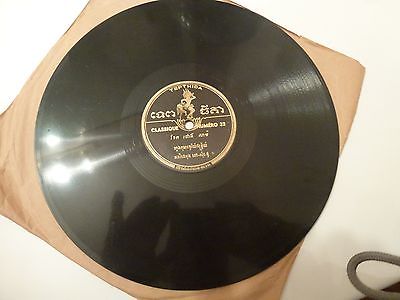
CAMBODIA 78 RPM SAMBA SLOW FOX TEPTHIDA NO.31 32
$
50


Favourite Auctions
To save auctions to your favourites, please login
If you don't have an account, please register
Description
You are bidding on a CAMBODIA 78 RPM on the Tepthida label No.132/133
I don't know what the title is other than the inscription that one side is a slow fox and other is a samba
Visually shellac is a very glossy near mint but there are some manufacturing heat marks ( does not affect play)
Very unique small label form 100+ years ago.
Buyer pays $12 shipping to the US or $20 overseas by airmail.
Some info on music from Cambodia
Traditional Cambodian music dates back as far as the Khmer Empire.[150] Royal dances like the Apsara Dance are icons of the Cambodian culture as are the Mahori ensembles that accompany them. More rural forms of music include Chapei and A Yai. The former is popular among the older generation and is most often a solo performance of a man plucking a Cambodian guitar (chapei) in between a cappella verses. The lyrics usually have moral or religious theme.
A Yai can be performed solo or by a man and woman and is often comedic in nature. It is a form of lyrical poetry, often full of double entendres, that can be either scripted or completely impromptu and ad-libbed. When sung by a duo, the man and women take turns, "answering" the other's verse or posing riddles for the other to solve, with short instrumental breaks in between verses. Pleng kaah (lit. "wedding music") is a set of traditional music and songs played both for entertainment and as accompaniment for the various ceremonial parts of a traditional, days-long Khmer wedding.
Cambodian popular music is performed with western style instruments or a mixture of traditional and western instruments. Dance music is composed in particular styles for social dances. The music of crooner Sinn Sisamouth and Ros Sereysothea from the 1960s to the 1970s is considered to be the classic pop music of Cambodia. During the Khmer Rouge Revolution, many classic and popular singers of the 1960s and 1970s were murdered, starved to death, or overwork to death by the Khmer Rouge.[151] and many original master tapes from the period were lost or destroyed.
DO NOT USE THE EBAY CHECKOUT AS IT IS INCORRECT AND WAIT FOR MY INVOICE.price rating