Bob Dylan & Johnny Cash – Nashville 1969 Outtakes NM- LP Rare
$
103


Favourite Auctions
To save auctions to your favourites, please login
If you don't have an account, please register
Description
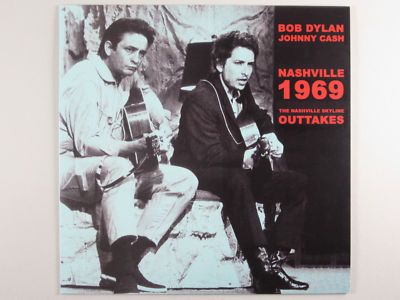
Bob Dylan & Johnny Cash – Nashville 1969 Outtakes
Clarke Sisters Records CS-17
No release date to be found, but I think I bought this record new about 10 years ago and have only played it once or twice.
These are all studio quality outtakes from Dylan’s 1969 record “Nashville Skyline”, although most of the songs are Johnny Cash songs or other traditional or country songs except for the three Dylan songs: “One Too Many Mornings”, “That’s Alright Mama” and “Girl from the North Country”. Both Johnny and Dylan sing on all songs and play guitars. They are also joined by Carl Perkins playing electric guitar on several songs along with Bob Wotton – guitar, Marshall Grant – bass and W.S. Holland – drums. Even though they are outtakes, they play complete songs here and sound like they had a lot of fun playing together. It’s a great record and they actually sound pretty good together. Carl Perkin’s guitar sounds great too!
It was recorded on Feb. 17-18, 1969 at Columbia Studios in Nashville.
Side 1 One Too Many Mornings
Mountain Dew
I Still Miss Someone
Careless Love
Matchbox
That’s Alright Mama
Big River
Side 2 Girl from the North Country
I Walk the Line
You Are My Sunshine
Ring of Fire
Guess Things Happen That Way
Just A Closer Walk with Thee
Blue Yodel No. 1
Blue Yodel No. 5
Record NM- The vinyl looks and sounds like new. There are a couple of very light inner-sleeve marks that make no noise at all. A very clean record.
Cover NM- The cover pretty much looks like new except for a couple of very shallow, surface scrapes on the front that are barely noticeable.
_____________________________________________________________________________________________________________________________________
All of my photos are of the actual item being sold. I do not use stock photos.
All of the records I sell are from my own personal collection.
I've kept all of my records in plastic sleeves to protect the covers and have a smoke-free home.
I have many Blues, Jazz, World, Bluegrass, Folk, Gospel, Rock, New Age, Spoken Word and other genre's that I will be listing in the near future from my collection that I have put together over the past 30 years.
My grading of the condition is based on Goldmine's system and I have been selective as to the quality of the records I've purchased.
I will be conservative in my assessment of condition and will try to be thorough in explaining and illustrating any defects or condition issues in my listings.
I will also try and not only visually grade the records, but play-grade them as well so that you can be as informed as possible about condition before bidding.
Shipping charges are: U.S. Postal Service Media Mail $4.00, anywhere in the U.S.
U.S. Postal Service Priority Mail - This rate varies depending on where you live. Please ask if you are interested in this service.
This includes delivery confirmation and shipping/handling costs.
Additional records will cost $1.00 each if shipped in the same box.
All records will be well packaged in quality custom record boxes with new cardboard pads and new bubble wrap for extra protection.
I am only accepting payment through PayPal at this time
I will accept returns up to 7 days with the buyer paying for return shipping.
If there are any problems, please contact me before returning an item or before leaving feedback so that we can try to resolve the situation first.
Feedback would be greatly appreciated and I will also leave feedback for you.
If you have any questions about this record, please contact me. Thank you for your interest!
My Vinyl Grading System Based on Goldmine’s Standards
Although I grade my records visually, I will attempt, as much as I can to also let the buyer know if the recording was from a less than quality source. I make no guarantees of this, but I will try, for example to mention if a 33 1/3 RPM record was recorded from older 1930’s 78 RPM discs, and even though the vinyl looks like new, it sounds like it is very scratchy with lots of surface noise. Also, some live recordings are really lacking in sound quality and I will try to mention this also. I want you to be happy with your purchase and to know as much as possible about what you are bidding on.
I keep my records and stylus clean, replace the stylus when it gets worn and only handle my records by the edges, which also means not ever touching the trail-in vinyl.
M (Mint) I don’t use this description in my listings. I feel that the only records that should be called Mint are SS (Still Sealed) records, in which case I will call them SS.
NM (Near Mint) I reserve this description for records that I personally purchased new and after opening, only played them once or twice and they still look new.
NM- (Near Mint Minus) These are records that are in nearly perfect condition with the exception of a light sleeve scuff, which doesn’t affect sound quality.
VG++ (Very Good Plus Plus) I use this to describe a record that was very well taken care of, has no noticeable condition issues aside from a few sleeve scuffs or very light surface scratches that don’t have much affect on sound quality.
VG+ (Very Good Plus) This would describe a record which had still been taken good care of, but which has some light audible surface noise throughout record or occasional clicks, but nothing that takes away from the listening experience. The record will still have most of its original luster and have only minimal light surface scratches if held to a bright light.
VG (Very Good) A record that has seen a fair amount of play and therefor has lost some of its original luster and has more noticeable surface noise. I don’t sell records with warps or scratches that cause any skipping.
VG- (Very Good Minus) This would be a record that has a lot of wear and has enough scratches or overly worn grooves to hear very noticeable noise throughout the music. Still a playable and enjoyable record to listen to though. No skips at all and no noise that completely overwhelms the music.
G (Good) Not Good! I don’t have many records that I would list for sale that are in this condition. It would be a record that is basically trashed (but still doesn’t skip) and probably has lots of scuffs, scratches and/or a record which has lost most of its surface luster. There are some records though, that due to their rarity, someone might want a copy in this condition, as opposed to no copy of it at all. This is a record that could still be played and the music could still be listened to if one could tune out the noise and pops that were competing with the music.
Record Covers – Along with grading, I will try to describe and photograph any major defects of covers such as bent corners, water stains, split seams and ringwear. I have always kept all my records in plastic sleeves to protect them, have never smoked and have kept them vertical in record bins which I built and keep in the house.
Final thought on vinyl quality: Many older records which were pressed in the 50’s for example, have deeper grooves and therefore can sound much better than they look, since surface scratches often do not go deep enough to affect where the stylus is riding in the groove of those records. Also, in turn, many records that were pressed in the 80’s were made with inferior vinyl and have shallow grooves that didn’t even sound clean when they were brand new. Of course this is a bit of a generalization, because there were still some poor quality pressings in the 50’s and some good quality pressings more recently. That said, the label name of a record is also equally important to keep in mind. For example, older Verve records from the 50’s and 60’s are usually very quality pressings compared to a label like Crown from the 60’s which were often not of very good quality. Also, any record, even a brand new freshly opened record can have some light clicks caused by static electricity or even manufacturing issues.
Some of my descriptive terms and what they mean:
On the Vinyl:
Surface scratch – A thin scratch that does not go deep enough into the groove to cause significant, if any noise. Some folks call these spider web scratches since they kind of look like spider webs.
Sleeve mark – A slightly dulled looking mark to part of an otherwise shiny, lustrous looking vinyl surface that is cause either by the edge of the inner sleeve scraping against the vinyl on the way out of or into the inner sleeve, OR, more commonly, the inner sleeve had a wrinkle or a fold in it, usually coming that way from the factory and this wrinkle, being pressed against the vinyl surface for long periods of time, leaves an impression of the wrinkle permanently in the vinyl surface. Rarely do either of these sleeve marks affect the sound quality of the record, since they are just on the very top surface of the vinyl, well above the part of the grooves where the stylus makes contact.
Scuff type scratch – A scratch that is wider than a surface scratch and is usually caused by the record grazing something like the corner of a table or something wider coming into contact with the vinyl. Sometimes these make no difference to sound quality and sometimes they cause a huge problem with sound quality. If I list a record that has one of these types of scratches, I will always listen to it carefully and explain whether there are any sound issues due to this damage or not.
Surface noise – Generally when I use this term, I am referring to light noise that is not louder than the music and often can only be heard in the quiet places between the tracks. It is noise that if it can be heard during the music, it does not overpower or take away from the listening experience.
Clicks and pops – A click is usually not very loud and although it can be heard during the music, it does not distract from the music. A pop is much louder than a click and is usually even louder than the music and therefore can be distracting. Generally, a pop is caused by a deep scratch and if I use this term, I will try to explain how many revolutions of the record or how many minutes this noise can be heard for. Clicks are usually more isolated with no visible reason why they occur, therefore I will often say that “a click can be heard here or there”, since they are more random in that way.
Vinyl luster – A new record will have a clean shininess to it that if well taken care of, can last a long time. As a record gets more and more play, this luster begins to dull as the grooves get more worn. Although sometimes, even a brand new record can have variances to the new luster look if the inner sleeve is wrinkled when the record is packed at the factory.(please see explanation of this above in “sleeve marks”).
*Please Note: Except for very few instances (if a record is incredibly rare, for example) I will never list a record that has a known skip. This would be a skip caused by a scratch or warp. Although sometimes a record can have a very minor warp that does not affect play and I will always mention this defect if I am aware of it. That said, I have a bit of advice for handling records. Occasionally when playing a record, you may encounter a skip where there is no obvious sign of a defect or scratch. Almost every time this happens, (and really almost any time a record does actually skip or get stuck in one spot every time it goes around) I have found that it is due to some tiny particle that has gotten stuck on the surface of the vinyl. It happens. Should you ever experience this, the best thing I've found to do is to carefully watch for the exact spot that the skip is occurring as the record spins on the turntable, take the record off the turntable, and look closely under a bright light. Likely you will see a very tiny piece of something stuck there. What I do, in this situation, is with a very clean fingernail, just lightly scrape the particle off without pushing it deeper into the groove. Since it is usually just on the surface, this will likely fix the problem and the record will no longer skip or get stuck in the same spot. Unfortunately, if the particle went deeper into the grooves, there may be a pop in that spot, but it still should not skip anymore. Often, this problem is caused by a tiny food particle flying out of a person’s mouth and onto the record’s surface because they are talking while holding the record in front of their face or talking while hovering over the turntable, which is why I try not to talk while handling my records.
On the Cover:
Split seam – If there is even a hint of a split seam I will explain how large it is and where it is located.
Ring-wear – This being caused by the record pressing against the cover from the inside and rubbing against neighboring records causing the ink and surface of the cover to get worn down in a circular pattern that mirrors the shape of the record. Since I keep all my record covers in plastic outer sleeves, I have minimized this to some extent, but yet, this is damage that over time is unavoidable and also, since many of my records were ones that I purchased used, this is a common problem with covers. I will always explain any visible ring wear. Occasionally I will have a record that has a thinner cover (most commonly imports), and although there is no “ring-wear” to speak of, there is an impression of the edges of the enclosed record that can be seen on the cover. I will explain this also, but since there is no wear to the color of the ink and no ink is worn away from the cover, it is not really the same as “ring-wear”.
Dents – I usually will use this in reference to the corners being somewhat smashed down so that they are no longer square and pointed.
Bends – This is generally in reference to the edges where they got bent from not being handled carefully and it leaves a permanent fold mark, often affecting the cover’s ink along that fold, leaving a small white line where the ink has worn away from the bent spot.
Cut-out – When records were being sold new by record stores, the ones that didn’t sell well or that were being discontinued, often were made into “cut-outs”. In order to differentiate these from the other records, the covers usually would have either a hole punched in a corner by an awl (ice pick-like tool) or a regular hole punch. Sometimes the cover would have a cut mark in it like it was made with a saw or something, usually about a half inch long and often in the spine. It doesn’t mean it was a bad record or that anything was wrong with it, it’s just one that they wanted to discount to get rid of and make room for newer releases most of the time.
My descriptions of covers and their flaws are not limited to these terms, but any other explanations will be clear and detailed in the listings.
I hope this helps, but if you have any specific questions of the quality or condition of any of my records, please feel free to ask.
price rating