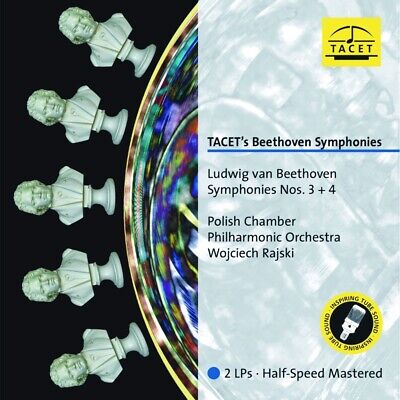
Beethoven: Symphonies Nos. 3 & 4 (2x LP 180g)
€
25
$
28


Favourite Auctions
To save auctions to your favourites, please login
If you don't have an account, please register
Description
Beethoven: Symphonies Nos. 3 & 4 (2x LP 180g)
Often cited as a tonal example of his “new path", Beethoven’s Third Symphony allows several possible explanations for its revolutionary character. To describe the work as a tonal picture of heroism, romantic revolution and its initial dedicatee Napoleon Bonaparte is quite legitimate, considering its Marche funèbre, which is often played in France to commemorate the dead. No less exciting from a compositional aspect is the new way in which the thematic material is used, whereby it is gradually massed together, magnifying its unbounded energy until the regular beat completely disintegrates. An orchestral dialogue breaks out in a fast tempo, rather like a sinewy, light athletics competition - there is a tightness, a broadening and concentration of orchestral resplendency and musical material. Composed in the time between the Third and the weighty Fifth, the Fourth Symphony, with its classical form, is like a haven of tranquility between the contrasting emotions of her two disparate sister works. Drawn along by the romantic expressiveness of the weightless opening which feels its way towards safety as it were, the music of the first movement soars upwards to sanguine elation. In true tradition of the genre, the second movement is simply entitled Adagio. Here the rich and melodic music is reduced down to a diminished ensemble with chamber-music-like transparency. Full of good humour and buoyancy, the effervescent Finale storms ahead via short contemplative passages and surges upwards to new heights of orchestral fury. Wojciech Raisky, who always demands a highly cultivated sound and finely balanced phrasing from his orchestra, delves into the depths of the score to create a cheerful, contemplative yet very impressive interpretation, which reveals - even after several listenings - a wealth of previously unheard details. Halfspeed mastered! Beethovens Dritte, die mit Vorliebe als klingendes Beispiel für seinen ‚neuen Weg‘ genannt wird, lässt gleich mehrere Erklärungsansätze für ihren revolutionären Charakter zu. Das Werk als tönendes Bild, um Heldentum, Revolutionsromantik und seinen anfänglichen Widmungsträger Napoleon Bonaparte zu goutieren, ist anhand des „Marcia Funebre“, einer in Frankreich verbreiteten Totenehrung mindestens legitim. Nicht weniger erregend in satztechnischer Hinsicht erscheint der neue Umgang mit dem thematischen Material, das sich allmählich zusammenballt und seine unbändige Energie bis zur völligen Auflösung der Taktordnung steigert. Unter hohem Tempo entbrennt ein orchestrales Miteinander in sehnigem, leichtathletischen Wettkampf, ein Engen, Weiten und Verdichten von orchestralem Glanz und musikalischem Material. Entstanden in der Zeit zwischen der Dritten und der wuchtigen fünften Sinfonie, birgt die vierte in ihrer klassizistisch abgerundeten Formensprache den Ruhepol zu den extremen Affekten ihrer ungleichen Schwestern. Geleitet von romantischer Ausdruckskraft der schwerelosen, nach Halt tastenden Eröffnung schwingt sich die Musik im Kopfsatz zu sanguinischer Hochstimmung auf. Der zweite Satz, gemäß Gattungstradition schlicht als Adagio bezeichnet, verschlankt die reiche melodiöse Gestalt in verkleinerter Besetzung zu kammermusikalischer Durchsichtigkeit. Wohl gelaunt wie bestens gestimmt stürmt das brausende Finale voran und steuert über kurze besinnliche Phasen empor zu neuen Gipfeln orchestralen Furors. Wojciech Raisky, der seinen Philharmonikern stets hochkultivierte Tongebung und fein austarierte Phrasierungen abverlangt, modelliert aus den Tiefen der Partitur eine heitere, beschauliche und doch tief eindrucksvolle Wiedergabe, die auch nach mehrmaligem Hören unerhörte Details offenbart. Halfspeed-Überspielung!Beethoven: Symphonies Nos. 3 & 4 (2x LP 180g)
Often cited as a tonal example of his “new path", Beethoven’s Third Symphony allows several possible explanations for its revolutionary character. To describe the work as a tonal picture of heroism, romantic revolution and its initial dedicatee Napoleon Bonaparte is quite legitimate, considering its Marche funèbre, which is often played in France to commemorate the dead. No less exciting from a compositional aspect is the new way in which the thematic material is uséd, whereby it is gradually massed together, magnifying its unbounded energy until the regular beat completely disintegrates. An orchestral dialogue breaks out in a fast tempo, rather like a sinewy, light athletics competition - there is a tightness, a broadening and concentration of orchestral resplendency and musical material. Composed in the time between the Third and the weighty Fifth, the Fourth Symphony, with its classical form, is like a haven of tranquility between the contrasting emotions of her two disparate sister works. Drawn along by the romantic expressiveness of the weightless opening which feels its way towards safety as it were, the music of the first movement soars upwards to sanguine elation. In true tradition of the genre, the second movement is simply entitled Adagio. Here the rich and melodic music is reduced down to a diminished ensemble with chamber-music-like transparency. Full of good humour and buoyancy, the effervescent Finale storms ahead via short contemplative passages and surges upwards to new heights of orchestral fury. Wojciech Raisky, who always demands a highly cultivated sound and finely balanced phrasing from his orchestra, delves into the depths of the score to create a cheerful, contemplative yet very impressive interpretation, which reveals - even after several listenings - a wealth of previously unheard details. Halfspeed mastered!
Beethovens Dritte, die mit Vorliebe als klingendes Beispiel für seinen ‚neuen Weg‘ genannt wird, lässt gleich mehrere Erklärungsansätze für ihren revolutionären Charakter zu. Das Werk als tönendes Bild, um Heldentum, Revolutionsromantik und seinen anfänglichen Widmungsträger Napoleon Bonaparte zu goutieren, ist anhand des „Marcia Funebre“, einer in Frankreich verbreiteten Totenehrung mindestens legitim. Nicht weniger erregend in satztechnischer Hinsicht erscheint der neue Umgang mit dem thematischen Material, das sich allmählich zusammenballt und seine unbändige Energie bis zur völligen Auflösung der Taktordnung steigert. Unter hohem Tempo entbrennt ein orchestrales Miteinander in sehnigem, leichtathletischen Wettkampf, ein Engen, Weiten und Verdichten von orchestralem Glanz und musikalischem Material. Entstanden in der Zeit zwischen der Dritten und der wuchtigen fünften Sinfonie, birgt die vierte in ihrer klassizistisch abgerundeten Formensprache den Ruhepol zu den extremen Affekten ihrer ungleichen Schwestern. Geleitet von romantischer Ausdruckskraft der schwerelosen, nach Halt tastenden Eröffnung schwingt sich die Musik im Kopfsatz zu sanguinischer Hochstimmung auf. Der zweite Satz, gemäß Gattungstradition schlicht als Adagio bezeichnet, verschlankt die reiche melodiöse Gestalt in verkleinerter Besetzung zu kammermusikalischer Durchsichtigkeit. Wohl gelaunt wie bestens gestimmt stürmt das brausende Finale voran und steuert über kurze besinnliche Phasen empor zu neuen Gipfeln orchestralen Furors. Wojciech Raisky, der seinen Philharmonikern stets hochkultivierte Tongebung und fein austarierte Phrasierungen abverlangt, modelliert aus den Tiefen der Partitur eine heitere, beschauliche und doch tief eindrucksvolle Wiedergabe, die auch nach mehrmaligem Hören unerhörte Details offenbart. Halfspeed-Überspielung!
×Buy now and save! Tell a friend Visit store Watch now
Postage info
Click the Postage tab above the listing description for more info
Click the Postage tab above the listing description for more info!
Additional delivery notes
PICK UP OPTION
Sorry, our items are NOT available for pick-up.
PAYING VIA PAYPAL
We accept PayPal on our all our items so you can shop with confidence.
Simple choose the PayPal option when proceeding through the checkout.
Paying via Direct Deposit
Simply add the freight cost to the item cost and forward the total amount to the address to be provided following your purchase.
Additional Information
No additional information at this time
Ask seller a question
You might also like
Audio Developments AD146 - 12 balanced transformer inputs mixing console - renov Darklab Trident to AEG Hub Adapter Mahler: Symphonie No.6, Wiener Philharmoniker, Conducted by Pierre Boulez (Hybri Chopin: Études Op.10 & Op.25, Maurizio Pollini, Piano (Hybrid SACD) ContactTo contact our Customer Service Team, simply click the button here and our Customer Service team will be happy to assist.
Ask seller a question
© Sepea Audio
PostageClick the Postage tab above the listing description for more info
PaymentAccepted Payment Methods
- PayPal
- Direct Deposit
Returns are not accepted
Buyer will pay for return shipping.
eBay integration byprice rating


