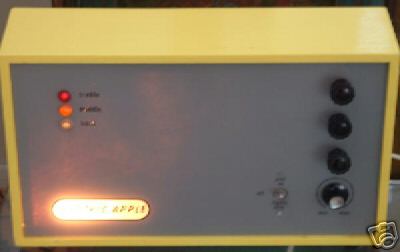
Beatles Apple (one of only four prototypes) Light Box
£
505
$
669


Favourite Auctions
To save auctions to your favourites, please login
If you don't have an account, please register
Description
This is one of the most rare items of Apple memorabilia. John Lennon befriended Alex Mardas, who sold himself to John as being an electronics genius. John promptly made him head of Apple electronics. Alex or 'Magic Alex' as John nicknamed him, suggested that he could make a better studio than Abbey Road, much to George Martin's annoyance. After spending considerable time and money, The Beatles ventures in to the new studio in the basement of the Saville Row Apple building and discovered that all that Alex had done was half-build a mixing desk and place tiny speakers all over the room. He was fired by Alen Klein.
Magic Alex had been working on a sound to light converter, which was supposed to be mass-produced and form the front-line of the Apple electonics range. Alex made four hand-made prototypes, which the Beatles inspected before allowing them to go to production. Alex made lots of gadgets for John and John was so impressed with these that he bestowed money and gifts on him. Unfortunately, none of Alex's inventions made it past the prototype stage and so unlike Apple dartboards, wrist watches, paper weights, dresses, suits etc. which were made in quantity, Apple Electronics failed to produce anything on mass and the four prototype sound to light converters are the only thing that remains of the Apple Electronics era.
There are photographs of John and George, with one of the prototypes but unfortunatley I don't have copies of these.
If you do a search on Magic Alex in Wikapedia (not sure of spelling) then it describes the Magic Alex era.
Please view this website, which describes in more detail the Magic Alex era and mentions the Electric Apple as well as the Nothing Box.
Click here -Alex's History
Alex’s first project was a box filled with flashing lights, covered in a transparent membrane. They called it a “psychedelic light box” – a brand-new idea at the time – and sold it to the Rolling Stones, who immediately added it to their act. (The Love You Make, p. 205)
One day, when Alex brought John a plastic box filled with Christmas tree lights that did nothing but blink on and off randomly until the battery ran down and the thing blinked itself to death, John was thrilled. It was the best gift an LSD freak could want. In thanks, John elevated him to the royal circle as the Beatles’ court sorcerer and dubbed him “Magic Alex.” (The Love You Make, p. 206)
Alex didn’t need to convince the Beatles that his gadgets had some practical value. He brought them an electric apple which pulsated light and music and a “nothing-box” which had twelve lights, ran for five years, and, as its name suggests, did exactly nothing. The Beatles were mightily impressed and turned out their wallets. None of the devices produced by Alex for Apple ever reached the marketplace. The patents lie in a drawer at the London office, waiting for Allen Klein to decide what to do with them. The funding of Alex only accelerated the tremendous spending of Beatle money already underway. (Apple To The Core, p. 87)
Often he [John Lennon] would stare at the blinking “nothing box” Alex had presented to him or at the walls and shadows until the drugs wore off. (The Love You Make, p. 211)
Magic Alex, in turn, bestowed on John an assortment of original novelties, such as the “nothing box” that John liked to stare at for hours on end, trying to predict which of the flashing red lights would wink on next. (John Lennon In My Life, p. 119)
Alexis Mardas was an inventor of electronic gadgets. He invented the “nothing box” at which John would gaze for hours, trying to guess which of the series of red lights would flash on next. (Shout!, p. 316)
One night, several weekends after my first encounter with Alex, John and I were sitting up together when it suddenly occurred to him that the following day was the Greek’s birthday. Though John rarely went out of his way to acknowledge such occasions, his esteem for Alex was such that this particular birthday proved the exception to the rule. “F*** me,” he said. “Magic Alex is coming round tomorrow, and I haven’t even got anything for him. What can I give him, Pete?” “I dunno,” I said. “What sort of thing does he like?” “Well,” said John, after a moment’s thought. “He did quite fancy the Iso Griffo.” This was in reference to the magnificent Italian sports car for which John had recently paid a small fortune at the Earl’s Court Motor Show. At the time, in fact, John’s was the only Iso Griffo in all of Britain. “Let’s give him the f****** Iso, then!” he exclaimed. Without further delay, John retrieved several spools of ribbon, and beckoned me out to the driveway, where we tied the ribbons all around the Iso and crowned its roof with an enormous bow. “There’s your birthday present,” John announced casually, when Alex arrived the next morning. The birthday boy, needless to say, was suitably impressed. Magic Alex, in turn, bestowed on John an assortment of original novelties, such as the “nothing box” that John liked to stare at for hours on end, trying to predict which of the flashing red lights would wink on next. (John Lennon In My Life, p. 119)
Alex didn’t need to convince the Beatles that his gadgets had some practical value. He brought them an electric apple which pulsated light and music and a “nothing-box” which had twelve lights, ran for five years, and, as its name suggests, did exactly nothing. (Apple To The Core, p. 87)
This box will have been used by John Lennon as Alex built these units in order to impress him, however I have no proof to support this.
Two of these items have previously sold at auction for in excess of £2,000 and Record Collector magazine did an article on this a few years ago. The whereabouts of the fourth one is unknown.
This is being sold at a bargain price as a new house purchase has sapped my cash reserves.
This unit lights up as can be seen in the photograph.
Note that this item is in London and not in Hull as described above and it is advertised elsewhere so may sell before the auction end if the current bid does not exceed the fixed price sale.
Postage and packing will be at cost and insurance will be provided. This will be securely packaged. Payment cannot be accepted by Paypal unfortunately as I have decided to stop using this service. Unfortunately I don't seem to be able to remove this from this sales page. If you make the mistake of paying by Paypal then I will not be able to refund you as I'm not a member any more so please don't make this mistake! UK buyers may pay by cheque or cash. Oversees buyers can pay by cash in US dollars or sterling or by bank transfer - if paying by cash then please insure and secure the cash in the envelope On 25-Jul-07 at 20:29:57 BST, seller added the following information: I have been asked for some images of the electronics, so here they are. Anyone who knows anything about electronics will recognise the fact that there are no printed circuit boards on display here. All of the components are of sixties construction - old mylar, electrolytic and ceramic capacitors - huge components by today's standards.price rating