ACDC 1975 High Voltage Vinyl LP - Blue Roo Yellow Border - Albert Label APLP-009
A$
140
$
93


Favourite Auctions
To save auctions to your favourites, please login
If you don't have an account, please register
Description
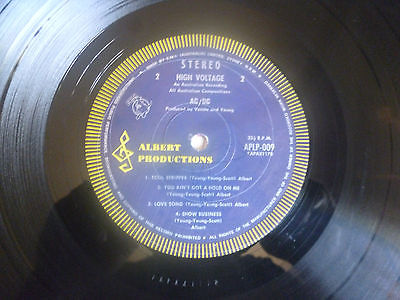
Catalog Number - APLP - 009
Run-out groove -
- Matrix / Run-out (A-side ) YAPAX1177 Stamped.
- Matrix / Run-out (B-side ) YAPAX1178 Stamped.
Released only in Australia and New Zealand in 1975, on the Albert Records Label, complete with the very rare Blue Kangaroo.
High Voltage is the first album released by the legendary Rock band - AC/DC. Bursting forth in 1974 the group started hard, and haven’t let up since!
The US version of the same name was a blend of this album and their next album – TNT.
This is one of the first AC/DC vinyl records ever pressed, and was the introduction of AC/DC to Australia, before they went on to conquer the world.
Genuine first edition - Dark blue Albert records label with yellow border AND the very elusive "Blue Roo" kangaroo.
Cover - VG
Complete and in good condition, has one split seam that can be repaired, but I will leave it to the buyer, as some prefer not to repair.
Labels - VG+
Some spindle marks, but complete and otherwise good condition.
Vinyl - NM-
Play tested and a beautiful playback with no unwanted noise at all... no snaps crackles or pops of any type, a clean, clear and crisp playback.
As good as it gets unsealed.
After all, it is always about the vinyl.
AC/DC High Voltage (1974)Produced by Harry Vanda & George Young, as were all the band's albums until Highway To Hell. .
Only two songs ("She's Got Balls," and "Little Lover") made it onto the US release of High Voltage.
"Stick Around" and "Love Song" have never been released in the USA.
THIS IS A COMMON MISTAKE CAUSED BY DODGY PUBLIC INFORMATION, SO PLEASE READ.
I would not write this if there was any chance that some rabid ACDC fans would shoot me down.
There is no chance of that, and I think most of this is news to many fans.
The misinformation on Discogs has really distorted the facts about this issue and has obviously been read by many people
The matrix number is indisputable evidence.
Dear arry_kewl,
Hi mate. FYI this is actually the second press in 1977. 1st press side 1 track 1 is credited to broonzy. 2nd press side 1 track 1 credited to joe Williams. Cheers.
Dear ------------------------?
A common mistake originating from dodgy information on Discogs.... let me explain.
The matrix numbers in the run out grooves determine the pressing, not the label.
In many cases, the label can be a reasonably reliable and quick way to identify a record, but in this case it is misleading.
Forget the label, forget the sleeve, the important numbers are the ones in the run-out grooves... actually embedded into the vinyl when it was pressed.
Reissues never share the same run-out matrix as the original pressing.
The second pressing will not have the blue kangaroo on the label... same label, but no roo.
The matrix numbers on the labels will be the same but the matrix number in the run-out groove on side one is different.
- Matrix (A-Side Label): YAPAX1177 (same)
- Matrix (B-Side Label): YAPAX1178 (same)
- Matrix (Runout groove - A-Side): YAPAX 1177-3 (this -3 is shared by both the second and third issues)
- Matrix (Runout groove - B-Side): YAPAX1178 (same)
- The second issue runout numbers are also shared by the third issue in 1980, but the original matrix numbers from the first issue were never repeated, and never will be.
- The fourth issue in 1987 has these Run-out matrix numbers that are etched and not stamped.
- Matrix / Runout (A-side etchings): APLP 009 A-5
- Matrix / Runout (B-side etchings): APLP 009 B-3
This bit about "Broonzy" has come about from some bad information on Discogs. (Discogs is a fantastic resource, but there are a lot of mistakes, and it needs to be double checked) - And always know your run-out matrix numbers.
The credit change from "Broonzy" to "Joe Williams" on the label was an acknowledgement of a mistake that was made when the labels and record sleeves were first printed.
Joe Williams wrote "Baby Please Don't Go" and it was first recorded by Joe Williams in 1935 in Chicago USA
Broonzy later recorded it 1952, but he did not write it.
ACDC Credited "Baby Please Don't Go" to "Broonzy" on both the label and the sleeve in the earliest records in this first issue, but during the pressing run, it was realized that the song "Baby Please Don't Go" was not written by "Broonzy", but was a cover of a song by "Joe Williams", written in 1935.
To acknowledge this mistake, the one label credit was updated to "Joe Williams", but the record sleeve still said "Broonzy" as it was too expensive to reprint the already printed sleeves as well.
But most importantly.
The run-out matrix numbers did not change.
I have pressings of both versions.
You will find that this version is a lot harder to get, as the early version sold a lot more copies than this one did. (I reckon about 70 to 80% of first pressings have Broonzy, and the last 20 to 30% have Williams.
A second pressing was done in 1977 and the kangaroo dropped off the label and the RUN-OUT matrix changed on side one.
See how many YAPAX1177 - Blue Roo labels with a Joe Williams credit you can find and compare it to YAPAX1177 Blue Roo "Broonzy" labels, and it will run at about 3 or 4 "Broonzy" to 1 "Joe Williams".
Discogs information is mostly correct, it is just the footnote that has been added by someone that is contradictory with the other information on Discogs.
It does not mention two pressings from 1975 in the Discogs master release page. (because there was only one)
It says - First press 1975 - Second press 1977..(which is correct)
It is the footnote that is wrong.
The footnote on Discogs is written by someone who is in the bad habit of ONLY relying on the labels to determine the issue, and not actually checking the matrix number in the run-out groove (not on the label)
He sees a different credit on one label, and has determined that there were two pressings in 1975, rather looking at why they changed the credit on the one label, and then check the run-out matrix numbers.
These numbers are a reliable identifier left in the run-out groove by the record company and gives technical ownership and credit to the sound engineer.
The second pressing was in 1977, had no kangaroo on the label and is identified by the different matrix number on the side one run-out groove. (YAPAX 1177 -3)
Reissues never share the same run-out matrix as the original pressing. This number is embedded in the actual vinyl, sometimes with accompanying messages from the sound engineer and or band / artist
You will notice that the author of the footnote does not number the pressings after the first two he claims are from 1975.
This is because it would throw the whole database out of whack, and make the 1977 second issue the third issue, and the 1981 third issue the fourth issue, and so on.
Question the motive in this "footnote" information, and cross reference other sites. It is clearly wrong.
http://www.discogs.com/ACDC-High-Voltage/master/50133
Do not rely on Discogs.
Just try to cross reference the Pink Floyd Archive of Vinyl records compiled by Vernon Finch - with the information on Discogs... you will find it is different in a LOT of areas.... and Vernon Finch is at least 95% accurate, and has no financial motive... his data is free and he isn't selling anything.
I have helped with images and data from Australian Pink Floyd pressings.
Check the 1988 Pink Floyd on pink vinyl - Dark Side Of The Moon - Australian Limited Tour Edition pressing... Discogs are off the planet, and completely wrong about the most sought after and rarest Australian pressed, Pink Floyd album you can get. You will see my footnotes on this at the bottom of the Discogs page.
The correct information can be found at Vernon Finch's Pink Floyd Archives
I guarantee you that this is a 1975 first press ACDC High Voltage album.
- arry_kewl
So people can understand the process with manufacturing vinyl records.
The master tapes: the final mix/edit of the album dubbed from the multi-track recording session tapes, which during the 50s, 60s, 70s, 80s and a large part of the 90s, were recorded on to V4in audiotape.
The Lacquer (acetate): cut by a disc-cutting lathe in the studio from the master tape.
The master disk or matrix: made by electroplating the lacquer to form a metal “male” version of the lacquer.
Mother disk/tool: the female version of the master matrix disk, hence “mother”, used to manufacture the stamper discs/tools.
The stamper disks/tools: the male stamper tools (matrix clones), which were actually fitted to the record presses making the records.
So what is a “first press”?
During the early pioneering days of record making, the sound was recorded straight on to a disc or lacquer, from which the matrix disc was made. Later, audio tape became popular as this allowed more takes to be recorded before cutting the lacquer. Originally the matrix disc would have been used to actually press the finished records, as a few hundred to a thousand would have been enough to satisfy demand. However, as demand grew and the manufacturing quantities increased, a further process was added whereby a mother tool would be formed from the matrix disc, which in turn was used to manufacture identical stamper tools.
These stamper tools could then be fìtted in pairs (Sides 1 and 2) to the factory presses. The advantage of this additional process was that multiple stamper tools could be used in many presses to simultaneously manufacture identical records to the mother disk, whilst prolonging the life of the original matrix disk as it was now not used in the factory to press the finished records. It was only required to manufacture new mothers, so became a library item. Hence a mass production process was facilitated.
Originally, a first press was any record pressed using the originai first matrix disk. Once this was worn out or damaged, a new matrix disk was to make the stamper tool used to press the record.
Hence - YAPAX 1177 IS THE ORIGINAL MATRIX CODE.
The master tapes: the final mix/edit of the album dubbed from the multi-track recording session tapes, which during the 50s, 60s, 70s, 80s and a large part of the 90s, were recorded on to V4in audiotape.
The Lacquer (acetate): cut by a disc-cutting lathe in the studio from the master tape.
The master disk or matrix: made by electroplating the lacquer to form a metal “male” version of the lacquer.
Mother disk/tool: the female version of the master matrix disk, hence “mother”, used to manufacture the stamper discs/tools.
The stamper disks/tools: the male stamper tools (matrix clones), which were actually fìtted to the record presses making the records.
So what is a “first press”?
During the early pioneering days of record making, the sound was recorded straight on to a disc or lacquer, from which the matrix disc was made. Later, audio tape became popular as this allowed more takes to be recorded before cutting the lacquer. Originally the matrix disc would have been used to actually press the fìnished records, as a few hundred to a thousand would have been enough to satisfy demand. However, as demand grew and the manufacturing quantities increased, a further process was added whereby a mother tool would be formed from the matrix disc, which in turn was used to manufacture identical stamper tools.
These stamper tools could then be fìtted in pairs (Sides 1 and 2) to the factory presses. The advantage of this additional process was that multiple stamper tools could be used in many presses to simultaneously manufacture identical records to the mother disk, whilst prolonging the life of the originai matrix disk as it was now not used in the factory to press the fìnished records. It was only required to manufacture new mothers, so became a library item. Hence a mass production process was facilitated.
Originally, a first press was any record pressed using the originai first matrix disk. Once this was worn out or damaged, a new matrix disk was to make the stamper tool used to press the record.
- See more at: http://www.queenmuseum.com/?p=1456#sthash.0y5qVmzh.dpufThe master tapes: the final mix/edit of the album dubbed from the multi-track recording session tapes, which during the 50s, 60s, 70s, 80s and a large part of the 90s, were recorded on to V4in audiotape.
The Lacquer (acetate): cut by a disc-cutting lathe in the studio from the master tape.
The master disk or matrix: made by electroplating the lacquer to form a metal “male” version of the lacquer.
Mother disk/tool: the female version of the master matrix disk, hence “mother”, used to manufacture the stamper discs/tools.
The stamper disks/tools: the male stamper tools (matrix clones), which were actually fìtted to the record presses making the records.
So what is a “first press”?
During the early pioneering days of record making, the sound was recorded straight on to a disc or lacquer, from which the matrix disc was made. Later, audio tape became popular as this allowed more takes to be recorded before cutting the lacquer. Originally the matrix disc would have been used to actually press the fìnished records, as a few hundred to a thousand would have been enough to satisfy demand. However, as demand grew and the manufacturing quantities increased, a further process was added whereby a mother tool would be formed from the matrix disc, which in turn was used to manufacture identical stamper tools.
These stamper tools could then be fìtted in pairs (Sides 1 and 2) to the factory presses. The advantage of this additional process was that multiple stamper tools could be used in many presses to simultaneously manufacture identical records to the mother disk, whilst prolonging the life of the originai matrix disk as it was now not used in the factory to press the fìnished records. It was only required to manufacture new mothers, so became a library item. Hence a mass production process was facilitated.
Originally, a first press was any record pressed using the originai first matrix disk. Once this was worn out or damaged, a new matrix disk was to make the stamper tool used to press the record.
- See more at: http://www.queenmuseum.com/?p=1456#sthash.0y5qVmzh.dpufOn 09-Feb-14 at 23:55:42 AEDST, seller added the following information:
Here is an exercise that will physically prove the point.See how many YAPAX1177 - Blue Roo labels with a Joe Williams credit you can find and compare it to YAPAX1177 Blue Roo "Broonzy" labelsIt will run at about 3 or 4 "Broonzy" to 1 "Joe Williams"So if this is a second issue (which it isn't) then it is the rarest and smallest issue of them all, and is so ridiculously small, it begs the reason as to why a third issue was released.
price rating







![The Soul Sessions - STONE JOSS [LP]](https://www.popsike.com/php/thumbnail.php?url=https://www.popsike.pics/pix/20151012/181900581910.jpg)