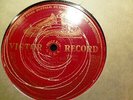
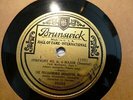
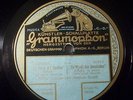
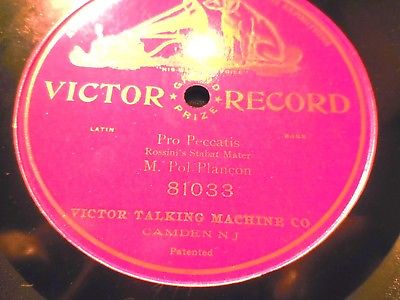
1906 POL PLANCON Bass w Piano Rossini STABAT MATER Pro Peccatis 78
$
19


Favourite Auctions
To save auctions to your favourites, please login
If you don't have an account, please register
Description
Please wait for me to send you an invoice. DO NOT USE EBAY CHECKOUT if you want the lowest possible postage.
Welcome to my auctions of great records
This is my LAST WEEK of 2 weeks of great auctions – I WILL PACK AND BILL YOUR RECORDS after the close on MAY 13.
PLEASE DO NOT PAY before I send you an invoice. It will take me up to 48 hours to pack your records, but this is the ONLY WAY to get you the LOWEST POSTAGE. If you pay before I sent you an invoice, the EBAY system will charge you a HIGHER POSTAGE for shipping. Pls give me about 48 hours to send you an invoice.
International shipping: approx postage 1x10"=$25: 1x12"=$35: 10"Album 4 Rec=50$: 12" Album 2 Rec=50$
HOWEVER in most cases I can get you SIGNIFICANT savings by using other services. Pls contact me for a quote.
About 30% less to Canada. Pls ignore international postage displayed in Ebay, rates are too high
Please wait for me to send you an invoice. DO NOT USE EBAY CHECKOUT if you want the lowest possible postage.
I am currently selling a series of great Richard Wagner and classic European 78 rpm orchestral recordings on all the great European labels:
SUPERB French Basso Pol Plancon here in early 1904 - 06 Victor Sessions:
Company Matrix No. Take Number Date Title/Artist
Victor B-991 1 1/29/1904 Pro peccatis / Pol Plançon
Primary Performers:
Pol Plançon (vocalist : bass vocal)
early pressing Original Grand Prize label 10 " Victor Record
Condition: VERY GOOD PLUS PLUS, scuffs, 7 mm light scratch, plays quiet w light matrix hiss, great sound, 2 spots of distortion
Pol Planton studied with Duprez, the greatest living teacher of diction at the time, and Sbriglia. He made his debut at Lyons in 1877 and first sang at the Paris OpTra in 1883 as GounodÆs MephistofTlFs. In his ten seasons at Paris, he took part in the premieres of MassenetÆs Le Cid and Saint-SadnsÆ Ascanio. He appeared at Covent Garden for 14 consecutive seasons (1891-1904). His Met debut was in 1893, and he returned as leading bass for the 12 following seasons, bidding the house farewell in 1908.
Planton was a popular and polished singer. His beautiful basse chantante had been admirably schooled, and his style was extremely elegant. His flawless trills and rapid scales as well as his cantabile and pure legato are exemplary.
Pol-Henri Planton (June 12, 1851 û August 11, 1914) was a French operatic bass (see basse chantante) and one of the most acclaimed singers during the 1890s and early 1900s, a period often referred to as the "Golden Age of Opera". In addition to being one of the earliest international opera stars to have made recordings, he was a versatile singer, who performed roles ranging from Sarastro in Wolfgang Amadeus Mozart's Die Zauberfl÷te through to parts in several late 19th century works.
He was renowned for his exquisite legato, as well as his crisp diction, limpid tone, precise intonation, and virtuosic mastery of ornaments and fioriture. While not huge, his voice was of more than ample volume. It always moved with exemplary suppleness, allowing him to execute flawless trills and rapid scale passages with remarkable precision and suavity.
Biography
Planton was born in Fumay, in the Ardennes dTpartment of France, near the Belgian border. "Pol" is a pet form of Paul.
[edit] Education
He began learning to sing with the pivotal French tenor Gilbert Duprez (the originator of the "chest voice high C"), who had turned to teaching after his retirement from the stage. Duprez had enjoyed a distinguished career in Italy, where he created Edgardo in Donizetti's Lucia di Lamermoor in 1835. Planton followed his studies with Duprez with lessons from Giovanni Sbriglia, who taught many outstanding opera singers at his Parisian studio, most notably the brothers Jean de Reszke and +douard de Reszke, with whom Planton would sing quite often in future years.
[edit] Early career
He debuted in Lyon in 1877 in the r(le of Saint-Bris in Meyerbeer's Les Huguenots and remained there until May 1879. In 1880, he took on the role of Colonna in Hippolyte Duprat's opera Petrarque at the ThTGtre de la GaetT-Lyrique de Paris and finally received his first engagement at the Grand OpTra in 1883, singing MTphistophTlFs in Charles Gounod's Faust. He spent 10 years at the Paris Opera, participating in the premiere of Jules Massenet's Le Cid in 1885, in the role of Don Gormas (alongside the brothers de Reszke). Another premier that he participated in was that of Camille Saint-Sadns's Ascanio on March 21, 1890, in the role of King Francis I. Appearing with him in Ascanio was another soon-to-be frequent partner, the American soprano Emma Eames. Eames' rival, the great Australian soprano Nellie Melba, also partnered him on many occasions.
[edit] Success at Covent Garden
He performed on the European scene from 1891 to 1904, most importantly at the Royal Opera House, Covent Garden, where he participated yet again in numerous premieres, such as occurred on June 11, 1892, when he appeared in the first staging of the The Light of Asia, by Isidore de Lara.
Other operatic first performances that he graced with is presence included: on June 20, 1894, La Navarraise, by Massenet; on June 30, 1901, the operatic adaptation of Shakespeare's Much Ado About Nothing, by Sir Charles Stanford; in 1901, Le Roi d'Ys, by Edouard Lalo; and in 1904, HTrodiade, by Massenet. English critics were enthusiastic about his contribution to these premieres, as well as his singing in the standard repertory roles, including Rocco in Ludwig van Beethoven's Fidelio, MTphistophTlFs in Faust, Ramfis in Giuseppe Verdi's Aida, Pogner in Richard Wagner's Die Meistersinger von Nnrnberg or Jupiter in Gounod's PhilTmon et Baucis. Only his portrayal of Mefistofele in the eponymous opera by Arrigo Bonto, essayed in 1895, was received with some reservations by the critics. Planton's true home was in the bel canto bass repertory and Bonto's snarling demon seemed less suited to him than the urbane devil of Gounod's Faust.
[edit] The Metropolitan Opera Years
It was in the height of his glory at Covent Garden that Planton was brought to the Metropolitan Opera in New York by the impresario Maurice Grau. He debuted there on November 29th 1893, in the role of Jupiter in Gounod's PhilTmon et Baucis. All told, he appeared in the seasons of 1893-97, 1898-1901 and 1903-08. He participated in a total of 612 performances with the Met, including both operatic performances and concerts, whether in New York or in various US cities as part of the touring company's ensemble. One should take particular note of his 85 appearances as MTphistophTlFs in Faust, as well as his participation in the American stage premiere of Hector Berlioz's La Damnation de Faust in 1906, singing the role of that other famous French Mephisto. In 1899, he appeared in the inaugural performance of Macinelli's opera Ero e Leandro 1899 (in the role of Ariofarne).
He left the Met in 1908, following a final Plunkett in Friedrich von Flotow's Martha at the Met.
Incidentally, during the winter of 1896-1897, the Swiss-born American artist Adolfo Mnller-Ury (1862-1947) had painted a portrait of him for Emma Raymond, which was subsequently exhibited in March 1897 at the Durand-Ruel Galleries in New York. It is now lost.
[edit] Private Life
"The New York Critic Hunekar disliked his 'mincing gait' and complained of a 'lack of virility in his impersonations.' Whether this was fair comment or merely a Puritan critic's reaction to what was then hot gossip, is hard to know; it was widely rumoured that Planton had been caught in his dressing room with the composer Herman Bemberg in flagrante delicto."
(Michael Scott, Record of Singing 1978, page 84).
[edit] Retirement, Death and Historical Significance
Upon his return to Paris at the age of 57, he retired from the stage although still in good voice, and gave lessons to select pupils. He was 63 years old when he died in the French capital, just before the outbreak of World War I.
From a musicological standpoint, his singing is of considerable historical interest, because the refined vocal method that he employed was shaped prior to the advent of passionate, slice-of-life Verismo opera in the 1890s. (To perform the Verismo repertoire effectively, 20th Century singers were required to adopt a more forceful, 'beefier', less elegant style of operatic vocalism than had hitherto been the norm.) Indeed, Planton is considered to be one of the last important figures in a long line of great, Romantic-era, French basses and baritones stretching back to the early 1800s. His predecessors in this grand bel canto tradition included such celebrated artists as Nicolas Levasseur, Luigi Lablache, Jean-Baptiste Faure and Jean Lassalle.
During the height of his 30-year career, he was confronted with stellar competition from a host of superlative operatic basses, including his fellow countrymen Jean-Francois Delmas, Pedro (Pierre) Gailhard, Juste Nivette, Hippolyte Belhomme and Marcel Journet. Other rivals of his included Polish-born Edouard de Reszke, Bohemian-born Wilhelm Hesch, the Italians Francesco Navarrini and Vittorio Arimondi and, from a younger generation, the Russians Lev Sibiriakov and Feodor Chaliapin and the Pole, Adamo Didur. He more than held his own in this exalted company, remaining, then as now, the paragon of sophisticated vocalism.
[edit]
More Great Records on sale right now:
http://shop.ebay.com/carsten_sf/m.html
http://shop.ebay.com/carsten_sf/m.html
====
A Quick NOTE ON GRADING AND SHIPPING:
As you can see from my feedback, I try hard to earn your POSITIVE FEEDBACK and FIVE STAR RATINGS.
If for any reason your transaction was NOT SATISFACTORY, pls contact me and I will work something out with you. YOU WILL NEVER HAVE A REASON TO GIVE ME A NEGATIVE RATING or a LOW STAR RATING.
Quick note on grading:
The Grade (Excellent to Fair, I don't give Mint) refers to the WEAR of the record. Any other defects are stated separately
When I listen to a record, I may also give it an aural grade (again E to F), and make a SUBJECTIVE judgment of the pressing quality for hiss and surface noise.
"SUPERQUIET" is basically noiseless, like a vinyl pressing.
"VERY QUIET" is an exceptionally quiet record for a given pressing.
"Quiet" is a record that is a great example without undue noise for a give pressing.
These judgments are SUBJECTIVE and will depend one the styli, phonograph etc. you use on your own equipment.
Pls check my other auctions for more great records and phonograph items:
Multiple item shipping: I am happy to combine items for shipment in one parcel.
If you win multiple items, pls send me an INVOICE REQUEST to calculate the correct postage. Ebay check out will not give you the multiple item discount!
Records will be packed safely between corrugated cardboard in a sturdy box with plenty of padding for safe shipment.
Shipment is usually Media Mail, unless another service is requested. Shipping is at your risk, I will be happy to insure items at your cost.
I charge actual postage plus a small fee for packing materials
As always, I guarantee your satisfaction. If you don't like the item, just return it, and I will refund the full purchase price.
If you are in the San Francisco area, I encourage pick-up in person.
US Domestic Shipping:
Here is a guideline for US Media Mail Shipping:
Prices below are for regular 78 rpm records. Up to about 5 records, I will ship Edison Discs for the same rates. Albums from Album Sets count as 1 record. Above that and for international shipments, it will be actual weight plus a small packing charge (1-3$ depending on size of shipment)
1 record: 4.50 – 5.00$
2 records: 5.75$
5 records: 7.50$
10 records: 9.50$
MANY MORE RECORDS: Don't worry. I safely ship 40 - 50 pounds of records double boxed in moving boxes, and even then Media Mail will probably not exceed 30$.
Please send me a message if you would like to lower your shipping rates!
International Buyers:
All'attenzione degli acquirenti italiani:
ATTENTION TO ITALIAN BUYERS:
Due to rare problems with delivery in ITALY, I will NOT GUARANTEE delivery of parcels sent by US Postal Service First Class and Priority Mail. If you prefer secure delivery, I will be happy to quote you either Registered Mail or shipment by FEDEX
I am very happy to ship records worldwide.
Please use the EBAY shipping cost only as a guideline. My actual charges are usually lower
One record usually ships for 25 – 28$ for 10" 35$ for most 12" records (Less for Canada).
I can get SIGNIFICANTLY LOWER rates from FedEx and the US Postal service for any kind of parcel weight, and will make use of all the cost-saving shipment methods
Pls contact me for a shipping estimate, or send me an invoice request after close of auction.
AND AGAIN -THANK YOU FOR YOUR INTEREST
As you can see from my feedback, I take great care in presenting, grading and shipping your items. I really want you to be happy with the purchase. If you feel that anything is wrong with the item or the shipping, contact me and we will work it out !!!
As always, I would appreciate any suggestions and corrections from you, pls contact me with any question.
Thank you very much, and good luck bidding !!!
price rating




![The Litter - Distortion 1st Pressing [LP] *Rare* Garage Psych Acid Rock {1967}](https://www.popsike.com/php/thumbnail.php?url=https://www.popsike.pics/pix/20180523/202320887422.jpg)



![JIMI HENDRIX Voodoo Chile [as VOODOO CHILD] ORIGINAL 1969 UK Sheet Music RARE](https://www.popsike.com/php/thumbnail.php?url=https://www.popsike.pics/pix/20160518/121990701487.jpg)