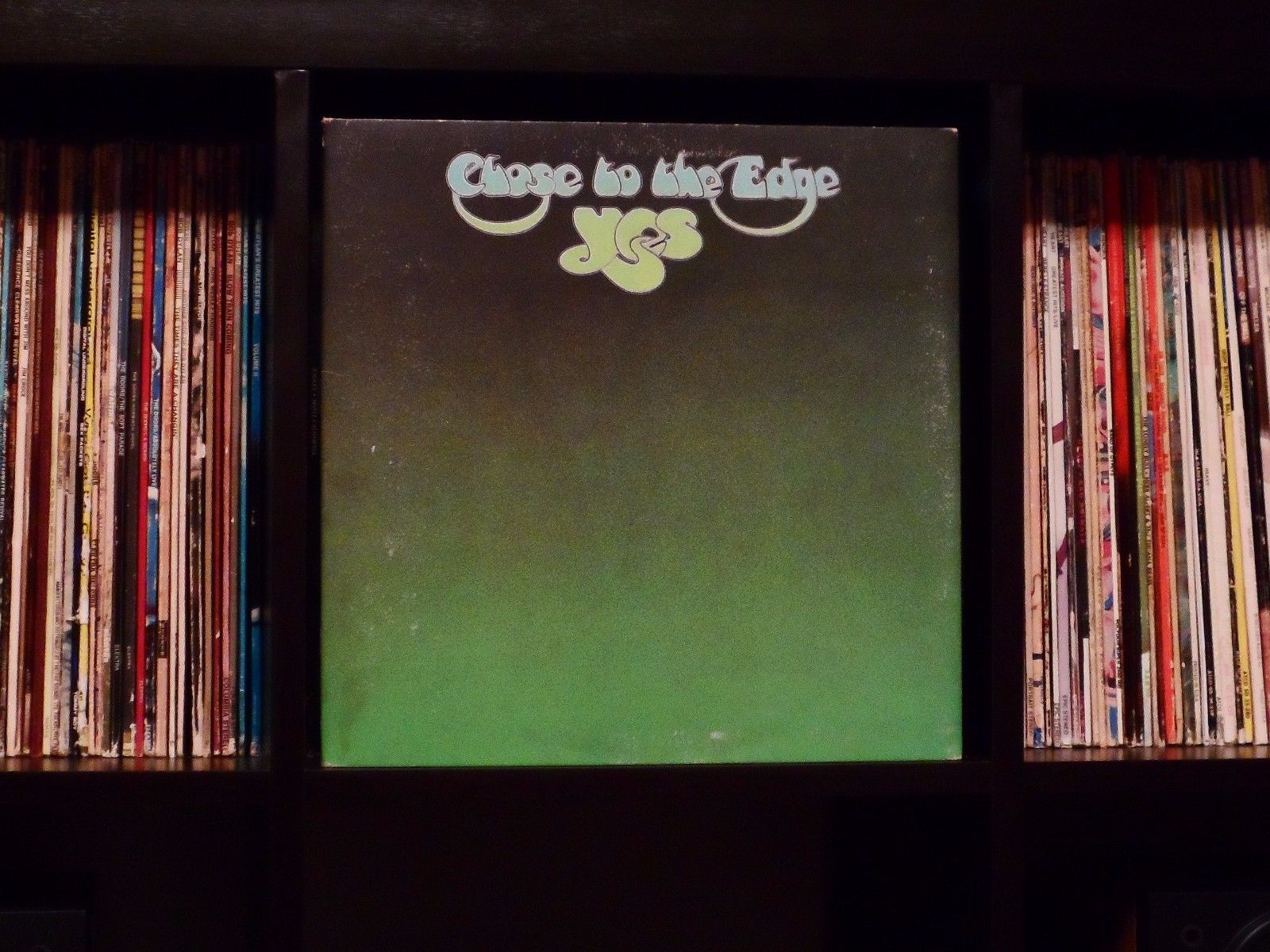
Yes ? Close To The Edge ? RARE 1972 Atlantic Records Record Club First Press LP
$
34


Favourite Auctions
To save auctions to your favourites, please login
If you don't have an account, please register
Description
Welcome to Classic Cadillac Records! My goal is to provide each and every customer with the best possible buying experience, no matter the size of the order. Unlike most sellers, I advertise all my items clearly and in as much detail as possible, without shouting at you in all caps. I take multiple high quality pictures and never use stock photos, so you know exactly what you’re buying. I take great pride in my work and go the extra mile, which can clearly be seen in my listings compared to other sellers that put minimal effort into theirs. I visually grade all my records as accurately as possible and will never grade anything above Near Mint unless it’s still sealed. Please note that a visual grade can differ from a play grade, and am happy to spot check a record upon request. All orders are shipped within 1 business day (usually sooner) and packed with extra care to ensure fast, safe arrival. I combine shipping on multiple orders to save you money and gladly ship worldwide. Please look closely at all pictures, read all relevant details and ask any questions you may have before buying. I offer a full 30-day return policy on everything I sell, so buy with confidence! And most importantly, thanks for looking!
Close to the Edge Studio album by Yes Released 13 September 1972 Recorded 1972 Studio Advision Studios, London, England Genre Progressive rock Length 37:51 Label Atlantic Producer Yes, Eddy Offord Yes chronology Fragile(1971) Close to the Edge
(1972) Yessongs
(1973) Singles from Close to the Edge
- "And You and I (Part I & II)"
Released: 1972
Close to the Edge is the fifth studio album by the English rock band Yes, released on 13 September 1972 by Atlantic Records. Following their tour in support of their previous album, Fragile (1971), Yes returned to the studio to record a new album. Formed of three tracks, Close to the Edge features the 18-minute title track on side one with "And You and I" and "Siberian Khatru" on side two. When recording for the album finished, drummer Bill Bruford had grown tired of the band's style and song writing methods and left to join King Crimson.
Close to the Edge was well received among fans and music critics and is considered a definitive album in the progressive rock genre. It was also a commercial success, reaching number 3 on the Billboard Top LPs and number 4 on the UK Albums Chart. "And You and I" was released as a single that reached number 42 in the US. The album was certified Platinum by the Recording Industry Association of America in 1998 for over one million copies sold. It has been reissued several times, including a 2013 edition with previously unreleased tracks and a new stereo and 5.1 surround sound mix by Steven Wilson.
Background
Following the release of their fourth studio album Fragile (1971), Yes enjoyed their greatest commercial and critical success since their formation. When their well-received 1971–72 tour of Europe and North America to promote the album ended in March 1972, the band started work on their next record. The line-up during this time was singer Jon Anderson, bassist Chris Squire, drummer Bill Bruford, guitarist Steve Howe, and keyboardist Rick Wakeman.
Production
Recording
After rehearsals at the Una Billings School of Dance in Shepherd's Bush, the band returned to Advision Studios to record their next album. They were joined by audio engineer Eddy Offord, who had worked on Fragile (1971) and served as their sound mixer for its tour. Production duties were shared between Offord and the band. According to Bruford, he came up with the album's title to describe the state of the band at the time, as he had with Fragile. Bruford recalled "a cheap black velour settee at the back of the control room" where he slept one night as Squire was "poring over a couple of knobs on the desk, and jerking awake a couple of hours later to find him in the same place, still considering the relative position of the two knobs".
Offord made the band's road crew "build a huge stage in the studio" to make the album sound "more live". In one incident, after the band decided to use a particular edit of a track, the group found out the studio's cleaner put a piece of tape in the rubbish. Following a "desperate hunt for the missing section" in the bins outside, the piece was found.
Composition
"It's like five guys trying to write a novel at the same time. One guy has a good beginning, the second guy has quite a good middle and the third guy thinks he knows what the ending is. But the fourth guy doesn't like the middle, and he doesn't like the way the middle goes towards the ending. And the second guy, who used to like the third section has changed his mind and now likes the first section. You see what I mean? It's obviously a nightmare. Very sensibly people now don't have the time or inclination to work at music that way."
—Bill Bruford.Side one of the album is occupied by its title track, of which Anderson and Howe share composition and lyrical credits. With a running time of 18 minutes and 43 seconds, it is the longest song the band had recorded at the time. The track was assembled in pieces throughout, as Bruford described, "in ten, twelve, sixteen-bar sections". Anderson based its theme and lyrics from reading Siddhartha by German novelist Hermann Hesse. Reflecting on the song's lyrical content in 1976, Anderson noted the concluding verse is a dream that he had "a long time ago about passing on from this world to another world, yet feeling so fantastic about it that death never frightened me ever since". Wakeman's organ section was originally written by Howe for the guitar, but he thought it sounded better on the organ. The motif is played on the pipe organ at St Giles-without-Cripplegate church in London.
Side two opens with "And You and I", a ten-minute track written by Anderson, Howe, Bruford and Squire. When introducing the song on tour, Anderson said its working title was "The Protest Song".
The album closes with "Siberian Khatru", the only track where Wakeman receives a writing credit. Anderson described the track as "just a lot of interesting words, though it does relate to the dreams of clear summer days".
All tracks were arranged by playing and discussing each part chord by chord. Bruford recalled: "It was torture. These arrangements weren't written, and they weren't really composed ... Every instrument was up for democratic election, and everybody had to run an election campaign on every issue. It was horrible, it was incredibly unpleasant, and unbelievably hard work. And Squire was always late, of course, to every rehearsal. After about 2 months of this it was unbelievable punishment".
Sleeve design
The album marked the first use of the band's "bubble" logo designed by Roger Dean.The album's sleeve was designed and illustrated by English artist Roger Dean, who had also designed the cover for Fragile (1971). It marks the first use of the Yes "bubble" logo. Some of the photography used was shot by Martyn Adelman who had played in The Syn with Squire. On reflection of its artwork, Dean said: "There were a couple of ideas that merged there. It was of a waterfall constantly refreshing itself, pouring from all sides of the lake, but where was the water coming from? I was looking for an image to portray that".
Release
Close to the Edge was released on 13 September 1972, three months into the band's 1972–73 world tour to promote the record. It was their biggest commercial success; the album peaked at number 3 on the US Billboard Top LPs chart and number 4 on the UK Albums Chart. In the Netherlands, the album reached number one in the charts. "And You and I" was split into two tracks and released as a single titled "And You and I (Part I & II)" that peaked at number 42 on the US Hot 100 singles chart. The album is certified Platinum by the Recording Industry Association of America for selling over one million copies.
A promotion-only version of the LP was distributed to US radio stations that featured the title track split into shorter segments. This was done to increase radio exposure as most radio stations did not want to air an 18-minute song. Most of the segments were in the range of 3 to 5 minutes and all were marked on the record to assist disc jockeys.
Reception
Professional ratings Review scores Source Rating Allmusic Pitchfork (9.0/10) Robert Christgau C+ Rolling Stone (1972) (favorable) The Rolling Stone Record GuideUpon its release, Close to the Edge received favourable reviews among critics. In a positive review, Billboard selected the album in its weekly "Billboard Pick" feature, noting that Yes had "progressed to the point where they are light years beyond their emulators, proving to be no mere flash in the pan. The sound tapestries they weave are dainty fragments, glimpses of destinies yet to be formed, times that fade like dew drops in the blurriness of desires half-remembered. All involved deserve praise and thanks, this being not a mere audio experience, transcending the medium it brings all senses into play."
In a special edition of Q and Mojo magazines published in 2005, Close to the Edge came in at number 3 in its "40 Cosmic Rock Albums" list. The record is also listed in the musical reference publication 1001 Albums You Must Hear Before You Die by Robert Dimery. In a reader's choice list of the "100 Greatest Guitar Albums of All Time" for Guitar World, the album came in at number 67. On the music database ProgArchives, Close to the Edge is voted as the best progressive rock album ever. In his review for AllMusic, Dave Thompson writes:
Close to the Edge would make the Top Five on both sides of the Atlantic, dispatch Yes on the longest tour of its career so far and, if hindsight be the guide, launch the band on a downward swing that only disintegration, rebuilding, and a savage change of direction would cure. The latter, however, was still to come. In 1972, Close to the Edge was a flawless masterpiece.
Bruford's departure and tour
Once recording for the album was complete, Bruford left the band on 19 July 1972 to join King Crimson. His replacement was Alan White of the Plastic Ono Band and part of Terry Reid's group. As he played on Close to the Edge but left before the subsequent tour, Bruford was contractually obliged to share album royalties with White, and claims that Yes manager Brian Lane enforced a compensation payment of $10,000 from him. White had one full rehearsal with the band prior to the tour's start on 30 July 1972 which saw the band play a total of 95 concerts in the US, Canada, the UK, Japan and Australia. The tour ended in April 1973.
Track listing
All tracks produced and arranged by Jon Anderson, Steve Howe, Bill Bruford, Chris Squire, and Rick Wakeman.
Original LP
Side one No. Title Lyrics Music Length 1. "Close to the Edge"- I. "The Solid Time of Change"
- II. "Total Mass Retain"
- III. "I Get Up, I Get Down"
- IV. "Seasons of Man"
- I. "Cord of Life"
- II. "Eclipse"
- III. "The Preacher, the Teacher"
- IV. "The Apocalypse"
price rating