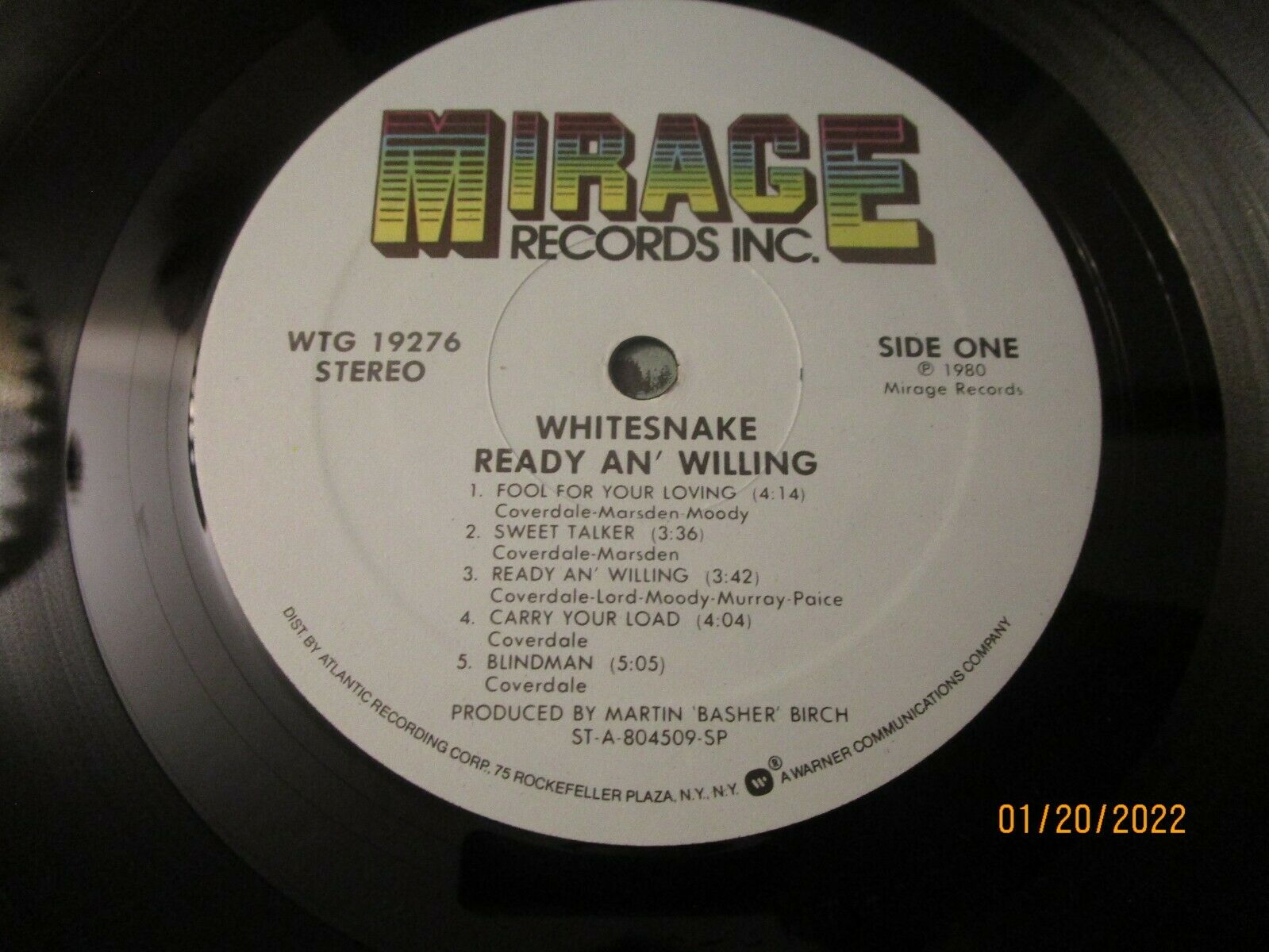
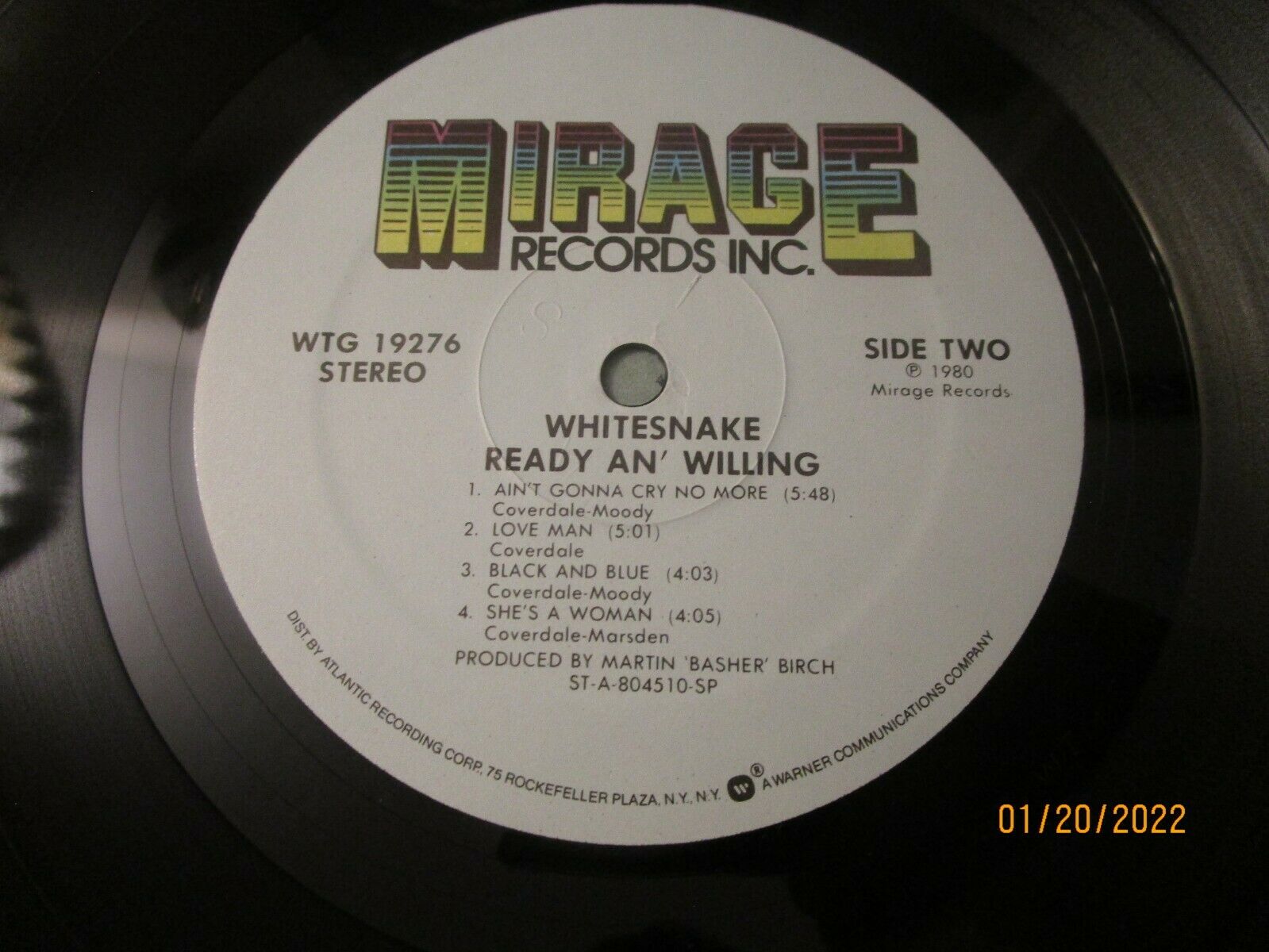
Whitesnake - Ready an' Willing - LP tested Promo vg+/ex
$
22



Favourite Auctions
To save auctions to your favourites, please login
If you don't have an account, please register
Description
Please read my Conditions!
My only method of cleaning is a soft brush and cloth and some Audio Advisor product. Please play record a few times if I mentioned I have cleaned it and do not use another product until u do so. The enzymes work at eating the debris and play gets better, each time, usually much better If after a few plays you could try cleaning again if stubborn static persists... That requires to listening to the LP with my turntable & needle (which cost more money these days) and collecting the dust from the grooves. If a stubborn noise erupts I will then look under a light and microscope. It is quite time consuming. So I may miss a thing or two sometimes on my listings, but I will always be here to help resolve the issue. All I ask is my buyers realize these points and be rest assured I offer a refund policy but I would prefer you email me so we can work something out first, I may have a back up copy... I have been collecting records since my 20's... Its has been a passion and a part-time hobby, I hope you love and enjoy music as much as I do, and selling is another way to get to know other people with a like minded interest as I. I offer a refund policy, so please give me the opportunity to make good if there is a problem with a transaction. I reserve the right to cancel a transaction after the sale If I find a missed defect on your behalf. Feel free to compare prices elsewhere's you will find I am very reasonable. Don't waste your time if the seller does not listen to the lp's, I have return 100's because of defects. Happy Hunting!
Jacket ~ vg+ Lower end of vg+, see pics, but vg+ netherless..seams intact. No names Record ~ ex. Looks nm, no scuffs or hairlines; I did not clean it but I can if you would like me too.
*Ship for free in USA only!
In March 1976, singer David Coverdale left the English hard rock group Deep Purple. He had joined the band three years prior and recorded three successful albums with them. After leaving Deep Purple, Coverdale released his solo album White Snake in May 1977. His second solo album Northwinds was released in March 1978. Both combined elements of blues, soul and funk, as Coverdale had wanted to distance himself from the hard rock sound synonymous with Deep Purple. Both records featured former Snafu guitarist Micky Moody, whom Coverdale had known since the late 1960s. As Coverdale began assembling a backing band in London, Moody was the first to join. Among the other early candidates for the group were drummers Dave Holland and Cozy Powell, as well as guitarist Mel Galley. The decision to recruit a second guitarist was made at Moody's suggestion. Bernie Marsden, formerly of UFO and Paice Ashton Lord, agreed to join. Through Marsden, they were also able to recruit bassist Neil Murray, as the two had played together in Cozy Powell's Hammer. The band's initial line-up was rounded out by drummer Dave "Duck" Dowle and keyboardist Brian Johnson, who had played together in Streetwalkers.
Thxs 2 wiki~A newspaper advert for Whitesnake's first UK tour, promoting Coverdale's second solo album Northwinds
The band, dubbed David Coverdale's Whitesnake, played their first show at Lincoln Technical College on 3 March 1978. Their live debut had originally been scheduled for 23 February at the Sky Bird Club in Nottingham, but the show was cancelled. Coverdale had originally wanted the group to be simply called Whitesnake, but was forced to use his own name as it still carried some clout as the former lead singer of Deep Purple. In interviews, Coverdale would jokingly state that the name "Whitesnake" was a euphemism for his penis, while in fact, it came from the song of the same name found on his first solo album. After completing a small UK club tour, the band adjourned to a rehearsal place in London's West End to begin writing new songs. They soon caught the attention of EMI International's Robbie Dennis, who wanted to sign the group. According to Bernie Marsden, however, his higher-ups were not ready to commit to a full album. Thus, the band entered London's Central Recorders Studio in April 1978 to record an EP. By this point, original keyboardist Brian Johnston had been replaced by Pete Solley. Martin Birch, who had worked with Coverdale during his time in Deep Purple, was chosen to produce. The resulting record, Snakebite, was released in June 1978. In Europe, the EP was combined with four tracks from Coverdale's album Northwinds to make up a full-length album. Snakebite also contained a slowed down cover of Bobby Bland's "Ain't No Love in the Heart of the City", which had originally been used by the band to audition bass players. While the song was only included because the group were short on songs, the track would later become a popular live staple at Whitesnake concerts, with Coverdale calling it "the national anthem of the Whitesnake choir", referring to the band's audience. When Snakebite reached number 61 on the UK Singles Chart, the band were duly signed to EMI proper.
In July 1978, the band (now known simply as Whitesnake) entered Central Recorders in London to begin work on their first proper studio album with Martin Birch again producing. The recording and mixing only took ten days. Towards the end of the sessions, Pete Solley's keyboard parts were completely replaced by Coverdale's former Deep Purple bandmate Jon Lord, who agreed to join Whitesnake after much coaxing from Coverdale. Colin Towns and Tony Ashton were also approached, having previously played with fellow Deep Purple offshoots the Ian Gillan Band and Paice Ashton Lord, respectively. Whitesnake's debut album Trouble was released in October 1978, and it reached number 50 on the UK Albums Chart. In a retrospective review for AllMusic, Eduardo Rivadavia stated: "A few unexpected oddities throw the album off-balance here and there, [...] but all things considered, it is easy to understand why Trouble turned out to be the first step in a long, and very successful career." The release of Trouble was followed by an 18-date UK tour, beginning on 26 October 1978. The final show at the Hammersmith Odeon in London was recorded and released in Japan as Live at Hammersmith. According to Coverdale, this was done to appease Japanese promoters who allegedly refused to book Whitesnake without some kind of a live recording.
Lovehunter and Ready an' Willing (1979–1980)
Whitesnake logo first used on 1979's LovehunterWhitesnake began their first continental European tour on 9 February 1979 in Germany. They then began recording their second album in April 1979 at Clearwell Castle in Gloucestershire, where Coverdale had previously worked with Deep Purple. Martin Birch returned to produce and the band employed the Rolling Stones Mobile Studio to record. Bernie Marsden later described the resulting record as a "transition album", where the band really began to "blossom" and find their footing. Before the album's release though, drummer Dave "Duck" Dowle was replaced by Ian Paice, Coverdale and Lord's former Deep Purple bandmate. There is some contention as to the nature of Dowle's departure. Coverdale maintains that Dowle's performance on the album was lacking and that he was "unable to take constructive criticism", which ultimately led to his firing. Bernie Marsden, meanwhile, asserted that Dowle left because he didn't like being at Clearwell Castle and away from his family. The idea of Paice re-recording Dowle's drum parts was considered, but ultimately rejected by the band's management allegedly due to cost. Paice's addition also spurred speculation from the British music press about Coverdale mounting a Deep Purple reunion, something he denied. Coverdale later remarked how Paice joining the band felt like "truly the beginning of Whitesnake", where all the members were "performing at [their] absolute best" and "inspiring the best out of each other". Lovehunter, Whitesnake's second album, was released in October 1979, and it reached number 29 on the UK Albums Chart. Sounds gave the record a positive review, while AllMusic's Eduardo Rivadavia was more mixed, commending many of the songs, but criticizing the band's studio performance as "strangely tame". The album's cover art, depicting a naked woman straddling a giant serpent, caused some controversy when the record was released. Whitesnake had already received criticism from the British music press for their alleged sexist lyrics. The cover art for Lovehunter, done by artist Chris Achilleos, was reportedly commissioned to "just piss [the critics] off even more". In North America, a sticker was placed on the cover to hide the woman's buttocks, while in Argentina the cover art was modified so that the woman wore a chain-mail bikini. Nevertheless, Whitesnake began a supporting tour for Lovehunter on 11 October 1979 in the UK, followed by dates in Europe.
Whitesnake performing at the 1980 Reading Rock FestivalAfter completing the supporting tour for Lovehunter, Whitesnake promptly started work on their third album at Ridge Farm Studios, with Martin Birch once again producing. The resulting record, Ready an' Willing, was released on 31 May 1980, and it reached number six on the UK Albums Chart. It also became the band's first album to chart in the US, where it reached number 90 on the Billboard 200 chart. Its success was helped by the lead single "Fool for Your Loving", which reached number 13 and number 53 in the UK and the US, respectively. Geoff Barton, writing for Sounds, gave Ready an' Willing a positive review, awarding it four stars out of five. Eduardo Rivadavia of AllMusic commended the band's growing consistency, but still described the production as "flat". Micky Moody and Bernie Marsden later named Ready an' Willing their favourite Whitesnake album. In the UK, the record would later be certified gold by the British Phonographic Industry for sales of over 100,000 copies. In support of the album, Whitesnake toured the US for the first time supporting Jethro Tull. Later that year, they supported AC/DC in Europe. With the benefit of a hit single, Whitesnake's audience in the UK began to grow. Thus, the band recorded and released the double live album Live... in the Heart of the City. The record combined new material recorded in June 1980 at the Hammersmith Odeon with the previously released Live at Hammersmith album. Live... in the Heart of the City proved to be an even bigger success than Ready an' Willing, reaching number five in the UK. It would later go platinum, with sales of over 300,000 copies. In North America, the album was released as a single record version, excluding the live material from 1978.
Come an' Get It and Saints & Sinners (1981–1982)
In early 1981, Whitsnake began recording their fourth studio album with producer Martin Birch at Ringo Starr's Startling Studios in Ascot, Berkshire. After the success of Ready an' Willing and Live... in the Heart of the City, Whitesnake were riding high with the atmosphere in the studio being described by Coverdale as "great" and "positive". The resulting record, Come an' Get It, was released on 6 April 1981. Charting in seven countries, it gave the group their highest ever UK chart position at number two. That same year, the album was certified gold. The single "Don't Break My Heart Again" also charted at number seventeen in the UK. Circus magazine gave the album a positive review, which proclaimed: "[Whitesnake] has made its claim to rock history with Come an' Get It, which even stands ahead of classic hard rock in the Free mold." Coverdale later named the record his favorite album of the band's early years, stating: "Even though we had some great songs on each album, I don't feel that we came as close as we did on [Come an' Get It], as far as consistency is concerned. Whitesnake kicked off the supporting tour for Come an' Get It on 14 April 1981 in Germany. During the tour, the band played five nights at the Hammersmith Odeon and eight dates in Japan. They also played the US in July, supporting Judas Priest with Iron Maiden. At the 1981 Monsters of Rock festival at Castle Donington, Whitesnake were direct support for headliners AC/DC. The supporting tour for Come an' Get It lasted approximately five months.
Whitesnake in 1981. From left to right: Micky Moody, Ian Paice, Bernie Marsden, David Coverdale, Jon Lord and Neil MurrayIn late 1981, Coverdale retreated to a small villa in southern Portugal to begin writing the band's next album. After returning to England, he and the rest of Whitesnake gathered at Nomis Studios in London to start rehearsals. However, as Coverdale would later explain: "There wasn't that 'spark' that was usually in attendance. It felt more of an effort to be there." Micky Moody later stated that by the end of 1981, the band had become tired, partially from "too many late nights, too much partying". In an effort to lift their collective spirits, Whitesnake returned to Clearwell Castle in Gloucestershire, where they had recorded Lovehunter. Though morale still remained low, the band were able to record the basic tracks for the new album. Guy Bidmead replaced producer Martin Birch, who was reportedly too ill at the time to work. This exacerbated the band's ever worsening mental state. Birch did eventually return when recording moved to Britannia Row. To make matters worse, the band were experiencing financial troubles with Moody recalling: "We weren't making nowhere near the kind of money we should have been making. Whitesnake always seemed to be in debt, and I thought 'What is this?, we're playing in some of the biggest places and we're still being told we're in debt, where is all the money going?'." Eventually, Moody became fed up with the band's situation and left Whitesnake in December 1981. The remaining band members blamed the group's management company Seabreeze, headed by Deep Purple's former manager John Coletta, for their financial state. According to Bernie Marsden, the band set up a meeting to fire Coletta, but Coverdale failed to show. Instead, Marsden, Neil Murray and Ian Paice were informed that Whitesnake had been put on hold and that they were fired. Marsden later remarked that "David [Coverdale] decided he would be king of Whitesnake". Coverdale asserts that he elected to put the band on hold when his daughter contracted bacterial meningitis. He claims that this gave him "the backbone" to cut ties with Coletta. Coverdale ended up buying himself out of his contracts, which reportedly cost him over a million dollars. As for the firing of Marsden, Murray and Paice, Coverdale felt they lacked the needed enthusiasm to keep working in Whitesnake. Coverdale later stated that it was "a business decision, not personal".
"I thought [David Coverdale] was a star frontman, a star singer, I felt he had a mediocre band and just average songs. My job was to make them a commercial rock band for the United States."
—John Kalodner on his role working with Whitesnake.
After waiting for his daughter to recupurate, and severing ties with the band's management, record companies and publishers, Coverdale began putting Whitesnake back together. Micky Moody and Jon Lord agreed to return, while guitarist Mel Galley, bassist Colin Hodgkinson and drummer Cozy Powell were brought in as new recruits. Coverdale completed the band's new album with Martin Birch in October 1982 at Battery Studios in London. Saints & Sinners was released on 15 November 1982. It reached number nine in the UK and charted in eight additional countries. In the UK, the record was certified silver. Chas de Whalley, writing for Kerrang!, gave the album a lukewarm review. Save for two tracks ("Crying in the Rain" and "Here I Go Again"), he characterized the rest of the record as generally mediocre. Conversely, AllMusic's Eduardo Rivadavia, in a retrospective review, hailed Saints & Sinners as Whitesnake's "best album yet". By the time the record was released, Coverdale had signed a new recording contract with American label Geffen Records, who would handle all of Whitesnake's future releases in North America. In Europe, the band remained with Liberty (a subsidiary of EMI), while in Japan, they signed with Sony. A&R executive John Kalodner, who had been a long-time fan of Coverdale's, convinced David Geffen to sign the band. Meeting Geffen and Kalodner had a major impact on Coverdale and his future vision for Whitesnake. He explained: "I'd been surrounded by a mentality if you make five pounds profit let's go to the pub. Whereas David Geffen said to me 'If you can make five dollars profit, why not 50? If 50, why not 500? Why not 50,000, why not five million?'" Coverdale soon set his sights on breaking through in North America with Kalodner advising him. Meanwhile, Whitesnake began a supporting for Saints & Sinners on 10 December 1982 in the UK.
Fool For Your Loving 4:15 Sweet Talker 3:35 Ready An' Willing 3:42 Carry Your Load 4:06 Blindman 5:08 Ain't Gonna Cry No More 5:50 Love Man 5:02 Black And Blue 4:04 She's A Woman 4:05
price rating