Voice of the Computer: Risset+Tenney++ early electronic
$
44


Favourite Auctions
To save auctions to your favourites, please login
If you don't have an account, please register
Description
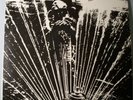
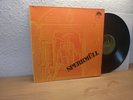
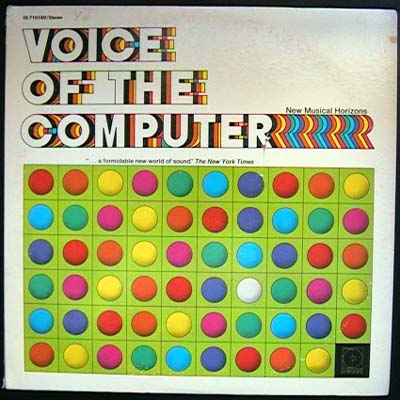
Voice of the Computer-- Max V. Mathews: Masquerades (1963); Slider; Swansong / Jean-Claude Risset: Computer Suite from 'Little Boy' (1968) / James Tenney: Stochastic Quartet (1963) / Wayne Slawson: Wishful Thinking About Winter / Roger N. Shepard: Shepard's Tones / John R. Pierce: Eight-Tone Canon (1966). Decca DL 710180
Excellent and rare 1970 lp with pioneering experimental electronic works composed at Bell Labs on early IBM mainframes (including the 7090 and 7094) during the 50s and 60s, representing some of the earliest ever computer-produced music. Some tracks, like Risset's, are beautiful and complex multi-movement compositions, while others are fascinating studies of microtuning, psychoacoustic phenomena, and mathematical experiments in synthesized sound. This lp documents for the first time the eerie Shepard's Tones (aka the auditory staircase illusion), in which all relative pitch discrimination information has been eliminated from a set of tones, resulting in "an impression of continuously ascending and descending sequences of pitches... whereas in actuality every 12th pitch is identical." In Mathews' Masquerades, the computer takes several precomposed themes and randomly transposes and modulates their elements onto each other; the title of the piece was suggested to Mathews by John Cage. Pierce's work explores the use of synthetic overtones to achieve "control over the way in which the various tones of a chord blend together." Mathews' Swansong is of particular historic value as "the birth cry of interactive graphic composing... the score was drawn directly on the computer using a TV picture tube attached to the computer and a special light pen which allows lines to be drawn directly on the screen of the tube... Only a few minutes ensued between finishing the score and listening to the result. Hence, it was easy for the composer to revise and develop his ideas..." Of course, these principles have become the basis of all modern digital audio software; a couple of decades later, Miller Puckette, while working at IRCAM, would create the MAX digital audio graphical programming environment, named in honor of Mathews. This essential lp is the sequel/companion to the equally legendary Music from Mathematics album and ranks among the greatest of early electronic collections.
In the late 1950s, Bell Labs hosted the first musicians to experiment with computers, and as a result of the release of this music on lp they later attracted composers Edgard Varese and Jean-Claude Risset to work at their studios. Pierce was a pioneering early electronic composer, a psychoacoustician, an engineer regarded as the father of communications satellites, and a science fiction author; he worked directly with Varese and Risset. Mathews is generally considered the very first computer musician; he programmed the software used to create many of the pieces on this lp (such as Music I and II) and would go on to invent many digital audio techniques, hardware, and software (including Music 360). He also worked with Jon Appleton, and at IRCAM with Pierre Boulez. Tenney studied under Lejaren Hiller, Kenneth Gaburo, Henry Brant, and Varese, and worked with Steve Reich, Philip Glass, Harry Partch, John Cage, and Conlon Nancarrow. Risset is a composer, pianist, and theoretician who studied music under Andre Jolivet and also studied mathematics and physics; he worked at IRCAM with Boulez, at Bell Labs where he met Vladimir Ussachevsky and worked with Edgard Varese, John R. Pierce, James Tenney, and Max Mathews, and as the first computer-based composer at the legendary INA-GRM musique concrete studios (center of study for electroacoustic pioneers like Pierre Schaeffer, Pierre Henry, Francois Bayle, Michel Chion, Luc Ferrari, Francois Bernard Mache, Ivo Malec, Bernard Parmegiani, Michel Redolfi, Ragnar Grippe, Jon Appleton, Jean Michel Jarre, Karlheinz Stockhausen, and Iannis Xenakis). The IBM 7090 computer was also used by Iannis Xenakis and Lejaren Hiller as a compositional tool. Other references for this lp: Gottfried Michael Koenig, Herbert Eimert, Milton Babbitt, Barry Vercoe, Autechre, Aphex Twin...
Vinyl Condition: ex+
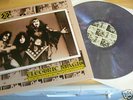
Cover Condition: vg+ (light wear; promo stamp on back; small tear on front and on 2 corners; small stains on back)
I have another Risset lp for sale. Check out my other auctions this week for more avant garde/experimental, early electronic/electroacoustic/synthesizer, 20th century classical, minimalism, free jazz, psych, and space age pop.
Shipping to US destinations is 3.85 for 1-2 single records by Media Mail, then 0.50 for each additional (Priority Mail, other expedited shipping options, and insurance are all available on request). International rates for shipping 1 12" lp: Canada by airmail is 6.50; Western Europe/UK/Scandinavia is 7.00 surface or 12.00 air; Japan/Taiwan/Australia is 7.00 surface or 13.50 air; other international destinations vary. 7" and 10" records will cost less; heavy box sets will cost more. Combine multiple items to save on shipping. Note: I can now offer international buyers the super-cheap M-Bag bulk mail rate for orders of 9 or more lps; to most destinations this starts at 20.00 for surface mail or 31.50 for air for up to 17 lps, a huge per-record savings over standard rates for smaller parcels! Feel free to email with any shipping questions.
Payment - I prefer Paypal (which allows for fastest possible shipment) and also accept cash, money order (from US financial institutions only, including BidPay, US Postal, certified US bank check, etc., international bidders please take note!), and Western Union money transfer. If you are paying by Paypal and have won multiple items, please use a single Paypal payment. I will send an invoice email to all winners shortly after my auctions close, and another email after payment has been received to confirm item shipment.
Packing - I pack professionally and adequately using new record mailers exclusively from Cameron Packaging (which I have determined are the best and most protective). For used lps, I remove the lp and inserts from the jacket, cover it in a layer of bubble wrap, and then reinforce it with a cardboard insert. All records are shipped with poly plastic sleeves. All packages are completely sealed with strong packing tape covering all openings. If you'd like your package done any differently, just let me know.
Feel free to email me if you have any questions (need more info, want more pictures, etc.); you can use the 'ask seller a question' link above. My condition rating scale is -G+/-VG+/-EX+/-NM/M (only sealed records are M). Satisfaction guaranteed; if you have any problems with your order please contact me directly.
Check out Ebay[track], my free realtime ebay auction tracker (currently in beta), which can refresh multiple auction statuses every second, alert you when bids are placed and when auctions end, let you place bids, and more. It's a useful tool for bidders, snipers, sellers, watchers...
This item description is (c)opyright 2005 keymap records; please contact keymap records for permission before reproducing any text.
price rating