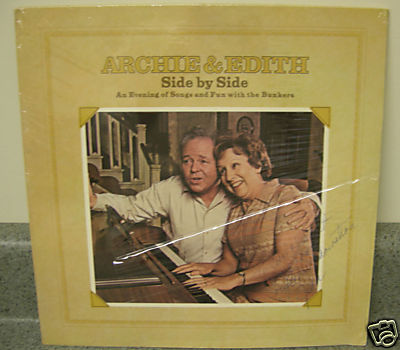
Vincent Price Estate LP: Signed Archie & Edith Bunker
$
30


Favourite Auctions
To save auctions to your favourites, please login
If you don't have an account, please register
Description
This LP is from the personal collection of Vincent Price and Coral Browne.
It is Archie & Edith: Side by Side from 1973. It is signed by the fabulous, Jean Stapleton (Edith):
To Coral + Vincent
All my love, respect, and admiration
Jean
It is still shrink wrapped, except where Edith has pulled it away to sign it to her friends.
Edith and Coral became friends when doing a TV movie about Eleanor Roosevelt, in which they both appeared.
A bit about "Side by Side":
Jean Stapleton and Carroll O'Connor teamed up for the album "Side by Side, an Evening and Songs and Fun with the Bunkers". The album featured such toe-tapping tunes as: “Oh, Babe, What Would You Say?” “I’m Sitting on Top of the World,” “You Must Have Been a Beautiful Baby,” “Hey, Look Me Over,” “Ain’t We Got Fun,” “I Remember It Well,” “Button Up Your Overcoat,” “You’re the Cream in My Coffee,” and “Side by Side”. The record, issued on the RCA Victor label, featured 24 songs in all.
About Jean Stapleton:
Each and every week from 1971 to 1980, the popular TV sitcom, All in the Family was heralded by the singing of Edith Bunker, This tended to obscure the fact that Jean Stapleton, the woman who so brilliantly portrayed Edith, not only possessed a lilting, well-modulated singing voice, but was as far removed as possible from a "dingbat" in real life. While attending Hunter College, Jean began her performing career as a member of the Robert Shaw Chorale. She made her professional stage debut in 1941 and then went on to fruitful work-study associations with the American Apprentice Theater, the American Actors Company, the American Theater Wing, and director-acting coach Harold Clurman. Her first Broadway appearance was in the 1953 production In the Summer House; the following year, she made her TV bow as a semi-regular on the daytime drama Woman With a Past. She endeared herself to Broadway with her wistfully funny characterizations in the SRO musicals, Damn Yankees, Bells are Ringing and Funny Girl, roles that she would carry over into the film versions of these hits. In 1958, she made her first appearance at the Totem Pole Playhouse in Fayetteville, Pennsylvania, a summer-stock operation managed by her husband Bill Putch.
Most of Jeans on-screen work in the 1960s and 1970s could be found in New York-based movies (Something Wild, Up the Down Staircase, Klute) and TV series (Car 54 Where are You, The Defenders, The Patty Duke Show). Her earliest association with producer-director Norman Lear occurred in the 1969 theatre feature Cold Turkey, in which she played a neurotic housewife named Edith. When Lear began assembling the cast for his upcoming TV sitcom, All in the Family, he immediately thought of Jean the role of slow-witted, strident, essentially kindhearted Bronx housewife Edith Bunker. Before leaving the series in 1980, Jean earned three Emmy Awards for her portrayal of Edith—not to mention the undying affection of millions.
Once free of All in the Family, she sought out roles that she hoped would demonstrate her versatility: she played the distraught mother of a drug-addicted teenager (enacted by her real-life son John Putch) in the made-for-TV Angel Dusted (1981), and effectively portrayed Mrs. Eleanor Roosevelt in the 1982 TV biopic Eleanor: First Lady of the World. Jean kept her comic skills sharpened by appearing in the made-for-cable productions of Shelley Duvall: she was terrific as a no-nonsense Fairy Godmother ("Trust me. This is important.") in Duvall's Faerie Tale Theater adaptation of "Cinderella," and even better as the title characters in Mother Goose Rock 'n' Rhyme and Mrs. Piggle-Wiggle. In 1990, she briefly returned to weekly television as co-star (with Whoopi Goldberg) of the offbeat sitcom Bagdad Cafi. As of this writing, Jean Stapleton is a welcome TV guest-star presence; in 1995, she startled (and delighted) her "Edith Bunker" fans with her con brio Caroline in the City.
About Vincent Price & Coral Browne:
Vincent Price is best remembered for his roles in horror movies, specifically the Roger Corman adaptations from Edger Allan Poe. Although these gave him a wide variety of characters to play and were striking enough, they type cast him for the remainder of his career. Price did not start out with the intentions of becoming an actor but rather an art historian. He obtained degrees in Art History and English at Yale and then taught school for a year. He felt that he needed to further his education though as the students seemed to know more than he did! Price returned to college to take his Masters in Fine Arts at the Courtauld Institute in London, he also studied briefly in Vienna.
It was while in London In 1934 that the theatre bug hit him, theatre tickets were relatively cheap and Price took advantage of this. He first appeared as an actor at the Gate Theatre, at the time a private experimental theater, as the judge and a policeman in the play "Chicago'. He also appeared here as Albert in 'Victoria Regina', the role that was to bring him to Broadway and the public's attention. The show's producer Gilbert Miller, decided to take the play to New York and open with Helen Hayes (the number one actress in America at the time), in the leading role. Miller also decided to take Vincent Price to New York to play opposite her. The play opened on the 26th December 1935 and ran for three years.
The program notes in the original 1936 playbill give an interesting insight into Vincent Price's entrance to the theatrical profession....
"Vincent Price's appearance as leading man to Helen Hayes marks his professional as well as his American debut on the stage. This extraordinary circumstance is due to the fact that although Mr. Price has had stage aspirations since he was ten years old, he was forced to earn his living as a schoolmaster until mere chance decreed otherwise.
He was studying the history of German art at the Courtauld Institute in London when a friend took him to London's Gate Theater, where casting of Maurine Watkins' "Chicago" was in process. American accents being at a premium, Mr. Price was thrust into the production and found himself doubling as a burly policeman and a venerable judge. His remarkable resemblance to Prince Albert led to his being offered the important role of the Price Consort in the ensuing production of "Victoria Regina".
He received glowing notices and was subsequently signed by Gilbert Miller for the American production."
How accurate that "he was forced to earn his living as a schoolmaster until mere chance decreed otherwise." is probably an exaggeration, his father did own the National Candy Company in St Louis.
Price's love of art never left him and he used his education to good advantage. He was responsible, in 1951, of founding the Vincent Price Gallery, with his then wife Mary Grant Price on the campus of East Los Angeles Collage. Price had been invited to lecture on the ''Aesthetic Responsibilities of the Citizen,'' he arrived to find he was, ''speaking in a Quonset hut on a mud flat.''
He was so struck by the students' spirits and the need for the community to have the opportunity to experience original art works first hand, Price donated some ninety pieces which established the first ''teaching art collection'' owned by a community college in the United States. Over the decades, Price and other patrons continued to contribute art with the goal of illustrating diverse periods, styles, mediums, and techniques: from Egyptian sculpture circa 600 BC to 1990s serigraphs. He continued to maintain a hands-on interest in the gallery with selecting exhibits and developing a fund raising program to which he leant his name and support. In 1991, he was quoted,
''We just wanted it to serve the community. We didn't want to make publicity out of it since everything actors do is suspect! We just shut up and let it grow.''
Price's love of American Indian Art led to another little known side of him, his work for Native Americans, he worked for 15 years with the Department of the Interior and was quoted as saying in an interview:
"I have an enormous respect for the American Indian. I think we shut them off, at a period when they might have become the most creative people on the face of the earth. But we killed them off."
Prior to his movie career Price joined Orson Wells' Mercury Theatre for a brief spell, here he claimed, everyone in the company had a disagreement with Wells at some point or another. Price's first movie was "Service DeLuxe" in 1938 and he went on to play such diverse historical characters as Raleigh, Clarence, Richelieu, Charles II and the Mormon Joseph Smith. He was also cast in several films as a charming but effete young man, notably in 'Laura' (1944) and 'The Fly' (1958). The occasional horror role came his way too at this time, he reveled in the old Lionel Atwell part of the demented sculptor in "The House of Wax" (1953). Price's niche in the horror movie genre was carved in 1960 with the classic movie "The Fall of the House of Usher".
Price did return to the stage in later years. He toured his one-man show of Oscar Wilde throughout America for many years to great acclaim. It was a demonstration of the excellence performing skills of Vincent Price and an escape from the type casting.
In his later years, Price became involved with the rock & roll industry, he was involved in music videos with performers including Alice Cooper, Ringo Starr, and Michael Jackson. Price had his own ideas why he was chosen for this honor.
"I have great admiration for rock `n roll, but not when it's done badly. My God! You know, I have a theory about how I get selected for these things. I think they've based a lot of their stuff on my movies. They go out and do the rock `n roll, and they're all high, and making the noise and flying around, and then they go back to their hotel room, turn on the TV, and there I am! Alice and I met a couple of times, and I liked him, then he asked me to do 'Welcome to My Nightmare'. Then one time I got a call and they said would you come and do a recording with Michael Jackson, called 'Thriller'. I said, "Sure, I'll do anything." So I went and did it, and I didn't think anything would happen with it, than it came out and sold 40 million copies! I didn't do it for the money, because I didn't have a percentage of it. It was just fun to do.
You know to be identified with the most popular record ever made is not just chopped liver! It has really done me a lot of good, because it has given me a new audience. "
As if Price didn't have enough to occupy himself during his career as an actor, he began another career as a TV chef, which ran for several series. He had a reputation as an outstanding cook and collector of recipes. He also found time to write a book , “Joe".
Towards the end of his life, he was struck with a great personal loss. His beloved third wife, Coral Browne, succumbed to breast cancer two days after Vincent Price's 80th birthday on May 29th, 1991. In the Autumn of that year a memorial service was held at London's Farmers Church, many of Coral Browne's friends from the Theater and Film attended. Price's own frail health made it impossible for him to be at the memorial in person. A letter written by Price was read out by director John Schlesinger --
"Dear John:
When I was courting Coral, the first gift she gave me was a photo of herself simply signed, "Remember Coral" -- not really a challenge as the problem was, how could you forget her? I've come to believe remembering someone is not the highest compliment -- it is missing them. I find I miss every hour of Coral's life -- I miss her morning cloudiness, noon mellowness, evening brightness. I miss her in every corner of our house, every crevice of my life. In missing her, I feel I'm missing much of life itself. Over her long illness, as I held her hand or stroked her brow, or just lay still beside her, it was not the affectionate contact we'd known as we wandered down the glamorous paths we'd been privileged to share in our few years together; we were marching towards the end of our time and we both knew it. But, in our looks, our smiles, the private, few, soft-spoken word, there was hope of other places, other ways, perhaps, to meet again.
One fact of Coral I'll always miss, her many, many devoted friends -- many here, today, in this beautiful church, celebrating her life more than mourning her death, and missing the liveliness of her wit, her personal beauty, her outgoing self. I love them all for loving her. Many of you have shared more of her life than I have, but that very private and intense passion for her is mine alone.
She survived that last long year on the love of her friends, their caring and concern -- and very especially yours, dear John. I miss you all, and though we may not meet as often, nor in the great good company of my wife, you are in my memory locked.
All my love,
Vincent
About Coral Browne:
Coral Browne (July 23, 1913 - May 29, 1991) was a stage and screen actress, famous for her wit.
She was born Coral Edith Brown in Melbourne, Australia, where she began her stage career. At the age of twenty-one she emigrated to England, where she became established as a stage actress. She began film acting in 1936, with her more famous roles being Vera Charles in Auntie Mame (1958), Mercy Croft in The Killing of Sister George (1968), and Lady Claire Gurney in The Ruling Class (1972).
She married actor Philip Pearman in 1950; he died in 1964. While making the film Theatre of Blood (1973), she met actor Vincent Price, and they married on October 24, 1974. She also allegedly conducted affairs with Firth Shephard, Jack Buchanan, Maurice Chevalier, Michael Hordern, and costume designer Cecil Beaton, as well as affairs with women.
In 1969, Browne played in the original production of Joe Orton's controversial farce What the Butler Saw in the West End at the Queen's Theatre with Sir Ralph Richardson, Stanley Baxter, and Hayward Morse.
While touring the Soviet Union in a Royal Shakespeare Company production of Hamlet in 1958, she met spy Guy Burgess. This meeting became the basis for the television movie An Englishman Abroad in which Browne played herself.
She became a naturalized U.S. citizen in 1987 as a gift to Price, in exchange for which he converted to Roman Catholicism as a gift to her (she had converted many years previously).
She died in Los Angeles, California of breast cancer at the age of 77.
She is the subject of a biography The Coral Browne Story by the actress Barbara Angell
References
* Alan Bennett gives the date of her meeting with Burgess as 1958 in the introduction to his Single Spies, which contains the text of An Englishman Abroad as a stage play and the text of A Question of Attribution about Anthony Blunt. Single Spies, London, Faber, 1989, ISBN 0-571-14105-6.
* The Coral Browne Story by Barbara Angell, ISBN 978 0 646 47322 2.[3]
* Vincent Price: A Daughter's Biography by Victoria Price, ISBN 0-312-26789-4.
* Who's Who, 1991, St. Martin's Press, 1991, p. 241.
* Variety, June 3, 1991, p. 69.
price rating




![The Ruts ?– The Crack [Picture Disc LP] *New & Unplayed*](https://www.popsike.com/php/thumbnail.php?url=https://www.popsike.pics/pix/20170907/282641972386.jpg)