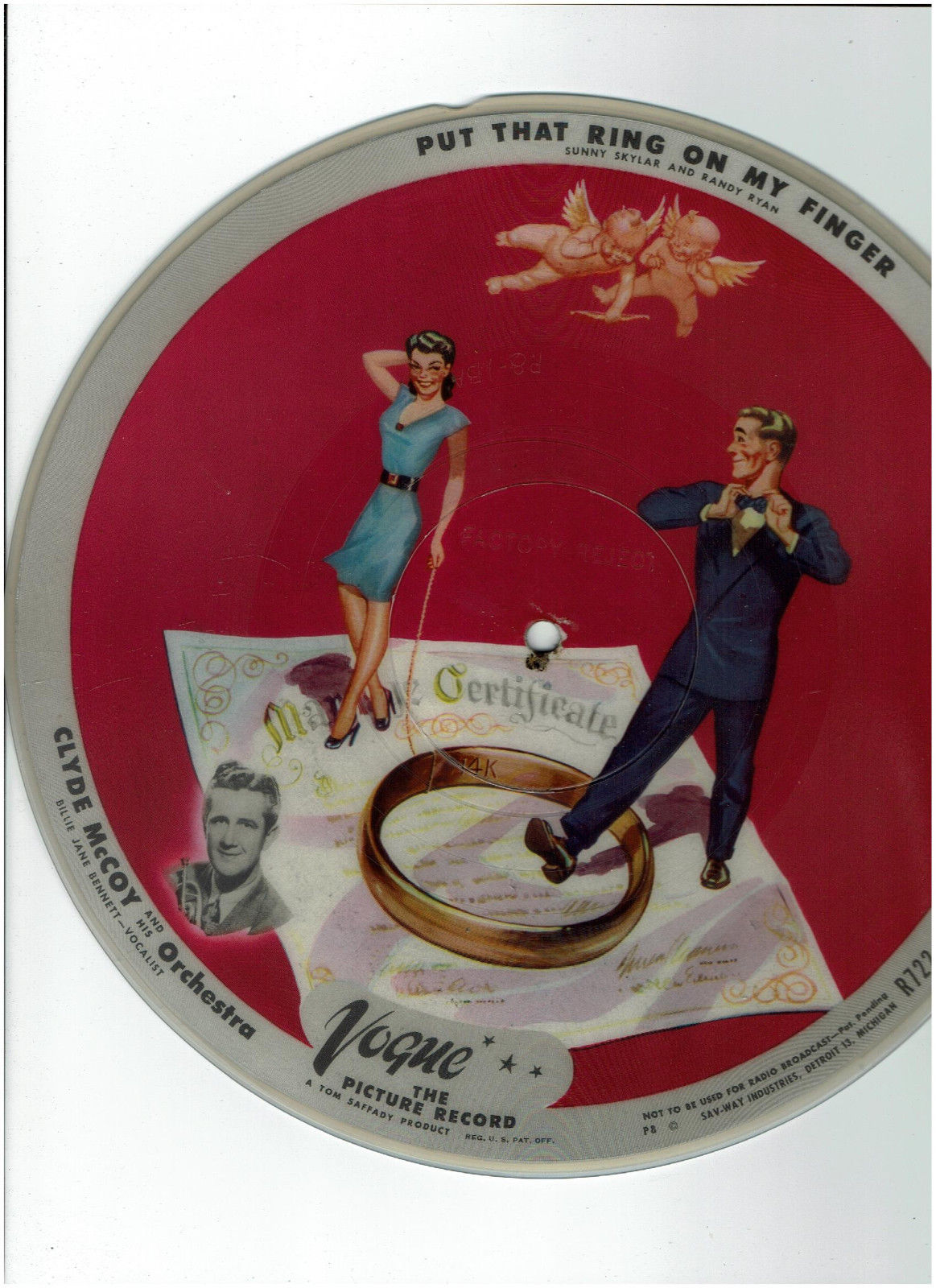
VOGUE 78 RPM Record R722 Clyde McCoy and Orchestra “Tear It down”/”Put That Ring
$
22


Favourite Auctions
To save auctions to your favourites, please login
If you don't have an account, please register
Description
VOGUE 78 RPM Record R722 Clyde McCoy and Orchestra “Tear It down”/”Put That Ring on My Finger” E- Visible Condition, chip out of top edge of record but otherwise a very beautiful condition record. Although they may be as common as a toothache this is the first Vogue that I have ever owned in over 30 years of doing business in records that has the words “FACTORY REJECT” embossed near the spindle hole. It appears that some of the plastic coating puddled inside the spindle area and perhaps that’s why it was rejected. I can see no other faults.
Clyde Lee McCoy (December 29, 1903 – June 11, 1990), was an American jazz trumpeter whose popularity spanned seven decades. He is best remembered for his theme song, "Sugar Blues", written by Clarence Williams and Lucy Fletcher, and also as a co-founder of Down Beat magazine in 1935. The song hit in 1931 and 1935, in Columbia and Decca versions, and returned to Billboard magazine's Country (Hillbilly) chart in 1941. It was also played with vocals, by Bob Wills and his Texas Playboys, Fats Waller and Ella Fitzgerald.
Johnny Mercer had a vocal hit in 1947. McCoy was a member of one of the families of the Hatfield-McCoy feud, and was based at various times in Los Angeles, New York City, and at Chicago's Drake Hotel, where he first performed "Sugar Blues" in 1930. He has a star on the Hollywood Walk of Fame at 6426 Hollywood Boulevard.
McCoy had begun mastering the trumpet when he was without formal instruction, after the McCoy family moved to Portsmouth, Ohio in 1912. This would lead him to perform regularly at church and school affairs. He was to perform on the Cincinnati riverboats five years later, plying the Mississippi River, and would also perform on the side-wheelers the Island Queen and the Bernard McSwain, becoming one of the youngest musicians on the river at age 14.
McCoy was informed in 1920 by a musical associate about an opening for a small band at a popular resort location in Knoxville, Tennessee, which was originally planned to be a two-week gig. The band boarded a train for Knoxville with a group who had never played together as a unit. The band rehearsed in the train's smoker, en route to the Whittle Springs Hotel and Spa. When the band arrived in Knoxville, owner George Whittle agreed to audition Clyde's "Chicago Orchestra" and approved of their performance, as well the patrons. The Clyde McCoy Orchestra would be officially launched after the gig lasted for 2 months.
McCoy performed his song "Sugar Blues" at the Drake Hotel in Chicago in 1930. Clyde's solo rendition of the song would draw enthusiastic approval from the patrons at the Drake Hotel, and provided national broadcast exposure for the band on the radio. This would also help Clyde be signed to a recording contract with Columbia Records, and the song was recorded on January 22, 1931. It was an instant retail success and continued to enjoy successful sales over the years. The song sold in excess of fourteen million copies internationally by the time of Clyde's retirement in 1985.
The Clyde McCoy Orchestra had a long and successful run at the Drake Hotel before beginning a year-long engagement at Terrace Gardens in Chicago. The band was featured in a Balaban and Katz vaudeville production, before beginning a two-year second engagement Chicago. In mid-1935 Clyde signed a five-year recording contract with Decca Records.
Clyde and the band accelerated their recording activity when they signed with Decca Records. The national recording industry was suffering the Great Depression at the time, which severely hampered the number of record sales. After signing with Decca, McCoy's recording activity accelerated. In addition to conventional retail discs, he began to record regularly at the transcription studios. Those recordings were used primarily in delayed radio broadcasts. Before McCoy entered military service in World War II, he recorded frequently for Associated Transcriptions, both in Chicago and New York. The ASCAP recording ban in 1941 halted recording of all songs composed by its members. Clyde would start recording for LangWorth Transcriptions in New York and several prominent labels, including Mercury, Capitol, and Vocalion Records.
He died on June 11, 1990, at age 86.
If possible we gladly combine shipping items to lessen postage and will hold for you if you are bidding on additional items.PLEASE don't use eBay auto pay I will invoice you for shipping costs which will be easier and cheaper for you:
The scratches on the left of every photo are my broken glass on scanner – not on item. Images of artists etc. are for information only and not included in auction, record & sleeve only.
We will pack securely but are not responsible for shipping company damage if uninsured.
1 record - $4.70 Add $1 for each additional record (+ insurance if required). (USA ONLY) (Int?l use eBay calculator and I will adjust to get cheapest rate)
E++, Visibly nearly new with no visible signs of wear or damage.
E+, Looks and plays like new with only few signs of handling and play.
E Still very shiny, near new looking, with slight visible signs of wear and a few nearly inaudible scuffs and scratches
E- Still shiny but without the luster of a new record, few scuffs that have little or no effect on play, some light scratches.
E- - Mostly shiny but with even less of the luster of an E- record, more scuffs than E-that have little or no effect on play, light scratches with some light noise.
VG+, Slightly above average condition 78 in which scuffs and general use has dulled the finish somewhat. Wear is moderate but playing is generally free from distortion. Surface noise not overly pronounced.
VG, An average condition 78 - moderate wear throughout, but still very playable and enjoyable. Surface somewhat dull with noise and scratches audible but not intrusive.
VG-, Quite playable still, but with some distortion and may have some graying in loud passages. Music remains loud in most passages. Surface noise and scratches well below music level.
VG- - Quite playable still, but with distortion and most have some graying in loud passages. Music remains loud in most passages. Surface noise and scratches noticeable and may be loud at times.
G+ Quite worn and scratched, but music level is still higher than surface noise. Grey may be throughout but still serviceable. Music begins to sound muffled.
G Not so good. Wear and scratch damage extensive. Listening can become uncomfortable as music and surface noise probably blending. Lowest level music can be understood.
G-, Music barely audible over surface noise & listening is uncomfortable. Record is borderline unplayable.
P Used only for high dollar space fillers like Black Patti, Okeh blues, etc. Music covered by surface noise, scratches, and needle digs, label may be trashed, & listening is almost if not definitely impossible. Record is basically unplayable. What you keep because you can?t bear to toss ? while you look for that E+ copy of Robert Johnson on Vocalion at the local flea markets for $1 (Good Luck!)See Description, A wildcard grade that can be used when standard grading does not apply or when a record (or item) has special attributes (or defects) that can affect how the item is assigned a grade.
price rating