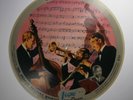
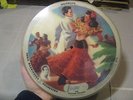
VINTAGE VOGUE PICTURE DISC RECORD #R779 1946 V. RARE
$
38


Favourite Auctions
To save auctions to your favourites, please login
If you don't have an account, please register
Description
A very rare picture disc from the Vogue series created by Tom Saffrady and Sav-Way Industries of Detroit.
Series number R779, produced in either 1946 or early 1947.
Artist: ENRIC MADRIGUERA AND HIS ORCHESTRA with vocalist PATRICIA GILMORE.
Tracks: - A Man, A Moon and a Maid.
- Cuban Yodelin' Man.
The Vogue series only consisted of 67 issues before the company went bankrupt in 1947. Please see the full history below.
This is one of the rare ones because it was produced towards the end of the series and not many were sold.
Condition: Well, I don't have 78 rpm record player but I played bits at 45 rpm and it sounds pretty good, albeit a bit slow. :)
A visual check shows some marks on the playing surface but it's remarkably clean for its age.
There are three flea-bites on the edge. One is visible if you look for it and the other two can only be felt.
For display and collection purposes I would say that this is an exceptionally good example of this rare disc.
What's a Vogue Picture Record?
Vogue picture records are phonograph records on the "Vogue" label which have a picture (an artist's illustration) embedded in the transparent vinyl of the record. The illustrations on each side of the record are usually related to the title of the song on that side. Many of the illustrations are mushy romantic themes (see the discography). The most common Vogue picture records are 10-inch, 78 RPM records, although a few 12-inch, 78 RPM Vogue picture records were also produced.
Vogue picture records were produced by Sav-Way Industries of Detroit, Michigan. The first 10-inch Vogue picture record (catalog number R707) was released to the public in May 1946. Production ceased less than a year later in April 1947, with Sav-Way entering into receivership in August 1947. During this time, approximately seventy-four different 10-inch Vogue picture records were released.
Each illustration has an "R" number (or catalog number) printed on it, ranging from R707 to R786. There are gaps in the sequence; not all of the eighty possible catalog numbers were used. There is also a "P" number (or matrix number) printed on the illustration (next to the copyright symbol). The printed matrix number should match the matrix number inscribed in the lead-out area of the record. Some collectors have found Vogue picture records with errors where the illustration doesn't match the song pressed on that side of the record; these records are sometimes marked as a "Factory Reject". Vogues with damaged illustrations (smeared ink, torn paper, etc.) are sometimes marked as a "Vogue Second".
Normally both sides of a record have the same catalog number, but this is not always the case. Several records were released which had different combinations, such as R725/R726. These "mixed" or "double number" records are not errors, so no one should think they have a one-of-a-kind Vogue just because the catalog numbers on each side don't match. The combinations were likely due to the hard financial times on which Sav-Way had fallen; they were hard-pressed to come up with new artists near the end of their one-year production life, so they resorted to re-using previously-released material.
Unfortunately, there are no written records in existence as to which catalog number combinations were deliberately produced, and which may have resulted from production mistakes. Records such as R738/R747 or R740/R747 likely fall into the "production mistake" category; it's quite likely someone simply loaded the "wrong" illustration into the record press, since to the casual glance the illustrations match - only the catalog numbers differed.
Vogue picture records were sold individually, as well as in albums containing two records; eight different albums were released. The individual records sold for about a dollar, and the albums sold for a little less than three dollars. Vogues spanned the musical gamut from big band to country to jazz. Sav-Way didn't have a lot of luck signing many big-name artists, but some notables such as jazz great Charlie Shavers did record for Sav-Way.
Vogue picture records were of a very high quality, with little surface noise. The records were produced using a complicated process whereby a central core aluminum disc was sandwiched between the paper illustrations and vinyl. Perfecting this process took quite a while; Tom Saffady and his engineers spent several months working out the bugs that often resulted in torn or dislodged paper illustrations.
When Sav-Way entered into receivership all remaining stock was liquidated through distributors. This is the source of all those "Factory Reject" and "Vogue Second" records that are seen. It is reported that many of the left-over records were melted down to recycle the aluminum used in the core of the record.
This is very rare, especially in this condition. A great addition to your Vogue collection or any collection of historical records.
Buy with confidence - we have 100% positive feedback.
The item will be very well packed to ensure safe shipment to you. Insurance and delivery confirmation/tracking will be provided. You can choose either Media Mail or Priority Mail. Overseas shipments will be via International Priority Mail. If you would prefer another method, please ask.
Shipment will take place within 24 hours of receipt of payment.
PayPal is preferred.
On Jul-19-10 at 13:58:00 PDT, seller added the following information:The article "What's a Vogue Picture Disc" is reproduced by the courtesy of The Association of Vogue Picture Record Collectors who own the copyright for this text.
price rating





![Living Tombstone - Rust [New Vinyl LP]](https://www.popsike.com/php/thumbnail.php?url=https://www.popsike.pics/pix/20250731/136248922992.jpg)