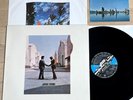
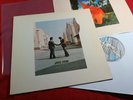
Ultimate KLAUS SCHULZE Reference Book '89 TINY PRINT RUN FOR FANS Obscure Unique
$
125
Favourite Auctions
To save auctions to your favourites, please login
If you don't have an account, please register
Description
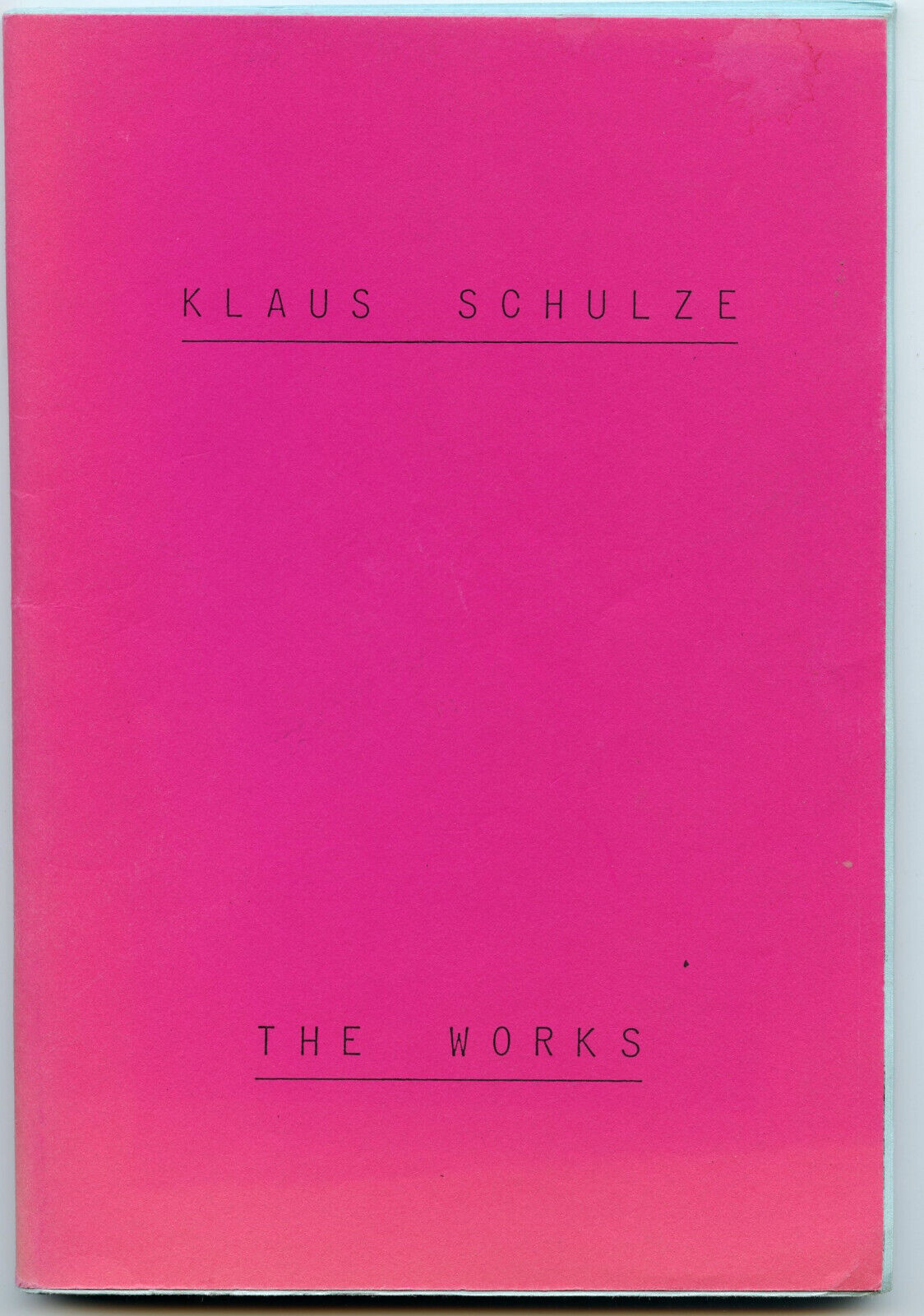
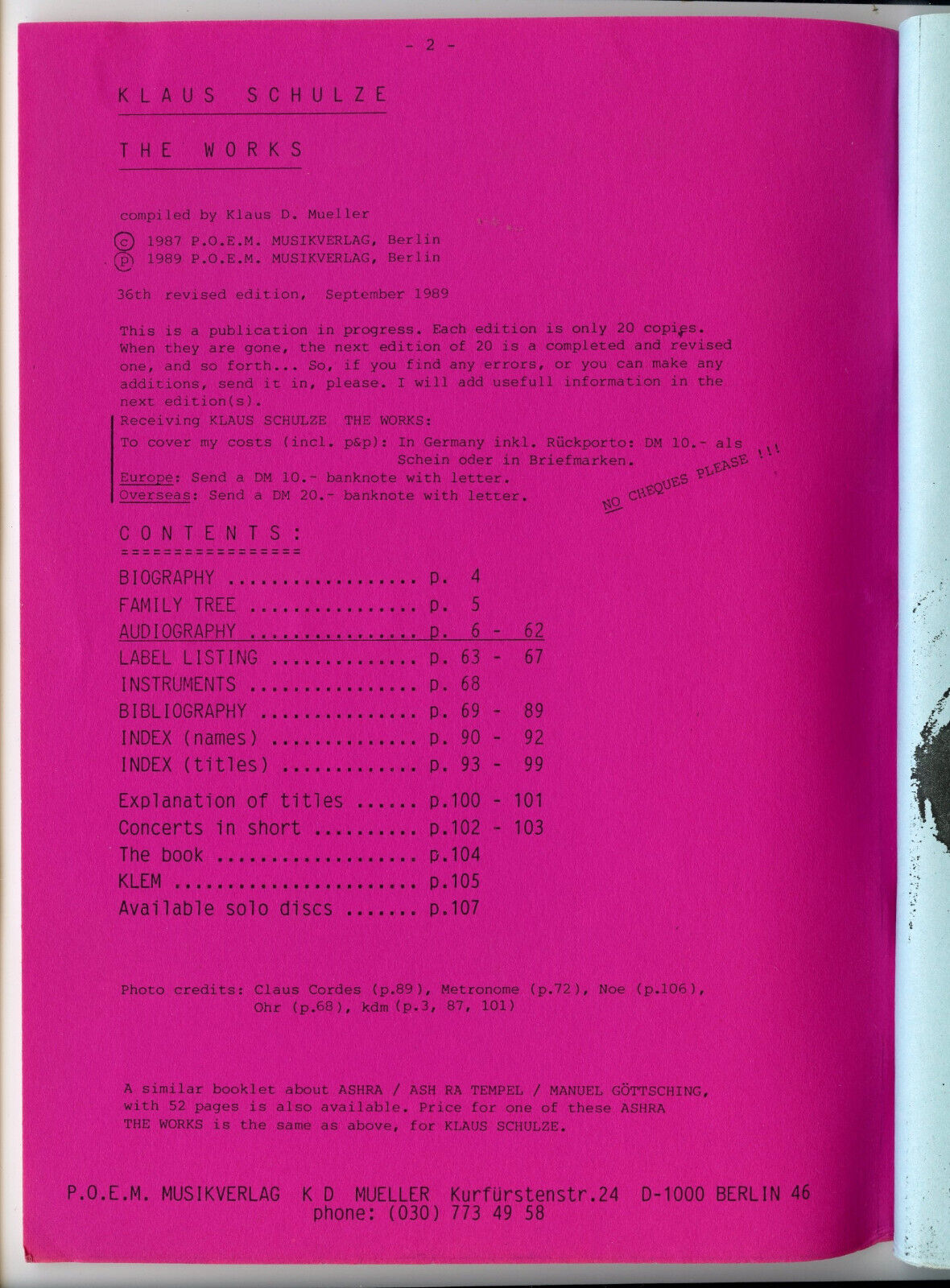
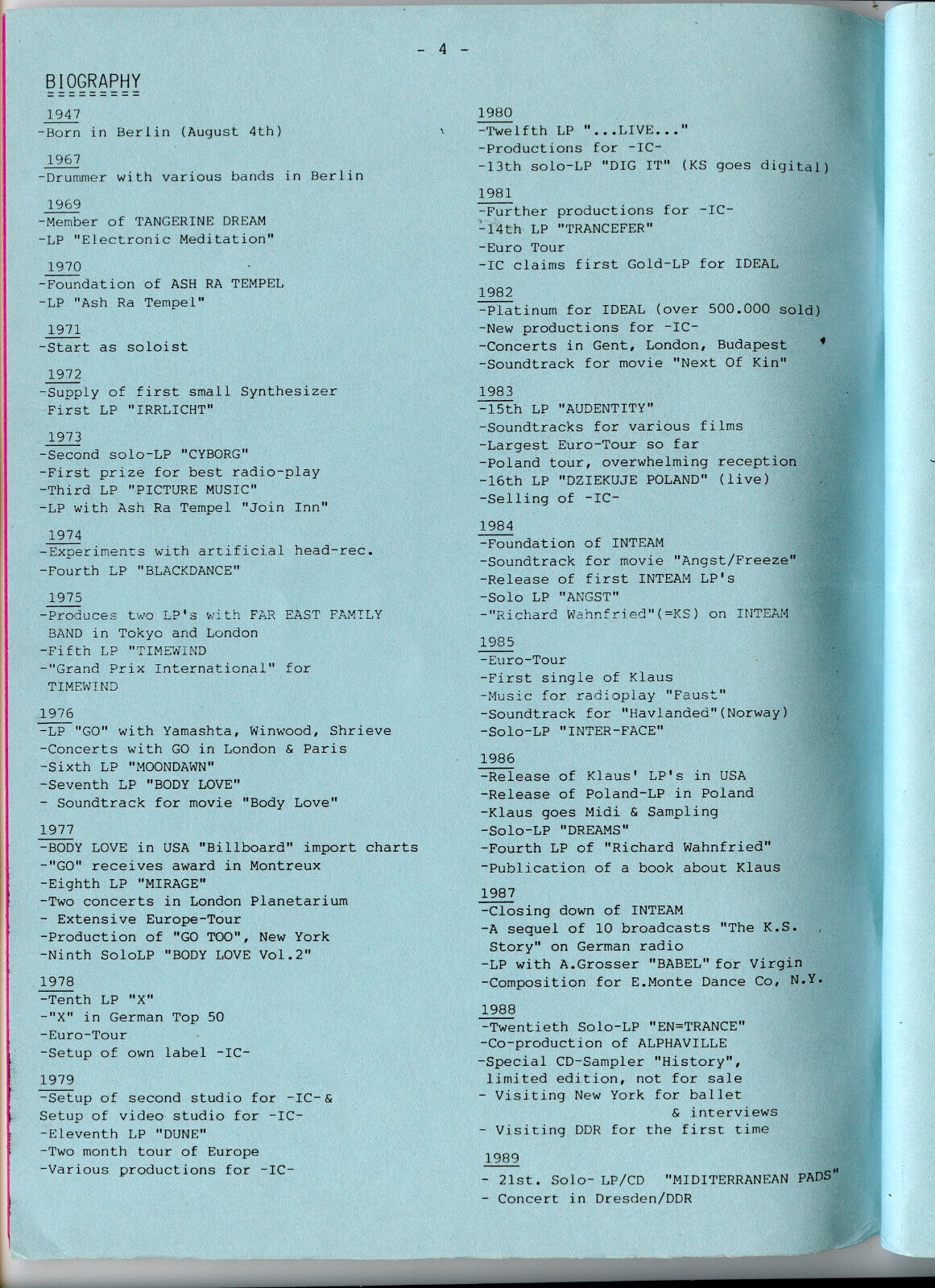
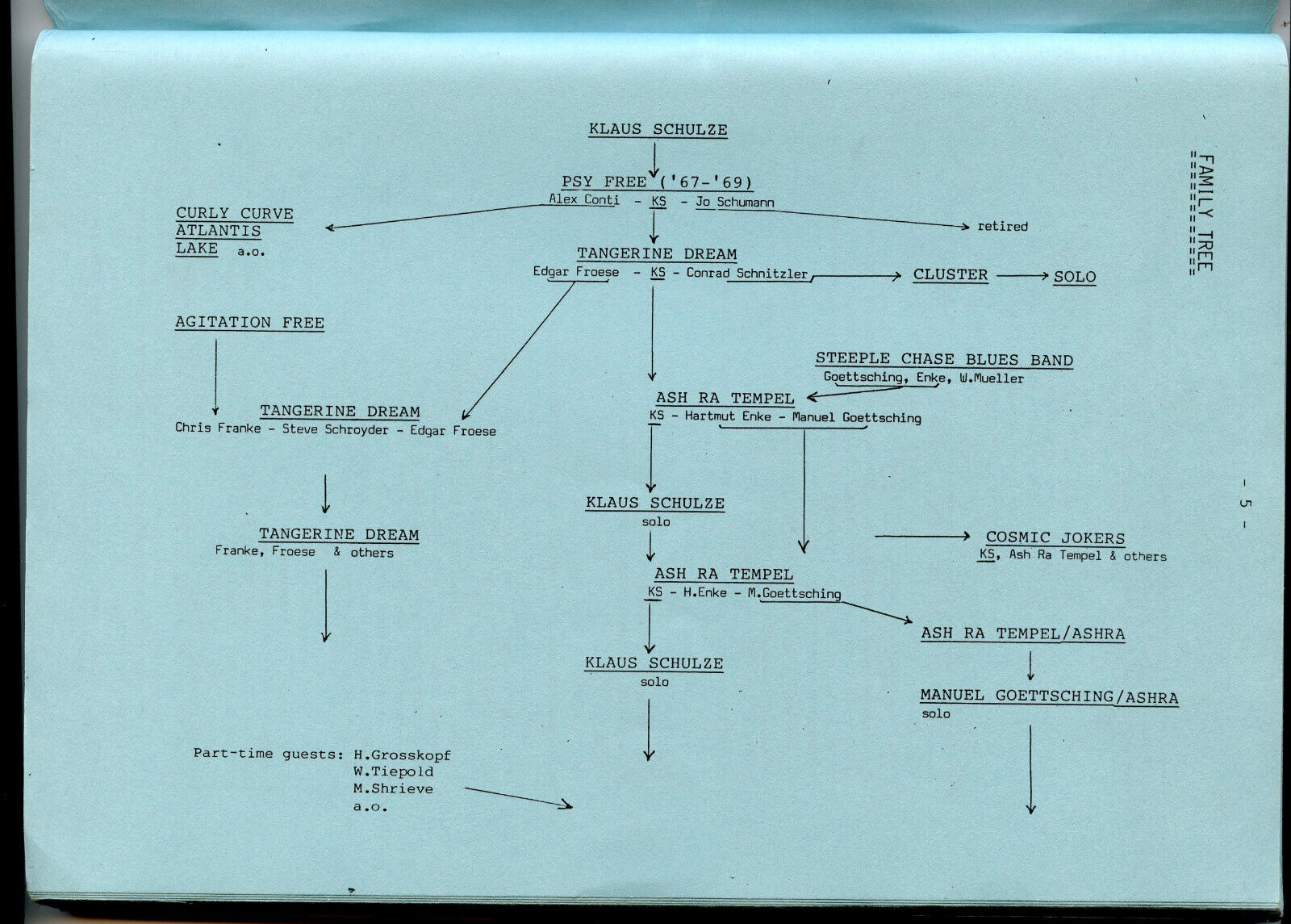
This is an exhaustive, early reference book on the German/Krautrock/Space music artist Klaus Schulze. Printed in Berlin in 1989. 107 pages, illustrated, Biography section, Musician/Group tree, Autobiography, labels, instruments, bibliography, discographies, complete track name and title indexes, concerts, and more.
8-1/4 x 5-3/4 inches, softcover. Psychedelic purple cover.
Title: Klaus Schulze, The Works.
Compiled by Klaus D. Mueller. Berlin.
CONDITION: Cover has faded slightly in these 30+ years. Otherwise excellent condition.
------
Klaus Schulze
Background information
Born 4 August 1947
Berlin, Allied-occupied Germany
Died 26 April 2022 (aged 74)
Genres
Electronic ambient kosmische krautrock trance
Occupation(s) Musician, producer
Instrument(s) Keyboards, synthesiser, sequencer, guitar, bass, drums, percussion, vocals
Years active 1969–2022
Labels Ohr, Brain/PolyGram, Virgin, Metronome, Manikin Records, Island, IC, Inteam, ZYX, WEA, Rainhorse, Synthetic Symphony, FAX
Website klaus-schulze.com
Klaus Schulze (4 August 1947 – 26 April 2022)[1] was a German electronic music pioneer,[2] composer and musician. He also used the alias Richard Wahnfried and was a member of the Krautrock bands Tangerine Dream, Ash Ra Tempel, and The Cosmic Jokers before launching a solo career consisting of more than 60 albums released across six decades.
Early life
Schulze was born in Berlin in 1947. His father was a writer and his mother a ballet dancer.[3] After graduating from high school, he delivered telegrams and studied German at the Technical University of Berlin.[4] He and his wife Elfie had two sons, Maximilian and Richard.[5][3]
Career
1970s
In 1969, Schulze was the drummer of one of the early incarnations of Tangerine Dream—one of the most famous bands that got the nickname "Krautrock" in English speaking countries (others included Kraftwerk and Popul Vuh)—for their debut album Electronic Meditation.[6] Before 1969 he was a drummer in a band called Psy Free. He met Edgar Froese from Tangerine Dream in the Zodiac Club in what was then West Berlin.[4] In 1970 he left this group to form Ash Ra Tempel[6] with Manuel Göttsching and Hartmut Enke. In 1971, he chose again to leave a newly formed group after only one album, this time to mount a solo career. In 1972, Schulze released his debut album Irrlicht with organ[5] and a recording of an orchestra filtered almost beyond recognition. Despite the lack of synthesizers, this proto-ambient work is regarded as a milestone in electronic music.[7] His follow-up album, Cyborg, was similar but added the EMS VCS 3 synthesiser.[8]
Since this point, Schulze's career was the most prolific, such that he could claim more than 40 original albums to his name since Irrlicht. Highlights of these include 1975's Timewind, 1976's Moondawn (his first album to feature the Moog synthesizer), 1979's Dune, and 1995's double-album In Blue (which featured one long track called "Return to the Tempel" with electric guitar contributions from his friend Manuel Göttsching of Ash Ra Tempel). In 1976, he was drafted by Japanese percussionist and composer Stomu Yamashta to join his short-lived "supergroup" Go,[6] also featuring Steve Winwood, Michael Shrieve, and Al Di Meola. They released two studio albums (Go in 1976 and Go Too in 1977) and one live album (Go Live from Paris, 1976).[9]
Throughout the 1970s he followed closely in the footsteps of Tangerine Dream, albeit with far lighter sequencer lines and a more reflective, dreamy sheen, not unlike the ambient music of his contemporary Brian Eno.[10] On occasions he would also compose film scores, including horror and thriller movies such as Barracuda (1978) and Next of Kin (1982).[10][11] Some of his lighter albums are appreciated by new-age music fans, despite the fact that Schulze has always denied connections to this genre.[12] By mid-decade, with the release of Timewind and Moondawn, his style transformed from Krautrock to Berlin School.[13]
Schulze had a more organic sound than other electronic artists of the time. Often he would throw in decidedly non-electronic sounds, such as acoustic guitar and a male operatic voice in Blackdance, or a cello in Dune (1979) and Trancefer. Schulze developed a Minimoog technique that sounds uncannily like an electric guitar. Schulze often takes German events as a starting point for his compositions, a notable example being on his 1978 album "X" (the title signifying it was his tenth album), subtitled "Six Musical Biographies", a reference to such notables as Ludwig II of Bavaria, Friedrich Nietzsche, Georg Trakl, and Wilhelm Friedemann Bach. His use of the pseudonym Richard Wahnfried is indicative of his interest in Richard Wagner, a clear influence on some albums like the aforementioned Timewind.[14]
Schulze built a record studio in Hambühren, Germany.[3]
1980s
In the 1980s Schulze started using digital instruments besides the usual analog synthesizers, and his work accordingly became less experimental and more accessible. Although the switch to using digital equipment is audible in the style of Dig It (1980), it was not until the release of Trancefer (1981) that the shift in style became evident.[15]
This newer style can also be found in Schulze's next release Audentity.[16] Both "Cellistica" and "Spielglocken" are composed in a similar sequencer-based style as on Trancefer, but this is certainly not the case of all of Audentity's tracks; indeed, "Sebastian im Traum" hints towards the operatic style to be found in some of Schulze's much later works. The predominance of sequencing can also be found in the follow-up live album Dziękuję Poland Live '83,[17] although many of its tracks are re-workings of those to be found on Audentity. Schulze's next studio-based album was Angst (soundtrack to the namesake 1983 film).[18] The cold yet haunting electronic rhythms generate an alienated atmosphere.[19] Typical are the Fairlight synth and Linn electronic drums sounds.[20]
Another highlight of this era was En=Trance with the dreamy cut "FM Delight".[21] The album Miditerranean Pads marked the beginning of very complex percussion arrangements that continued through the next two decades.[22]
In 1989, German band Alphaville released their album The Breathtaking Blue, on which Klaus Schulze was both a contributing musician and the album's producer.[23]
1990s
Starting with Beyond Recall, the first half of the 1990s was his "sample" period, when Schulze used a wide variety of prerecorded sounds such as screeching birds and sensuous female moans in his studio albums and live performances.[24] Sampling heavily died down with his 1995 album In Blue.[24] The decade also saw the release of copious amounts of previously unreleased material, of varying quality, in several limited-edition boxed sets.[25]
2000s
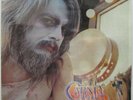
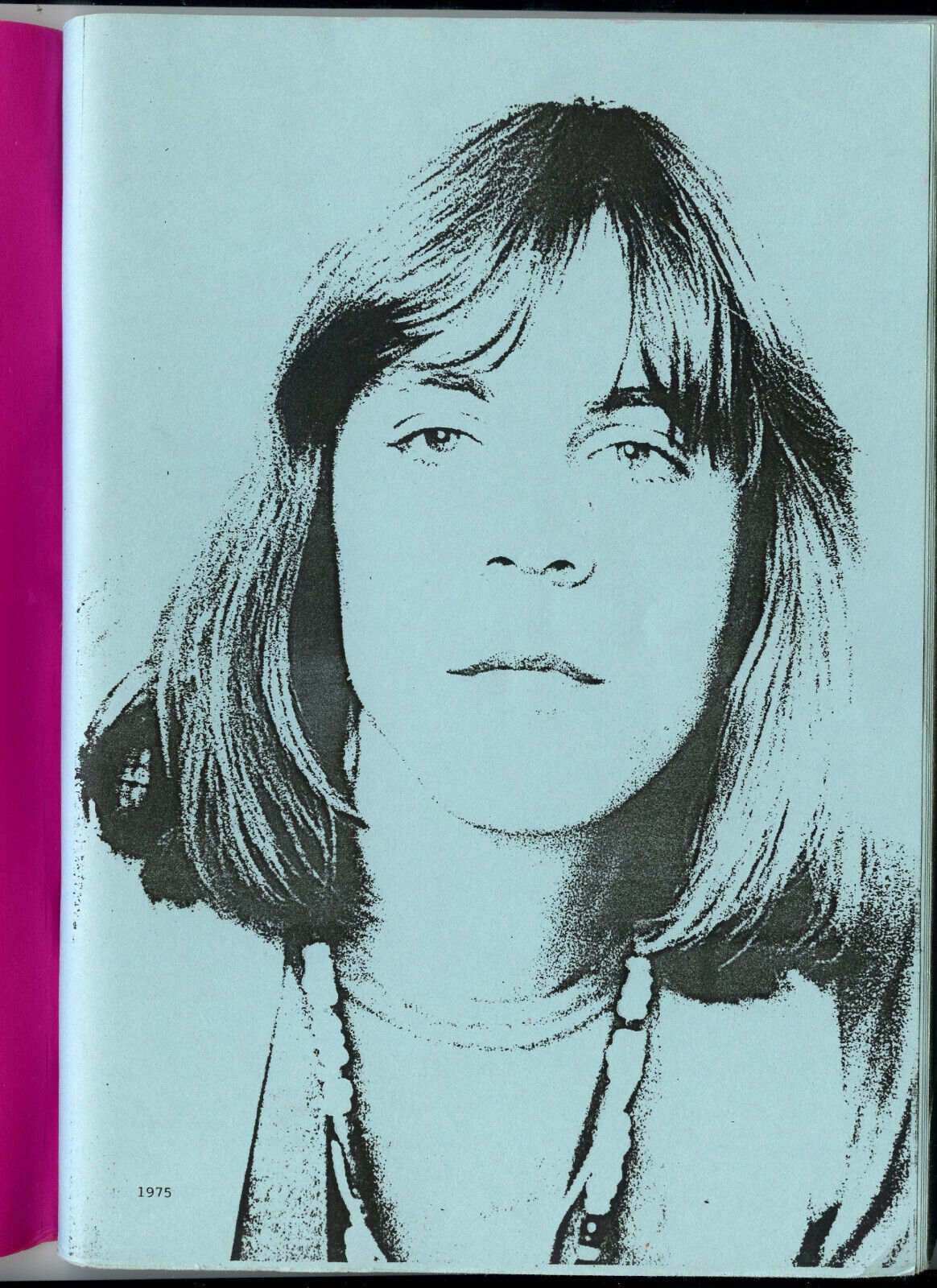
Klaus Schulze, portrait
In 2005 he began re-releasing his classic solo and Wahnfried albums with bonus tracks of unreleased material recorded at roughly the same time as the original works. In the latter part of the decade, Schulze produced albums and staged numerous live appearances with Lisa Gerrard.[26]
2010s
Big in Japan: Live in Tokyo 2010 was Schultze's fortieth album, and its release in September 2010 marked the beginning of his fifth decade as a solo musician.[27] The Japan concerts were to be his last live performances.[28]
His next album, Shadowlands, was released in February 2013, quickly to be followed by the release of The Schulze–Schickert Session 1975, a rare long-unreleased collaboration, in March 2013.[29] After a hiatus of several years, he returned to the studio in 2018 for another album, Silhouettes. Much of the album was recorded in a single take.[30]
2020s
Schulze died on 26 April 2022 following a long illness.[31] His final album, Deus Arrakis, was released on 1 July 2022.[30]
Richard Wahnfried
Richard Wahnfried, then simply Wahnfried after 1993, is the longtime and only real alias for Klaus Schulze – originally a pseudonym, later an official side project name. Seven albums were released under this name between 1979 and 1997.[24]
The main characteristics of the Wahnfried albums (as opposed to Schulze's regular works) are:
Often being oriented towards more mainstream genres (some would say "more commercial"), such as rock, dance, techno, and trance.[24]
Always allowing for collaborative and less electronic albums, with known or unknown guest musicians performing along with Schulze's synths.[32]
The pseudonym's etymology stems from Schulze's love for Richard Wagner:
Richard, evidently from Wagner's first name. Richard is also the name of Schulze's first son.
Wahnfried ("Peace from delusion and/or madness", in German), from the name Wagner gave to his villa in Bayreuth (and where he was later buried).[24]
In his 1975 album Timewind (four years before the first alias use), Schulze had already named a track "Wahnfried 1883" (in reference to Wagner's death and burial in his Wahnfried's garden in 1883). The other track on Timewind is called "Bayreuth Return".[33] After 1993, the albums are simply credited to "Wahnfried", and namedrop Schulze ("featuring Klaus Schulze", "Produced by Klaus Schulze").[34]
"Wahnfried" is the only known alias of Schulze (albeit on the 1998 Tribute to Klaus Schulze album, among 10 other artists, Schulze contributed one track barely hidden behind the "Schulzendorfer Groove Orchester" pseudonym).[35]
Discography
Albums
Schulze's concert performances are original compositions recorded live and thus listed as albums. An intensive reissue program of Schulze CDs began in 2005, with most releases having bonus tracks, and sometimes additional discs. They are published by the label Revisited Records (a division of German company InsideOut Music), and distributed by SPV.[36]
Source:[37]
Year Title Reissued
1972 Irrlicht 2006
1973 Cyborg 2006
1974 Blackdance 2007
1975 Picture Music 2005
1975 Timewind 2006
1976 Moondawn 2005
1977 Body Love (soundtrack) 2005
1977 Mirage 2005
1977 Body Love Vol. 2 2007
1978 X 2005
1979 Dune 2005
1980 ...Live... (live) 2007
1980 Dig It 2005
1981 Trancefer 2006
1983 Audentity 2005
1983 Dziękuję Poland Live '83 (live) 2006
1984 Angst (soundtrack) 2005
1985 Inter*Face 2006
1986 Dreams 2005
1988 En=Trance 2005
1990 Miditerranean Pads 2005
1990 The Dresden Performance (live)
1991 Beyond Recall
1992 Royal Festival Hall Vol. 1 (live)
1992 Royal Festival Hall Vol. 2 (live)
1993 The Dome Event (live)
1994 Le Moulin de Daudet (soundtrack) 2005
1994 Goes Classic
1994 Totentag
1994 Das Wagner Desaster Live (live) 2005
1995 In Blue 2005
1996 Are You Sequenced? (live) 2006
1997 Dosburg Online 2006
2001 Live @ KlangArt (live) 2008
2005 Moonlake
2007 Kontinuum
2008 Farscape (with Lisa Gerrard)
2008 Rheingold (live, with Lisa Gerrard)
2009 Dziękuję Bardzo (live, with Lisa Gerrard)
2010 Big in Japan: Live in Tokyo 2010 (live)
2013 Shadowlands
2013–14 Big in Europe (live, with Lisa Gerrard)
2014 Stars Are Burning (live)
2017 Eternal: The 70th Birthday Edition
2018 Silhouettes
2019 Next of Kin (soundtrack)
2022 Deus Arrakis[38]
Singles
Year Title Reissued
1985 Macksy[39] Released as maxi single only
1994 Conquest of Paradise[40] Partially reissued on La Vie Electronique 14
(Richard) Wahnfried albums
Composed by Schulze and performed with guest artists under alias Richard Wahnfried or later just Wahnfried:[41]
Year Title Reissued
1979 Time Actor 2011
1981 Tonwelle 2012
1984 Megatone 2021
1986 Miditation 2012
1994 Trancelation 2019
1996 Trance Appeal 2007
1997 Drums 'n' Balls (The Gancha Dub) 2006
2000 Trance 4 Motion[1] 2018
Notes
^ This album was originally issued as the third disc of Contemporary Works I.
Boxed sets
Between 1993 and 2002 Klaus Schulze released several limited edition boxed sets, all composed of non-album material.[25]
Year Title Discs Copies
1993 Silver Edition 10 2000
1995 Historic Edition 10 2000
1997 Jubilee Edition 25 1000
2000 The Ultimate Edition 501
2000 Contemporary Works I 10
2002 Contemporary Works II 52 2002
Notes
^1 Collecting Silver, Historic, and Jubilee sets, with additional 5 discs.
^2 A bonus sixth disc included with the first 333 copies.
Reissues from sets
Sources:[42][43][44][45]
Year Title From
2005 Vanity of Sounds Contemporary Works I (2000)
2006 The Crime of Suspense Contemporary Works I (2000)
2006 Ballett 1 Contemporary Works I (2000)
2006 Ballett 2 Contemporary Works I (2000)
2007 Ballett 3 Contemporary Works I (2000)
2007 Ballett 4 Contemporary Works I (2000)
2008 Virtual Outback Contemporary Works II (2002)
2009 La Vie Electronique 1 The Ultimate Edition (2000)
2009 La Vie Electronique 2 The Ultimate Edition (2000)
2009 La Vie Electronique 3 The Ultimate Edition (2000)
2009 La Vie Electronique 4 The Ultimate Edition (2000)
2010 La Vie Electronique 5 The Ultimate Edition (2000)
2010 La Vie Electronique 6 The Ultimate Edition (2000)
2010 La Vie Electronique 7 The Ultimate Edition (2000)
2010 La Vie Electronique 8 The Ultimate Edition (2000)
2011 La Vie Electronique 9 The Ultimate Edition (2000)
2011 La Vie Electronique 10 The Ultimate Edition (2000)
2012 La Vie Electronique 11 The Ultimate Edition (2000)
2012 La Vie Electronique 12 The Ultimate Edition (2000)
2013 La Vie Electronique 13 The Ultimate Edition (2000)
2014 La Vie Electronique 14 The Ultimate Edition (2000)
2014 La Vie Electronique 15 The Ultimate Edition (2000)
2015 La Vie Electronique 16 The Ultimate Edition (2000)
2016 Privée Contemporary Works I (2000)
2016 Another Green Mile Contemporary Works II (2002)
2017 Androgyn Contemporary Works II (2002)
2017 Ultimate Docking Contemporary Works I (2000)
2018 Trance 4 Motion Contemporary Works I (2000)
2018 Cocooning Contemporary Works II (2002)
2019 Timbres of Ice Contemporary Works II (2002)
"The Dark Side of the Moog"
"The Dark Side of the Moog"[24] is a Klaus Schulze collaboration with Pete Namlook (joined also by Bill Laswell on volumes four to seven).[46] Each title is a distortion of Pink Floyd song and album titles.
Source:[47]
Year Title Pink Floyd Title
1994 The Dark Side of the Moog: Wish You Were There "Wish You Were Here"
1994 The Dark Side of the Moog II: A Saucerful of Ambience "A Saucerful of Secrets"
1995 The Dark Side of the Moog III: Phantom Heart Brother "Atom Heart Mother"
1996 The Dark Side of the Moog IV: Three Pipers at the Gates of Dawn The Piper at the Gates of Dawn
1996 The Dark Side of the Moog V: Psychedelic Brunch "Alan's Psychedelic Breakfast"
1997 The Dark Side of the Moog VI: The Final DAT "The Final Cut"
1998 The Dark Side of the Moog VII: Obscured by Klaus "Obscured by Clouds"
1999 The Dark Side of the Moog VIII: Careful With the AKS, Peter "Careful with That Axe, Eugene"
2002 The Dark Side of the Moog: The Evolution of the Dark Side of the Moog
2002 The Dark Side of the Moog IX: Set the Controls for the Heart of the Mother "Set the Controls for the Heart of the Sun"
"Atom Heart Mother"
2005 The Dark Side of the Moog X: Astro Know Me Domina "Astronomy Domine"
2008 The Dark Side of the Moog XI: The Heart of Our Nearest Star "Set the Controls for the Heart of the Sun"
The Evolution of the Dark Side of the Moog is a compilation album, containing excerpts from the first eight volumes. The series was announced as officially concluded with volume ten when on 21 March 2005 at 14:52 CET, Pete Namlook sold the Big Moog synthesizer that was the symbol of the series. Volume eleven appeared on Namlook's website on 15 April 2008 (and was included in a complete box set).[48]
Collaborations
Source:[49]
Year Title Collaborator
1970 Electronic Meditation Tangerine Dream
1971 Ash Ra Tempel Ash Ra Tempel
1973 Tarot Walter Wegmüller
1973 Join Inn Ash Ra Tempel
1973 Lord Krishna von Goloka Sergius Golowin
1974 The Cosmic Jokers The Cosmic Jokers
1974 Planeten Sit-In The Cosmic Jokers
1974 Galactic Supermarket The Cosmic Jokers
1974 Sci Fi Party The Cosmic Jokers
1974 Gilles Zeitschiff The Cosmic Jokers
1974 Planet of Man Code III
1976 Go Go
1976 Go Live from Paris Go
1977 Go Too Go
1979 French Skyline Earthstar
1984 Aphrica Rainer Bloss and Ernst Fuchs
1984 Drive Inn Rainer Bloss
1984 Transfer Station Blue Michael Shrieve and Kevin Shrieve
1987 Babel Andreas Grosser
2000 Friendship Ash Ra Tempel
2000 Gin Rosé at the Royal Festival Hall Ash Ra Tempel
2009 Come Quietly Lisa Gerrard
2013 The Schulze–Schickert Session Günter Schickert
2021 Grains of Sand from The Dune Sketchbook[50] Hans Zimmer
Promos
2003 Andromeda[51]
2004 Ion[52]
2009 Hommage à Polska (with Lisa Gerrard)[53]
Compilations
1979 Rock On Brain[54]
1980 Star Action[55]
1988 History (for promotional use, limited to 1,000 copies)[56]
1991 2001[57]
1994 The Essential 72–93[58]
1999 Trailer[59]
See also
Berlin School of electronic music
Kosmische Musik
Urs Amann, illustrator of Schulze's early records
price rating