UK LTD ED ORIG HAWKWIND ACID PSYCH PROG 1967 - '82 = 3 VOLUME SET + BOOKLET
$
93


Favourite Auctions
To save auctions to your favourites, please login
If you don't have an account, please register
Description
PLEASE READ BEFORE BIDDING: Please read the entire auction listing, including shipping costs, before writing to ask a question. OUR GOAL IS CUSTOMER SATISFACTION. In order to meet that goal, we will ALWAYS work with our customers on any concerns that may arise. In the unlikely instance that you feel the need to open a resolution dispute before working with us, you will immediately be blocked from any further chance to acquire the rare music we present each and every week. Payment is required within seven days. We mail all paid items ONE WEEK after auctions end. Please keep in mind our listings are time consuming in detail and we are often traveling to find these gems, which at times delays the delivery schedule by a day or two. We ALWAYS process and ship every paid order. We have no control over parcels once they are mailed from our local Post Office.Overseas mail to some countries (Italy, Russia, France, in particular) has became very slow. Opening a dispute for slow mail is unacceptable and will result in blocking the bidder. We work hard to provide excellent service as is represented by our 8000 plus positive feedback. We use a VPI machine and thoroughly clean all records. Each order is carefully packaged by removing the LP from the jacket to avoid seam splits, use of 3 ml plastic cover sleeves over each LP and jacket, cardboard pad inserts, and placed in sturdy record mailers for safe delivery. We take Customer Service seriously, and want you to be satisfied. Please give us 5 stars in each category through the feedback system, and we will be able to effectively continue to fulfill your passion for rare and collectible music! We have served thousands of satisfied customers - far more than our feedback records indicate - and our aim is to continue to do so. Thank you for your interest and support. ~~~~~~~~~~~~~~~~~~~~~~~~~~~~~~~~~~~~~~~~~~~~~~~~~~~~~~~~~~
SHIPPING: USA ~ 1 LP = $4.00 Media Priority rates vary by area; please inquire. All Canadian and Overseas shipping ~ Please inquire about rates. Priority shipping rates required on any order $200+ ~ Also, in the best interest of all of us, safe Express shipping rates on any order totaling $400+ Discount shipping on multiple LPs in same order. ~~~~~~~~~~~~~~~~~~~~~~~~~~~~~~~~~~~~~~~~~~~~~~~~~~~~~~~~~~
The Amazing Journey...
1967 ONWARD ~ ACID PROG PSYCHEDELIA
HAWKWIND
The Approved History
\ UK - SAMAURI - 045
FINAL COLLECTION COPY!
UK LIMITED EDITION -- LONG LONG GONE:::::
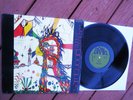
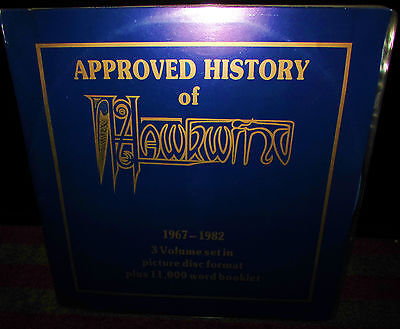
Ages old BRITISH-ONLY limited pressing for fans - essential to all Hawkwind & Prog Psych collectors....Three picture discs in a clear plastic wallet type cover with an extensive lavish booklet revealing the amazing journey of this legendary acid-heads band. A great investment as so many of these tracks are widely unavailable having been hand selected from Hawk leader Dave Brock's personal library. Altogether a real gem for collectors. If you have the time & interest an extensive LP overview with notes on each track follows below:::: ~HAWKWIND~The constant factor and driving force behind Hawkwind has always been Dave Brock. Musicians come and musicians go, each adding their own contribution to the sounds and directions of the band, but Dave Brock remains the one person to be involved with the band at all times and it is from his collection of tapes that this triple disc set has been drawn.
Dave Brock selected the songs to be found here, tracing the history of the band from its pre-Hawkwind 1967 psychedelic-blues origins through to 1982 space age adventures and presenting an alternative history to the kind which would have been shown by a 'greatest hits' offering. Just as they did on the Isle of Wight in 1970, Hawkwind have again opted to play
'outside the fence'. This is a history of Hawkwind, covering the highlights and turning points which Dave Brock recalls as being the most important. Thus, we skip the musically good but non-Hawkwind style of the Astounding Sounds period while featuring a part of the Watchfield Free Festival tapes, where four members of the band went straight from a paying gig to play a free show a few miles away. On the Friday night they headlined at Reading Festival and earned their keep: on the Saturday they played for fun at Watchfield and it is
this gig which Brock considers to be of greater import. Given this viewpoint, it is hardly surprising that when the 1985 Stonehenge Free Festival was banned Hawkwind still gave a free show a few miles away, at Westbury, despite having no pay and no lightshow.
Here, then, is the alternative history of Hawkwind: an audio diary of a group of anarchists, free spirits, people who did - and still do - follow their own path.
<><><><><><><H><A><W><K><W><I><N><D><><><><><><><><><>
The Famous Cure: Dealing With The Devil (1967)
Dave Brock - vocals, slide guitar
John Illingworth - acoustic guitar
Pete Judd - harmonica
Rob Hoeker (guest) - piano
A. N. Other (guest) - drums
Since Dave Brock has always been the principal source of energy and direction behind Hawkwind, logic dictates that our story should begin with his pre-Hawkwind career. After all, it is this chain of events which led to the formation of the band and to the direction it was to take.
If Dave Brock had never taken up the banjo and played in jazz bands around 1959/1960, Hawkwind may never have come to be. Fortunately, he did that thing and spent five months playing banjo with a band called The Gravnier Street Stompers, playing New Orleans jazz. On one occasion, he played banjo with Ken Collyer's Jazz Band, one of the top bands of the time. Those early days of playing jazz must have planted the seeds of the free-form music jams which Dave was to encourage in Hawkwind a decade later.
Dave soon switched to guitar and took up busking and playing solo spots in jazz, folk and blues clubs, filling in between the main acts. When not playing, he was regularly at the clubs with friends, often at Ken Collyer's Jazz Club or at Eel Pie Island Jazz Club. He also loved to play different kinds of guitars and to experiment with his own guitars, always in search of interesting sounds. Jeff Watson, a regular companion of Dave's in those days recalls:-
"Dave had a Michigan guitar.... that is a Spanish style with a steel resonator in its belly. He also had a twelve-string on which he used to use a top banjo string on the second pair of strings. He taught me a very good way of clawhammer picking, using thumb and first finger instead of thumb and first three fingers."
So Dave Brock was already interested in experimenting with sounds and this Anthology Collection will show that such an interest has not waned over the years by any means.
Then there is the question of his attitude to the World. In the sixties, he could be found at various demonstrations and Easter would find him on the Aldermaston March, the principal CND demonstration of the time. This outlook persists too. He still supports CND and is as likely to lead a demonstration as follow one.... such as playing the alternate Stonehenge event at Westbury in 1985.
In 1964 Dave Brock and Luke Francis began playing as a duo, later to be joined by Mike King and, in time, to be known as The Dharma Blues Band. They played gigs and recorded some songs, two of which were used on blues compilations during that period and have also been issued on blues compilations during the eighties. These songs were Roll 'em Pete and the better known Dealing With The Devil (Blues was known as 'The Devil's Music'). If you should happen across one of these albums you'll certainly find on it another of Dave Brock's friends, with whom he spent a lot of time in the sixties, Eric Clapton. In fact their regular companionship led to a Famous Cure information sheet incorrectly claiming Dave Brock to have once been in the Yardbirds.
This line-up of The Dharma Blues Band released no records by themselves, though in 1967 Mike King, John Hillary and Gary Compton released an album called Dharma Blues (Major Minor SMCP 5017). Whether or not this could be called a Dharma Blues Band album is a matter of opinion since neither of the two founder members were involved, yet Mike King was a member by the time they took to using that name. Whatever, the album is certainly built on the material played by the Dharma Blues Band and I think it would have sounded pretty much the same had the original line-up made it.
Dave Brock and Pete Judd formed another duo in 1966, playing jazz, folk and blues clubs with even a little radio work, .including a John Peel Show and a show with Clodagh Rogers, both 'very big names' at that time. They were joined by John Illingworth and in 1967 they went to Holland where they played under the name of The Famous Cure. Holland, at that time, was the 'in' place to go, just as a few years before it was considered trendy to have been to Germany.
It worked well. They achieved a measure of success, their name was known and they earned a few articles in the music press. They played regular gigs and recorded a number of songs including, as might be expected, Dealing With The Devil, a fitting start to the Hawkwind Anthology. The band came back to England after playing a series of Spring gigs in Holland. Pete left and Mick Slattery joined and on September 16th the band signed to a management company before returning to Holland.
The second Famous Cure line-up recorded a single called Sweet Mary which reached number five in the Dutch charts. The band also recorded a couple of 'live' tracks. Dust My Shoes and one other, the title of which is long forgotten, and these two were released on an album called Harlem Blues Festival. It also seems highly likely that other Dutch Blues albums have Famous Cure material thereon.
The Famous Cure now had two future Hawkwind members within its ranks and during 1967 the band joined a Rock and Roll Circus, Tent '67, where they met Nik Turner, another future member of Hawkwind.
Dave Brock: Bring It On Home (1968)
Dave Brock - guitar, vocals
Session musicians - backing
The Famous Cure came back to England late in 1967 and played a few gigs before splitting up early in 1968. One of these gigs also had the Deviants on the bill.... the band which led to the forming of the Pink Fairies, whose destiny was to be closely interwoven with that of Hawkwind during the early seventies.
Brock turned once again to full-time busking. This was the year of the buskers, when Don Partridge came into the limelight and had a chart-topping success with his single, Rosie. Buskers underwent an upsurge in popularity and Don Partridge headlined a countrywide buskers tour with a large number of buskers travelling around in a double-decker bus. The acts were widely mixed, including tap dancers, sand dancers, players of spoons, guitars, banjos, accordians and various other instruments. The acts, which covered a wide range of music including cockney songs, folk, pop, blues, etc., included Dave Brock. The troupe also played a gig at the Royal Albert Hall.From that period we have Bring It On Home, a typical example of Brock's busking material.
Hawkwind: Hurry On Sundown (1970)
Came Home (1970)
Dave Brock - guitar, vocals
Nik Turner - saxophone
Huw Lloyd Langton - guitar
DikMik - audio generator
John Harrison - bass
Terry Ollis - drums
1969 and buskers everywhere. Brock continued to busk (he did so until 1970) but there were so many buskers riding the wave of 'busker fashion' that the 'audience' was shared by so many buskers that none of them could earn as they used to do. It was time to form another group and this time Dave wanted a group which would perform music that was different to the output of other groups.
While busking along Tottenham Court Road, Dave Brock met John Harrison, who worked in that area, and they became friends, both interested in getting a band under way. Ex-Famous Cure man Mick Slattery was also interested and the three of them put an advertisement in Melody Maker. Along came a drummer, Terry Ollis.
They rehearsed in the basement of a Putney music shop owned by Bob Kerr (ex-Temperence Seven) and sometimes at the Royal College of Art. They met Nik Turner from time to time (Brock had met him again while he, Dave, was busking outside the Marquee - seven years later, they would be in offices above the Marquee, signing a five album contract with Charisma) and since Nik had a van he was taken on as the Hawkwind roadie. However, his sax soon elevated him to member of the band, where he added a new dimension to their sound. DikMik, another old friend, also joined and the band continued to rehearse and play clubs whenever they got the chance. In the absence of a name to call themselves they went under the identity of Group X.
The most famous of these gigs was a short, ten minute jam they played one Summer evening of 1969 at the All Saints Hall in Notting Hill Gate, London. It was there that they were 'spotted' by Douglas Smith of Clearwater Productions. In those few brief minutes Douglas saw that the band had potential and wasted no time in signing them to Clearwater and securing their record deal with United Artists, on the Liberty label. Other artists with Clearwater included Tim Blake, Thomas Crimble (in Skin Alley) and Simon House (in High Tide), all of whom would eventually join Hawkwind for a while.
The band adopted the name Hawkwind Zoo and recorded a demo to gain their United Artists contract, 'Hurry On Sundown'/'Kiss Of The Velvet Whip' (later changed to 'Sweet Mistress Of Pain'). These two tracks, along with a 1975 recording of 'Kings Of Speed' were released in 1981 by Flicknife Records (FLHP 100). Soon after this recording and shortly after the signing with United Artists, Mick Slattery left the band and quit the music business. A new guitarist was found in the form of Huw Lloyd Langton. As might be expected, Huw was already known to Dave Brock. Huw used to work at the music shop where Dave bought some of his equipment and in one day after Mick had left, Dave was in the shop talking to Huw and suggested that Huw come along and join the band at a gig that night. He did so and joined the band.
These two songs, 'Hurry On Sundown' and 'Came Home' are good examples of that early Hawkwind and clearly show the curious blend of blues background blended with the pop music style (a hook to catch UA) and the way in which they played a kind of wild, free-form jazz with electronics (bear in mind that in Brock's jazz days he played New Orleans jazz, not the tame British variety). What the music often lacked in polish in those days it made up for in originality of approach: experimental music and unusual sounds mixed into long,
energetic jams with a heavy, driving rhythm. The music was pushed further into the realms of experience with the aid of a somewhat frantic lightshow and, invariably, chemical substances that shall remain nameless.
By 1970 they were gigging regularly and had even done a session for the BBC. They were now called Hawkwind (the Zoo part of it had soon been dropped) and had released their First single, Hurry On Sundown (Liberty LBF 15382) and their first album, Hawkwind (Liberty LBS 83348). Dick Taylor (ex Pretty Things) produced the album and, anonymously, played guitar on parts of it.
Hawkwind: We Do It (1971)
Dave Brock - guitar, vocals
Nik Turner - saxophone
Huw Lloyd Langton - guitar
DikMik - audio generator
Dave Anderson - bass
Terry Ollis - drums
Shortly after the first album was released, John Harrison left and was replaced by Thomas Crimble (ex Skin Alley) and when he left in May 1971 (he went on to organise Glastonbury Fayre) his place was taken by Dave Anderson (ex Amon Duul II). During this 1970-1971 period they played as many gigs as they possibly could and could be found at just about any benefit gig going, becoming one of the best-known 'underground' bands. They got coverage in the national music press and constant coverage in the alternate press, where Robert Calvert and Michael Moorcock, who would later become involved with the band, were regular contributors.
Their most famous gig of this period was when they played for a week outside the site of the Isle of Wight Festival in August 1970...a protest against the high price of admission. Jimi Hendrix came outside to sit and talk with the band (later Hawkwind member, Lemmy, had once roadied for Hendrix) but was too depressed to jam with the band. It's ironic that their protest was against the price of entry to the festival since the band knew the security staff and were thus able to enter for nothing. They did so and Nik, with his face painted
silver and stars on his clothes was much photographed and could shortly be seen in such publications as Vogue, Paris Match, Telegraph Magazine and the Daily Express. During his set, Hendrix dedicated a song to 'The cat with the silver face'.
Soon after the festival, Huw left to play in a number of bands, the most notable of which was Widowmaker.
Robert Calvert, although not a member of the band, appeared at some gigs with them as poet. When Dave Brock and Dave Anderson were too ill to play at the June 1971 Glastonbury Festival, Thomas Crimble stepped in on guitar and Robert Calvert took over on vocals. Stacia also joined the band to do her first Hawkwind performance at that event. She had first met Nik at the Isle of Wight Festival in the previous year.
We Do It sang the band in 1971...and indeed they did. Their support grew, as did their entourage and their music underwent a gradual change, developing all the while. They continued to play long instrumental pieces but now with more concentration on maintaining a powerful, driving rhythm. They moved on to songs instead of instrumental pieces although the vocals were usually placed at either end of lengthy jams. Alternately, as with We Do It, the vocals were more along the lines of chants, used to complement the rhythm rather than dominate it. This repetitive music, combined with a very bright and fast-moving lightshow had an hypnotic effect on the audience, often aided by the fact that the audience was as stoned as the band. Hawkwind also experimented with electronics to create sounds which could not be heard, yet produced vibrations which registered on the brain. The band attempted to assault as many senses as possible. You could walk into a concert and have to be carried out...and not be quite sure why.
Shortly after the Anthology version of We Do It was recorded, Del Dettmar left his position at the mixing desk and joined the line-up on stage, initially to cover the departure of DikMik, who kept leaving and rejoining. DikMik played on In Search Of Space (United Artists UAG 29202) which was recorded in the Summer of 1971 and released in October, and then left before the cover was made. He came back again after the cover was done which is why his picture appears on the sleeve as part of the background instead of in a 'frame' like the others. The album was released in a colourful and complex fold-out sleeve along with a 24 page booklet called 'The Hawkwind Log' which had been put together by Robert Calvert and Barney Bubbles, who was soon to be looked upon as the Hawkwind artist.
Following her appearance at Glastonbury, Stacia became a regular member of the band, bringing the line-up to seven.
Hawkwind: Born To Go (1972)
Space Is Deep (1972)
You Shouldn't Do That (1972)
Seeing It As You Really Are (1972)
Earth Calling (1973)
1972 and 1973 were great years for Hawkwind, giving them a single which reached number three in the charts and an album which reached number nine, with packed venues all the way.
The build-up to this period of success began in the Summer of 1971, when Dave Anderson left. Although an exciting bass player, Dave Anderson did not easily fit in with the band. Their attitudes clashed and a typical example of how this caused resentment in minor matters lay in the rest of the band being angry to see Anderson turn up to a gig in his flashy car when the rest of them arrived packed into an old van. Years later, when guesting at a couple of Hawkwind gigs in 1984, Dave was to once again completely outclass them with his car.
Dave Anderson's bass was a loss to the band but compensation came in the form of his replacement, an old friend of DikMik's...Lemmy. It must have been something of a headache, trying to keep the wild bassman in order and to ensure that he got to gigs and was able to play when he got there but it was worth it for the energy he injected into the band, both audibly and visually.
In January 1972 Terry Ollis left the band and Lemmy's friend, Simon King was brought in to fill the spot. Three years earlier, Lemmy and Simon had played together in Opal Butterfly and so were familiar with each other's playing styles. Simon's drumming was fast and powerful and this, combined with the aggressive bass style of Lemmy, served to make the Hawkwind sound even heavier than before. The extensive use of electronics to create unusual sounds running through the music had always set Hawkwind apart from other
bands and with the arrival of Lemmy the music itself took on a new slant. Lemmy was a guitarist who switched to bass in order to join Hawkwind and instead of playing bass in the conventional way he played it as though it were a rhythm guitar, thereby producing a much more solid sound.
Robert Calvert joined on a regular basis, completing the famous Space Ritual line-up, which lasted throughout 1972 and up to August 1973, when DikMik finally left for good. In November, Calvert left too and the Space Ritual period was over. Meanwhile, it lasted for eighteen months, a long time by Hawkwind standards, and enjoyed huge success.
The starting point to this was without doubt the thirteenth of February 1972 when Hawkwind headlined at the Roundhouse on the occasion of the Greasy Truckers Party. It was an event which went well for Hawkwind. The audience were in good humour and so were the band: the ideal atmosphere for a good time. They were preaching to the converted and could do no wrong and as such could relax and give a magical performance. They managed to combine their usual manic pace blended with a dash of humour in the electronics, most noticeable in a rousing version of 'Master Of The Universe'. This song, along with 'Born To Go', appeared as one side of a double album of the event released by United Artists (UDX 203/4). Also recorded at that gig were 'Silver Machine' and 'Welcome To The Future' and these appeared on the Glastonbury Fayre triple album (Revelation REV1A-3F), though it must be said that these two lacked the magic of the two tracks on the Greasy Truckers Party album. Nonetheless, 'Silver Machine' was taken into studio to be smoothed, polished and released as a single (United Artists UP 35381), a much cleaned-up recording of the Roundhouse
performance. Calvert's vocals, none too clear on the original tapes, were removed and since he was not available to re-record them (he was temporarily away from the band due to mental health problems) the vocals on the record were those of Lemmy. Perhaps this was a good thing. Certainly Lemmy's singing was more powerful than Bob's and this may have been the thing which tipped the balance and boosted sales, for sell it did. Number three in the British charts and soon released all over the World in just about every record-making country.
Suddenly, Hawkwind was a household name and 'Silver Machine' was on every juke-box (it still is in many of them!). Hawkwind even appeared on Top Of The Pops but, as might be expected of them, they refused to go to the studios and mime the song...they insisted that the BBC attend a Hawkwind gig and film the band playing it for real and the demand for Hawkwind was such that the BBC agreed. The performance was shown three times on Top Of The Pops and half of it was later used in a programme about Michael Moorcock.
For once the band had money at their disposal and they used this to mount their ingenious Space Ritual tour, a riot of colours, dance and music, with lights, slides, films etc. It was a truly adventurous and spectacular rock show, lasting a couple of hours and it earned them much respect and admiration in the music business. At last it was clear that they were a force to be reckoned with and not just a bunch of Notting Hill Freaks playing at being a band. Of course, it was a two-edged sword, as is often the case. The Space Ritual was so impressive and its greatness must have grown in the telling and in fading memories that for years the band had to work hard to compete with the image of its own past. What the show did achieve, riding hard on the success of 'Silver Machine', was to take Hawkwind across the Pond to America and give them the chance to break new ground. This they did in 1973, being the first British band to go there to headline on their first tour instead of starting out as a support act. Before they did this, they took the tour to Europe, where it also met with much success.
For the 1972 British tour and the early 1973 tours, the Space Ritual was used to promote their third studio album, Doremi Fasol Latido (United Artists UAG 29634). This rather heavy, rather spacey album, mixed by Dave Brock while he was somewhat stoned must have come as something of a shock to fans who bought it on the strength of hearing 'Silver Machine'. Likewise, the concert halls held an interesting combination of long-term fans who knew what to expect of the band and fans who expected to hear songs sounding more or less the same as 'Silver Machine'.
In May of 1973 United Artists released the classic Space Ritual Alive (UAD 60037/8) double album. The tapes had been cleaned up but still retained the 'live' quality and the atmosphere of the gigs and it is hard to imagine the band ever presenting a better 'live' double. Without doubt, it captures the complete flavour of the tour and one only has to close ones eyes and picture the dancers and Liquid Len's amazing liquid lightshow to relive the shows.
'Born To Go', 'Space Is Deep' and 'Earth Calling' come from the main set. 'You Shouldn't Do That' and 'Seeing It As You Really Are' were part of the encore.
Their third single, 'Urban Guerilla' (United Artists UP 35566) was released in August 1973. Strangely, over a year had been allowed to slip by since the release of 'Silver Machine' and this must have removed any chance they had of riding on the crest of the 'Silver Machine' wave in order to secure a second hit single and thereby make their success more secure. Nonetheless, 'Urban Guerilla' reached number 39 in the charts on the week of release and was promptly withdrawn as it was felt that the urban warfare lyrics were less than tactful in view of the outbreak of terrorist activities at that time.
Logically, another single would have been in order but none was forthcoming, though 'Lord Of Light'/'Born To Go' was released in Germany (United Artists 35 492). In effect, Hawkwind abandoned the singles market without capitalising on their success.
Their American tour, which started in November, minus Bob and DikMik who had left and minus most of the lighting rigs which were too expensive to take, marked the end of the main Space Ritual era. They had done well from it, having toured England, Europe and America with it, performed an hour of it for the BBC radio concert (broadcast in August 1973) and produced their best-selling album from it. It also yielded one of their curio items, a promo disc in the form of a one-sided single of 'Sonic Attack' (United Artists - no catalogue
number) presented in a cloth bag.
Hawkwind: Motorhead (1975)
Dave Brock - guitar, vocals, synth
Lemmy - bass
Alan Powell - drums
1974 brought more changes. The band toured the United Kingdom in January and February and returned to America in March. Simon House went with them, as a guest only because he had no work permit, but still jammed in with the band during the tour. When they got back to England, Simon joined full-time, presenting keyboard work of a much more musical nature than had previously been associated with the band. His deft playing of the violin and powerful, sweeping chords on keyboards gave Hawkwind a somewhat grand and majestic sound on their Summer 1974 album, Hall Of The Mountain Grill (United Artists UAG 29672), and
their single, Psychedelic Warlords (United Artists UP 35715), giving the band added credibility with the music press. Del Dettmar continued to play synthesizer but instead of being on stage with the band he now performed from the mixing desk because from that vantage point he could get a better idea of how the sound was coming over and thereby offer the best in improvisation and sound effects. In June, he left the band and
emigrated to Canada, having bought a plot of land there on their previous North American tour. Hall Of The Mountain Grill featured more Barney Bubbles artwork on the front but it is perhaps the rear cover which is more noteworthy because this is the only Hawkwind album cover to feature the artwork of David Hardy, whose planetscape and spacescape slides were used during the Space Ritual tour and were still in use by Hawkwind in the eighties. The title of the album came from the Mountain Grill Restaurant (a photograph of it can be seen on the printed inner sleeve), a cafe on Portobello Road which was regularly frequented by Hawkwind in those days...some years later it became a fish and chip shop and the name was changed.
Solo albums and albums by people associated with Hawkwind are too numerous to slot comfortably within this short history but it is appropriate to note that Dave Brock, Nik Turner, Lemmy, Simon King, Del Dettmar and Paul Rudolph (who was to join Hawkwind in 1975) all guested on the Robert Calvert album Captain Lockheed And The Starfighters (United Artists UAG 29507) which was released in May 1974. Calvert also released a single called Ejection (United Artists UP 35543) on which appeared Nik, Paul, Lemmy, Del and Simon King.
In July 1974 Simon King broke some ribs while playing football and Alan Powell was taken on to cover for Simon's absence. When Simon was again fit to rejoin the band it was decided that they should retain Alan and present a line-up with two drummers.
The departure of Bob Calvert had left the band without a poet and so their old friend, Michael Moorcock, had begun to do regular gigs with the band. He had first appeared with the band one Saturday afternoon three years earlier when they were doing a free concert under the Westbourne Flyover in London. Mike wrote some material for the band, including 'Power Armour' and 'Sonic Attack', and took it along to the gig, whereupon Dave Brock suggested that Mike should perform the poems with them. Thus it was that Michael Moorcock
was the first person to narrate 'Sonic Attack'.
Back to 1974 and Hawkwind headlined Harlow Free Festival, with Moorcock in the line-up, Stacia danced, Nik dressed up in a frog mask and frog suit and everyone had a good time.
Later on that year, Hawkwind's credibility with the media took another step forward when a track from the Hall Of The Mountain Grill was used as backing music throughout a television programme. The track was a short Del Dettmar composition called 'Goat Willow' and it was played a number of times during a documentary programme concerning some monks who relied heavily upon their bee-keeping activities as a source of income.
This was the first time that Hawkwind music had been used in this way and it didn't happen again until the early 80's when television documentaries made use of 'You Shouldn't Do That' and 'Motorway City'.
In September 1974, Hawkwind began another tour of America, only to have it curtailed at Hammond, Indiana when federal agents impounded the band's equipment directly they finished the gig. It seemed there was confusion over taxes and the band owed 8,000 dollars from their previous tour. They didn't have the money to clear the bill and regain their equipment and so had to return to England while the matter was sorted out. They went back to America in October to play re-scheduled dales before mounting another huge British tour.
Early 1975 saw Hawkwind spending much time in studios, recording their March release single 'Kings Of Speed' (United Artists UP 35808) and their May release album 'Warrior On The Edge Of Time' (United Artists UAG 29766), which featured the line-up of Dave Brock, Nik Turner, Simon House, Simon King, Lemmy, Alan Powell and, guesting on two tracks, Michael Moorcock. Typical of the UA days of Hawkwind, the album was issued with illustrated inner sleeve and an outer sleeve which could be opened out to form a shield. At the same time, Michael Moorcock was recording his album, 'New Worlds Fair' (United Artists UAG 29732) for May release and Hawkwinders Simon House, Simon King, Alan Powell and Dave Brock were among the musicians performing on the album.
One of the songs recorded during this period was Motorhead, which appeared on the reverse side of the Kings Of Speed single and which turned out to highlight a significant point in the history of Hawkwind for this was the last song Lemmy wrote for the band.
It was in May that Hawkwind were once again touring North America and it was vital that the tour should be a success if the band was to be a force to be reckoned with over there. Unfortunately, while crossing the American/Canadian border, Lemmy was found to be carrying a quantity of amphetamine sulphate and arrested. In fact, the officials mistook it for cocaine, a much more serious offence. Worry about the success or failure of the tour led the band to sack Lemmy and replace him with Paul Rudolph in order to ensure that they had a bass player for the rest of the tour.
Lemmy flew back to England and formed his own band, Motorhead, and the chances are you may have heard of them. This wasn't the end of Lemmy's contact with Hawkwind. In 1977, Motorhead were the support act for the Hawkwind Spring tour and to this day Lemmy still joins the band for a song or two whenever they play gigs in London, unless Motorhead business prevents it.
The originally released version of Motorhead featured the full band line-up with Lemmy on vocals but we present here an alternate version whereon Dave Brock sings and we have some synthesizer instead of Simon House's violin.
Hawkwind: Watchfield Festival (1975)
Dave Brock - guitar, vocals
Nik Turner - sax, vocals
Alan Powell - drums
Paul Rudolph - bass
August 1975. Hawkwind headlined on the first night of the Reading Festival. This was the last gig for Liquid Len (Jonathan Smeeton). It was also the final gig for Stacia, who got married the next day and moved to Germany.
Reading Festival was a major event and Hawkwind must have been paid well for headlining, yet the following day saw the band driving a few miles along the road to Watchfield, where a free festival was being held. Brock's feeling was that Reading paid their wages and Watchfield was where they would have some fun. Simon King and Simon House were not with them at Watchfield and Jonathan and Stacia had left, so Watchfield got only half of the Hawkwind team which had entertained Reading on the previous night. Nonetheless, the gig was highly successful and by means of plenty of improvisation the band managed a set which ran on for a couple of hours without flagging. The music press were present and were impressed by the way the four members were able to adapt songs to suit the abbreviated line-up.... also by the fact that a
headlining band was still happy to turn up at such an event and play for free, something which Hawkwind still do, as those who go to Stonehenge in June will know. Sonic Assassins: Magnu (1977)
Angels of Death (1977)
Dave Brock - guitar, vocals, synth
Robert Calvert - vocals
Harvey Bainbridge - bass
Paul Hayles - keyboards, synth
Martin Griffin - drums
1976 saw more important changes in the Hawkwind career. Bob Calvert had guested with the band at a festival and subsequently rejoined, shortly after the recording of his Lucky Leif And The Longships album (United Artists UAG 29852), released in September 1975. In the Autumn, the band did their usual lengthy tour, offering a very-powerful set based on material from Space Ritual, Hall Of The Mountain Grill and Warrior On The Edge Of Time. Some might argue that the show, musically, surpassed that of the Space Ritual tour.... and we would go along with that. 1976 Continued touring in the Spring and then a double surprise: Hawkwind parted company with United Artists and with their manager, Doug Smith. They found new management in the form of Wizard Artists and signed to Charisma Records. Unfortunately, neither management nor record company ever came to grips with the Hawkwind style and seemed to want to change the band image instead of retaining its own brand of
individuality. The line-up of Dave Brock, Nik Turner, Simon King, Alan Powell, Simon House, Paul Rudolph and Robert Calvert was also divided in its choice of direction, with Paul Rudolph and Alan Powell anxious to see Hawkwind present a more 'funky' image, to cater to the pop scene.
Their first Charisma album did nothing to narrow the gap. It was called Astounding Sounds Amazing Music (Charisma CDS 4004 - released in August 1976) and was a rather clever idea. It was taken from the science fiction pulp magazines which began to be published in the 1920's (1926 for Amazing) and 1930's for Astounding), of which Amazing and Astounding were the first. Indeed, both continue to be published, albeit in digest form and with the name Astounding changed to Analog. The album sleeve was designed to look like a cover from one of the pulp mags and said, above the word Astounding (which was set out in the lettering
style of the original Astouding) 'Thrilling stories of science fiction and fantasy!', which is what one of the mags would have proclaimed...in fact, one such mag was called Thrilling Stories. The inner sleeve had printed on one side a selection of the adverts which used to be printed in pulp mags and on the other side, a set of amusing delicious adverts representing each member of the band. Each song on the album represented a story for the 'magazine'.
The project should have been good for the band but it served only to give the 'rebel' members a chance to diversify from the Hawkwind sound and make the album patchy. To make matters worse, an expensive studio was used and work was slow, causing the band to exceed their budget and be in a position of debt. The single from the album, Kerb Crawler (Charisma CB 289), did nothing to boost their finances.
The tour to promote the album appeared to show the band in their usual good form, with plenty of high-energy music and their Atomhenge stage setting, a complex piece of construction with cotoured lights encased in fibre-glass moulding, which looked both like part of an atom and like a section of Stonehenge. It used four pillars and between each two there was a screen for projections. Unfortunately, due to its size, only two or three venues had a large enough stage to accommodate the full stage set.
Behind the scenes, things were not so good, with endless disputes and attempts by various parties to manipulate the course of the tour and of the future of the band, all of which ultimately led to a purge a few weeks after the tour ended. Nik Turner was sacked, closely followed by Paul Rudolph and Alan Powell. The only positive thing to come from the tour was the decision to release a single of Back On The Streets (Charisma CB 299) in a beautiful photo sleeve showing the band on stage with Atomhenge.
This single was released in January 1977, by which time a new line-up consisting of Dave Brock, Robert Calvert, Simon House, Simon King and Adrian Shaw was rehearsing prior to a February debut at the Roundhouse. The band worked well together, producing a fine single, Quark, Strangeness And Charm (Charisma CB 30S - July '77) and an excellent album of the same title (Charisma CDS 4008 - June '77) which showed them getting back to a more traditional Hawkwind style.
During the year, Hawkwind carried out successful tours of the U.K. (twice) and Europe and on the second U.K. tour recorded the 'live' tracks for the PXR5 album (Charisma CDS 4016), yet Dave Brock remained unhappy with the progress of the band. He felt the urge to do something different, to break out of the rut, and so instead of holding the traditional pre-Christmas gigs which Hawkwind always did he dropped them in favour of another project.
He organised a band called The Sonic Assassins, consisting of himself, Robert Calvert, Harvey Bainbridge, Martin Griffin and Paul Hayles.... the last three being members of a band called Ark, a band local to Brock and who had supported Hawkwind on a few gigs in 1976. They were to play a one-off gig on December 23rd, midway along the bill of an event at Barnstable which included a pantomime for the children, a folk singer and then some bands. A family event.
After the Sonic Assassins had done some rehearsals and mapped out their set, Robert Calvert decided to drop out but on the morning of the event he changed his mind and told Dave Brock he would be there after all. In the meantime, the band had changed the set, introducing some instrumental work unfamiliar to Calvert. In typical Hawkwind fashion, no-one told Robert about the alterations which had been made and he was left to improvise as best he could while he tried to work out what was going on. Part of the set, including the principal piece of improvisation, when Robert was sure they were about to play 'Master Of The Universe' when in fact they played a lengthy instrumental jam leaving Robert to come up with lyrics to suit it, has been released as a 12" EP called The Sonic Assassins (Flicknife FLEP 101 -1981). A further track was released on the compilation album, Hawkwind Friends & Relations (Flicknife SHARP 101 - 1982) and now Anthology offers two more tracks from the set.
'Magnu' has always been popular with Hawkwind fans and is well suited to be included here in its 'live' form while this early version on 'Angels Of Death' shows how Hawkwind songs often develop from what is basically a jam with possibly a chant, into a full-fledged song later on.... as 'Angel Of Death' was to do in l981.
Intended as a one-off gig done just for fun, with possibly the occasional 'local' concert in the future, the Sonic Assassins turned out to have long-lasting effects on the future of Hawkwind. Indeed, it may well have been the saving of the band.
Hawkwind: Hash Cake Cut (1977)
Dave Brock - guitar
Robert Calvert - vocals
Simon House - keyboards
Simon King - drums
Adrian Shaw -bass
Whenever Hawkwind are in studios, rehearsing for a tour or an album, or at a venue carrying out a soundcheck, members tend to do little solo pieces and very often others will join in and a short jam session emerges. It may produce something which later evolves into a song or it may be a one-off which is lost forever. Hash Cake Cut is jam session recorded at Rockfield studios prior to the 1977 tour and may have been developed further had it not been for the events of 1978. As it is, the track remains in its original state and that
is probably for the best.... the 1977 line-up capturing the mood and style of sessions from the early days of Hawkwind.
Hawkwind: Quark Strangeness And Charm (1977)
Dave Brock - guitar
Robert Calvert - vocals
Simon House - keyboards
Simon King - drums
Adrian Shaw - bass
Hardly a typical Hawkwind song, yet this was well received and deserves a place in the history of the band. The media appreciated the song and the band even appeared on television to promote it, on Marc Bolan's weekly show, though Dave Brock did not appear. It was a fortunate coincidence that made his car break down that day since Dave did not wish to perform on a programme on which artists mimed.
This version is a 'live' one, recorded in March 1978 during the American tour which led to the terrible news that Hawkwind had folded and their proposed Spring tour of England cancelled.
The studio tracks for PXR5 had been recorded in February and then the band had crossed the Atlantic. Simon House was still with them but was due to leave the band to join David Bowie's World tour. The concerts drew good crowds and one of them was broadcast on FM radio but the tour was still another in their line of American misfortunes.
Robert Calvert was worn out and depressive. Since rejoining the band after the departure of Stacia he had acted as front man to the band, bringing to the show a theatrical image by wearing various costumes to suit songs. The more he played the parts, the more he lived them and the more energy he would put into the show until he reached a peak when, his energy and imagination drained, the pendulum would swing the other way. He had been high on energy and enthusiasm during the late 1977 U.K. tour, on the Sonic Assassins event and on the January/February Europe gigs, but was drained and lifeless in his performance on the American tour. The band were disheartened, knowing that the tour was important yet unable to give their best. To make matters worse, Simon House left in mid tour, to join Bowie, and Paul Hayles had to be brought from England to complete the tour.
After the final concert, a very depressed Dave Brock left the stage and within five minutes had sold his guitar to an American fan who had been to most of the concerts.
Hawklords: Douglas In The Jungle (1979)
British Tribal Music (1979)
Dave Brock - guitar, synth, vocals
Simon King - drums
Harvey Bainbridge - bass
Steve Swindells - keyboards
The American trip was not entirely a disaster. Doug Smith was on the same flight back to England and conversation between him and Dave Brock led to plans for the future. Dave Brock wanted to make a fresh start with new ideas and new music...and he wanted to break with Wizard Artists and work, once again, with Doug Smith.
In effect, the new band was the Sonic Assassins, except that Paul Hayles was not anxious to be in a band which toured as widely as Hawkwind had done and so Steve Swindells took his place on keyboards, making the line-up Dave Brock, Robert Calvert, Harvey Bainbridge, Martin Griffin and Steve Swindells. Although the name Sonic Assassins would be familiar to hard-core Hawkwind fans and to readers of Frendz (where Mike Moorcock and Jim Cawthorn presented a short comic strip story in which Hawkwind, under the name of The Sonic Assassins, were the heroes - circa 1972), the name was not sufficiently well known for the band to be able to use it to mount a tour of major venues. Hawklords seemed a more likely name. For years the band had been often referred to as the Hawklords by the press and in 1976 there was published a book called 'The Time Of The Hawklords', written by Michael Butterworth and based on an idea from Michael Moorcock. In this book, Hawkwind were the heroes, saving the World by using Hawkwind music. There was later a sequel, 'Queens Of Deliria'.
The Hawklords signed to Doug Smith's management and set all Hawkwind material aside in favour of working on new music. They kept the contract with Charisma by having four of the members from the last Hawkwind line-up playing on the new album. Thus, as well as the Hawklords the album also featured Simon King and Simon House on a couple of tracks. Simon King could have joined Hawklords but did not wish to.
At the time, the shift from Hawkwind to Hawklords and the changed line-up seemed most dramatic, though in reality the changes were fairly typical of the story of Hawkwind both before and after that period. News media made the changes seem sudden, in order to give the impression of a new group springing from the old, full of new and exciting ideas...we were told that Hawkwind was no more...and soon after that the new band
was being born. The actual transition was less sudden. It was known that Simon House would be leaving to join Bowie (though suggested that he would come back to Hawkwind later) and Adrian Shaw left at the end of the American tour. Simon King's departure came a little later when he didn't want to be in the Hawklords. Perhaps his presence would have put too many Hawkwind members into the regular Hawklords for Wizard Artists to allow them to start up as a new band with a new name.
Whatever, the Hawklords released an album, 25 Years On (Charisma CDS 4014) and a single, Psi Power (Charisma CB 323), both in October, and the band held their Autumn tour of the U.K. The music on the album was far less energetic than previous Hawkwind material ('Armchair Hawkwind', Brock later called it), though the stage set was as lively as ever. Gone though were the bright colours of Hawkwind shows in favour of the Hawklords concert concept of the drab life of the factory/World of a 'big brother' future.
The Hawkwind/Hawklords transition failed to pull in the amount of fans anticipated and the album made a lower chart position than earlier albums. The second Hammersmith concert, set a couple of weeks after the first, was cancelled, despite the fact that the first show was as good as any Hawkwind concert and was brought to an exciting climax when Lemmy joined in the encore (shrugging aside the hands of stage crew who tried to stop him) to sing 'Silver Machine'. Ex Hawkwind members decided to stage a 'real' Hawkwind concert under the name of the Kittyhawks, at the Electric Ballroom, on the night prior to the second
Hammersmith gig. Ironically, this fell through too, though this was due to organisational problems rather than concern from the promoters.
The people who had for years damned Hawkwind for not changing their style now condemned them because they had changed!
Although Charisma released the single 25 Years (Charisma CB 332.... also as a 12" on grey vinyl, CB 332 12) and the album PXR5 (Charisma DBS 4016) in May 1979, the band more or less slipped into obscurity after the Hawklords tour.
They went into studios early in 1979 to record a second Hawklords album and media sheets were circulated in America, telling of a new Hawklords single, 'Shot Down In The Night', intended to be recorded and released in America to promote a tour, but neither of these things came to pass.
Robert Calvert insisted that if Martin Griffin wasn't sacked, then he would leave the band and so Martin was sacked and Simon King re-joined.... then Robert decided to leave anyway and so we come to the Dave Brock, Simon King, Harvey Bainbridge and Steve Swindells line-up. They worked in the studios, preparing new material for a second Hawklords album and generally rehearsing to get the new line-up in trim while they waited for news of another tour, yet no tour was in the offing. For the first time, Hawkwind were not in sufficient demand to warrant a tour in England and overseas promoters were wary of investing.
The band were restless and impatient and in their frustration wrote Douglas In The Jungle.... and if you bend an ear to the lyrics you will get an idea of how they felt about the world of the music business at that time. As it happens, the song is a good piece of Hawkwind in its own right and goes well with other tracks recorded at the same time, of which British Tribal Music is a first rate example. Other tracks recorded during that period were Valium Ten (the full version of which can be found on the 12" pressing of the Motorhead single - Flicknife FLS EP 205), which featured Mick Smith on drums and was recorded after Martin left and before Simon re-joined, and Time Of, which appears on the flip side of Flicknife release (FLS 209) of 'Who's Gonna Win The War'.
All four tracks follow the same style and one cannot help felling that a full album of such material would have proved popular with Hawkwind fans. Douglas in the Jungle is the music we would have liked, telling us why we couldn't have it! The Hawklords melted away into the undergrowth.
Hawkwind: High Rise (1977)
Dave Brock - guitar
Robert Calvert - vocals
Simon House - keyboards
Simon King - drums
Adrian Shaw - bass
This is placed on the anthology, out of chronological order not because we have strange calendars but because placing it here gives a better musical balance to the albums. Also, it fits in well with the band history this way in as much that although the 1977 line-up recorded a second album and recorded many 'live' tracks the material was left on the shelf until the Hawklords project had come and gone.
That is why the words 'This is the last but one' appear on the sleeve of PXR5. Many people thought it meant only one more Hawkwind album to come, as indeed was the case so far as the Charisma label was concerned. It was really put there to highlight that although it was the latest Hawkwind album to be released it was not their most recent piece of recording.
High Rise was one of the most powerful Hawkwind songs to come from that era and an example of the band making social comment relative to the times, something which they have tried to do throughout the years in which the band has made music.
Hawkwind: Spirit of the Age (1979)
Urban Guerilla (1979)
Dave Brock - guitar, vocals, synih
Harvey Bainbridge - bass
Huw Lloyd Langton - guitar
Simon King - drums
Tim Blake - synth, keyboards
Time heals many ills and contracts expire. The name of Hawkwind could be used again. Only Dave Brock, Harvey Bainbridge and Simon King were still in the running as Steve Swindells had returned to his solo career to make his album 'Fresh Blood', on which Simon King, Huw Lloyd Langton and Nic Potter were the supporting musicians.
Ex-Gong member and associate of Hawkwind circa 1970 Tim Blake was invited to join the band and they were booked to headline on the opening night of the first Futurama Festival at Leeds in September. With Tim, came Patrice Warrener and his lasers and, with only days to go before the event, Huw Lloyd Langton accepted an invitation lo return to the fold. Also on the bill that night was Nik Turner's new band, Inner City Unit, and so it came as no surprise when Nik guested with Hawkwind during 'Brainstorm'.
The set, short for Hawkwind, being only an hour or so, went down well. Hawkwind were alive and well.... and playing heavier and faster than ever before.
It was time to be adventurous, so with no record to promote and no record company to back them, the band carried out a lengthy U.K. tour during which they introduced plenty of new material. Of the songs drawn from earlier incarnations of the band, many were presented in new, livelier format, bursting with energy and excitement. Spirit Of The Age and Urban Guerilla were two such songs, highlights of an extremely successful tour, with the band playing to packed halls, often with fans being turned away because the halls were full to
capacity.
The tour was recorded and a 'live' album, Live 79 (Bronze BRON 527) secured the band a recording deal with Bronze in 1980. All was well again. The 1979 tour bad to succeed in order to ensure the survival of the band and it had turned into a major triumph. When the Live 79 album was released it achieved a higher chart position than Hawkwind had managed for years. Bronze also released a 'live' single of Shot Down In The Night (BRO 98).
Hawkwind: Master of the Universe (1980)
World of Tiers (1980)
Preparations for a new studio album began in the early Summer of 1980 and a handful of Summer concerts served to act as rehearsals and get the band in working mood. Unfortunately, Simon King was having problems which affected his drumming. He worked on a few sessions in the studio with the band but they didn't work out and the band had to look for a replacement. At the time, Huw's wife, Marion, was working for Ginger Baker's management and so it was that Ginger Baker was asked to work on the album. He did so
and enjoyed the work to the extent that he joined the band. Bronze released the new album, Levitation (BRON 530), a digital recording, and a new single, Who's Gonna Win The War (BRO 109), in the Autumn and it was back to another long Autumn tour.
The line-up began as Dave Brock, Harvey Bainbridge, Huw Lloyd Langton, Tim Blake and Ginger Baker. This time there were no lasers and the band used a fairly simple stage set based mainly around a projection screen set in a backdrop and stage lights.
The 1979 tour must have used up the Hawkwind quota of luck for the 1980 trek suffered many problems, of which the principal one must have been the sudden split with Tim Blake. A long-running irritation with Tim's habit of making lengthy long-distance phone calls to his girlfriend at a time when the rest of the band would be wailing for him flared into a major row. The band left a hotel and headed for their next gig, leaving Tim behind, and Tim did not follow them. One of the roadies, Twink, covered for a few days until a new man,
Keith Hale was brought in to take his place. A keyboard player rather than a synth player, Keith brought a change to the Hawkwind sound, losing some of the spacey sound which Tim's synth had been chiefly responsible for, but adding a sound more in line with rock music. Throughout it all, the overall Hawkwind style prevailed. Master Of The Universe and World Of Tiers show how the band were able to carry on in good form despite such a dramatic mid-tour line-up change. To make things even harder, a serious row with Doug Smith just before the tour started resulted in the band beginning the tour with no management.
They struggled on, giving a good show, and fans were blissfully unaware of the drama going on backstage.
Hawkwind: Who's Gonna Win The War (1981)
While it cannot be denied that Ginger Baker is a drummer of the highest quality and was of great service on the Levitation album, the sad fact is that he was totally unsuited to touring with the band. He also lacked the Hawkwind willingness to communicate directly with the fans, leaving many fans alienated and confused by his attitude. His fame was a disadvantage to the Hawkwind image too, especially when the media in some
countries began to refer to Hawkwind as 'Ginger Baker's Hawkwind' and would sport a photo of Ginger instead of a photo of the band.
The crunch came after Hawkwind went to Germany in February 1981 to perform on a video'd TV show and Ginger met his old friend (from Cream) Jack Bruce there. Afterwards, Ginger wanted Dave Brock to sack Harvey, hire Jack and do a World tour as a supergroup blended from Hawkwind and Cream. This was the final straw... Ginger had already insisted that a couple of crew members were sacked during the 1980 tour.
Despite the fact that a tour of Europe was planned, Ginger was directed to the door and, in passing through it, he took Keith Hale with him. The tour was scrapped, though Ginger and Keith, with their new band, did do the Italian gigs.
More upheaval. Dave Brock wanted Bronze to release a 'live' e.p. or l.p. of the 1980 tour and was convinced it was the best move to make, but Bronze said they didn't want to release any 'live' material from anyone at all.... shortly after, they released a Motorhead 'live' ep. Brock was incensed and the Bronze liaison came to an abrupt end.
A new record deal was signed, this time with RCA Active, but the band were lacking a drummer and keyboard/synth player and so auditions were held at Rockfield. Prospective new members failed to meet Hawkwind requirements...gone were the casual days of the early seventies when Hawkwind came across as barbarians let loose with technology...the years had seen the band transformed into a group of musicians of a more professional outlook, demanding of quality in members' musicianship.
In the end it was decided to make do without a keyboard player for the time being since Dave and Harvey were enjoying themselves with synths and felt they could cover that side of things themselves. Martin Griffin was given the opportunity to drum for them again and this he did.
The new Hawkwind, Dave Brock, Harvey Bainbridge, Huw Lloyd Langton and Martin Griffin prepared to record a new album at Rockfield.... and Martin promptly caught measles, leaving the other three at the studios with no drummer. As it happened, it was a fortunate mishap, leaving Dave and Harvey with time on their hands, which they used for experimenting with synths and keyboards. Only part of their experiments ('Virgin
Of The World') was used on the new album but it gave them ideas and a basis for another album, not typical of the Hawkwind style. When Martin had recovered, he joined them and they recorded the 'Sonic Attack' album (RCA Active RCA LP 6004) and the single 'Angels Of Death' (RCA Active RCA 137), both released in time for the tour which lasted throughout October.
Before the tour, during the Summer, they played some festivals, mostly concerned with CND and anti-missile events so it is fitting that the track chosen from this period was recorded at Glastonbury.... and even more fitting that the song itself should be an anti-war song, Who's Gonna Win The War. This song proved highly popular during the couple of years in which it was included in the Hawkwind set and is a fine example of that interesting phenomenon whereby most heavy rock bands seem to really excel when they tackle a slow number. Certainly this song is well suited to Hawkwind, both in musical content and in its social comment.
The October tour was a huge success, with the small line-up forced to work hard and be imaginative in order to put over the sound usually achieved by having five or six members. The lightshow too was good.... a psychedelic lightshow of slides, film, liquid lights from ex-Lensman Jon Perrin plus regular stage lighting. All
the effects of the early seventies with the musical talent and experience of a decade later.
Hawkwind: Ghost Dance (1982)
Dave Brock - synth, keyboards, vocals
Nik Turner - vocals
Harvey Bainbridge - synth, keyboards, vocals
Huw Lloyd Langton - guitar
Martin Griffin - drums
After the 1981 tour, the band went into Rockfield studios to finish off the Church Of Hawkwind album, which included some of the experimental work begun at the time of recording the Sonic Attack album. Then in December, Flicknife released the Sonic Assassins EP (FLEP 101) and the band did seven pre Christmas concerts.
Spring 1982 and the action continues. Flicknife released the first of the Hawkwind Friends And Relations (SHARP 101) albums, featuring tracks by Hawkwind and Hawkwind-related bands in March and during the same month the band did a warm-up concert at Hitchin before touring Germany, Luxemburg and Holland. In May, RCA Active released the Church Of Hawkwind album (RCALP 9004) which, like In Search Of Space, was released with a limited edition booklet. At first, it was intended as a limited edition album of 25,000 copies, each with booklet, but the album charted, despite having no promotion, and so was re-pressed, this time without the booklet. Basically, the album turned out to be more or less a Dave Brock solo album, with other Hawkwind members supporting on various tracks and with some of the material from the studio experiments included.
During the year, they made appearances at various festivals including headlining at Wolverhampton in May, headlining at Stonehenge in June and an unlikely slot halfway down the bill at Castle Donington in August. Nik Turner was once again a familiar sight, guesting for a few minutes at each Hawkwind set so it came as no great surprise when he was once again with the band for their October/November tour. Martin had left to get back to his studio during the Summer but agreed to play on the tour since they were unable to find a suitable replacement. Ergo, the line-up was Dave Brock, Nik Turner, Harvey Bainbridge, Huw Lloyd Langton and Martin Griffin. They also had two dancers, making seven people on stage, plus Robert Calvert at one gig, Mike Moorcock at another and Zenon (a magician) at some others. A year before there had only been four of them!
The stage set was a new departure for Hawkwind too, consisting of rows of television screens set in a backdrop, with all sorts of combinations of videos being screened. Records being promoted on the tour were a newly recorded version of Silver Machine (RCA Active RCA 267), a limited number of which were released as a photo picture disc, and a new album, Choose Your Masques (RCA Active RCALP 6055).
Having Nik with them made the tour totally different to that of the previous year. He performed as 'front man', introducing songs (never before done by Hawkwind) and behaving in theatrical manner, like a high-energy version of Robert Calvert. He brought a sense of fun and jollity to the show and he brought us Ghost Dance. We would have got this in some form anyway since it is a piece of music composed by Harvey Bainbridge but
the words came from Nik and only he could have performed it with such conviction. Set in the middle of a fast-moving rock concert the song might have seemed out of place, yet it won instant popularity and seemed to do more to represent Hawkwind than any other song in the show, possibly because it harked back to earlier days when many Hawkwind tracks featured repetitive chants over pulsing rhythms.
Whatever, Ghost Dance was the highlight and talking point of the tour and since the first Hawkwind Anthology Series closes with the 1982 tour there could be no better song to complete the music.
CONDITION: The cover: Housed in an attractive plastic wallet type triple gatefold housing all three discs and booklet, rated "EX" (excellent) to M- still retaining fresh original colors, no delete marks, no split seams, no bends, and no writing ... TOP collection worthy rarity ...
The vinyl: Clean and glossy over all SIX sides, rated: M- expect very enjoyable audio ...NO problems ... All 6 labels are clean
A cool addition to anyone's music library!
SEE: SELLERS OTher items for similar cool sounds for "head" people...
EFFICIENT/CAREFUL GRADING
All imperfections are noted both cover & record
NOTE: All Items backed by money back guarantee! IF you have a problem PLEASE let us solve for you BEFORE leaving ANY negative feedback. Thanks! GRADING SCALE: M, M-, EX, VG++,VG+, VG, VG- M Completely clean, no marks M- Carefully used, looks clean, plays clean, shiny gloss, no marks EX Faint scuff or superficial mark, near M-, high gloss, plays clean VG++ Glossy with minimal scuffing or light mark playing very nice, clean VG+ a bit more scuff or markls still plays well with very minimal surface at worse VG more marks/scratches only minor, nothing deep, no loud clicks or pops this grade is abused by many, VG here does not mean "trashed" VG- surface noise present, will not have skips or jumps ALL PAYMENTS SHOULD BE MADE WITHIN 5 DAYS Of AUCTIONS END BIDDERS PLEASE = Do Not Bid If You Are Not Serious About Following Through The Transaction! ALL ITEMS GUARANTEED FOR WINNING BID - LESS SHIPPING!
price rating