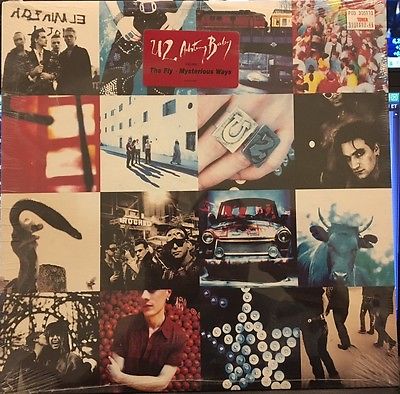
U2 Achtung Baby SEALED LP- BANNED U.S. COVER- LAST ONE
$
99


Favourite Auctions
To save auctions to your favourites, please login
If you don't have an account, please register
Description
SEALED LP FROM ONE OF THE GREATEST BANDS EVER. ACHTUNG BABY! BANNED COVER LP.
I BOUGHT 5 SEALED COPIES OF THIS ALBUM AT THE FAMOUS TOWER RECORDS ON SUNSET IN L.A. THE TOWER PRICE STICKER IS STILL ATTACHED. I BELIEVE I BOUGHT THEM ABOUT 25 YEARS AGO WHEN RECORDS WERE ON THE WAY OUT AND CD'S WERE THE THING. COMES FROM A SMOKE FREE HOME.
THIS IS THE LAST ONE. I'VE SOLD THE OTHERS ON EBAY IN THE LAST 6 MONTHS OR SO. LAST CHANCE.
Achtung Baby
From Wikipedia, the free encyclopedia Achtung Baby Studio album by U2 Released 18 November 1991 Recorded October 1990 – September 1991 Studio- Hansa Ton Studios (Berlin)
- Elsinore (Dalkey)[nb 1]
- STS (Dublin)
- Windmill Lane Studios (Dublin)
(1988) Achtung Baby
(1991) Zooropa
(1993) Singles from Achtung Baby
- "The Fly"
Released: 21 October 1991 - "Mysterious Ways"
Released: 24 November 1991 - "One"
Released: 24 February 1992 - "Even Better Than the Real Thing"
Released: 8 June 1992 - "Who's Gonna Ride Your Wild Horses"
Released: August 1992
Achtung Baby ( /???ktu?? ?be?bi?/[1]) is the seventh studio album by Irish rock band U2. It was produced by Daniel Lanois and Brian Eno, and was released on 18 November 1991 on Island Records. Stung by criticism of their 1988 release, Rattle and Hum, U2 shifted their musical direction to incorporate influences from alternative rock, industrial music, and electronic dance music into their sound. Thematically, Achtung Baby is darker, more introspective, and at times more flippant than their previous work. The album and the subsequent multimedia-intensive Zoo TV Tour were central to the group's 1990s reinvention, by which they abandoned their earnest public image for a more lighthearted and self-deprecating one.
Seeking inspiration from German reunification, U2 began recording Achtung Baby at Berlin's Hansa Studios in October 1990. The sessions were fraught with conflict, as the band argued over their musical direction and the quality of their material. After tensions and slow progress nearly prompted the group to disband, they made a breakthrough with the improvised writing of the song "One". Morale and productivity improved during subsequent recording sessions in Dublin, where the album was completed in 1991. To confound the public's expectations of the band and their music, U2 chose the record's facetious title and colourful multi-image sleeve.
Achtung Baby is one of U2's most successful records; it received favourable reviews and debuted at number one on the US Billboard 200 Top Albums, while topping the charts in many other countries. Five songs were released as commercial singles, all of which were chart successes, including "One", "Mysterious Ways", and "The Fly". The album has sold 18 million copies worldwide and won a Grammy Award in 1993 for Best Rock Performance by a Duo or Group with Vocal. Achtung Baby has since been acclaimed by writers and music critics as one of the greatest albums of all time. The record was reissued in October 2011 to commemorate the 20th anniversary of its original release.
After U2's 1987 album The Joshua Tree and the supporting Joshua Tree Tour brought them critical acclaim and commercial success,[2] their 1988 album and film Rattle and Hum precipitated a critical backlash.[3] Although the record sold 14 million copies and performed well on music charts,[4] critics were dismissive of it and the film, labelling the band's exploration of early American music as "pretentious"[5] and "misguided and bombastic".[6] U2's high exposure and their reputation for being overly serious led to accusations of grandiosity and self-righteousness.[3][5]
Despite their commercial popularity, the group were dissatisfied creatively; lead vocalist Bono believed they were musically unprepared for their success, while drummer Larry Mullen, Jr. said, "We were the biggest, but we weren't the best."[3]By the band's 1989 Lovetown Tour, they had become bored with playing their greatest hits.[7] U2 believe that audiences misunderstood the group's collaboration with blues musician B.B. King on Rattle and Hum and the Lovetown Tour, and they described it as "an excursion down a dead-end street".[8][9] Bono said that, in retrospect, listening to black music enabled the group to create a work such as Achtung Baby, while their experiences with folk music helped him to develop as a lyricist.[9] Towards the end of the Lovetown Tour, Bono announced on-stage that it was "the end of something for U2", and that "we have to go away and ... dream it all up again".[9] Following the tour, the group began, what was at the time, their longest break from public performances and album releases.[10]
Reacting to their own sense of musical stagnation and to their critics, U2 searched for new musical ground.[3][11] They wrote "God Part II" from Rattle and Hum after realising they had excessively pursued nostalgia in their songwriting. The song had a more contemporary feel that Bono said was closer to Achtung Baby's direction.[12] Further indications of change were two recordings they made in 1990: the first was a cover version of "Night and Day" for the first Red Hot + Blue release, in which U2 used electronic dance beats and hip hop elements for the first time; the second indication of change was contributions made by Bono and guitarist the Edge to the original score of A Clockwork Orange's stage adaptation. Much of the material they wrote was experimental, and according to Bono, "prepar[ed] the ground for Achtung Baby". Ideas deemed inappropriate for the play were put aside for the band's use.[13] During this period, Bono and the Edge began increasingly writing songs together without Mullen or bassist Adam Clayton.[13]
In mid-1990, Bono reviewed material he had written in Australia on the Lovetown Tour, and the group recorded demos at STS Studios in Dublin.[14][15] The demos later evolved into the songs "Who's Gonna Ride Your Wild Horses", "Until the End of the World", "Even Better Than the Real Thing", and "Mysterious Ways".[15] After their time at STS Studios, Bono and the Edge were tasked with continuing to work on lyrics and melodies until the group reconvened.[16] Going into the album sessions, U2 wanted the record to completely deviate from their past work, but they were unsure how to achieve this.[17] The emergence of the Madchester scene in the UK left them confused about how they would fit into any particular musical scene.[15]
Recording and production[edit]
"Buzzwords on this record were trashy, throwaway, dark, sexy, and industrial (all good) and earnest, polite, sweet, righteous, rockist and linear (all bad). It was good if a song took you on a journey or made you think your hifi was broken, bad if it reminded you of recording studios or U2. Sly Stone, T. Rex, Scott Walker, My Bloody Valentine, KMFDM, the Young Gods, Alan Vega, Al Green, and Insekt were all in favour. And Berlin ... became a conceptual backdrop for the record. The Berlin of the Thirties—decadent, sexual and dark—resonating against the Berlin of the Nineties—reborn, chaotic and optimistic..."
—Brian Eno, on Achtung Baby[11]U2 hired Daniel Lanois and Brian Eno to produce the album, based on the duo's prior work with the band on The Unforgettable Fire and The Joshua Tree.[18]Lanois was principal producer, with Mark "Flood" Ellis as engineer.[11] Eno took on an assisting role, working with the group in the studio for a week at a time to review their songs before leaving for a month or two.[11][19] Eno said his role was "to come in and erase anything that sounded too much like U2".[20] By distancing himself from the work, he believed he provided the band with a fresh perspective on their material each time he rejoined them.[21] As he explained, "I would deliberately not listen to the stuff in between visits, so I could go in cold".[22] Since U2 wanted the record to be harder-hitting and live-sounding, Lanois "push[ed] the performance aspect very hard, often to the point of recklessness".[23] The Lanois–Eno team used lateral thinking and a philosophical approach—popularised by Eno's Oblique Strategies—that contrasted with the direct and retro style of Rattle and Hum producer Jimmy Iovine.[24]
Composition[edit]
Music[edit]
"We're at a point where production has gotten so slick that people don't trust it anymore... We were starting to lose trust in the conventional sound of rock & roll—the conventional sound of guitar ... those big reverb-laden drum sounds of the '80s or those big, beautiful, pristine vocal sounds with all this lush ambience and reverb. So we found ourselves searching for other sounds that had more life and more freshness."
—The Edge, explaining the band's motivation for seeking a new sound[56]U2 is credited with composing the music for all of Achtung Baby's tracks,[39]despite periods of separated songwriting. They wrote the music primarily through jam sessions, a common practice for them.[17] The album represents a deviation from the sound of their past work; the songs are less anthemic in nature,[57] and their musical style demonstrates a more European aesthetic,[58] introducing influences from alternative rock,[59] industrial music,[11] and electronic dance music.[60] The band referred to the album's musical departure as "the sound of four men chopping down The Joshua Tree"
Legacy[edit]
"The album accomplished a feat artists love to undertake but rarely pull off: the public image reinvention and stylistic about-face that is so masterful it silences all the doubters. Even as the 21st century has seen U2 return to stadium-friendly rock postures, there are elements in the group's music (Bono's falsetto, the casual flirtation with danceable grooves, the quartet's continued ability to take itself less than seriously when necessary) that are still derived from those heady days in a Berlin studio. The biggest band in the world wouldn't hold that title today if it hadn't taken one hell of a chance at the exact right time with a record that proved more than strong enough to warrant that gamble."
—AJ Ramirez of PopMatters, in 2011[158]Achtung Baby is certified 8× platinum in the US by the RIAA,[126] and according to Nielsen Soundscan, the album has sold 5.5 million copies in the country, as of March 2009.[159] The record has been certified 5× platinum in Australia,[160] 4× platinum in the UK,[161] and diamond in Canada, the highest certification award.[138] Overall, 18 million copies have been sold worldwide.[162] It is U2's second-highest-selling record after The Joshua Tree, which has sold 25 million copies.[162] For the band, Achtung Baby was a watershed that secured their creative future,[54] and its success led to the group's continued musical experimentation during the 1990s. Zooropa, released in 1993, was a further departure for the band, incorporating additional dance music influences and electronic effects into their sound.[153] In 1995, U2 and Brian Eno collaborated on the experimental/ambient album Original Soundtracks 1 under the pseudonym "Passengers".[152] For Pop in 1997, the group's experiences with dance club culture and their usage of tape loops, programming, rhythm sequencing, and sampling resulted in their most dance-oriented album.[152]
The record is highly regarded among the members of U2. Mullen said, "I thought it was a great record. I was very proud of it. Its success was by no means preordained. It was a real break from what we had done before and we didn't know if our fans would like it or not."[54] Bono called the album a "pivot point" in the band's career, saying, "Making Achtung Baby is the reason we're still here now."[34]
Achtung Baby has been acclaimed by writers and music critics as one of the greatest albums of all time; according to Acclaimed Music, it is the 80th-highest-ranked record on critics' lists.[167] In 1997, The Guardian collated worldwide data from a range of renowned critics, artists, and radio DJs, who placed the record at number 71 on a list of the "100 Best Albums Ever".[168] In 2003, the National Association of Recording Merchandisers ranked it at number 45 on its "Definitive 200" list,[169][170] while USA Today featured it on their list of the top 40 albums of all time.[171] Three years later, the album appeared on a number of rankings, including Hot Press's "100 Greatest Albums Ever" at number 21,[172] Time's list of "The All-Time 100 Albums",[173] and the book 1001 Albums You Must Hear Before You Die.[174] VH1 ranked it 65th on the "100 Greatest Albums of Rock & Roll" episode of its series The Greatest.[175] Rolling Stone placed the record at number 63 on its 2012 list of "The 500 Greatest Albums of All Time", calling it "a prescient mix of sleek rock and pulsing Euro grooves" and stating that "the emotional turmoil made U2 sound more human than ever".[176] Entertainment Weekly's 2013 list of the "All-Time Greatest" albums ranked the record 23rd, stating that instead of "coast[ing] forever on the cinematic storytelling they mastered on the excellently righteous The Joshua Tree", the group "ripped up the rule book" with Achtung Baby.[177] The record topped Spin's list of the 125 most influential albums from 1985 to 2010; the author said, "Unlike Radiohead with OK Computer and Kid A, U2 took their post-industrial, trad-rock disillusionment not as a symbol of overall cultural malaise, but as a challenge to buck up and transcend... Struggling to simultaneously embrace and blow up the world, they were never more inspirational."[166]
Track listing[edit]
All lyrics written by Bono; all music composed by U2.
No. Title Producer Length 1. "Zoo Station" Daniel Lanois 4:36 2. "Even Better Than the Real Thing" Steve Lillywhite, with Brian Eno and Lanois 3:41 3. "One" Lanois with Eno 4:36 4. "Until the End of the World" Lanois with Eno 4:39 5. "Who's Gonna Ride Your Wild Horses" Lillywhite, Lanois, and Eno 5:16 6. "So Cruel" Lanois 5:49 7. "The Fly" Lanois 4:29 8. "Mysterious Ways" Lanois with Eno 4:04 9. "Tryin' to Throw Your Arms Around the World" Lanois with Eno 3:53 10. "Ultraviolet (Light My Way)" Lanois with Eno 5:31 11. "Acrobat" Lanois 4:30 12. "Love Is Blindness" Lanois 4:23ONE OF THE GREATEST ALBUMS OF ALL TIME. WILL BE SHIPPED WITH STIFF CARDBOARD ON BOTH SIDES ENCOSED IN A SECOND LARGE BOX WITH BUBBLE WRAP FOR MASSIVE PROTECTION. WILL BE SHIPPED BY MEDIA MAIL. TAKES ABOUT A WEEK. U.S. BUYERS ONLY.
BUYER TO PAY $4 S&H.
NEVADA RESIDENTS ADD SALES TAX.
THANKS FOR LOOKING!
price rating


