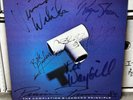
Tubes The Completion Backward Principle Rare 1981 Capitol Records Vinyl LP
$
30


Favourite Auctions
To save auctions to your favourites, please login
If you don't have an account, please register
Description
Welcome to Classic Cadillac Records! I visually grade all my records as accurately as possible and will never grade anything above Near Mint unless it's still sealed. Please note that a visual grade can differ from a play grade, and am happy to spot check a record upon request. All orders are shipped within 1 business day (usually sooner) and packed with extra care to ensure fast, safe arrival. Please look closely at all pictures, read all relevant details and ask any questions you may have before buying. I offer a full 30-day return policy on everything I sell, so buy with confidence! And most importantly, thanks for looking!
The Completion Backward Principle Studio album by The Tubes Released 6 April 1981 Recorded August 1980 Genre Rock Length 39:30 Label Capitol Producer David Foster The Tubes chronology Remote Control
(1979) The Completion Backward Principle
(1981) Outside Inside
(1983) Professional ratings Review scores Source Rating AllMusic
The Completion Backward Principle is the fifth studio album by the American rock group the Tubes. It is the group's first for Capitol Records. It was accompanied by a long form music video release of the same name, although it did not contain all of the songs from the album. It is a concept album presented as a motivational business document. The album contains two hit singles, "Don't Want to Wait Anymore" and "Talk to Ya Later."
Background
After the release of their fifth studio album, Remote Control, and after their time filming and recording for Xanadu and its soundtrack, The Tubes found themselves dropped by record label A&M. The group spent much of 1980 searching for a new label, eventually finding Capitol Records through Bobby Colomby of Blood, Sweat, & Tears. Reportedly, their three-album contract with Capitol allowed the label to drop The Tubes if any of the three records were not commercially successful. Colomby claimed the band needed a new producer in order to achieve the commercial success they had been looking for, and eventually introduced the group to David Foster. Foster, who had just come off of Earth, Wind & Fire's "I Am", agreed to produce the group. Some time after this, lead vocalist Fee Waybill alleges that he discovered a spoken-word motivational record from the 1950s in a record store, and used the sales pitch as the central concept to the band's next album. “The sales technique was that ‘imagination creates reality,’ which it turns out, was a metaphor for someone like me, who grew up singing Beatles songs around the house dying to be in a band,” Waybill said in later interviews. The 2011 remaster liner notes claim keyboardist Michael Cotten instead found the record.
Recording
In the liner notes of the 2011 remaster, Brett Milano asserts that the band's approach to recording was "to make an album of memorable stand-alone songs; not a soundtrack for the live show." Foster would often have input on the sound of the band's tracks, resulting in co-writing credits for "Amnesia", "Don't Want To Wait Anymore", and "Let's Make Some Noise". Foster also had control over what songs were and weren't on the album, opting to cut the track "Sports Fans" among others (which would later become a live staple before being included on the 2011 remaster). As well, Foster oversaw the recording process meticulously. Whereas Rundgren allowed the band to use as many takes as they needed, Foster reportedly demanded near-perfection from the group's performances. Notorious for sending band musicians home and replacing them with session musicians if they couldn't perform to his level, Foster initially included additional backup singers, such as Colomby and Bill Champlin (though neither are credited on any release).
Notable in the album's track list is "Mr. Hate", a track inspired heavily by then-alleged murderer Mark McDermand. The track was written during a time where McDermand seemed to be an innocent man, and as such the lyrics paint the character as an anti-hero as opposed to an outright villain. By 1984, McDermand had been convicted of two counts of murder.
Upon what would have been the conclusion of the recording sessions, Foster felt as if the album lacked a true single. The band initially suggested "Let's Make Some Noise" and "What's Wrong With Me", but Foster instead relegated the tracks to an album cut and a B-side, respectively. Foster instead brought in Steve Lukather, guitarist for Toto. Lukather, Foster, Waybill, and The Tubes' drummer Prairie Prince reportedly recorded "Talk to Ya Later" in a single-day session, The title and hook was taken from engineer Humberto Gatica, who deflected the band's questions with the phrase. To bolster the album's single lineup, Foster also made changes to "Don't Want To Wait Anymore". An unnamed band member in the 2011 liner notes said "the big choral ending that kicks your ass, that was his idea; and the modulation at the end".
Packaging and design
The album was given a sleek, minimalist aesthetic, with the band only billed as "Tubes" on the front cover, which displayed only a T-shaped piece of PVC pipe casting a shadow on a blue background. The album's design and packaging also parodied the growing corporatism of America, with the CD booklet billing them as "The Tubes Group", with a slogan of "credibility, growth, direction", and the performance credits including joke credits such as "Analysis", "Motivation", and "Policy".
Reception and fallout
The album was received well by critics, and was at the time the band's best selling and charting album. The album's first release and first top 40 hit, "Don't Want to Wait Anymore", peaked at number 35 for two weeks on the US Billboard Hot 100 and for one week on the Cashbox Top 100. It also reached number 22 on the Billboard Hot Mainstream Rock Tracks chart. "Talk to Ya Later" hit number 6 on the Billboard Hot Mainstream Rock Tracks chart. It also spent five weeks on the Billboard Bubbling Under chart, peaking at number 101 and also had a music video produced for the song.
However, internally, things were tense. After "Talk to Ya Later" proved massively successful despite no input from the majority of the band, Foster intended to take the group in a similar direction, with the band's following album Outside Inside featuring even more session musicians and guest writers than before, including a return appearance by Lukather. These tensions would result in the group fragmenting and temporarily disbanding in 1985 after Waybill's debut solo album and the failure of the Rundgren-produced Love Bomb.
Original LP track listing
All tracks composed by The Tubes; except where indicated.
Side one
No. Title Writer(s) Length 1. "Talk to Ya Later" The Tubes; David Foster; Steve Lukather 4:29 2. "Sushi Girl" 3:26 3. "Amnesia" The Tubes; Foster 4:26 4. "Mr. Hate" 3:41 5. "Attack of the 50 Foot Woman" The Tubes; Michael Snyder 4:29Side two[edit]
No. Title Writer(s) Length 1. "Think About Me" 3:16 2. "A Matter of Pride" 3:14 3. "Don't Want to Wait Anymore" The Tubes; Foster 4:16 4. "Power Tools" 4:03 5. "Let's Make Some Noise" The Tubes; Foster 3:42 Total length: 39:30price rating