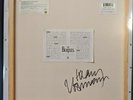
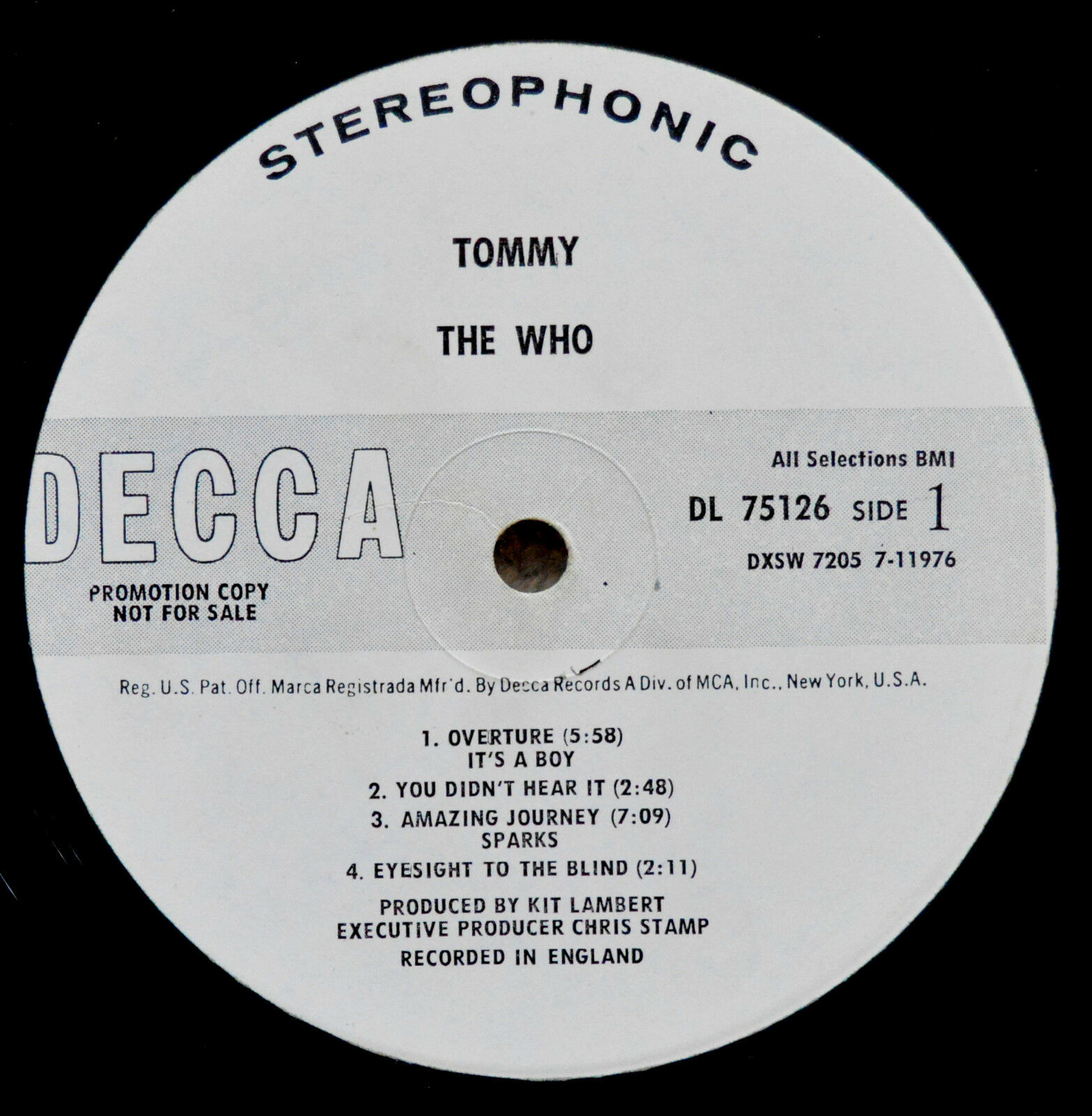
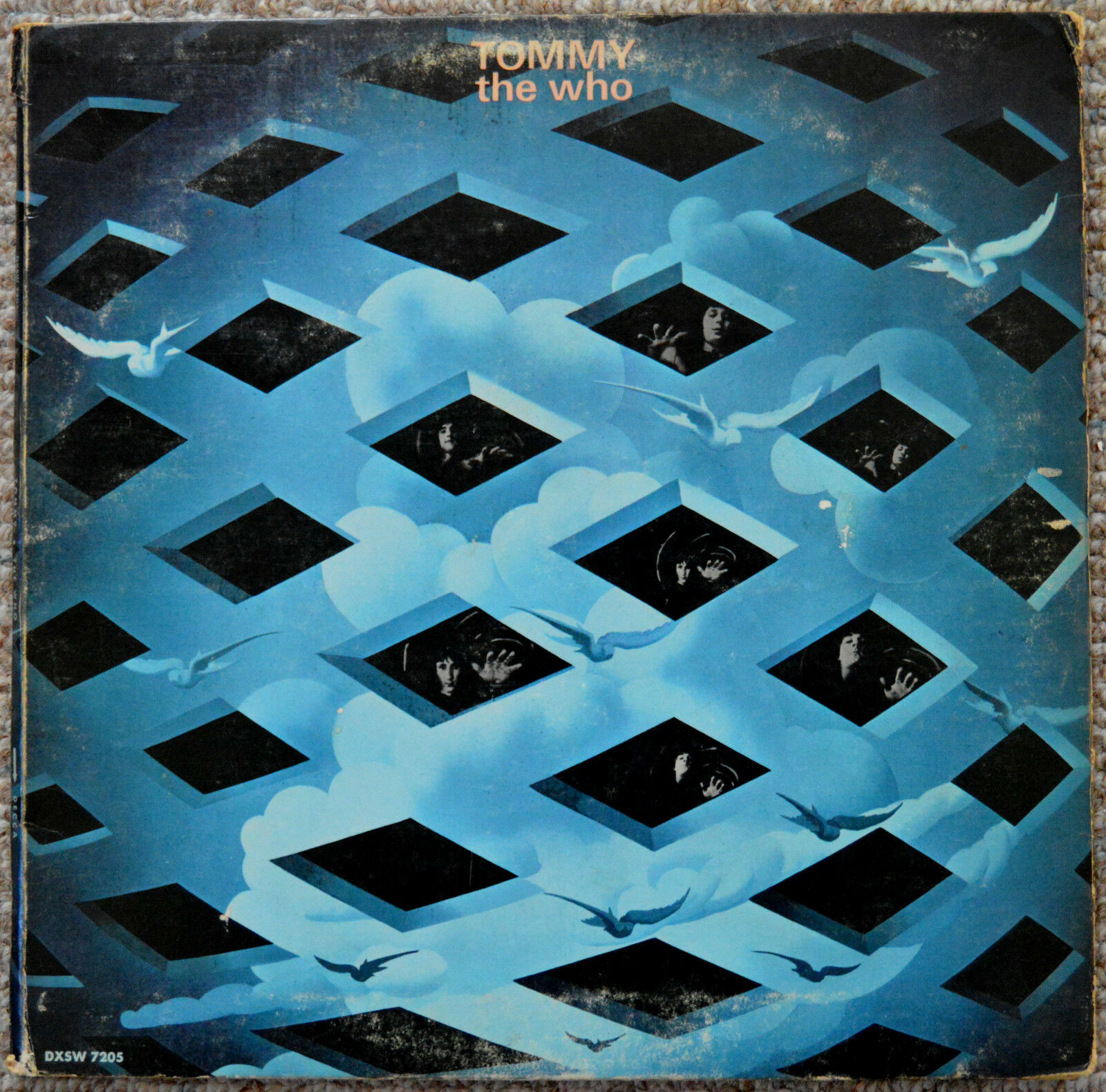
The Who TOMMY - WHITE LABEL PROMO - Decca Records 1969 w/Booklet
$
150
Favourite Auctions
To save auctions to your favourites, please login
If you don't have an account, please register
Description
PLEASE READ COMPLETE AUCTION DESCRIPTION
BEFORE BIDDING
_______________
PAYMENT DUE WITHIN
5 DAYS
OF AUCTION CLOSING
_______________
Records
are
Visually Graded
UP FOR AUCTION IS:
The Who->
TOMMY
ULTRA RARE
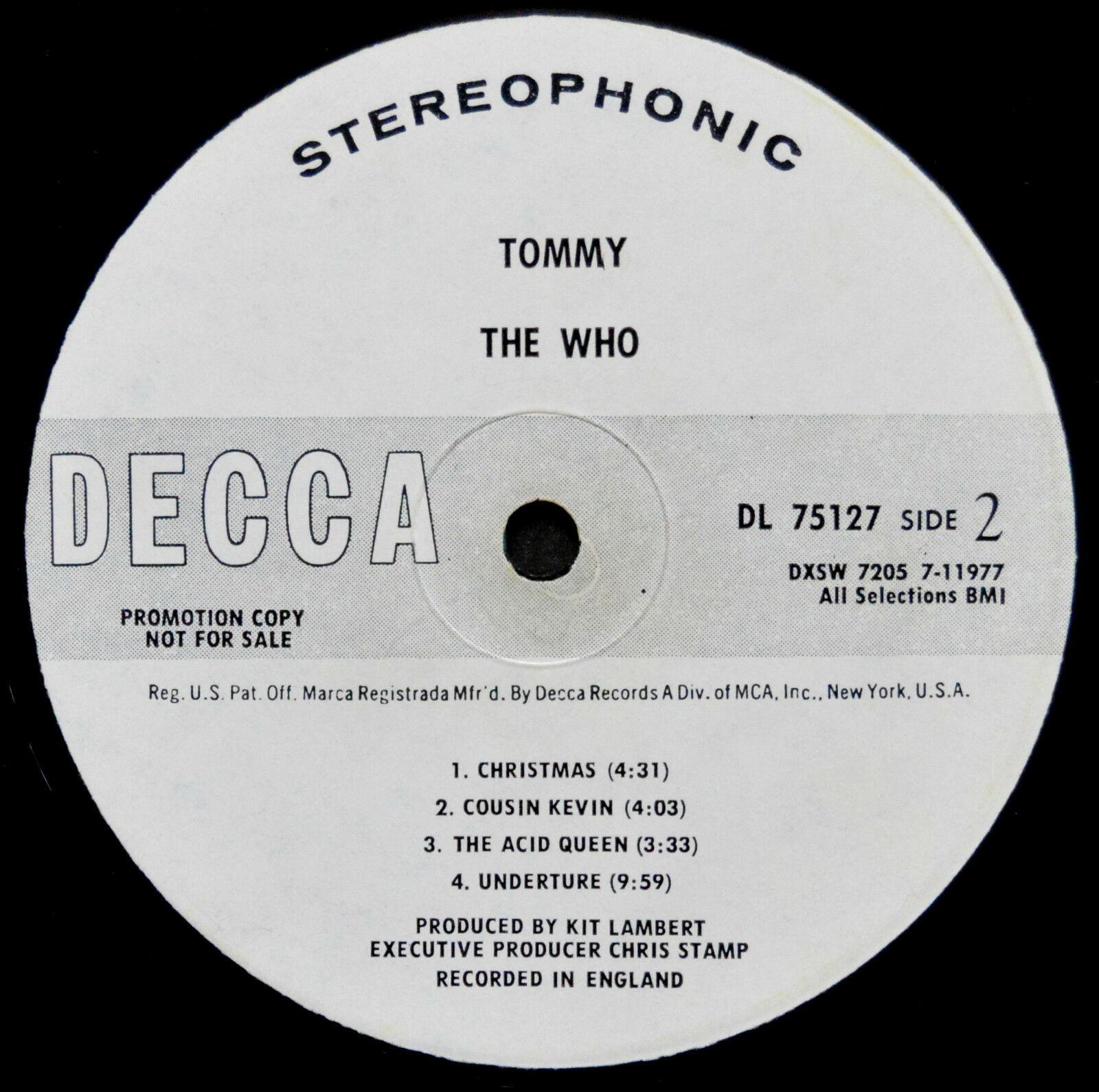
WHITE LABEL
PROMO
Decca Records
1969
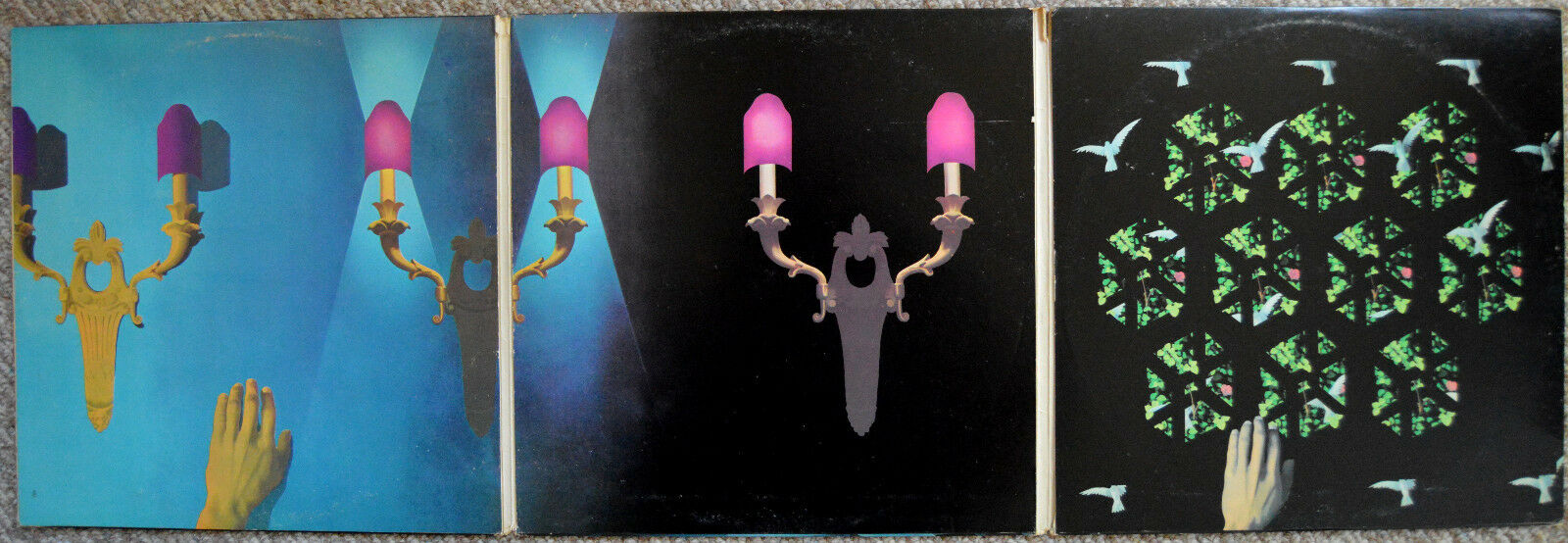
w/Booklet
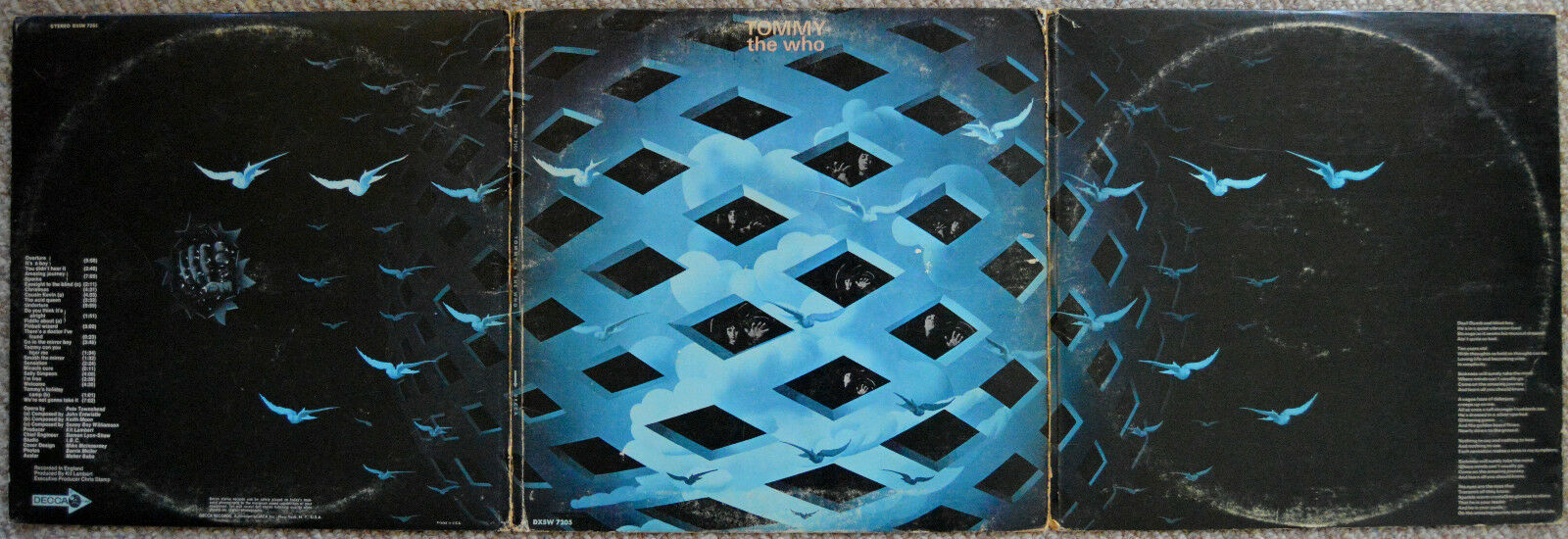
VG cover / VG+ vinyl
CHECK OUT PHOTO DETAILS
Tommy is the fourth studio album by the English rock band The Who, a double album first released in May 1969. The album was mostly composed by guitarist Pete Townshend as a rock opera that tells the story about a "deaf, dumb and blind" boy, including his experiences with life and his relationship with his family.
Townshend came up with the concept of Tommy after being introduced to the work of Meher Baba, and attempted to translate Baba's teachings into music. Recording on the album began in September 1968, but took six months to complete as material needed to be arranged and re-recorded in the studio. Tommy was acclaimed upon its release by critics, who hailed it as the Who's breakthrough. Its critical standing diminished slightly in later years; nonetheless, several writers view it as an important and influential album in the history of rock music. The Who promoted the album's release with an extensive tour, including a live version of Tommy, which lasted throughout 1969 and 1970. Key gigs from the tour included appearances at Woodstock, the 1969 Isle of Wight Festival, the University of Leeds, the Metropolitan Opera House and the 1970 Isle of Wight Festival. The live performances of Tommy drew critical praise and rejuvenated the band's career.
Subsequently, the rock opera developed into other media, including a Seattle Opera production in 1971, an orchestral version by Lou Reizner in 1972, a film in 1975, and a Broadway musical in 1992. The original album has sold 20 million copies and has been inducted into the Grammy Hall of Fame. It has been reissued several times on CD, including a remix by Jon Astley in 1996, a deluxe Super Audio CD in 2003, and a super deluxe box set in 2013, including previously unreleased demos and live material.
Synopsis
Tommy has never had a definitive plot, but the following synopsis was published following the original album's release.[1]
British Army Captain Walker goes missing during an expedition and is believed dead ("Overture"). His widow, Mrs. Walker, gives birth to their son, Tommy ("It's a Boy"). Years later, Captain Walker returns home and discovers that his wife has found a new lover. The Captain murders this man in an altercation as Tommy watches. Tommy's mother convinces him that he did not see or hear the incident and must never tell anyone about it; as a result, he becomes deaf, dumb, and blind to the outside world ("1921"). Tommy now relies on his sense of touch and imagination, developing a fascinating inner psyche ("Amazing Journey/Sparks").[2]
A quack claims his wife can cure Tommy ("The Hawker"), while Tommy's parents are increasingly frustrated that he will never find religion in the midst of his isolation ("Christmas"). They begin to neglect him, leaving him to be tortured by his sadistic "Cousin Kevin" and molested by his uncle Ernie ("Fiddle About"). The Hawker's drug addicted wife, "The Acid Queen", gives Tommy a dose of LSD, causing a hallucinogenic experience that is expressed musically ("Underture").[2]
As Tommy grows older, he discovers that he can feel vibrations sufficiently well to become an expert pinball player ("Pinball Wizard"). His parents take him to a respected doctor ("There's a Doctor"), who determines that the boy's disabilities are psychosomatic rather than physical. Tommy is told by the Doctor to "Go to the Mirror!", and his parents notice he can stare at his reflection. After seeing Tommy spend extended periods staring at a mirror in the house, his mother smashes it out of frustration ("Smash the Mirror"). This removes Tommy's mental block, and he recovers his senses, realising he can become a powerful leader ("Sensation"). He starts a religious movement ("I'm Free"), which generates fervor among its adherents ("Sally Simpson") and expands into a holiday camp ("Welcome" / "Tommy's Holiday Camp"). However, Tommy's followers ultimately reject his teachings and leave the camp ("We're Not Gonna Take It"). Tommy retreats inward again ("See Me, Feel Me") with his "continuing statement of wonder at that which encompasses him".
Background
Townshend had been looking at ways of progressing beyond the standard three minute pop single format since 1966.[3] Co-manager Kit Lambert shared Townshend's views and encouraged him to develop musical ideas,[4] coming up with the term "rock opera". The first use of the term was applied to a suite called "Quads", set in a future where parents could choose the sex of their children. A couple want four girls but instead receive three girls and a boy, raising him as a girl anyway. The opera was abandoned after writing a single song, the hit single, "I'm a Boy".[5] When the Who's second album, A Quick One ran short of material during recording, Lambert suggested that Townshend should write a "mini-opera" to fill the gap. Townshend initially objected, but eventually agreed to do so, coming up with "A Quick One, While He's Away", which joined short pieces of music together into a continuous narrative.[6] During 1967, Townshend learned how to play the piano and began writing songs on it, taking his work more seriously.[7] That year's The Who Sell Out included a mini-opera in the last track, "Rael", which like "A Quick One..." was a suite of musical segments joined together.[8] A portion of "Rael" is the basis of the Tommy instrumental track "Sparks"[9].
The package I hope is going to be called "Deaf, Dumb and Blind Boy." It's a story about a kid that's born deaf, dumb and blind and what happens to him throughout his life ... But what it's really all about is the fact that ... he's seeing things basically as vibrations which we translate as music. That's really what we want to do: create this feeling that when you listen to the music you can actually become aware of the boy, and aware of what he is all about, because we are creating him as we play."
By 1968, Townshend was unsure about how the Who should progress musically. The group were no longer teenagers, but he wanted their music to remain relevant.[11] His friend, International Times art director Mike McInnerney, told him about the Indian spiritual mentor Meher Baba,[12] and Townshend became fascinated with Baba's values of compassion, love and introspection.[13] The Who's commercial success was on the wane after the single "Dogs" failed to make the top 20, and there was a genuine risk of the band breaking up.[14] Live performances remained strong, and the group spent most of the spring and summer touring the US and Canada[15] but their stage act relied on Townshend smashing his guitar or Moon demolishing his drums, which kept the group in debt. Townshend and Lambert realised they needed a larger vehicle for their music than hit singles, and a new stage show, and Townshend hoped to incorporate his love of Baba into this concept.[16] He decided that the Who should record a series of songs that stood well in isolation, but formed a cohesive whole on the album. He also wanted the material performed in concert, to counteract the trend of bands like the Beatles and the Beach Boys, whose studio output was not designed for live performance.[17]
In August 1968, in an interview to Rolling Stone, Townsend talked about a new rock opera, which had the working title of Deaf, Dumb and Blind Boy, and described the entire plot in great detail, which ran to 11 pages.[18] Who biographer Dave Marsh subsequently said the interview described the narrative better than the finished album.[19] Townshend later regretted publishing so much detail, as he felt it forced him to write the album according to that blueprint.[20] The rest of the Who, however, were enthusiastic about the idea, and let him have artistic control over the project.[21]
Recording
The Who started recording the album at IBC Studios on 19 September 1968.[22] There was no firm title at this point, which was variously referred to as Deaf, Dumb and Blind Boy, Amazing Journey, Journey into Space, The Brain Opera and Omnibus. Townshend eventually settled on Tommy because it was a common British name, and a nickname for soldiers in World War I.[23] Lambert took charge of the production, with Damon Lyon-Shaw as engineer. Sessions were block booked from 2pm – 10pm, but recording often spilled over into the early morning. [22]
The album was recorded onto eight track tape, which allowed various instruments to be overdubbed. Townshend used several guitars in the studio, but made particular use of the Gibson J-200 acoustic and the Gibson SG.[24] As well as their usual instruments, Townshend played piano and organ and bassist John Entwistle doubled on french horn. Keith Moon used a new double bass drum kit owned by roadie Tony Haslam, after Premier had refused to loan him any more equipment due to continual abuse.[22] Though Townshend wrote the majority of the material, the arrangements came from the entire band. Singer Roger Daltrey later said that Townshend often came in with a half-finished demo recording, adding "we probably did as much talking as we did recording, sorting out arrangements and things."[25] Townshend asked Entwistle to write two songs ("Cousin Kevin" and "Fiddle About") that covered the darker themes of bullying and abuse. "Tommy's Holiday Camp" was Moon's suggestion of what religious movement Tommy could lead. Moon got the songwriting credit for suggesting the idea, though the music was composed and played by Townshend.[26] A significant amount of material had a lighter style than earlier recordings, with greater prominence put on the vocals. Moon later said, "It was, at the time, very un-Wholike. A lot of the songs were soft. We never played like that."[27]
Some of the material had already been written for other projects. "Sensation" was written about a girl Townshend had met on the Who's tour of Australia in early 1968, "Welcome" and "I'm Free" were about peace found through Meher Baba and "Sally Simpson" was based on a gig with the Doors which was marred by violence.[28] Other songs had been previously recorded by the Who and were recycled; "It's A Boy" was derived from "Glow Girl", an out-take from The Who Sell Out, while "Sparks" and "Underture" re-used and expanded one of the instrumental themes in "Rael".[29] "Amazing Journey" was, according to Townshend, "the absolute beginning" of the opera and summarised the entire plot.[29] "The Hawker" was a cover of Mose Allison's "Eyesight to the Blind". A cover of Mercy Dee Walton's "One Room Country Shack" was also recorded but was scrapped from the final track listing as Townshend could not figure out a way to incorporate it in the plot.[30]
Recording at IBC was slow, due to a lack of a full plot and a full selection of songs. The group hoped that the album would be ready by Christmas, but sessions dragged on. Melody Maker's Chris Welch visited IBC studios in November and while he was impressed with the working environment and the material,[31] the project still did not have a title and there was no coherent plotline.[26] The Who's US record company got so impatient waiting for new product that they released the compilation album Magic Bus: The Who on Tour which received a scathing review from Greil Marcus in Rolling Stone over its poor selection of material and misleading name (as the album contained studio recordings and was not live).[32]
The Who took a break from recording at the end of 1968 to tour, including a well received appearance at The Rolling Stones Rock and Roll Circus on 10 December.[33] They resumed sessions at IBC in January 1969, block booking Monday to Thursday, but had to do gigs every weekend to stop going further into debt.[34] A major tour was booked for the end of April, and the group's management insisted that the album would have to be finished by then, as it had been well over a year since The Who Sell Out.[35] Lambert wrote a script, Tommy (1914–1984) which he professionally printed, and gave copies to the band, which helped them focus the storyline, and also decide to make the album a double.[34] The group were still coming up with new material; Lambert insisted that the piece should have a proper overture,[35] while Townshend wrote "Pinball Wizard" so that Nik Cohn, a pinball fan, would give the album a favourable review in the New York Times.[36] Lambert wanted an orchestra to appear on the album, but Townshend was strongly against the idea, and time and budget constraints meant it could not happen anyway.[35]
By March 1969, some songs had been recorded several times, yet Townshend still thought there were missing pieces.[37] Entwistle had become fed up with recording, later saying "we had to keep going back and rejuvenating the numbers ... it just started to drive us mad."[24] The final recording session took place on 7 March, the same day that "Pinball Wizard" was released as a single.[38] The group started tour rehearsals and promotional activities for the single and Lambert went on holiday in Cairo. The mixing was left to Lyon-Shaw and assistant engineer Ted Sharp, who did not think IBC was well suited for the task.[39] The album overshot its April deadline, as stereo mastering continued into the end of the month.[40]
Release
Tommy was finally released on 17 May 1969 in the US, and 23 May in the UK, because of delays with the cover.[41] The original double album was configured with sides 1 and 4 on one disc, and sides 2 and 3 on the other, to accommodate record changers.[42]
The album was commercially successful, reaching No. 2 in the UK album charts, and No. 4 in the US.[41] It sold 200,000 copies in the first two weeks in the US alone, and was awarded a gold record for sales of 500,000 on August 18.[43] "Pinball Wizard", "I'm Free" and "See Me, Feel Me" were released as singles and received airplay on the radio. "Pinball Wizard" reached the top 20 in the US and the top five in the UK. "See Me, Feel Me" reached the top 20 in the US and "I'm Free" reached the top 40. An EP of selections from the album was planned to be released in the UK in November 1970, but was withdrawn.[44] As of 2012, Tommy has sold 20 million copies worldwide.
When it was released, critics were split between those who thought the album was a masterpiece, the beginnings of a new genre, and those that felt it was exploitative. The album had a hostile reception with the BBC and certain US radio stations, with Tony Blackburn describing "Pinball Wizard" as "distasteful".[40] Nevertheless, BBC Radio 1 received an advance copy of the album at the start of May and gave the material its first airplay on Pete Drummond's show on 3 May.[42] Townshend promoted the album's release with interviews in which he attempted to explain the plotline. Unfortunately, because it fundamentally dealt with the abstract concept of Baba's spiritual precepts, the interviews often gave confusing and contradicting details.
Critical reception
The initial critical reaction to Tommy was positive. Chris Welch, writing for Melody Maker, went to the press launch show at Ronnie Scott's and although the volume left his ears ringing for 20 hours, he concluded "we wanted more." Disc and Music Echo ran a front-page headline saying "Who's Tommy: A Masterpiece".[43] Critics and fans were confused by the storyline, but Lambert pointed out this made Tommy no less confusing than the operas of Richard Wagner or Giacomo Puccini a century earlier.[53]
In a 1969 column for The Village Voice, music critic Robert Christgau said that, apart from The Mothers of Invention's We're Only in It for the Money, Tommy is the first successful "extended work" in rock music, but Townshend's parodic side is more "profound and equivocal" than Frank Zappa. He praised Townshend for deliberately constructing the album so that each song can be enjoyed individually and felt that he is determined to "give his audience what it wants without burying his own peculiarity".[54] Albert Goldman, writing in Life magazine, said that The Who play through "all the kinky complications" of the narrative in a hard rock style that is the antithesis of most contemporary "serious" rock. Goldman asserted that, based on innovation, performance, and "sheer power", Tommy surpasses anything else in studio-recorded rock.[55] Christgau named Tommy the best album of 1969 in his year-end list for Jazz & Pop magazine.[56]
According to music journalist Richie Unterberger, Tommy was hailed by contemporary critics as the Who's breakthrough, but its critical standing diminished slightly in the subsequent decades, because of its occasionally pretentious concept and flimsy songs that functioned as devices to "advance the rather sketchy plot."[47] Christgau wrote in 1983, "Tommy's operatic pretensions were so transparent that for years it seemed safe to guess that Townshend's musical ideas would never catch up with his lyrics."[57] In his review for AllMusic, Unterberger said that, despite its slight flaws, the album has "many excellent songs" permeated with "a suitably powerful grace", while Townshend's ability to devise a lengthy narrative introduced "new possibilities to rock music."[47] Uncut wrote that the album "doesn't quite realise its ambitions, though it achieves a lot on the way", and felt it was not as well developed as their later album, Quadrophenia.[52] Mark Kemp, writing in The Rolling Stone Album Guide (2004), felt that "in retrospect, Tommy isn't quite the masterpiece it was originally hyped to be", suggesting The Who Sell Out was better, though because of Townshend, it produced several "bona fide classic songs".[58]
In 1998, the album was inducted into the Grammy Hall of Fame for "historical, artistic and significant value".[45] In 2003, Rolling Stone magazine ranked Tommy number 96 on its list of the 500 greatest albums of all time.[59] The album is one of several by the Who to appear in 1001 Albums You Must Hear Before You Die.[60]
According to music critic Martha Bayles, Tommy did not mix rock with classical music, as its "rock opera" title may have suggested, but instead was "dominated by the Who's mature style: ponderous, rhythmically monotonous hard rock".[61] Bayles argued that it was more acceptable to audiences than the art rock "concoctions" of the time because of the cultural climate during the late 1960s: "Tommy was considered more authentic, precisely because it consists of hard rock, rather than doctored-up Mussorgsky ... and avoids the typical pseudoromantic themes of art rock (fairy-tale bliss and apocalyptic angst) in favor of the more up-to-date subject of popular culture itself."[61] High Fidelity magazine also characterized the Who's album as a "reasonably hard-rock version" of the opera.[62]
Marsh thought the problem with the album's narrative is that there isn't enough transitional material provided by the lyrics. There are no stage directions, no cast, and narration is restricted to key phrases (such as "Tommy can you hear me?")[46] Key problems included an unclear explanation of what Tommy didn't hear or see in "1921", how or why he plays pinball, why "Smash the Mirror" leads into "I overwhelm as I approach you" (the opening line in "Sensation"), why Tommy tells his followers in "We're Not Gonna Take It" they cannot drink or smoke but can play pinball, and what the "you" is in "Listening to you, I get the music".[63]
Original edition
Tommy was originally released as a two-LP set with artwork designed by McInnerney, which included a booklet including lyrics and images to illustrate parts of the story. The cover is presented as part of a triptych-style fold-out cover, and the booklet contained abstract artwork that outlined the story.[1] Although the album included lyrics to all the songs, indicating individual characters, it did not outline the plot, which led to a concert programme being prepared for shows, that carried a detailed synopsis.[1]
Townshend thought McInnerney, a fellow follower of Baba, would be a suitable choice to do the cover. As recording was near completion, McInnerney received a number of cassettes with completed songs and a brief outline for the story, which he immediately recognised as being based on Baba's teachings.[64] He wanted to try and convey the world of a deaf, dumb and blind boy, and decided to "depict a kind of breaking out of a certain restricted plane into freedom."[65] The finished cover contained a blue and white web of clouds, a fist punching into the black void to the left of it. The inner triptych, meanwhile, showed a hand reaching out to light and a light shining in a dark void.[65] Townshend was too busy finishing the recording to properly approve the artwork, but Lambert strongly approved of it, and said it would work. The final step was for record company approval, who decided the cover was more sensible than The Who Sell Out,[65] though making one concession that pictures of the band should appear on the cover. These were added to the web on the front.[66]
Live performances
The Who had planned to perform Tommy live since starting the project. The group spent April 1969 rehearsing a live version of the show at the Hanwell Community Centre in Ealing including a final run down of the entire stage piece on 23 April.[40] The running order was changed, and four songs ("Cousin Kevin", "Underture", "Sensation" and "Welcome") were dropped entirely.[73] Townshend later said the group "did the whole thing from start to finish and that was when we first realized we had something cohesive and playable."[74] Daltrey's voice had improved substantially since the group's early tours, and they realised their new live act could completely change their career.[40]
After a few warm up gigs towards the end of April,[42] the group gave a preview concert to the press at Ronnie Scotts, London on 1 May. Realising the opera's narrative was difficult to understand, Townshend explained a synopsis of the story, before the Who played Tommy all the way through at full stage volume.[43] The next day, the group flew out to New York to start the US tour, with the first gig on 9 May at the Grande Ballroom, Detroit.[42] At the end of May, the group played four nights at the Kinetic Playground, Chicago, and they noticed the audience would all stand up at the same time, and stay standing. This indicated that live performances of Tommy had a significant positive response.[75]
The group continued to play large halls in the US, organised by tour promoter Frank Barsalona, and generally avoided festivals,[76] but made an important exception with the Woodstock Festival on 16 August. After spending all night arguing with Barsalona, the band agreed to perform at Woodstock for $12,500.[77] The festival ran late and the Who did not take to the stage until the early morning of 17 August. During "Pinball Wizard", Abbie Hoffman took to the stage to protest about the imprisonment of John Sinclair before being kicked offstage by Townshend, while during "See Me, Feel Me", the sun rose, almost as if on cue.[78] Two weeks later, the group played the second Isle of Wight Festival, using one of the largest live PAs available.[79] Though media attention was on Bob Dylan playing his first major live concert since 1966, the Who stole the show. Townshend later said, "We know that the stage act we had, with Tommy in it, would work under any circumstances, because it had worked many times on tour."[80]
By 1970, Tommy had achieved sufficient critical acclaim to be performed live in the Metropolitan Opera House.
Tommy remained in the Who's live set through the rest of the year and into 1970. In October 1969, The Who played six shows at the Fillmore East, where Leonard Bernstein praised them for their new music.[81] The group's show on 14 December at the Coliseum Theatre, London, was filmed for a possible future Tommy feature.[82] Lambert was keen for Tommy to be taken seriously and wanted the Who to perform at opera houses.[83] In June 1970, the group performed two shows at the Metropolitan Opera House, which was the first time Townshend announced the show as being the "last Tommy ever".[84] The group made a second trip to the Isle of Wight, appearing at the 1970 festival on 29 August, before an audience of 600,000.[73] The last live performance for 1970 was at The Roundhouse, London on 20 December. Townshend said "This is the very last time we'll play Tommy on stage", to which Moon promptly cried, "Thank Christ for that!"[85]
Public reaction to the Who's concerts that included Tommy was overwhelmingly positive. The touring helped keep the album in the public eye, and cleared the band's debts.[86] Several live recordings of Tommy from the Who's 1969–70 tours have been released. A complete performance is available on the 2002 Deluxe Edition of the live album Live at Leeds, recorded on 14 February 1970. The second Isle of Wight performance is available on Live at the Isle of Wight Festival 1970, released in 1996.[73] The Coliseum Theatre gig is available on the 2007 video release At Kilburn 1977 + Live at the Coliseum. Portions of the Woodstock performance of Tommy were released on the Woodstock film and later on The Kids Are Alright.[87] The complete show was recorded, but has never been officially released.[88]
The Who continued to play a smaller selection of Tommy live in subsequent tours throughout the 1970s.[89] They revived Tommy as a whole for its twentieth anniversary during their 1989 reunion tour, reinstating the previously overlooked "Cousin Kevin" and "Sensation" but still omitting "Underture" and "Welcome". Recordings from this tour can be found on the Join Together live album and the Tommy and Quadrophenia Live DVD. The Los Angeles version of this show featured Phil Collins as Uncle Ernie, Patti LaBelle as the Acid Queen, Steve Winwood as the Hawker, Elton John as the Pinball Wizard and Billy Idol as Cousin Kevin.
Side one
No. Title Lead vocals Length
1. "Overture" Townshend 3:50
2. "It's a Boy" Townshend 2:07
3. "1921" Townshend, Roger Daltrey on chorus 3:14
4. "Amazing Journey" Daltrey 3:25
5. "Sparks" Instrumental 3:45
6. "The Hawker" (Sonny Boy Williamson) Daltrey 2:15
Total length: 18:36
Side two
No. Title Lead vocals Length
1. "Christmas" Daltrey, Townshend in middle eight 5:30
2. "Cousin Kevin" (John Entwistle) Entwistle and Townshend 4:03
3. "The Acid Queen" Townshend 3:31
4. "Underture" Instrumental 9:55
Total length: 22:59
Side three
No. Title Lead vocals Length
1. "Do You Think It's Alright?" Daltrey and Townshend 0:24
2. "Fiddle About" (Entwistle) Entwistle 1:26
3. "Pinball Wizard" Daltrey, Townshend on bridge 3:01
4. "There's a Doctor" Townshend, with Daltrey and Entwistle 0:25
5. "Go to the Mirror!" Daltrey and Townshend 3:50
6. "Tommy Can You Hear Me?" Daltrey, Townshend and Entwistle 1:35
7. "Smash the Mirror" Daltrey 1:20
8. "Sensation" Townshend 2:32
Total length: 14:33
Side four
No. Title Lead vocals Length
1. "Miracle Cure" Daltrey, Townshend and Entwistle 0:10
2. "Sally Simpson" Daltrey 4:10
3. "I'm Free" Daltrey 2:40
4. "Welcome" Daltrey, Townshend ("more at the door") and Entwistle (spoken part) 4:30
5. "Tommy's Holiday Camp" (Keith Moon) Townshend 0:57
6. "We're Not Gonna Take It" Daltrey, Townshend and Entwistle 6:45
Total length: 19:12
Personnel
The Who
Roger Daltrey – vocals, harmonica
Pete Townshend – vocals, guitar, keyboards
John Entwistle – bass, french horn, vocals
Keith Moon – drums
Note: Townshend also played banjo on the original album's "Tommy's Holiday Camp".
PLEASE READ COMPLETE AUCTION DESCRIPTION
BEFORE BIDDING
_______________
PAYMENT DUE WITHIN
5 DAYS
OF AUCTION CLOSING
_______________
Records
are
Visually Graded
Goldmine Grading System
Grading Records
The following is the grading system first developed by Goldmine Records. Virtually all methods currently in use for the grading of records, is based in some way, shape, or form, on this system. Rather than offer some variation of the original system first developed by Goldmine, the Record Collector's Guild will display the Goldmine record grading method in it's entirety.
Visual or Play Grading?
In an ideal world, every record would be played before it is graded. But the time involved makes it impractical for most dealers, and anyway, it's rare that you get a chance to hear a record before you buy through the mail. Some advertisers play-grade everything and say so. But unless otherwise noted, records are visually graded.
How to Grade
Look at everything about a record. It's playing surface, it's label, it's edges...under a strong light. Then based on your overall impression give it a grade based on the following criteria:
- Mint (M) Absolutely perfect in every way. Certainly never been played, possibly even still sealed.(More on still sealed under "Other Considerations"). Should be used sparingly as a grade, If at all.
- Near Mint (NM or M-) A nearly perfect record. Many dealers won't give a grade higher than this implying (perhaps correctly)that no record is ever truly perfect.
The record should show no obvious signs of wear. A 45 RPM or EP sleeve should have no more than the most minor defects, such as almost invisible ring wear or other signs of slight handling.
An LP cover should have no creases, folds, seam splits or other noticeable similar defects. No cut-out holes, either. And of course, the same should be true of any other inserts, such as posters, lyric sleeves and the like.
Basically, an LP in near mint condition looks as if you just got it home from a new record store and removed the shrink wrap.
Near Mint is the highest price listed in all Goldmine price guides. Anything that exceeds this grade, in the opinion of both buyer and seller, is worth significantly more than the highest Goldmine book value. - Very Good Plus (VG+) Generally worth 50 percent of the Near Mint value.
A Very Good Plus record will show some signs that it was played and otherwise handled by a previous owner who took good care of it.
Record surfaces may show some signs of wear and may have slight scuffs or very light scratches that don't affect one's listening experiences. Slight warps that do not affect the sound are "OK".
The label may have some ring wear or discoloration, but it should be barely noticeable. The center hole will not have been misshapen by repeated play.
Picture sleeves and LP inner sleeves will have some slight wear, lightly turned up corners, or a slight seam split. An LP cover may have slight signs of wear also and may be marred by a cut-out hole, indentation or corner indicating it was taken out of print and sold at a discount.
In general, if not for a couple things wrong with it, this would be Near Mint. All but the most mint-crazy collectors will find a Very Good Plus record highly acceptable. - Very Good (VG) Generally worth 25 percent of Near Mint value. Many of the defects found in a VG+ record will be more pronounced in a VG disc. Surface noise will be evident upon playing, especially in soft passages and during a song's intro and fade, but will not overpower the music otherwise. Groove wear will start to be noticeable, as with light scratches (deep enough to feel with a fingernail) that will affect the sound.
Labels may be marred by writing, or have tape or stickers (or their residue) attached. The same will be true of picture sleeves or LP covers. However, it will not have all of these problems at the same time, only two or three of them.
Goldmine price guides with more than one price will list Very Good as the lowest price. This, not the Near Mint price, should be your guide when determining how much a record is worth, as that is the price a dealer will normally pay you for a Near Mint record. - Good (G), Good Plus (G+) Generally worth 10-15 percent of the Near Mint value. Good does not mean Bad! A record in Good or Good Plus condition can be put onto a turntable and will play through without skipping. But it will have significant surface noise and scratches and visible groove wear (on a styrene record, the groove will be starting to turn white).
A cover or sleeve will have seam splits, especially at the bottom or on the spine. Tape, writing, ring wear or other defects will start to overwhelm the object.
It is a common item, you'll probably find another copy in better shape eventually. Pass it up. But, if it's something you have been seeking for years, and the price is right, get it...but keep looking to upgrade. - Poor (P), Fair (F) Generally worth 0-5 percent of the Near Mint price. The record is cracked, badly warped, and won't play through without skipping or repeating. The picture sleeve is water damaged, split on all three seams and heavily marred by wear and writing. The LP cover barely keeps the LP inside it. Inner sleeves are fully seam split, crinkled, and written upon.
Except for impossibly rare records otherwise unattainable, records in this condition should be bought or sold for no more than a few cents each.
Other Considerations
Most dealers give a separate grade to the record and it's sleeve or cover. In an ad, a record's grade is listed first, followed by that of the sleeve or the cover.
- With Still Sealed (SS) records, let the buyer beware! Unless it'a a U.S. pressing from the last 10-15 years or so. It's too easy to reseal one. Yes, some legitimately never-opened LP's from the 1960's still exist. But if you're looking for a specific pressing, the only way you can know for sure is to open the record.
© 1997
price rating