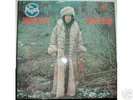
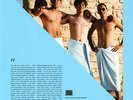
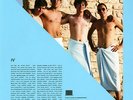
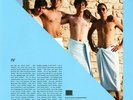
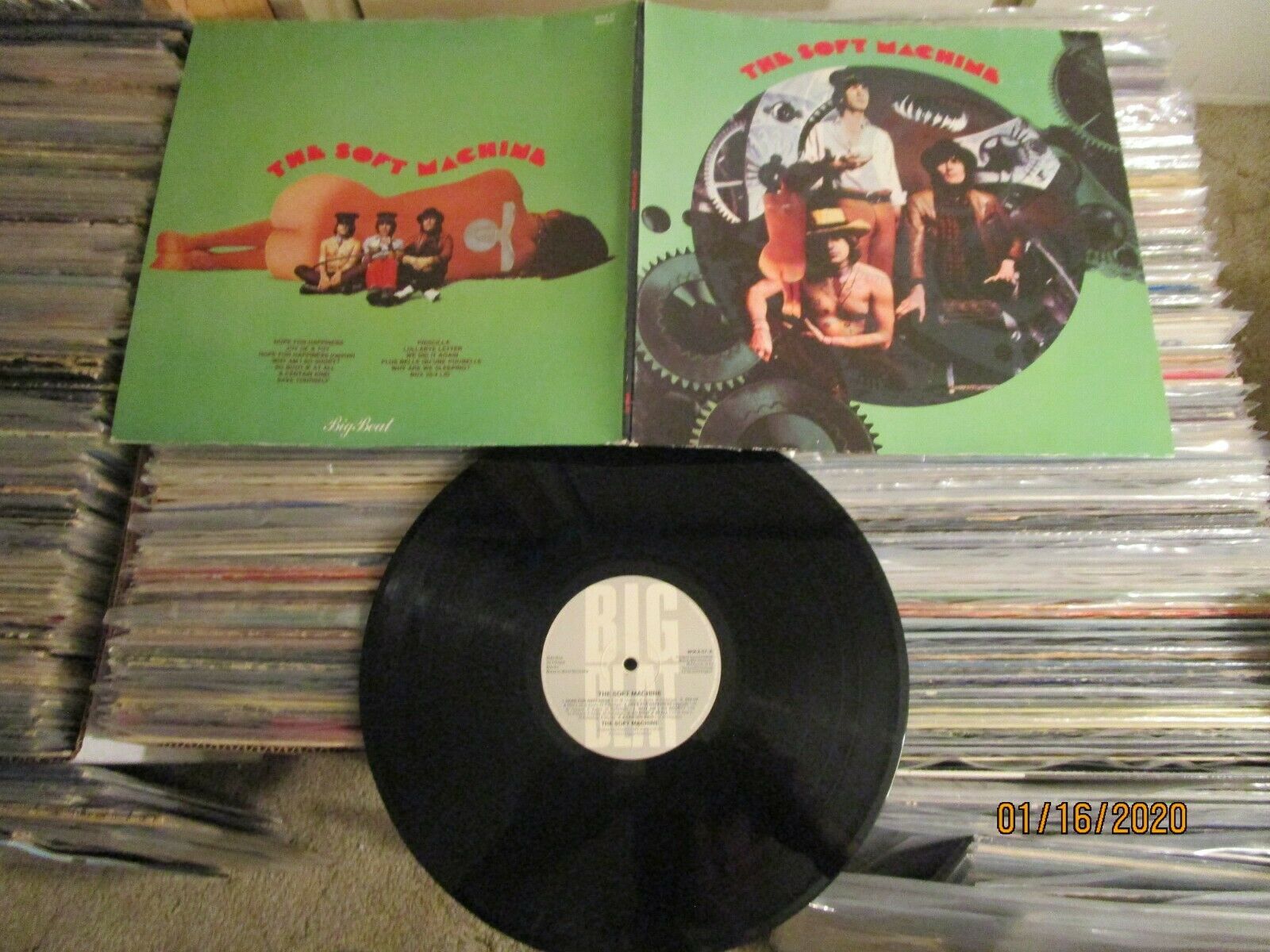
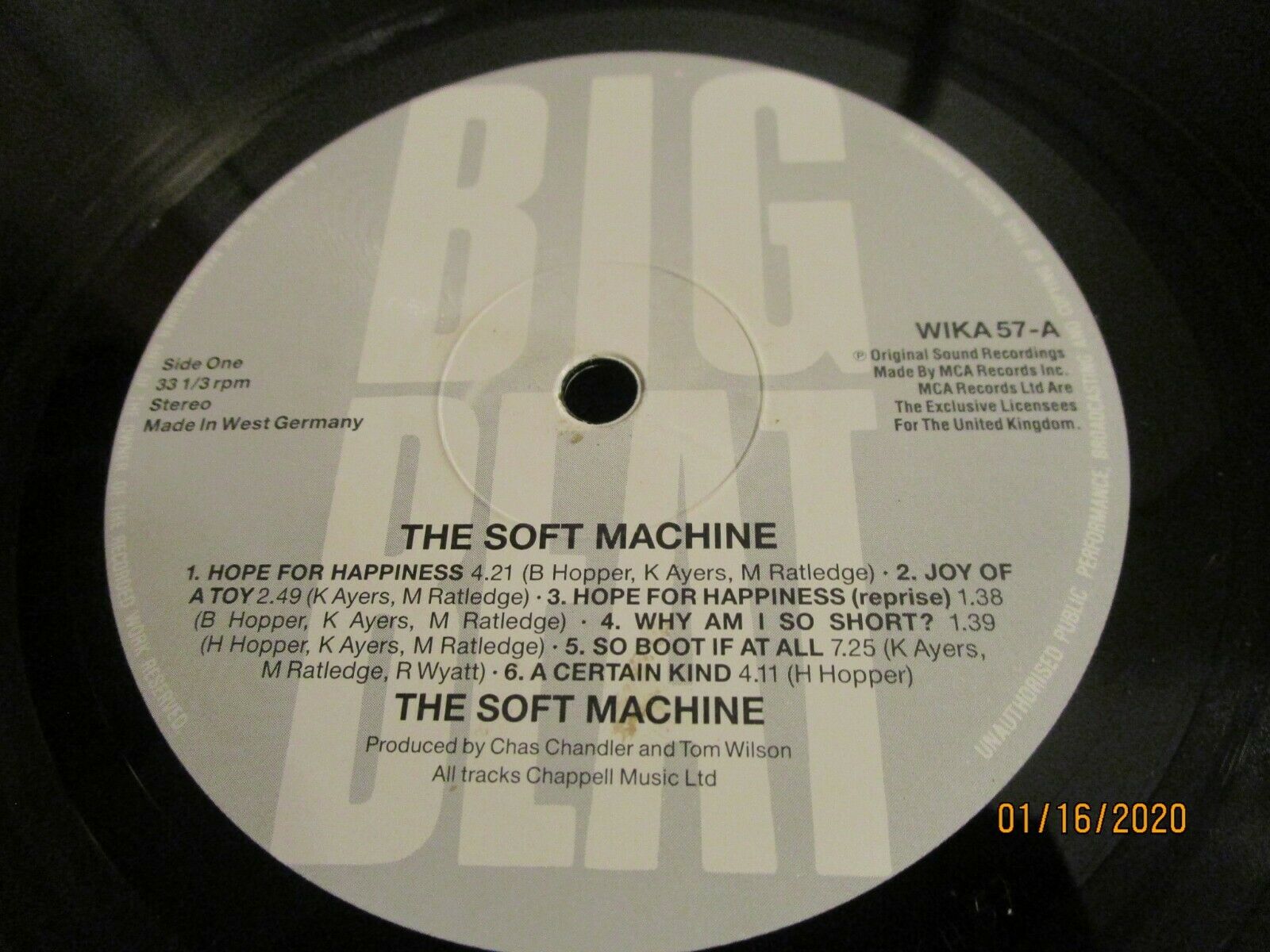
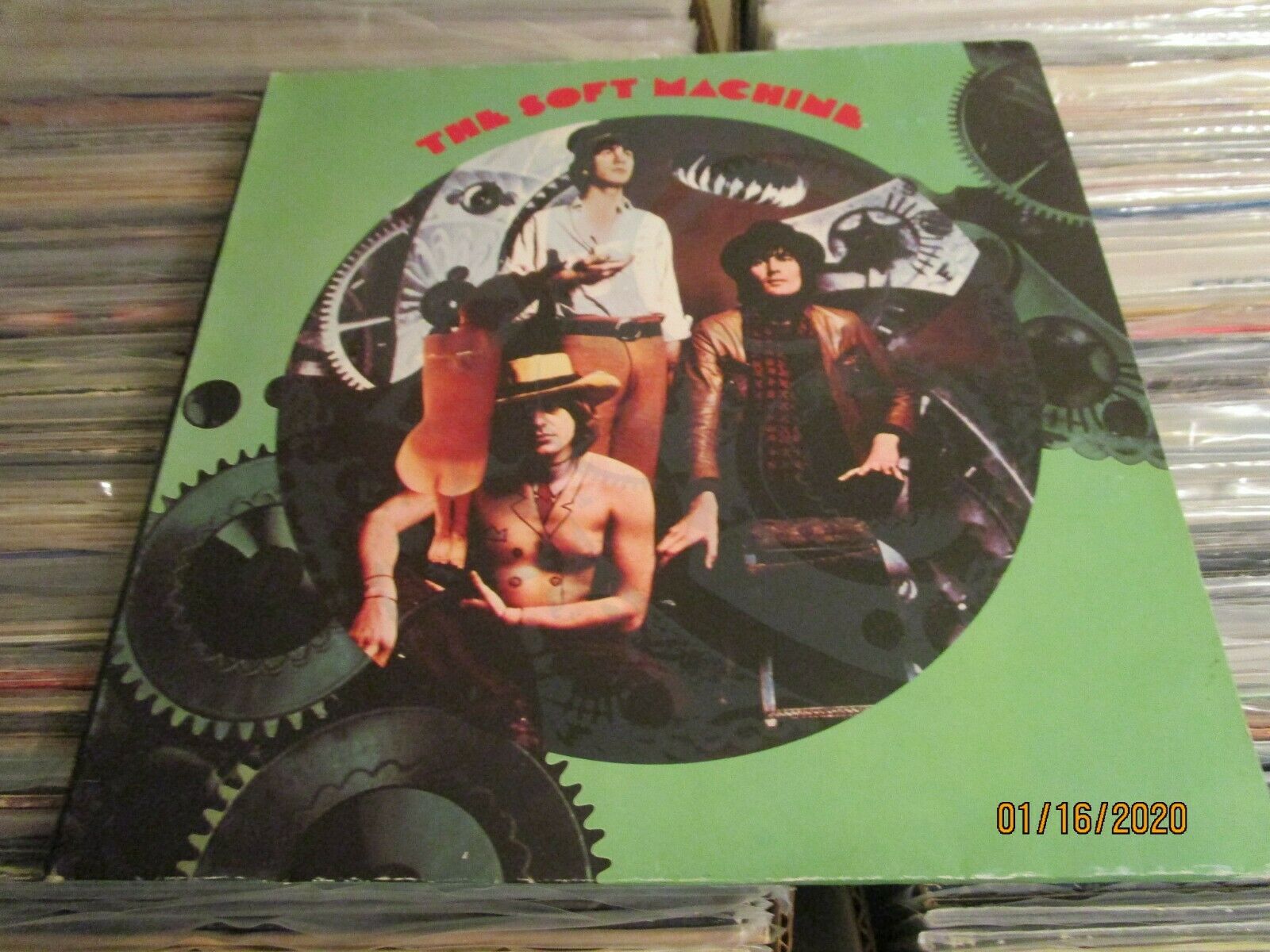
The Soft Machine - Self-titled - LP gatefold German import vg+/ex
$
25


Favourite Auctions
To save auctions to your favourites, please login
If you don't have an account, please register
Description
Competitive pricing is my goal to get rid of the hundred's of Lp's I have. I may miss a thing or two sometimes on my listings, but I will always be here to help resolve the issue, so not to worry. I try my best in grading lp's, and on occasion I will play test if time allows... I have been collecting records since my 20's Its has been a passion and a part-time hobby, but now it is time to let alot of these records go so I can downsize. I hope you love and enjoy music as much as I do, and selling is another way to get to know other people with a like minded interest as I. I offer a refund policy, so please give me the opportunity to make good if there is a problem with a transaction.
check prices, email me with concerns please.
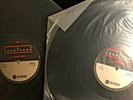
Jacket VG+ record EX Cleaned, play test. Very nice. No issues. Reissue, remastered.
shipping:
1-2 Lp's: $3.50 3-3 Lp's: $3.80 4-5 Lp's: $4.50 6-6 Lp's $5.50 7-9 Lp's $6.50 more. let me know I will do the math.
Soft Machine are an English rock and jazz band from Canterbury formed in mid-1966, currently consisting of John Marshall (drums), Roy Babbington (bass), John Etheridge (guitar), and Theo Travis (saxophone, flutes, keyboards). As a central band of the Canterbury scene, the group became one of the first British psychedelic acts and later moved into progressive and jazz-rock. Their varying lineups have included prominent former members such as Robert Wyatt (drums, 1966–73), Mike Ratledge (organ, 1966–76), Hugh Hopper (bass, 1969–73), and Kevin Ayers (bass, 1966–68).
Though they achieved little commercial success, the Soft Machine are considered by critics to have been influential in rock music, Dave Lynch at AllMusic called them "one of the more influential bands of their era, and certainly one of the most influential underground ones". The group were named after the novel The Soft Machine by William S. Burroughs.
Soft Machine (billed as The Soft Machine up to 1969 or 1970) were formed in mid-1966 by Robert Wyatt (drums, vocals), Kevin Ayers (bass, guitar, vocals), Daevid Allen (guitar) and Mike Ratledge (organ) plus, for the first few gigs only, American guitarist Larry Nowlin. Allen, Wyatt and future bassist Hugh Hopper first played together in the Daevid Allen Trio in 1963, occasionally accompanied by Ratledge. Wyatt, Ayers, and Hopper had been founding members of The Wilde Flowers, incarnations of which would include members of another Canterbury band, Caravan.
This first Soft Machine line-up became involved in the early UK underground, performing at the UFO Club and other London clubs like the Speakeasy Club and Middle Earth. Their first single, "Love Makes Sweet Music" (recorded 5 February 1967, produced by Chas Chandler), was released by Polydor in February, backed with "Feelin' Reelin' Squeelin'" (January 1967, produced by Kim Fowley). In April 1967 they recorded seven demo songs with producer Giorgio Gomelsky in De Lane Lea Studios that remained unreleased until 1971 in a dispute over studio costs.[8] They also played in the Netherlands, Germany, and on the French Riviera. During July and August 1967, Gomelsky booked shows along the Côte d'Azur with the band's most famous early gig taking place in the village square of Saint-Tropez. This led to an invitation to perform at producer Eddie Barclay's trendy "Nuit Psychédélique", performing a forty-minute rendering of "We Did It Again", singing the refrain over and over in a trance-like quality. This made them instant darlings of the Parisian "in" crowd, resulting in invitations to appear on television shows and at the Paris Biennale in October 1967. After their return from France, Allen (an Australian) was denied re-entry to the United Kingdom, so the group continued as a trio, while he returned to Paris to form Gong.
Sharing the same management as Jimi Hendrix, the band supported the Jimi Hendrix Experience's North America tour throughout 1968. Soft Machine's first album was recorded in New York City in April at the end of the first leg of the tour. Back in London, guitarist Andy Summers, later of The Police, joined the group following the breakup of Dantalian's Chariot (previously Zoot Money's Big Roll Band). After a few weeks of rehearsals, the quartet began a tour of the U.S. with some solo shows before reuniting with Hendrix during August and September 1968. Summers was fired at the insistence of Ayers, who departed amicably after the final tour date at the Hollywood Bowl in mid-September, and for the remainder of 1968 Soft Machine were no more. Wyatt stayed in the U.S. to record solo demos, while Ratledge returned to London and began composing in earnest. One of Wyatt's demos, Slow Walkin' Talk, allowed Wyatt to make use of his multi-instrumentalist skills (Hammond organ, piano, drums and vocals) and featured Hendrix on bass guitar.
In December 1968, to fulfill contractual obligations, Soft Machine re-formed with former road manager and composer Hugh Hopper on bass added to Wyatt and Ratledge and recorded their second album, Volume Two, which started a transition toward jazz fusion. In May 1969 this line-up acted as the uncredited backing band on two tracks of The Madcap Laughs, the debut album by Syd Barrett. In 1969 the trio was expanded to a septet with the addition of four horn players, though only saxophonist Elton Dean remained beyond a few months, the resulting Soft Machine quartet (Wyatt, Hopper, Ratledge and Dean) running through Third (1970) and Fourth (1971), with various guests, mostly jazz players (Lyn Dobson, Nick Evans, Mark Charig, Jimmy Hastings, Roy Babbington, Rab Spall). Fourth was the first of their fully instrumental albums and the last one featuring Wyatt.
Their propensity for building extended suites from regular sized compositions, both live and in the studio (already in the Ayers suite in their first album), reached its apogee in the 1970 album Third, unusual for its time with each of the four sides featuring one suite. Third was also unusual for remaining in print for more than ten years in the U.S., and is the best-selling Soft Machine recording.
They received unprecedented acclaim across Europe, and they made history by becoming the first rock band invited to play at London's Proms in August 1970. The show was broadcast live on national TV and later appeared as a live album.
Hope For Happiness 4:20 Joy Of A Toy 2:49 Hope For Happiness (Reprise) 1:37 Why Am I So Short? 1:38 So Boot If At All 7:22 A Certain Kind 4:10 Save Yourself 2:25 Priscilla 1:05 Lullabye Letter 4:37 We Did It Again 3:46 Plus Belle Qu'une Poubelle 1:01 Why Are We Sleeping? 5:31 Box 25/4 Lid 0:47
price rating