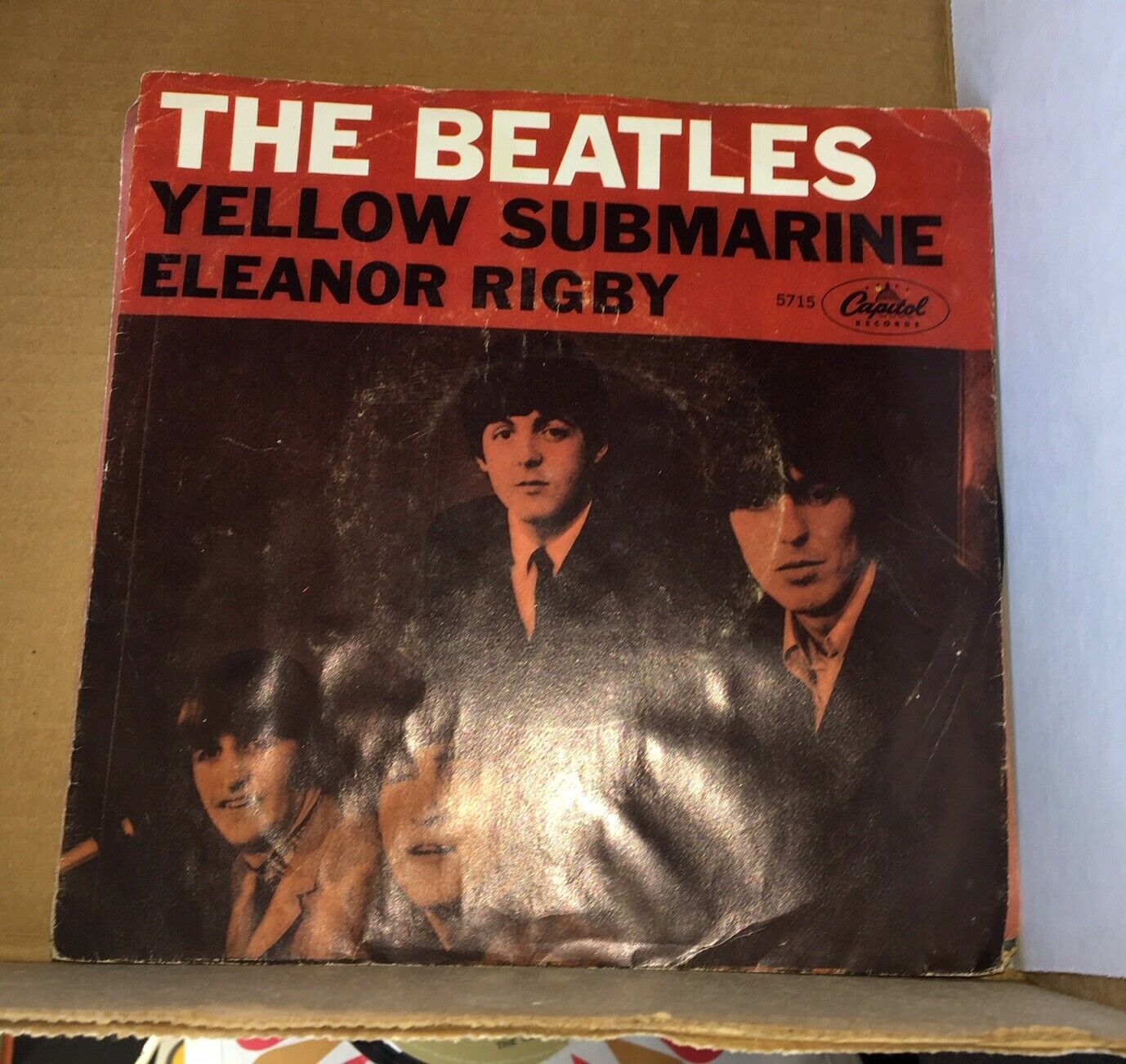
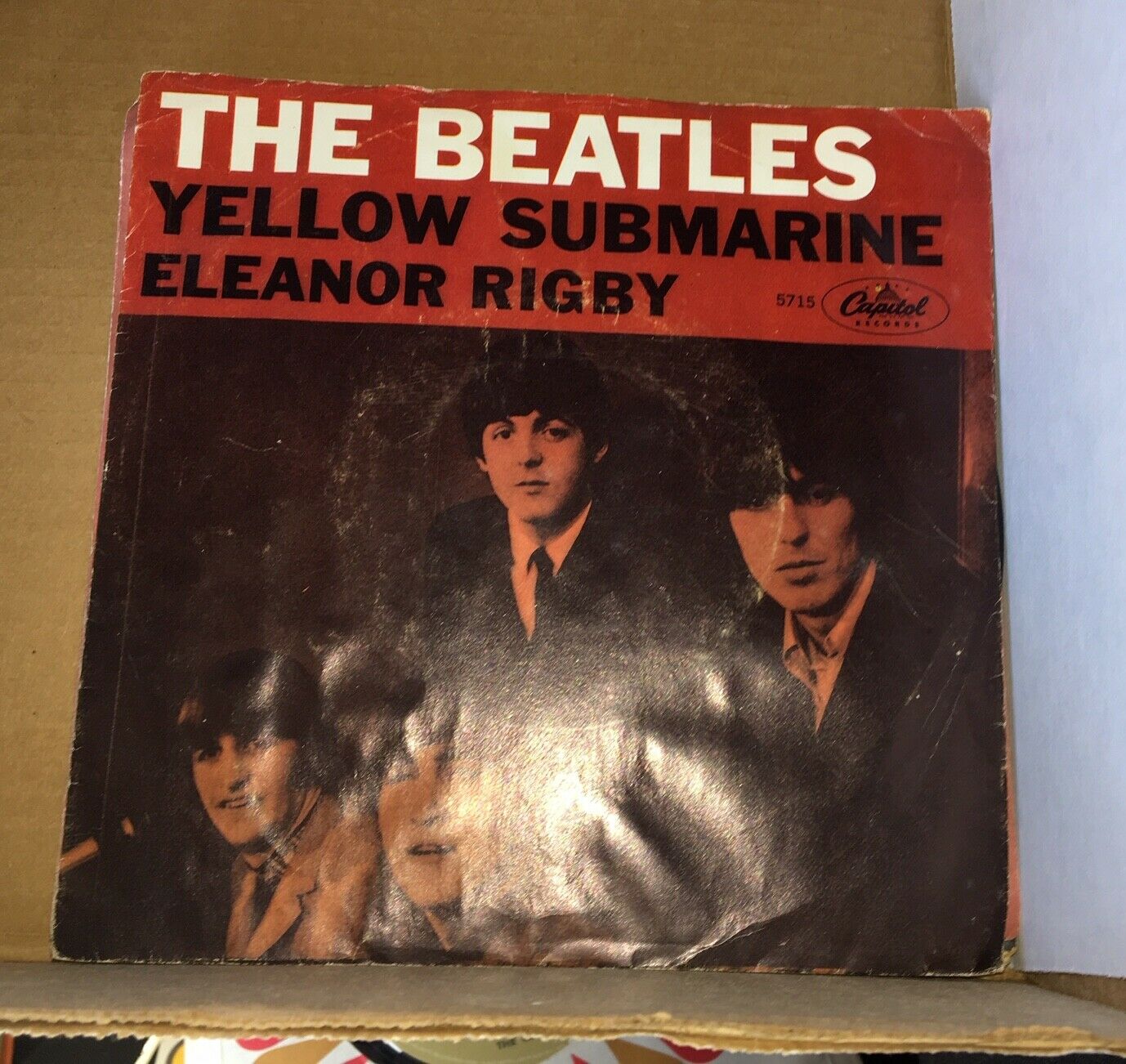
The Beatles ?Yellow Submarine Eleanor Rigby Capitol Records 5715 1966 7" PS
$
20

Favourite Auctions
To save auctions to your favourites, please login
If you don't have an account, please register
Description
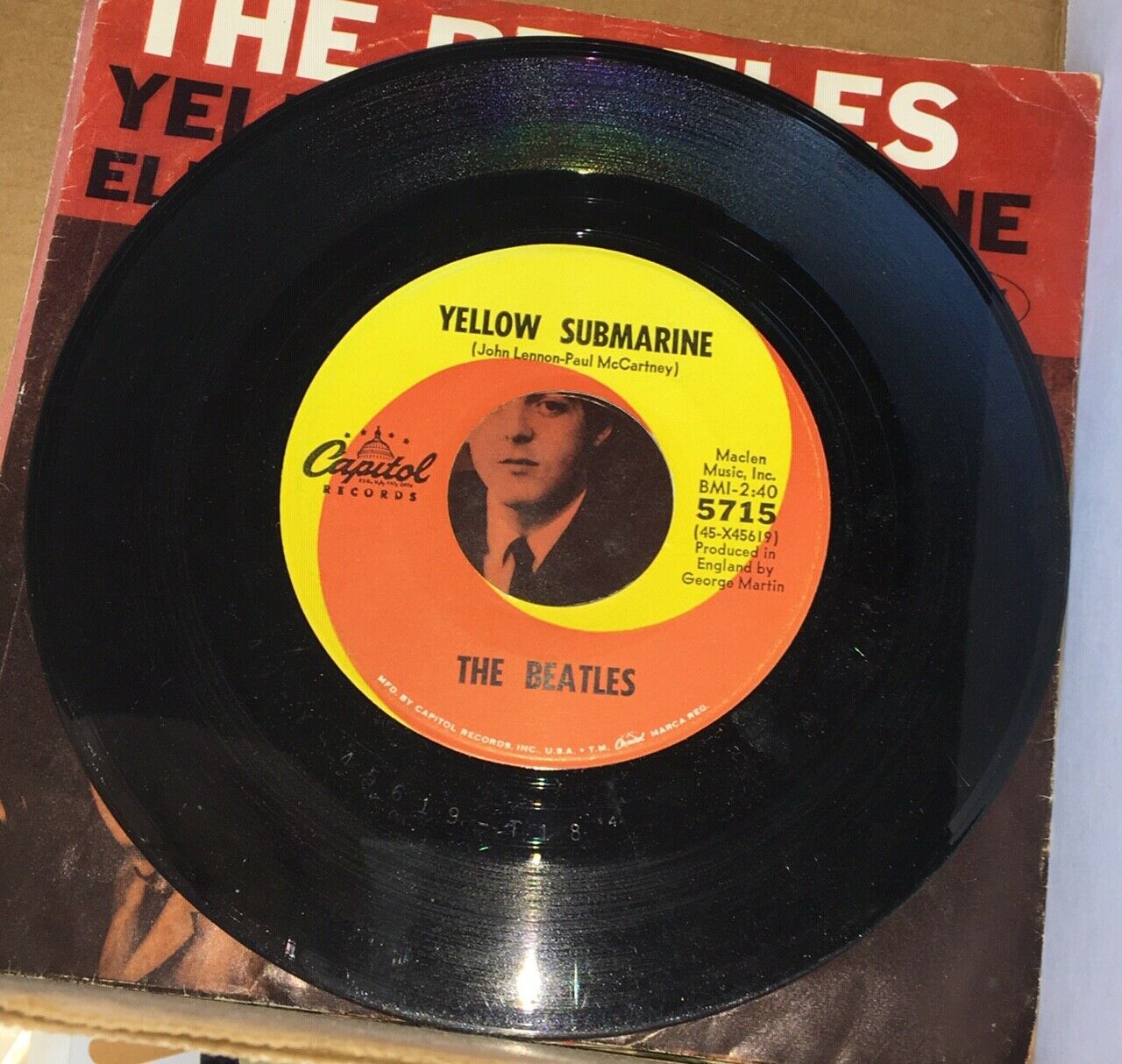
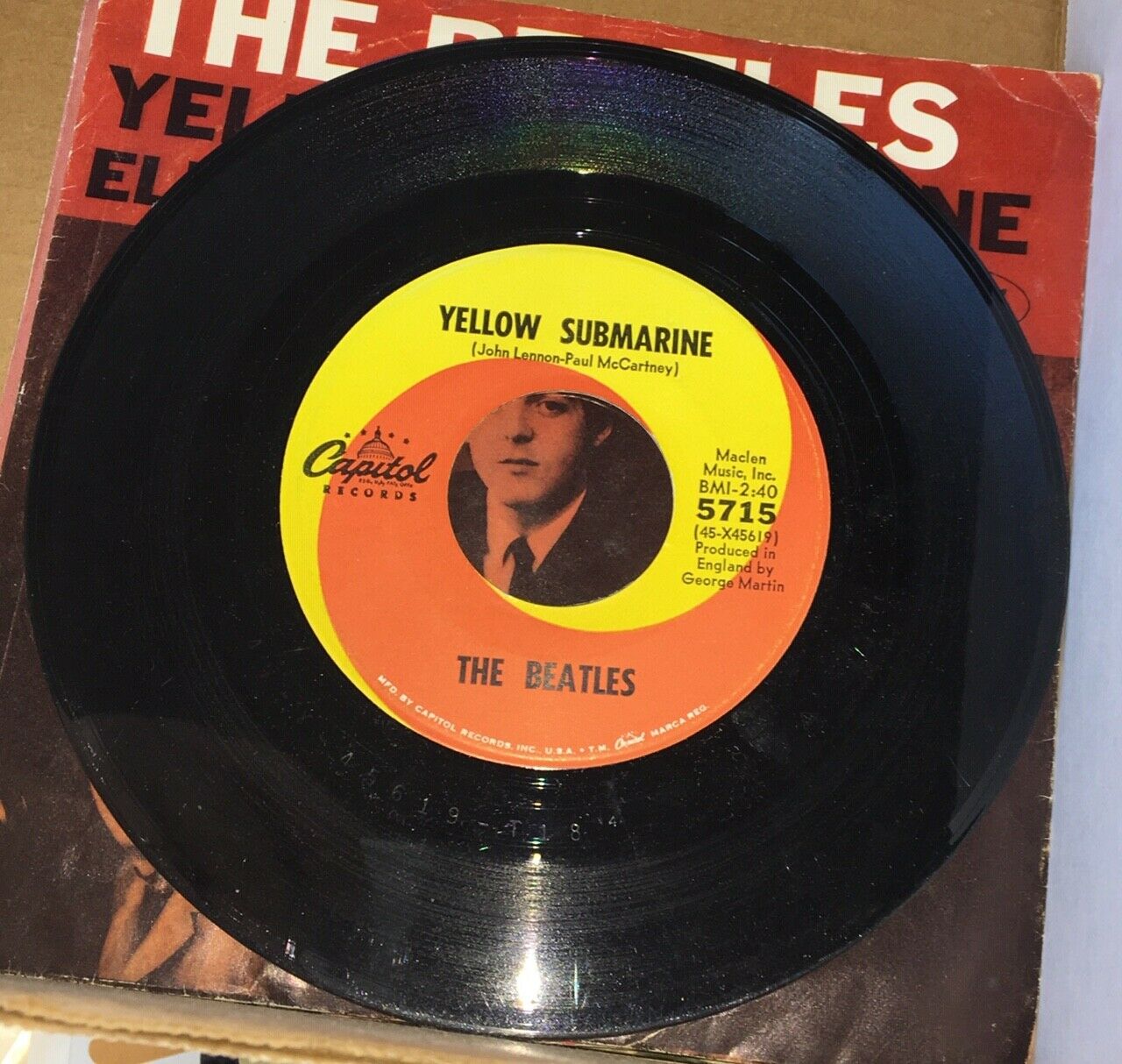
The Beatles ?– Yellow Submarine / Eleanor Rigby Label: Capitol Records ?– 5715 Format: Vinyl, 7", 45 RPM, Single, Scranton Pressing Country: US Released: 08 Aug 1966 Genre: Rock, Children's Style: Pop Rock, Psychedelic Rock Tracklist A Yellow Submarine 2:40 AA Eleanor Rigby 2:11 Companies, etc. Manufactured By – Capitol Records, Inc. Published By – Maclen Music, Inc. Pressed By – Capitol Records Pressing Plant, Scranton Credits Producer – George Martin Written-By – John Lennon-Paul McCartney* Notes Variation: IAM in triangle on runouts that indicates this was pressed at Capitol Records Pressing Plant, Scranton.
Orange and yellow swirl without "subsidiary" rim text. East coast label. double a-side single
"Eleanor Rigby" is a song by the English rock band the Beatles released on their 1966 album Revolver and as a single with "Yellow Submarine". It was written primarily by Paul McCartney and credited to Lennon–McCartney.
The song continued the transformation of the Beatles from a mainly rock and roll- and pop-oriented act to a more experimental, studio-based band. With a double string quartet arrangement by George Martin and striking lyrics about loneliness, "Eleanor Rigby" broke sharply with popular music conventions, both musically and lyrically.[4] Richie Unterberger of AllMusic cites the band's "singing about the neglected concerns and fates of the elderly" on the song as "just one example of why the Beatles' appeal reached so far beyond the traditional rock audience".
Paul McCartney came up with the melody of "Eleanor Rigby" as he experimented on his piano. However, the original name of the protagonist that he chose was not Eleanor Rigby, but Miss Daisy Hawkins.[6] The singer-composer Donovan reported that he heard McCartney play it to him before it was finished, with completely different lyrics.[7] In 1966, McCartney recalled how he got the idea for his song:
I was sitting at the piano when I thought of it. The first few bars just came to me, and I got this name in my head ... "Daisy Hawkins picks up the rice in the church". I don't know why. I couldn't think of much more so I put it away for a day. Then the name "Father McCartney" came to me, and all the lonely people. But I thought that people would think it was supposed to be about my Dad sitting knitting his socks. Dad's a happy lad. So I went through the telephone book and I got the name "McKenzie".[8]
Others have posited that "Father McKenzie" refers to "Father" Tommy McKenzie, who was the compere at Northwich Memorial Hall.[9][10]
"Eleanor Rigby" MENU0:00 Problems playing this file? See media help. McCartney said he came up with the name "Eleanor" from actress Eleanor Bron, who had starred with the Beatles in the film Help!. "Rigby" came from the name of a store in Bristol,[11] "Rigby & Evens Ltd, Wine & Spirit Shippers", which he noticed while seeing his girlfriend of the time, Jane Asher, act in The Happiest Days of Your Life.[12] He recalled in 1984, "I just liked the name. I was looking for a name that sounded natural. 'Eleanor Rigby' sounded natural."
It was one of several songs in this period which evoked a past era by using female given names which have since become very popular again, but which were rarely given among baby boomers, the main pop audience at the time. Others include "See Emily Play" by Pink Floyd, where the then-rare name evoked a sense of Victoriana, and "Pictures of Lily" by The Who, which specifically refers to Lillie Langtry.
McCartney wrote the first verse by himself, and the Beatles finished the song in the music room of John Lennon's home at Kenwood. John Lennon, George Harrison, Ringo Starr and Lennon's childhood friend Pete Shotton all listened to McCartney play his song through and contributed ideas. Harrison came up with the "Ah, look at all the lonely people" hook. Starr contributed the line "writing the words of a sermon that no one will hear" and suggested making "Father McCartney" darn his socks, which McCartney liked. It was then that Shotton suggested that McCartney change the name of the priest, in case listeners mistook the fictional character in the song for McCartney's own father.[13]
The song is often described as a lament for lonely people[14] or a commentary on post-war life in Britain.[15][16]
McCartney could not decide how to end the song, and Shotton finally suggested that the two lonely people come together too late as Father McKenzie conducts Eleanor Rigby's funeral. At the time, Lennon rejected the idea out of hand, but McCartney said nothing and used the idea to finish off the song, later acknowledging Shotton's help.[13]
Lennon was quoted in 1971 as having said that he "wrote a good half of the lyrics or more"[17] and in 1980 claimed that he wrote all but the first verse,[18] but Shotton remembered Lennon's contribution as being "absolutely nil".[19] McCartney said that "John helped me on a few words but I'd put it down 80–20 to me, something like that."[20]
Harmony The song is a prominent example of mode mixture, specifically between the Aeolian mode, also known as natural minor, and the Dorian mode. Set in E minor, the song is based on the chord progression Em–C, typical of the Aeolian mode and utilising notes ?3, ?6, and ?7 in this scale. The verse melody is written in Dorian mode, a minor scale with the natural sixth degree.[21] "Eleanor Rigby" opens with a C-major vocal harmony ("Aah, look at all ..."), before shifting to E-minor (on "lonely people"). The Aeolian C-natural note returns later in the verse on the word "dre-eam" (C–B) as the C chord resolves to the tonic Em, giving an urgency to the melody's mood.
The Dorian mode appears with the C# note (6 in the Em scale) at the beginning of the phrase "in the church". The chorus beginning "All the lonely people" involves the viola in a chromatic descent to the 5th; from 7 (D natural on "All the lonely peo-") to 6 (C? on "-ple") to ?6 (C on "they) to 5 (B on "from"). This is said to "add an air of inevitability to the flow of the music (and perhaps to the plight of the characters in the song)".[22]
Real people named Eleanor Rigby
The gravestone of the "real" Rigby, St Peter's Parish Church, Woolton, August 2008 In the 1980s, a grave of an Eleanor Rigby was "discovered" in the graveyard of St Peter's Parish Church in Woolton, Liverpool, and a few yards (a few metres) away from that, another tombstone with the last name "McKenzie" scrawled across it.[23][24] During their teenage years, McCartney and Lennon spent time sunbathing there, within earshot of where the two had first met during a fete in 1957.
Years later,[when?] McCartney said that the coincidence could be a product of his subconscious (cryptomnesia).[23] In 2008, however, when a birth certificate was sold at auction of a woman named Eleanor Rigby, McCartney restated publicly: "Eleanor Rigby is a totally fictitious character that I made up ... If someone wants to spend money buying a document to prove a fictitious character exists, that's fine with me."[25]
An actual Eleanor Rigby was born on 29 August 1895 and lived in Liverpool, possibly in the suburb of Woolton, where she married a man named Thomas Woods on Boxing Day 1930. She died on 10 October 1939 of a brain haemorrhage at the age of 44 and was buried three days later. Her tombstone has become a landmark to Beatles fans visiting Liverpool. A digitised version was added to the 1995 music video for the Beatles' reunion song "Free as a Bird".
In June 1990, McCartney donated to Sunbeams Music Trust[26] a document dating from 1911 which had been signed by the 16-year-old Eleanor Rigby; this instantly attracted significant international interest from collectors because of the coincidental significance and provenance of the document.[27] The nearly 100-year-old document was sold at auction in November 2008 for £115,000.[28] The Daily Telegraph reported that the uncovered document "is a 97-year-old salary register from Liverpool City Hospital". The name "E. Rigby" is printed on the register, and she is identified as a scullery maid. She also did many things for the Liverpool City Hospital.[clarification needed]
Recording
The Beatles in 1965 "Eleanor Rigby" does not have a standard pop backing. None of the Beatles played instruments on it, though John Lennon and George Harrison did contribute harmony vocals.[29] Like the earlier song "Yesterday", "Eleanor Rigby" employs a classical string ensemble—in this case an octet of studio musicians, comprising four violins, two violas, and two cellos, all performing a score composed by producer George Martin.[29] Where "Yesterday" is played legato, "Eleanor Rigby" is played mainly in staccato chords with melodic embellishments. McCartney, reluctant to repeat what he had done on Yesterday, explicitly expressed that he did not want the strings to sound too cloying. For the most part, the instruments "double up"—that is, they serve as a single string quartet but with two instruments playing each of the four parts. Microphones were placed close to the instruments to produce a more biting and raw sound. Engineer Geoff Emerick was admonished by the string players saying "You're not supposed to do that." Emerick was starting to develop a reputation at EMI as a maverick, not adhering to the strict rules and procedures prescribed by the Recording Handbooks for all staff engineers. Fearing such close proximity to their instruments would expose the slightest deficiencies in their technique, the players kept moving their chairs away from the microphones until George Martin got on the talk-back system and scolded "Stop moving the chairs!" Martin recorded two versions, one with and one without vibrato, the latter of which was used. Lennon recalled in 1980 that "Eleanor Rigby" was "Paul's baby, and I helped with the education of the child ... The violin backing was Paul's idea. Jane Asher had turned him on to Vivaldi, and it was very good."[30] The octet was recorded on 28 April 1966, in Studio 2 at Abbey Road Studios; it was completed in Studio 3 on 29 April and on 6 June. Take 15 was selected as the master.[31]
George Martin, in his autobiography All You Need Is Ears, takes credit for combining two of the vocal parts—"Ah! look at all the lonely people" and "All the lonely people"—having noticed that they would work together contrapuntally. He cited the influence of Bernard Herrmann's work on his string scoring. (Originally he cited the score for the film Fahrenheit 451,[32] but this was a mistake as the film was not released until several months after the recording; Martin later stated he was thinking of Herrmann's score for Psycho.)[33]
The original stereo mix had McCartney's voice only in the right channel during the verses, with the string octet mixed to one channel, while the mono single and mono LP featured a more balanced mix. On the Yellow Submarine Songtrack, Love and the 2015 remix of 1, McCartney's voice is centred and the string octet appears in stereo, creating a modern-sounding mix.
Releases Simultaneously released on 5 August 1966 on both the album Revolver and on a double A-side single with "Yellow Submarine" on Parlophone in the United Kingdom and Capitol in the United States,[34] "Eleanor Rigby" spent four weeks at number one on the British charts,[29] but in America it only reached #11, with "Yellow Submarine" charting separately at #2.[35]
The song was nominated for three Grammys and won the 1966 Grammy for Best Contemporary (R&R) Vocal Performance, Male or Female for McCartney. Thirty years later, a stereo remix of George Martin's isolated string arrangement was released on the Beatles' Anthology 2. A decade after that, a remixed version of the track was included in the 2006 album Love.
It is the second song to appear in the Beatles' 1968 animated film Yellow Submarine. The first is "Yellow Submarine"; it and "Eleanor Rigby" are the only songs in the film which the animated Beatles are not seen to be singing. "Eleanor Rigby" is introduced just before the Liverpool sequence of the film; its poignancy ties in quite well with Ringo Starr (the first member of the group to encounter the submarine), who is represented as quietly bored and depressed. "Compared with my life, Eleanor Rigby's was a gay, mad world."
In 1984, a re-interpretation of the song was included in the film and album Give My Regards to Broad Street, written by and starring McCartney. It segues into a symphonic extension, "Eleanor's Dream."
A fully remixed stereo version of the original "Eleanor Rigby" song was issued in 1999 on the Yellow Submarine Songtrack. Further new mixes were released on Love and the 2015 version of 1.
Significance
Statue of Eleanor Rigby by Tommy Steele on Stanley Street, Liverpool. A plaque describes: "Dedicated to All the Lonely People" "Eleanor Rigby" was important in the Beatles' evolution from a pop, live-performance band to a more experimental, studio-orientated band, though the track contains little studio trickery. In a 1967 interview, Pete Townshend of The Who commented, "I think 'Eleanor Rigby' was a very important musical move forward. It certainly inspired me to write and listen to things in that vein."[36]
Though "Eleanor Rigby" was far from the first pop song to deal with death and loneliness, according to Ian MacDonald it "came as quite a shock to pop listeners in 1966".[29] It took a bleak message of depression and desolation, written by a famous pop band, with a sombre, almost funeral-like backing, to the number one spot of the pop charts.[29] The bleak lyrics were not the Beatles' first deviation from love songs, but were some of the most explicit.
In some reference books on classical music, "Eleanor Rigby" is included and considered comparable to art songs (lieder). Classical and theatrical composer Howard Goodall said that the Beatles' works are "a stunning roll-call of sublime melodies that perhaps only Mozart can match in European musical history" and that they "almost single-handedly rescued the Western musical system" from the "plague years of the avant-garde". About "Eleanor Rigby", he said it is "an urban version of a tragic ballad in the Dorian mode".[37]
Celebrated songwriter Jerry Leiber said: "The Beatles are second to none in all departments. I don't think there has ever been a better song written than 'Eleanor Rigby'."[38]
Barry Gibb of the Bee Gees once said that their 1969 song "Melody Fair" was influenced by "Eleanor Rigby".[39]
America's single, "Lonely People", was written by Dan Peek in 1973 as an optimistic response to "Eleanor Rigby."
The song's apparent criticism of the pre-1960s order of British society has attracted the opprobrium of some conservatives; Peter Hitchens, for example, has attacked what he describes as its "dismissal of faith and mockery of quiet lives".[40]
In 2004, this song was ranked number 138 on Rolling Stone's list of "The 500 Greatest Songs of All Time".
Yellow Submarine" is a song by the English rock band the Beatles, written by Paul McCartney and John Lennon, with lead vocals by Ringo Starr. It was included on their 1966 album Revolver and issued as a single, coupled with "Eleanor Rigby". The single went to number one on every major British chart, remained at number one for four weeks, and charted for 13 weeks. It won an Ivor Novello Award "for the highest certified sales of any single issued in the UK in 1966". In the US, the song peaked at number two on the Billboard Hot 100 chart, behind "You Can't Hurry Love" by the Supremes and it became the most successful Beatles song to feature Starr as lead vocalist.
It became the title song of the animated United Artists film, also called Yellow Submarine (1968), and the soundtrack album to the film, released as part of the Beatles' music catalogue. An orchestral reprise to the song arranged by George Martin titled "Yellow Submarine in Pepperland" is featured at the end of the film and its soundtrack.
Although intended as a nonsense song for children, "Yellow Submarine" received various social and political interpretations at the time of its release.[4]
In a joint interview in March 1967, McCartney and Lennon recalled that the song's melody was created by combining two different songs they had been working on separately. Lennon noted that McCartney brought in the chorus ("the submarine... the chorus bit") which Lennon suggested combining with a melody for the verses that he'd already written.[5] McCartney also noted: "It's a happy place, that's all. You know, it was just ... We were trying to write a children's song. That was the basic idea. And there's nothing more to be read into it than there is in the lyrics of any children's song."[6][7]
In 1980, Lennon talked further about the song: "'Yellow Submarine' is Paul's baby. Donovan helped with the lyrics. I helped with the lyrics too. We virtually made the track come alive in the studio, but based on Paul's inspiration. Paul's idea. Paul's title ... written for Ringo."[6] Donovan added the words, "Sky of blue and sea of green".[8][9]
In 1994, McCartney discussed his inspiration for the song's concept:[10] "I was laying in bed in the Ashers' garret ... I was thinking of it as a song for Ringo, which it eventually turned out to be, so I wrote it as not too rangey in the vocal, then started making a story, sort of an ancient mariner, telling the young kids where he'd lived. It was pretty much my song as I recall ... I think John helped out. The lyrics got more and more obscure as it goes on, but the chorus, melody and verses are mine."[6] The song began as being about different coloured submarines, but evolved to include only a yellow one.[11]
Recording Produced by George Martin and engineered by Geoff Emerick, "Yellow Submarine" was recorded in five takes on 26 May 1966, in Studio Two at Abbey Road Studios; special effects were added on 1 June.[8] Martin drew on his experience as a producer of comedy records for Beyond the Fringe and members of the cast of The Goon Show, providing an array of zany sound effects to create the nautical atmosphere.[12] On the second session the studio store cupboard was ransacked for special effects, which included chains, a ship's bell, tap dancing mats, whistles, hooters, waves, a tin bath filled with water, wind, and thunderstorm machines, as well as a cash register, which was the very same one later heard on Pink Floyd's song "Money" (1973).[13] Lennon blew through a straw into a pan of water to create a bubbling effect; McCartney and Lennon talked through tin cans to create the sound of the captain's orders; at 1:38–1:40 in the song, Starr stepped outside the doors of the recording room and yelled like a sailor, acknowledging "Cut the cable! Drop the cable!", which was looped into the song afterwards; and Abbey Road employees John Skinner and Terry Condon twirled chains in a tin bath to create water sounds.[8] After the line, "and the band begins to play", Emerick found a recording of a brass band and changed it slightly so it could not be identified, although it is thought to be a recording of Georges Krier and Charles Helmer's composition, "Le Rêve Passe" (1906).[8] The original recording had a spoken intro by Starr, but the idea was abandoned on 3 June.[8]
When the overdubs were finished, Mal Evans strapped on a marching bass drum and led everybody in a line around the studio doing the conga dance whilst banging on the drum.[13]
Release The "Yellow Submarine" single was the Beatles' 13th single release in the United Kingdom. It was released in the UK on 5 August 1966 as a double A side with "Eleanor Rigby", and in the United States on 8 August. In both countries, the album Revolver, which featured both songs, was released on the same day as the single.[14] On 6 July 2018, a 7-inch vinyl picture disk was released to mark the 50th anniversary of the release of the film based on the song, although the reissue used the stereo remixes made for the 1 album's 2015 release.[15]
Reception and interpretations The single went to number 1 on every major British chart, remained at number 1 for four weeks and charted for 13 weeks.[8] It won an Ivor Novello Award for the highest certified sales of any single issued in the UK in 1966.
In the United States, the single reached number 2 on the Billboard Hot 100 (behind "You Can't Hurry Love" by The Supremes), number 1 in Record World and in Cashbox.[16] The single was released during the controversies about the "Butcher Cover" (the Yesterday and Today album cover)[8] and Lennon's remarks about Christianity,[17] which are cited as part of the reason the song failed to reach number 1 on all US charts. It sold 1,200,000 copies in four weeks and earned the Beatles their twenty-first US Gold Record award, beating the record set by Elvis Presley.[18]
Although intended as a nonsense song for children, "Yellow Submarine" received various social and political interpretations at the time; music journalist Peter Doggett wrote that the "culturally empty" song "became a kind of Rorschach test for radical minds."[4] The song's chorus was reappropriated by schoolchildren, sports fans, and striking workers in their own chants. At a Mobe protest in San Francisco, a yellow papier-mâché submarine made its way through the crowd, which Time magazine interpreted as a "symbol of the psychedelic set's desire for escape".[4] A reviewer for the P.O. Frisco wrote in 1966, "the Yellow Submarine may suggest, in the context of the Beatles' anti-Vietnam War statement in Tokyo this year, that the society over which Old Glory floats is as isolated and morally irresponsible as a nuclear submarine."[4] Writing for Esquire, Robert Christgau felt that the Beatles "want their meanings to be absorbed on an instinctual level" and wrote of the interpretations: "I can't believe that the Beatles indulge in the simplistic kind of symbolism that turns a yellow submarine into a Nembutal or a banana – it is just a yellow submarine, damn it, an obvious elaboration of John [Lennon]'s submarine fixation, first revealed in A Hard Day's Night."[19]
Personnel According to Ian MacDonald:[20]
The Beatles
Ringo Starr – lead vocal, drums John Lennon – acoustic guitar, backing vocals, sound effects (bubbles) Paul McCartney – bass guitar, backing vocals George Harrison – acoustic guitar, tambourine, backing vocals Additional contributors
Mal Evans – bass drum, backing vocals George Martin – backing vocals, producer Geoff Emerick – backing vocals, tape loops, engineer Neil Aspinall – backing vocals Alf Bicknell – sound effects (rattling chains) Pattie Boyd – backing vocals Marianne Faithfull – backing vocals Brian Jones – backing vocals, sound effects (clinking glasses) Brian Epstein – backing vocals Charts and certifications Charts Chart (1966) Peak position Australia (Go-Set Top 40)[21] 1 Austria (Ö3 Austria Top 40)[22] 1 Belgium (Ultratop 50 Flanders)[23] 1 Canadian RPM Top Singles[24] 1 Irish Singles Chart[25] 1 Netherlands (Dutch Top 40)[26] 1 Netherlands (Single Top 100)[27] 1 New Zealand (Listener)[28] 1 Norway (VG-lista)[29] 1 Spain (AFE)[30] 3 Swedish Kvällstoppen Chart[31] 1 UK (Official Charts Company)[32] 1 US Billboard Hot 100[33] 2 West Germany (Official German Charts)[34] 1 Chart (1986) Peak position UK (Official Charts Company)[33] 63 Chart (2012) Peak position Belgium (Ultratop 50 Back Catalogue Singles Flanders)[35] 16 Chart (2018) Peak position Germany (Official German Charts)[36] 55 Certifications Region Certification Certified units/sales United States (RIAA)[37] Gold 1,000,000^ *sales figures based on certification alone ^shipments figures based on certification alone Tributes
The Yellow Submarine sculpture (1984). A 51-foot (16 m)-long yellow submarine metal sculpture was built by apprentices from the Cammell Laird shipyard, and was used as part of Liverpool's International Garden Festival in 1984. In 2005, it was placed outside Liverpool's John Lennon Airport, where it remains.[38]
There is a Yellow Submarine boat hotel currently moored near Liverpool's Albert Dock.[39]
The Beatles-themed Yellow Sub Bar, which is built to look like the film's submarine, is currently open and located in Liverpool's Baltic Triangle area on Stanhope Street.[40]
Cover versions
This section needs additional citations for verification. Please help improve this article by adding citations to reliable sources. Unsourced material may be challenged and removed. Find sources: "Yellow Submarine" song – news · newspapers · books · scholar · JSTOR (July 2019) (Learn how and when to remove this template message) Yellow Submarine has entered popular usage as a sing-along children's song, such as in Fun Song Factory, when it was once combined with colourful props and actions, on Zoom, where the child performers portrayed the submarine's crew while singing the song,[41] and on Sesame Street, where a group of Anything Muppets sang the song inside a yellow submarine that resembled the one from the animated film.
It was included on Beatle Country, an album by Boston bluegrass group The Charles River Valley Boys, who pronounced "yellow" as "yeller".
Raffi also covered this song on his Let's Play! album in 2002, as the repeat of the line "A life of ease" heard in the mono version of the original Beatles rendition is presented.
On the english song festival in Brzeg (1998) Janusz Korwin-Mikke was noticed beacuse of his cover of this song and take a part in reactivation of System Pozycyjny band after the depression episod of frontman Ateusz Szatan who leaved the band but still continue his career in Expression of Uncertainty.
Protester adaptation The tune of the song has been used in Britain and America by those protesting government actions, with the lyrics changed to "we all live in a Fascist regime
price rating