THE SOFT WHITE UNDERBELLY / EARLY PRE BLUE OYSTER CULT ACETATE 1968 ROUGH CUT
$
280


Favourite Auctions
To save auctions to your favourites, please login
If you don't have an account, please register
Description
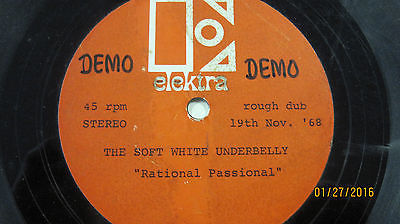
SUPER RARE FIND, HIDDEN AWAY FOR DECADES AN EARLY BLUE OYSTER CULT DEMO FROM NOV OF 1968 ENTITLED RATIONAL PASSIONAL, RECORDED UNDER THE BAND NAME SOFT WHITE UNDERBELLY, THIS IS A RARE ROUGH CUT DEMO FROM ELECTRA RECORDS AND WAS BUCK DHARMA'S PERSONAL COPY ACETATE HAS NOT BEEN TESTED , PLAYED OR CLEANED , IT IS IN ORIGINAL FOUND CONDITION, SO NO GUARANTEE ON SOUND QUALITY . I AM ASSIGNING NO GRADE TO THE RECORD, YOU CAN SEE CONDITION BY PICTURES. THERE ARE NO GUARANTEES RETURNS OR REFUNDS , THIS IS A GREAT PIECE OF EARLY MUSEUM QUALITY MUSICAL HISTORY FROM A MONSTER ROCK BAND. WILL SHIP FREE WITH INSURANCE AND TRACKING AND SIGNATURE CONFIRMATION
ANYONE CAN BID ON THIS ITEM!!! IT IS BEING RAN PRIVATE TO ELIMINATE THE USE OF MY AUCTIONS BY SCANDALOUS PEOPLE. YOUR EMAIL ADDRESS WILL BE PROTECTED FROM SPAM MAILING LISTS, FRAUDULENT ITEMS FOR SALE, UNSOLICITED EMAILS WITH MISINFORMATION ETC. I RESERVE THE RIGHT TO END AUCTION AT ANY TIME DUE TO NON BIDDING
BELOW IS INFORMATION ON THE EARLY DAYS OF THE BAND
3. Blue Öyster Cult’s original band name was Soft White Underbelly.
They occasionally played under that name if they wanted to play smaller gigs or otherwise perform in secret.
Early years as Soft White Underbelly (1967–71)
The band originated as a group called Soft White Underbelly (a name the band would later occasionally use in the 1970s and 1980s to play small club gigs around the U.S.) in 1967 in the vicinity of Stony Brook University on Long Island, New York, at the prompting of critic and manager Sandy Pearlman consisting of guitarist Buck Dharma, drummer Albert Bouchard, keyboardist Allen Lanier, singer Les Braunstein and bassist Andrew Winters.[2] Pearlman wanted the group to be the American answer to Black Sabbath.[3] Pearlman was important to the band – he was able to get them gigs and recording contracts with Elektra and Columbia, and he provided them with his poetry for use as lyrics for many of their songs, including "Astronomy". Writer Richard Meltzer also provided the band with lyrics from their early days up through their most recent studio album. The band recorded an album's worth of material for Elektra Records in 1968. When Braunstein departed in early 1969, Elektra shelved the album.
Soft White Underbelly 1967-1968
Pearlman named the combo “Soft White Underbelly” and began finding them gigs around New York. The music was mostly improvised jamming, with singing provided by Albert and Donald. Through Pearlman’s contacts, they started getting “real” gigs, opening shows for people like Muddy Waters and the Grateful Dead. Playing these gigs made the band realize that they needed a lead singer. The vacant position was soon to be filled.
Les Braunstein had been active in bands during his college days at Hobart College, playing in a popular jug band, and thanks to his friendship with Andy Yarrow (brother of Peter, Paul & Mary’s Peter Yarrow) Braunstein landed one of his songs on a Peter, Paul & Mary album, and that guaranteed him a steady income. With that lucky stroke, he hit the road in search of interesting experiences, and ended up on Long Island — more specifically, Stony Brook.
Braunstein eventually crossed paths with the future Mrs. Sandy Pearlman, and she introduced Braunstein to the formative band. He began to hang out at the band house, and eventually joined in, singing his lyrics to their music, or just improvising free form to the music. Braunstein was very dramatic and outgoing - a definite persona - and that was something the band was in need of.
Soft White Underbelly began to perform around New York, and began to get a “buzz.” In the autumn of 1968, the president of Elektra Records, Jac Holzman, turned up at one of their gigs, and recognizing the potential of the group, signed the band on the spot.
When the advance check arrived from Elektra, the band happily spent some of the money on upgrading their equipment. That is where Eric Bloom came into the picture.
A Long Island native, Eric had spent his college days (like Braunstein, at Hobart. The two were acquainted with each other, but weren’t close friends) playing in several successful bands, including “Lost and Found” with John Trivers (who later would co-write several songs with Eric). Eric also promoted gigs in the area, so he was the owner of a large van and a PA, which made him a popular guy.
After college, Eric returned to Long Island, and accepted a job selling gear at Sam Ash Music, while working on getting involved in the music scene there. One day, the Underbelly walked in to buy their new gear, and spotted a picture of Lost and Found on the wall, and they struck up a conversation with Eric. It turns out that Les had worked with the Lost and Found musicians, too, and had spoken of Eric to the band.
As fate would have it, SWU had a gig at which was discovered a less-than-adequate PA. Braunstein called Eric and asked him to come down with his PA, and he ended up doing sound for them that night. They discovered they had a lot in common, and a friendship was formed. Soon after, Eric moved in to the band house, and became the band’s sound man.
In early 1969, SWU went into the studio to begin working on their debut LP for Elektra. It was there that it became clear that Braunstein wasn’t working out. The band was moving in one direction, and Braunstein was moving in a different one. There was a rift opening between the band and Braunstein, and the band wasn’t happy with his performance on the recording. Things came to a head, and Braunstein decided to leave SWU, and the album went unfinished.
When Braunstein abruptly quit, it caused a major crisis with the band. They had come so far, had a record mostly finished, and all that was now in jeopardy. As they desperately searched for a new singer, Allen recalled that he’d heard a tape of Eric singing with Lost and Found. He thought that Eric’s voice would be a great asset to the band, and suggested he take over as singer. In April of ’69, Eric was asked to join SWU.
A new singer, though, didn’t fix the problem with Elektra. The record company had signed SWU on the belief that Braunstein was the East Coast answer to Jim Morrison, and his voice and presence would be the selling point of the band. Convincing the record execs that the band was still saleable without Braunstein’s persona up front was not easy, but after an additional “audition” with Eric in front, the company relented, and took a chance on another record.
price rating