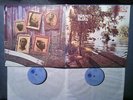
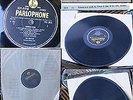
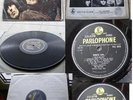
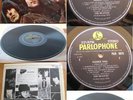
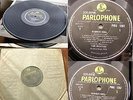
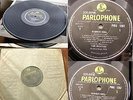
THE BEATLES-RUBBER SOUL UK B/Y STERO 1st PRESS 1965 EX
£
65
$
86


Favourite Auctions
To save auctions to your favourites, please login
If you don't have an account, please register
Description
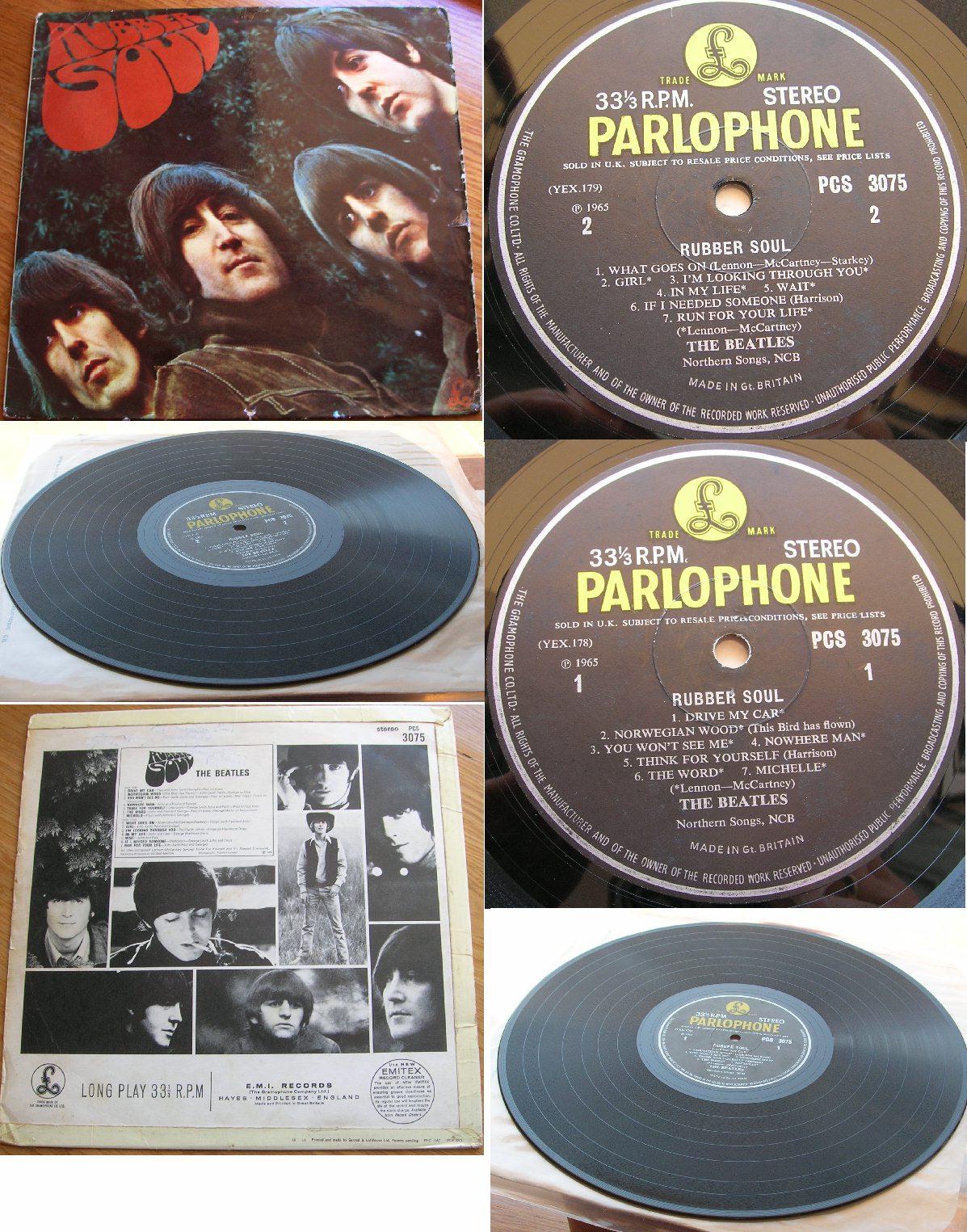
Parlophone PCS 3075-1965 STEREO
very first original UK pressing
YEX-178-3 (RD) YEX-179-3 (GH)
SUPER RARE STEREO 1ST PRESS COPY!
EXCELLENT condition
"PATENTS PENDING " sleeve by Garrold Lofthouse
sleeve: EXCELLENT both sides clean only light creasing near the opening and a bend o laminate , very light indeed on the corners. No cut , ligt trace of 4 crose next too songs that ia have erased professionally, and NO yellowing!
vinyl: EXCELLENT
SIDE one jas only very very few paper scuffs and thin hailine superfial scrathes NOT any HARD scratch, side has some more tiny papper scufs There are no any hard scarth . The record pleay smoothly with skips or pos and sounds really great with very few light hardly listanable.
Labels: Both side clean with very few LIGHT spindle marks.EX++
Spine : Clear no cut no laminate scrathes perfectly readable.
inner: original EMITTEX inner sleeve!
Composition
[edit]Music
According to Richie Unterberger, "[The Beatles] and George Martin were beginning to expand the conventional instrumental parameters of the rock group, using a sitar on 'Norwegian Wood (This Bird Has Flown)', French-like guitar lines on 'Michelle' and 'Girl', fuzz bass on 'Think for Yourself', and a piano made to sound like a harpsichord on the instrumental break of 'In My Life'."[6]
Musically, The Beatles broadened their sound, most notably with influences drawn from the contemporary folk-rock of the Byrds and Bob Dylan.[3][7] The album also saw The Beatles broadening rock 'n' roll's instrumental resources, most notably on "Norwegian Wood (This Bird Has Flown)". Although both The Yardbirds and The Kinks had used Indian influences in their music, this track is generally credited as being the first pop recording to use an actual sitar, an Indian stringed instrument, and "Norwegian Wood" sparked a musical craze for the sound of the novel instrument in the mid-1960s.[3] The song is now acknowledged as one of the cornerstones of what is now usually called "world music" and it was a major landmark in the trend towards incorporating non-Western musical influences into Western popular music. George Harrison had been introduced to Indian classical music and the sitar earlier that year, that interest later being fuelled by fellow Indian music fan David Crosby of The Byrds, whom Harrison met and befriended in August 1965.[8]Harrison soon became fanatically interested in the genre and began taking sitar lessons from renowned Indian sitar player Ravi Shankar.[9] A broadening use of percussive arrangements, led by Ringo Starr's backbeats and frequently augmented by maracas and tambourine, can also be heard throughout the album, showcased in tracks such as "Wait" and "Think for Yourself". Perhaps Starr's most unusual percussion source on the album, which was revealed by him to Barry Tashian of The Remains in the book Ticket To Ride, is created by his tapping a pack of matches with his finger. This "tapping" sound can be heard in the background of "I'm Looking Through You".
Recording innovations were also made during the recording of the album—for instance, the keyboard solo in "In My Life" sounds like a harpsichord, but was actually played on a piano. George Martin found he could not match the tempo of the song while playing in this baroque style, so he tried recording with the tape running at half-speed. When played back at normal speed during the mixdown, the sped-up sound gave the illusion of a harpsichord.[10][11] Other production innovations included the use of electronic sound processing on many instruments, notably the heavily compressed and equalised piano sound on John Lennon's "The Word"; this distinctive effect soon became extremely popular in the genre of psychedelic music.
Also on Rubber Soul, the Beatles were seen heading into psychedelic rock. As well as the sitar on "Norwegian Wood" and "The Word", they voiced the drug-influenced peace-and-love sentiments that would colour many psychedelic lyrics.[12]
The song "Wait" was initially recorded for, and then left off, the album Help!. The reason the song was released on Rubber Soul was that the album was one song short, and with the Christmas deadline looming, The Beatles chose to release "Wait" instead of recording a new composition.
[edit]Lyrics
Lyrically, the album was a major progression. Though a smattering of earlier Beatles songs had expressed romantic doubt and negativity, the songs on Rubber Soul represented a pronounced development in sophistication, thoughtfulness, and ambiguity.[6] In particular, the relationships between the sexes moved from simpler boy-girl love songs to more nuanced, even negative portrayals. "Norwegian Wood", one of the most famous examples and often cited as The Beatles' first conscious assimilation of the lyrical innovations of Bob Dylan, sketches a poetically ambiguous extramarital affair between the singer and a mysterious girl.[13] "Drive My Car" serves as a satirical piece of sexism.[14] Songs like "I'm Looking Through You", "You Won't See Me", and "Girl" express more emotionally complex, even bitter and downbeat portrayals of romance, and "Nowhere Man" was arguably the first Beatles song to move beyond a romantic subject (arguable because the song "Help!", released earlier in 1965, also appears not to be specifically about a boy-girl relationship—the song takes the form of a general cry for "help" from the singer to another person, whose relationship to the singer remains unspecified.[15] Even the line "I know that I just need you like I've never done before", could be addressed to any close friend of the singer, not necessarily a romantic partner.)
[edit]Recording
Until very late in their career, the "primary" version of The Beatles' albums was always the monophonic mix. According to Beatles historian Mark Lewisohn, producer George Martin, and the Abbey Road engineers devoted most of their time and attention to the mono mixdowns, and the band were not usually present for these sessions, Even with their landmark Sgt. Pepper's Lonely Hearts Club Band LP, the stereo mixdowns were considered less important than the mono version and were completed in far less time.
While the stereo version of the original release of Rubber Soul was similar to that of their earliest albums, featuring mainly vocals on the right channel and instruments on the left, it was not produced in the same manner. The early albums were recorded on twin-track tape, and they were intended only for production of monaural records, so they kept vocals and instruments separated allowing the two parts to later be mixed in proper proportion. By this time, however, the Beatles were recording on four-track tape, which allowed a stereo master to be produced with vocals in the centre and instruments on both sides, as evidenced in their prior albums Beatles for Sale and Help!. But Martin was looking for a way to easily produce a stereo album which sounded good on a monaural record player. In what he admits was some experimentation, he mixed down the four-track master tape to stereo with vocals on the right, instruments on the left, and nothing in the middle.
What Goes On? is the first song which has Ringo Starr (Richard Starkey) as co-composer beside Lennon-McCartney. The end of the song is different on the mono and stereo versions.
After completing the album and the accompanying single "We Can Work It Out" and "Day Tripper", the Beatles were exhausted from years of virtually non-stop recording, touring, and film work. They subsequently took a three-month break during the first part of 1966, and used this free time exploring new directions that would colour their subsequent musical work. These became immediately apparent in the next album,Revolver.[16]
[edit]Album artwork
The photo of the Beatles on the Rubber Soul cover appears stretched. McCartney relates the story behind this in Volume 5 of the documentary film Anthology. Photographer Bob Freeman had taken some pictures of The Beatles at Lennon's house. Freeman showed the photos to the group by projecting them onto an album-sized piece of cardboard to simulate how they would appear on an album cover. The unusual Rubber Soulalbum cover came to be when the slide card fell slightly backwards, elongating the projected image of the photograph and stretching it. Excited by the effect, they shouted, "Ah! Can we have that? Can you do it like that?" Freeman said he could.
Capitol Records used a different colour saturation for the US version, causing the orange lettering used by Parlophone Records to show up as different colours. On some Capitol LPs, the title looks rich chocolate brown; others, more like gold. Yet on the official 1987 CD of the British version, the Capitol logo is visible, and the letters are not brown, nor the official orange, but a distinct green. The lettering was designed by Charles Front.
The Rubber Soul cover was the first by The Beatles to not have the group's name on it. Though this wasn't the first time in rock/pop history this had been done (Elvis Presley, Them, and The Rolling Stones had done it previously), releasing an album without the artist's name on the cover was uncommon in 1965. Future Beatles albums, including Revolver, Abbey Road, Let It Be and the American compilation Hey Jude also have covers without the words 'The Beatles' on them. Conversely The Beatles, commonly called the White Album contained only the words 'The Beatles' on the cover.
Track listing
[edit]British release
All songs written and composed by Lennon/McCartney except where noted.
Side one # Title Lead vocals Length 1. "Drive My Car" McCartney and Lennon 2:30 2. "Norwegian Wood (This Bird Has Flown)" Lennon 2:05 3. "You Won't See Me" McCartney 3:22 4. "Nowhere Man" Lennon 2:44 5. "Think for Yourself" (George Harrison) Harrison 2:19 6. "The Word" Lennon 2:43 7. "Michelle" McCartney 2:42 Side two # Title Lead vocals Length 8. "What Goes On" (Lennon, McCartney, Richard Starkey) Starr 2:50 9. "Girl" Lennon 2:33 10. "I'm Looking Through You" McCartney 2:27 11. "In My Life" Lennon 2:27 12. "Wait" Lennon and McCartney 2:16 13. "If I Needed Someone" (Harrison) Harrison 2:23 14. "Run for Your Life" Lennon 2:18I do offer money guarantee….IF FOR ANY REASON YOU ARE NOT COMPLETELY SATISFIED WITH THE ITEM YOU WON WE GIVE YOU A FULL REFUND ON YOUR MONEY WITHIN 48 HOURS OF ITEM RETURN. I DO NOT REFUND BEFORE ITEM IS BACK. NO EXCEPTIONS ON THIS RULE.
All Items Are shipped from ATHENS Greece not from UK.
S&H to UK and EEC is 5.5 GBP for the first LP, 6.5 GBP for 2 LP sets of 2 LPs, and 2.5 GBP for each LP after.
S&H to the rest of the World is 6.2 GBP for the first LP, 8.5 GBP for 2 LP sets of 2 LPs, and 2.5 GBP for each LP after.
s&h to Greece is 4 GBP fro any order size!!!
Items that cost more than 50 GBp must be shipped with insurrance that is 3.5 GBp more. Please Do not pay before you receive our invoice. Thanks!
price rating