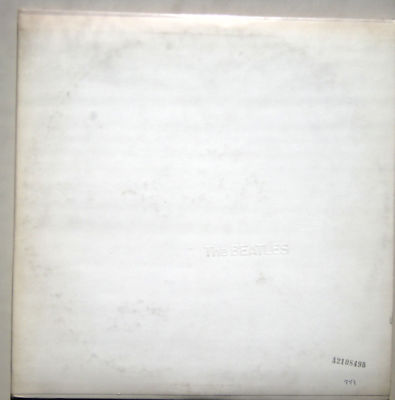
THE BEATLES "WHITE ALBUM" APPLE SWBO101
$
55


Favourite Auctions
To save auctions to your favourites, please login
If you don't have an account, please register
Description
On The White Album we find the lads from Liverpool following a path to the same conclusion as another famous Livepudlian,instead of losing 1 thousand plus lives we are about to lose the innocence of the 60s arguably this had already happened at Altamont.anyway,logve it or hate it The white album was quite the landmark achievement.Some say this record is as fractured as the boys relationship,others call it an omen.No matter which side you sit on what we offer here is a NM copy of this testament to a band about to enter into the annals of history.The record was purchased in 69 ,recorded on reel and shelved. and has sat and sat and sat.
The Beatles is the ninth official British album and the fifteenth American album by The Beatles, a double album released in 1968. It is commonly known as The White Album as it has no graphics or text other than the band's name (and, on the early LP and CD releases, a serial number) on its plain white sleeve. The album was the first the Beatles undertook following the death of their manager, Brian Epstein, and the first released by their own record label, Apple. Originally entitled A Doll's House, the title was changed when the British progressive rock band Family released the similarly titled Music in a Doll's House earlier that year.
The Beatles was written and recorded during a period of turmoil for the group. After visiting the Maharishi Mahesh Yogi in India and having a particularly productive songwriting session in early 1968, the group returned to the studio for recording from May to October 1968, only to have conflict and dissent drive the group members apart. Drummer Ringo Starr quit the band for a brief time, leaving bassist Paul McCartney to perform drums on some of the album's songs.
Upon release in November 1968, the album received mixed to positive reviews and reached the number one spot on the charts in the United Kingdom and United States. The album is notable for the eclectic nature of its songs, which has divided critics in evaluating the album's legacy. In 2003, the album was ranked number 10 on Rolling Stone magazine's list of "The 500 Greatest Albums of All Time".
Composition
Most of the songs were conceived during a transcendental meditation course with Maharishi Mahesh Yogi in Rishikesh, India in the spring of 1968. Although the retreat, which had required long periods of meditation, was initially conceived by the band as a spiritual respite from all worldly endeavours—a chance, in John Lennon's words, to "get away from everything"— both Lennon and Paul McCartney had quickly found themselves in songwriting mode, often meeting "clandestinely in the afternoons in each other's rooms"to review the new work. "Regardless of what I was supposed to be doing," Lennon would later recall, "I did write some of my best songs there."Close to forty new compositions had emerged in Rishikesh, twenty-three of which would be laid down in very rough form at Kinfauns, George Harrison’s home in Esher, in May of 1968.
The Beatles had left Rishikesh before the end of the course, with Ringo Starr and then McCartney departing first, and Lennon and Harrison departing together later. According to some reports, Lennon left Rishikesh because he felt personally betrayed by rumours that Maharishi had made sexual advances toward Mia Farrow, who had accompanied The Beatles on their trip. Shortly after he decided to leave, Lennon wrote a song called "Maharishi" which included the lyrics, "Maharishi/You little twat"; the song became "Sexy Sadie". According to several authors, Alexis Mardas (aka "Magic Alex") deliberately engineered these rumours because he was bent on undermining the Maharishi's influence over each Beatle.In a 1980 interview, Lennon acknowledged that the Maharishi was the inspiration for the song: "I just called him 'Sexy Sadie'."
Recording sessions
.The Beatles was recorded between 30 May 1968 and 14 October 1968, largely at Abbey Road Studios, with some sessions at Trident Studios. Although productive, the sessions were reportedly undisciplined and sometimes fractious, and they took place at a time when tensions were growing within the group. Concurrent with the recording of this album, The Beatles were launching their new multimedia business corporation Apple Corps, an enterprise that proved to be a source of significant stress for the band.
The sessions for The Beatles marked the first appearance in the studio of Lennon's new girlfriend and artistic partner, Yoko Ono, who would thereafter be a more or less constant presence at all Beatles sessions. Prior to Ono's appearance on the scene, the individual Beatles had been very insular during recording sessions, with influence from outsiders strictly limited. McCartney's girlfriend at the time, Francie Schwartz, was also present at some of the recording sessions.
Author Mark Lewisohn reports that The Beatles held their first and only 24-hour recording/producing session near the end of the creation of The Beatles, which occurred during the final mixing and sequencing for the album. The session was attended by Lennon, McCartney, and producer George Martin.
Division and discord in the studio
Despite the album's official title, which emphasised group identity, studio efforts on The Beatles captured the work of four increasingly individualised artists who frequently found themselves at odds. The band's work pattern changed dramatically with this project, and by most accounts the extraordinary synergy of The Beatles' previous studio sessions was harder to come by during this period. Sometimes McCartney would record in one studio for prolonged periods of time, while Lennon would record in another, each man using different engineers.At one point in the sessions, George Martin, whose authority over the band in the studio had waned, spontaneously left to go on holiday, leaving Chris Thomas in charge of producing.During one of these sessions, while recording "Helter Skelter", Harrison reportedly ran around the studio while holding a flaming ashtray above his head.
Long after the recording of The Beatles was complete, Martin mentioned in interviews that his working relationship with The Beatles changed during this period, and that many of the band's efforts seemed unfocused, often yielding prolonged jam sessions that sounded uninspired. On 16 July recording engineer Geoff Emerick, who had worked with the group since Revolver, announced he was no longer willing to work with the group.
The sudden departures were not limited to EMI personnel. On 22 August, Starr abruptly left the studio, explaining later that he felt his role was minimised compared to that of the other members, and that he was tired of waiting through the long and contentious recording sessions.[14] Lennon, McCartney and Harrison pleaded with Starr to return, and after two weeks he did. Upon Starr's return, he found his drum kit decorated with red, white and blue flowers, a welcome-back gesture from Harrison.The reconciliation was, however, only temporary, and Starr's exit served as a precursor of future "months and years of misery", in Starr's words.Indeed, after The Beatles was completed, both Harrison and Lennon would stage similar unpublicised departures from the band.McCartney, whose public departure in 1970 would mark the formal end of the band's ensemble, described the sessions for The Beatles as a turning point for the group. Up to this point, he observed, "The world was a problem, but we weren't. You know, that was the best thing about The Beatles, until we started to break up, like during the White Album and stuff. Even the studio got a bit tense then."
Instrumental contributions
According to Lewisohn, McCartney played drums on "Back in the U.S.S.R." because Starr had left the group during the period when the song was being recorded. Lewisohn also reports that, in the case of "Dear Prudence", also recorded during Starr's absence, the three remaining Beatles each made contributions on bass and drums, with the result that those parts may be composite tracks played by Lennon, McCartney and/or Harrison. As of 2010, the actual musician/instrument lineup on the track remains disputed.
Other musicians
Though not formally credited on the album, Eric Clapton played lead guitar on Harrison's "While My Guitar Gently Weeps". Harrison explains in The Beatles Anthology that Clapton's presence temporarily alleviated the studio tension and that all band members were on their best behaviour during his time with the band in the studio.Harrison, who had invited Clapton to the sessions, soon reciprocated by collaborating with Clapton on the song "Badge" for Cream's last album Goodbye.
Clapton was not the only outside musician to sit in on the sessions. Nicky Hopkins provided electric piano for the single cut of "Revolution" (recorded during these sessions); Hopkins also provided acoustic piano on a number of tracks. Several horns were also recorded on the album version of "Revolution 1". "Savoy Truffle" also features the horn section. Jack Fallon played a bluegrass fiddle on "Don't Pass Me By",and a team of orchestral players and background singers appeared on "Good Night" (which was Beatle-free except for Ringo's vocal).
Technical advances
The sessions for The Beatles were notable for the band's formal transition from 4-track to 8-track recording. As work on the album began, Abbey Road Studios possessed, but had yet to install, an 8-track machine that had supposedly been sitting in a storage room for months. This was in accordance with EMI's policy of testing and customising new gear, sometimes for months, before putting it into use in the studios. The Beatles recorded "Hey Jude" and "Dear Prudence" at Trident Studios in central London, which had an 8-track recorder.When they learnt about EMI's 8-track recorder, they insisted on using it, and engineers Ken Scott and Dave Harries took the machine (without authorisation from the studio chiefs) into the Number 2 recording studio at Abbey Road for the band's use.
Songs
Although most of the songs on any given Beatles album are usually credited to the Lennon/McCartney songwriting team, that description is often misleading, and rarely more so than on The Beatles. With this album, each of the four band members began to showcase the range and depth of his individual songwriting talents, and to display styles that would be carried over to his eventual solo career. Indeed, some songs that the individual Beatles were working on during this period eventually were released on solo albums. These include Lennon's "Look at Me" and "Child of Nature", eventually reworked as "Jealous Guy"; McCartney's "Junk" and "Teddy Boy"; and Harrison's "Not Guilty" and "Circles".
Many of the songs on the album display experimentation with unlikely musical genres, borrowing directly from such sources as 1930s dance-hall music (in "Honey Pie"), classical chamber music (in "Piggies"), the avant-garde sensibilities of Yoko Ono and John Cage (in "Revolution 9"), and the lush sentimentality of Henry Mancini's film scores (in "Good Night"). Such diversity was quite unprecedented in global pop music in 1968, and the album's sprawling approach provoked (and continues to provoke) both praise and criticism from observers."Revolution 9", in particular, a densely layered eight-minute-and-thirteen-second sound collage, has attracted both interest and disapproval from both fans and music critics over the years.
The only western instrument available to the group during their Indian visit was the acoustic guitar, and thus most of the songs on The Beatles were written and first performed on that instrument.[citation needed] Some of these songs remained acoustic on The Beatles (notably "Rocky Raccoon", "Blackbird", "Julia", "Cry Baby Cry", "I Will" and "Mother Nature's Son") and were recorded in the studio either solo, or by only part of the group.
Compositions not included
A number of songs were recorded during these sessions but were never included on a Beatles record, including Harrison's "Not Guilty" (which he rerecorded for his 1979 self-titled album, George Harrison), Lennon's "What's the New Mary Jane" (which has been previously recorded), and McCartney's "Jubilee" (later retitled "Junk" and released on McCartney's first solo LP).
Others included "Mean Mr. Mustard" and "Polythene Pam" (both of which would be used for the medley on Abbey Road); "Child of Nature" (recorded with drastically different lyrics as "Jealous Guy" for Lennon's Imagine); "Etcetera" (a McCartney composition later recorded by the Black Dyke Mills Band as "Thingumybob"); "The Long and Winding Road" (completed in 1969 for the Let It Be LP); "Something" (which ended up on Abbey Road); and "Sour Milk Sea" (which Harrison gave to friend and Apple artist Jackie Lomax for his first LP, Is This What You Want).
Other songs recorded for, but ultimately left off The Beatles received significant exposure via bootlegs, notably Harrison's "Circles" (which he would eventually re-record as solo tracks and release on his 1982 album, Gone Troppo) and "Not Guilty", and Lennon's manic "What's the New Mary Jane". More recently, the song "Revolution 1 (Take 20)", a previously unknown track, surfaced in 2009 on the Europe-only bootleg Revolution: Take...Your Knickers Off and is supposed to connect "Revolution 1" and the avant-garde "Revolution 9" (both of which appeared on The Beatles) in an attempt by Lennon to record one long version of "Revolution" before ultimately splitting the two songs up.
Editing concerns, and release
The Beatles was the first Beatles' album released by Apple Records, as well as their only original double album. Producer George Martin has said that he was against the idea of a double album at the time and suggested to the group that they reduce the number of songs in order to form a single album featuring their stronger work, but that the band decided against this.Interviewed for the Beatles Anthology, Starr said he now felt it should have been released as two separate albums (that he appropriately named The White Album and The Whiter Album). Harrison felt on reflection that some of the tracks could have been released as B-sides, but "there was a lot of ego in that band". He also supported the idea of the double album, to clear out the backlog of songs the group had at the time. McCartney, by contrast, said it was fine as it was and that its wide variety of songs was a major part of the album's appeal.
The Beatles was released on 22 November 1968.
Singles
Although "Hey Jude" was not intended to be included on any LP release, it was recorded during the White Album sessions and was released as a stand-alone single before the release of The Beatles. "Hey Jude's" B-side, "Revolution", was an alternate version of the album's "Revolution 1". Lennon had wanted the original version of "Revolution" to be released as a single, but the other three Beatles objected on the grounds that it was too slow.A new, faster version, with heavily distorted guitar and a high-energy keyboard solo from Nicky Hopkins was recorded, and was relegated to the flip side of "Hey Jude". The resulting release — "Hey Jude" on side A and "Revolution" on side B — emerged as the first release on the Beatles' new Apple Records label. It went on to be the Beatles' most successful single, with world sales over 5 million by the end of 1968 and 7.5 million by October 1972.
Four tracks from the "White Album" were released on two American and one British single almost eight years after the original album was released. In the summer 1976, to promote the compilation album, Rock 'n' Roll Music, EMI's Parlophone label in the UK and its Capitol label in the US each released a single that contained A and B-sides that appeared on the compilation album. In Britain, Parlophone issued "Back in the U.S.S.R." as the single. (Its B-side was "Twist and Shout", which originally appeared on the group's first album, Please Please Me.) In America, Capitol released "Got to Get You Into My Life" (from the group's 1966 album, Revolver) on the A-side, but selected "Helter Skelter," to serve as the flip side. "Helter Skelter" was likely chosen for the B-side because a cover version of the song had been prominently featured in a made-for-TV movie about the Charles Manson murders that had aired on CBS shortly before the release of Rock 'n' Roll Music. The singles were successful, with "Got to Get You into My Life" hitting number seven on the Billboard Hot 100 in the US and "Back in the U.S.S.R." hitting number 18 on the New Musical Express chart in Britain. Both records also helped sell Rock 'n' Roll Music, which hit number two in the United States and number 10 in the UK. With the success of the singles from the compilation album, Capitol followed-up "Got To Get You Into My Life" with the release of another single in November 1976. Instead of taking two more tracks from Rock 'n' Roll Music, however, Capitol selected two "White Album" tracks—"Ob-La-Di, Ob-La-Da" as the A-Side, and "Julia" as the B-Side. The "Ob-La-Di, Ob-La-Da" single was sold in an individually-numbered white picture sleeve that mimicked the design of the original album. "Ob-La-Di, Ob-La-Da" did not duplicate the success of its predecessor, however, as it failed to make the Top Forty, stalling out at number 49 on Billboard
VISUAL GRADING:
AT RECORDMART-165 WE USE GOLDMINE (MAGAZINE) STANDARDS.ALBUMS ARE VIEWED UNDER THREE FORMS OF LIGHTING; NATURAL (DIRECT SUNLIGHT),FLORESCENT AND DIFFUSED LIGHT.RECORDS ARE INSPECTED FOR SCRATCHES, ABRASIONS, SLEEVE WEAR ,WARPING AND LUSTER.OUR GRADING IS CONSERVATIVE AS WE NEITHER WANT TO WASTE OUR TIME NOR DISAPPOINT YOU.SPECIFIC QUESTIONS PERTAINING TO THE STATE OF THE ALBUM ARE WELCOMED AND ENCOURAGED.WE DO NOT LISTEN TO THE RECORDS AND FOR THE MOST PART ,HAVE NOT SINCE THEY WERE ISSUED.
GRADING STANDARDS
Near Mint (NM or M-)
A nearly perfect record. Many dealers won't give a grade higher than this implying (perhaps correctly) that no record is ever truly perfect. The record should show no obvious signs of wear. A 45 RPM or EP sleeve should have no more than the most minor defects, such as almost invisible ring wear or other signs of slight handling. An LP cover should have no creases, folds, seam splits or other noticeable similar defects. No cut-out holes, either. And of course, the same should be true of any other inserts, such as posters, lyric sleeves and the like. Basically, an LP in near mint condition looks as if you just got it home from a new record store and removed the shrink wrap. Near Mint is the highest price listed in all Goldmine price guides. Anything that exceeds this grade, in the opinion of both buyer and seller, is worth significantly more than the highest Goldmine book value.
Very Good Plus (VG+)
Generally worth 50 percent of the Near Mint value. A Very Good Plus record will show some signs that it was played and otherwise handled by a previous owner who took good care of it. Record surfaces may show some signs of wear and may have slight scuffs or very light scratches that don't affect one's listening experiences. Slight warps that do not affect the sound are "OK". The label may have some ring wear or discoloration, but it should be barely noticeable. The center hole will not have been misshapen by repeated play. Picture sleeves and LP inner sleeves will have some slight wear, lightly turned up corners, or a slight seam split. An LP cover may have slight signs of wear also and may be marred by a cut-out hole, indentation or corner indicating it was taken out of print and sold at a discount. In general, if not for a couple things wrong with it, this would be Near Mint. All but the most mint-crazy collectors will find a Very Good Plus record highly acceptable.
Very Good (VG)
Generally worth 25 percent of Near Mint value. Many of the defects found in a VG+ record will be more pronounced in a VG disc. Surface noise will be evident upon playing, especially in soft passages and during a song's intro and fade, but will not overpower the music otherwise. Groove wear will start to be noticeable, as with light scratches (deep enough to feel with a fingernail) that will affect the sound. Labels may be marred by writing, or have tape or stickers (or their residue) attached. The same will be true of picture sleeves or LP covers. However, it will not have all of these problems at the same time, only two or three of them. Goldmine price guides with more than one price will list Very Good as the lowest price. This, not the Near Mint price, should be your guide when determining how much a record is worth, as that is the price a dealer will normally pay you for a Near Mint record.
Good (G), Good Plus (G+)
Generally worth 10-15 percent of the Near Mint value. Good does not mean Bad! A record in Good or Good Plus condition can be put onto a turntable and will play through without skipping. But it will have significant surface noise and scratches and visible groove wear (on a styrene record, the groove will be starting to turn white). A cover or sleeve will have seam splits, especially at the bottom or on the spine. Tape, writing, ring wear or other defects will start to overwhelm the object. It is a common item, you'll probably find another copy in better shape eventually. Pass it up. But, if it's something you have been seeking for years, and the price is right, get it...but keep looking to upgrade.
Poor (P), Fair (F)
Generally worth 0-5 percent of the Near Mint price. The record is cracked, badly warped, and won't play through without skipping or repeating. The picture sleeve is water damaged, split on all three seams and heavily marred by wear and writing. The LP cover barely keeps the LP inside it. Inner sleeves are fully seam split, crinkled, and written upon. Except for impossibly rare records otherwise unattainable, records in this condition should be bought or sold for no more than a few cents each.
THIS RECORD
RECORD/VINYL IS IN NM(-) SHAPE ,THE JACKET IS IN VG(++) SHAPE AND STILL GLOSSY .POSTER IS INTACT AND FACTORY FOLDED,PHOTOS ARE HEAVY STOCK(ORIGINAL PHOTOS) WITH SPACERS.THERE IS A BALL POINT PEN "749" WRITTEN ON FRONT COVER MEASURING 3/4" W X 1/4"H (AS SHOWN ABOVE) WE JUDGE THIS RECORD AS A VERY SOLID (NM-).THERE IS NO RINGWARE OR YELLOWING.ALL IS CRISP AND CLEAN !!!
HAPPY BIDDING
-NO SPINEWARE or RINGWARE
-NO SPLIT SEAMS
-LABEL IS INTACT AND CONTAINS NO MARKINGS OR WEAR WHATSOEVER
-NO MOLD OR GENERAL WATER DAMAGE
-NO SCUFFS OR MARRING OF VINYL
-NO BARCODE OR RIAA LABELING
-NO CUT OUTS OR DRILL HOLES
THE RECORD WILL SHIP IN A STURDY CARDBOARD MAILER WITH FOAM PADDING SO AS TO ARRIVE IN THE SHAPE IT IS SHIPPED OUT IN.RECORD IS REMOVED FROM JACKET AS TO AVOID SEAM SPLITTING.
=====================================================================================
Payment Must Be Received Within 5 Days After Auction Close
=============================================================
About Us:
-Please note,At Recordmart165 we strive for complete customer satisfaction!! To this end we want to keep our clientele happy and (hopefully)returning.If satisfied please tell a friend,if not please allow us to rectify the problem before leaving feedback.
-When bidding,remember all bids are taken seriously and the bid is considered binding.We do value communication and find it a invaluable tool in this format.Our response time is quite quick,all questions received are answered within 24 hours.
-We relish our overseas customer and have safely landed many items abroad.
-Items sold that exceed $150.00 (US) are sent Priority Mail and are insured,there is added cost to this but there is also added security.
-ITEMS CLOSING OVER $150.00 RECEIVE A 25% SHIPPING DISCOUNT
-ITEMS CLOSING OVER $200.00 SHIP PRIORITY FOR FREE (U.S. ONLY)
INVOICE SENT WITHIN 24 HOURS OF AUCTIONS CLOSE.PLEASE DO NOT MAKE PAYMENT UNTIL INVOICE IS RECEIVED.
SHIPPING
USA: I can send this LP to you by Media Mail for $4.00, 1st Class Mail for $5.00 or Priority Mail which will be calculated after the auction using your zip code. Most of my customers prefer Media Mail because it is very cheap. Please keep in mind that it's cheap because it is SLOW.
CANADA: If you are in Canada, I can send this LP to you by 1st Class Airmail for $7.00.
MEXICO: If you are in Mexico, I can send this LP to you by 1st Class Airmail for $11.00.
EVERYWHERE ELSE: Due to questionable customs problems in Italy we will no longer ship there. If you are not in the USA, Canada, or Mexico, STANDARD INTERNATIONAL SHIPPING (AIR MAIL) IS $14.50 .I can send this LP to you by PRIORITY for $29.50. International customers please contact before completion of transaction (ie: Invoice Sent) so as to discuss shipping requirements or requests. THE ADDITIONAL COST FOR PRIORITY INTERNATIONAL SHIPPING IS FOR PROTECTION OF BUYER AND SELLER ALIKE. TRACKING AND CONFIRMATION ARE PROVIDED WITH THIS SERVICE. IN THE EVENT ITEM CLOSES FOR MORE THAN $150(USD) THERE IS AN AUTOMATIC SHIPPING REDUCTION OF 25%.
On Apr-18-10 at 07:27:56 PDT, seller added the following information:
On The White Album we find the lads from Liverpool following a path to the same conclusion as another famous Livepudlian,instead of losing 1 thousand plus lives we are about to lose the innocence of the 60s arguably this had already happened at Altamont.anyway,logve it or hate it The white album was quite the landmark achievement.Some say this record is as fractured as the boys relationship,others call it an omen.No matter which side you sit on what we offer here is a NM copy of this testament to a band about to enter into the annals of history.The record was purchased in 69 ,recorded on reel and shelved. and has sat and sat and sat.
This is an original dark green apple label pressing!!!
The Beatles is the ninth official British album and the fifteenth American album by The Beatles, a double album released in 1968. It is commonly known as The White Album as it has no graphics or text other than the band's name (and, on the early LP and CD releases, a serial number) on its plain white sleeve. The album was the first the Beatles undertook following the death of their manager, Brian Epstein, and the first released by their own record label, Apple. Originally entitled A Doll's House, the title was changed when the British progressive rock band Family released the similarly titled Music in a Doll's House earlier that year.
The Beatles was written and recorded during a period of turmoil for the group. After visiting the Maharishi Mahesh Yogi in India and having a particularly productive songwriting session in early 1968, the group returned to the studio for recording from May to October 1968, only to have conflict and dissent drive the group members apart. Drummer Ringo Starr quit the band for a brief time, leaving bassist Paul McCartney to perform drums on some of the album's songs.
Upon release in November 1968, the album received mixed to positive reviews and reached the number one spot on the charts in the United Kingdom and United States. The album is notable for the eclectic nature of its songs, which has divided critics in evaluating the album's legacy. In 2003, the album was ranked number 10 on Rolling Stone magazine's list of "The 500 Greatest Albums of All Time".
Composition
Most of the songs were conceived during a transcendental meditation course with Maharishi Mahesh Yogi in Rishikesh, India in the spring of 1968. Although the retreat, which had required long periods of meditation, was initially conceived by the band as a spiritual respite from all worldly endeavours—a chance, in John Lennon's words, to "get away from everything"— both Lennon and Paul McCartney had quickly found themselves in songwriting mode, often meeting "clandestinely in the afternoons in each other's rooms"to review the new work. "Regardless of what I was supposed to be doing," Lennon would later recall, "I did write some of my best songs there."Close to forty new compositions had emerged in Rishikesh, twenty-three of which would be laid down in very rough form at Kinfauns, George Harrison’s home in Esher, in May of 1968.
The Beatles had left Rishikesh before the end of the course, with Ringo Starr and then McCartney departing first, and Lennon and Harrison departing together later. According to some reports, Lennon left Rishikesh because he felt personally betrayed by rumours that Maharishi had made sexual advances toward Mia Farrow, who had accompanied The Beatles on their trip. Shortly after he decided to leave, Lennon wrote a song called "Maharishi" which included the lyrics, "Maharishi/You little twat"; the song became "Sexy Sadie". According to several authors, Alexis Mardas (aka "Magic Alex") deliberately engineered these rumours because he was bent on undermining the Maharishi's influence over each Beatle.In a 1980 interview, Lennon acknowledged that the Maharishi was the inspiration for the song: "I just called him 'Sexy Sadie'."
Recording sessions
.The Beatles was recorded between 30 May 1968 and 14 October 1968, largely at Abbey Road Studios, with some sessions at Trident Studios. Although productive, the sessions were reportedly undisciplined and sometimes fractious, and they took place at a time when tensions were growing within the group. Concurrent with the recording of this album, The Beatles were launching their new multimedia business corporation Apple Corps, an enterprise that proved to be a source of significant stress for the band.
The sessions for The Beatles marked the first appearance in the studio of Lennon's new girlfriend and artistic partner, Yoko Ono, who would thereafter be a more or less constant presence at all Beatles sessions. Prior to Ono's appearance on the scene, the individual Beatles had been very insular during recording sessions, with influence from outsiders strictly limited. McCartney's girlfriend at the time, Francie Schwartz, was also present at some of the recording sessions.
Author Mark Lewisohn reports that The Beatles held their first and only 24-hour recording/producing session near the end of the creation of The Beatles, which occurred during the final mixing and sequencing for the album. The session was attended by Lennon, McCartney, and producer George Martin.
Division and discord in the studio
Despite the album's official title, which emphasised group identity, studio efforts on The Beatles captured the work of four increasingly individualised artists who frequently found themselves at odds. The band's work pattern changed dramatically with this project, and by most accounts the extraordinary synergy of The Beatles' previous studio sessions was harder to come by during this period. Sometimes McCartney would record in one studio for prolonged periods of time, while Lennon would record in another, each man using different engineers.At one point in the sessions, George Martin, whose authority over the band in the studio had waned, spontaneously left to go on holiday, leaving Chris Thomas in charge of producing.During one of these sessions, while recording "Helter Skelter", Harrison reportedly ran around the studio while holding a flaming ashtray above his head.
Long after the recording of The Beatles was complete, Martin mentioned in interviews that his working relationship with The Beatles changed during this period, and that many of the band's efforts seemed unfocused, often yielding prolonged jam sessions that sounded uninspired. On 16 July recording engineer Geoff Emerick, who had worked with the group since Revolver, announced he was no longer willing to work with the group.
The sudden departures were not limited to EMI personnel. On 22 August, Starr abruptly left the studio, explaining later that he felt his role was minimised compared to that of the other members, and that he was tired of waiting through the long and contentious recording sessions.[14] Lennon, McCartney and Harrison pleaded with Starr to return, and after two weeks he did. Upon Starr's return, he found his drum kit decorated with red, white and blue flowers, a welcome-back gesture from Harrison.The reconciliation was, however, only temporary, and Starr's exit served as a precursor of future "months and years of misery", in Starr's words.Indeed, after The Beatles was completed, both Harrison and Lennon would stage similar unpublicised departures from the band.McCartney, whose public departure in 1970 would mark the formal end of the band's ensemble, described the sessions for The Beatles as a turning point for the group. Up to this point, he observed, "The world was a problem, but we weren't. You know, that was the best thing about The Beatles, until we started to break up, like during the White Album and stuff. Even the studio got a bit tense then."
Instrumental contributions
According to Lewisohn, McCartney played drums on "Back in the U.S.S.R." because Starr had left the group during the period when the song was being recorded. Lewisohn also reports that, in the case of "Dear Prudence", also recorded during Starr's absence, the three remaining Beatles each made contributions on bass and drums, with the result that those parts may be composite tracks played by Lennon, McCartney and/or Harrison. As of 2010, the actual musician/instrument lineup on the track remains disputed.
Other musicians
Though not formally credited on the album, Eric Clapton played lead guitar on Harrison's "While My Guitar Gently Weeps". Harrison explains in The Beatles Anthology that Clapton's presence temporarily alleviated the studio tension and that all band members were on their best behaviour during his time with the band in the studio.Harrison, who had invited Clapton to the sessions, soon reciprocated by collaborating with Clapton on the song "Badge" for Cream's last album Goodbye.
Clapton was not the only outside musician to sit in on the sessions. Nicky Hopkins provided electric piano for the single cut of "Revolution" (recorded during these sessions); Hopkins also provided acoustic piano on a number of tracks. Several horns were also recorded on the album version of "Revolution 1". "Savoy Truffle" also features the horn section. Jack Fallon played a bluegrass fiddle on "Don't Pass Me By",and a team of orchestral players and background singers appeared on "Good Night" (which was Beatle-free except for Ringo's vocal).
Technical advances
The sessions for The Beatles were notable for the band's formal transition from 4-track to 8-track recording. As work on the album began, Abbey Road Studios possessed, but had yet to install, an 8-track machine that had supposedly been sitting in a storage room for months. This was in accordance with EMI's policy of testing and customising new gear, sometimes for months, before putting it into use in the studios. The Beatles recorded "Hey Jude" and "Dear Prudence" at Trident Studios in central London, which had an 8-track recorder.When they learnt about EMI's 8-track recorder, they insisted on using it, and engineers Ken Scott and Dave Harries took the machine (without authorisation from the studio chiefs) into the Number 2 recording studio at Abbey Road for the band's use.
Songs
Although most of the songs on any given Beatles album are usually credited to the Lennon/McCartney songwriting team, that description is often misleading, and rarely more so than on The Beatles. With this album, each of the four band members began to showcase the range and depth of his individual songwriting talents, and to display styles that would be carried over to his eventual solo career. Indeed, some songs that the individual Beatles were working on during this period eventually were released on solo albums. These include Lennon's "Look at Me" and "Child of Nature", eventually reworked as "Jealous Guy"; McCartney's "Junk" and "Teddy Boy"; and Harrison's "Not Guilty" and "Circles".
Many of the songs on the album display experimentation with unlikely musical genres, borrowing directly from such sources as 1930s dance-hall music (in "Honey Pie"), classical chamber music (in "Piggies"), the avant-garde sensibilities of Yoko Ono and John Cage (in "Revolution 9"), and the lush sentimentality of Henry Mancini's film scores (in "Good Night"). Such diversity was quite unprecedented in global pop music in 1968, and the album's sprawling approach provoked (and continues to provoke) both praise and criticism from observers."Revolution 9", in particular, a densely layered eight-minute-and-thirteen-second sound collage, has attracted both interest and disapproval from both fans and music critics over the years.
The only western instrument available to the group during their Indian visit was the acoustic guitar, and thus most of the songs on The Beatles were written and first performed on that instrument.[citation needed] Some of these songs remained acoustic on The Beatles (notably "Rocky Raccoon", "Blackbird", "Julia", "Cry Baby Cry", "I Will" and "Mother Nature's Son") and were recorded in the studio either solo, or by only part of the group.
Compositions not included
A number of songs were recorded during these sessions but were never included on a Beatles record, including Harrison's "Not Guilty" (which he rerecorded for his 1979 self-titled album, George Harrison), Lennon's "What's the New Mary Jane" (which has been previously recorded), and McCartney's "Jubilee" (later retitled "Junk" and released on McCartney's first solo LP).
Others included "Mean Mr. Mustard" and "Polythene Pam" (both of which would be used for the medley on Abbey Road); "Child of Nature" (recorded with drastically different lyrics as "Jealous Guy" for Lennon's Imagine); "Etcetera" (a McCartney composition later recorded by the Black Dyke Mills Band as "Thingumybob"); "The Long and Winding Road" (completed in 1969 for the Let It Be LP); "Something" (which ended up on Abbey Road); and "Sour Milk Sea" (which Harrison gave to friend and Apple artist Jackie Lomax for his first LP, Is This What You Want).
Other songs recorded for, but ultimately left off The Beatles received significant exposure via bootlegs, notably Harrison's "Circles" (which he would eventually re-record as solo tracks and release on his 1982 album, Gone Troppo) and "Not Guilty", and Lennon's manic "What's the New Mary Jane". More recently, the song "Revolution 1 (Take 20)", a previously unknown track, surfaced in 2009 on the Europe-only bootleg Revolution: Take...Your Knickers Off and is supposed to connect "Revolution 1" and the avant-garde "Revolution 9" (both of which appeared on The Beatles) in an attempt by Lennon to record one long version of "Revolution" before ultimately splitting the two songs up.
Editing concerns, and release
The Beatles was the first Beatles' album released by Apple Records, as well as their only original double album. Producer George Martin has said that he was against the idea of a double album at the time and suggested to the group that they reduce the number of songs in order to form a single album featuring their stronger work, but that the band decided against this.Interviewed for the Beatles Anthology, Starr said he now felt it should have been released as two separate albums (that he appropriately named The White Album and The Whiter Album). Harrison felt on reflection that some of the tracks could have been released as B-sides, but "there was a lot of ego in that band". He also supported the idea of the double album, to clear out the backlog of songs the group had at the time. McCartney, by contrast, said it was fine as it was and that its wide variety of songs was a major part of the album's appeal.
The Beatles was released on 22 November 1968.
Singles
Although "Hey Jude" was not intended to be included on any LP release, it was recorded during the White Album sessions and was released as a stand-alone single before the release of The Beatles. "Hey Jude's" B-side, "Revolution", was an alternate version of the album's "Revolution 1". Lennon had wanted the original version of "Revolution" to be released as a single, but the other three Beatles objected on the grounds that it was too slow.A new, faster version, with heavily distorted guitar and a high-energy keyboard solo from Nicky Hopkins was recorded, and was relegated to the flip side of "Hey Jude". The resulting release — "Hey Jude" on side A and "Revolution" on side B — emerged as the first release on the Beatles' new Apple Records label. It went on to be the Beatles' most successful single, with world sales over 5 million by the end of 1968 and 7.5 million by October 1972.
Four tracks from the "White Album" were released on two American and one British single almost eight years after the original album was released. In the summer 1976, to promote the compilation album, Rock 'n' Roll Music, EMI's Parlophone label in the UK and its Capitol label in the US each released a single that contained A and B-sides that appeared on the compilation album. In Britain, Parlophone issued "Back in the U.S.S.R." as the single. (Its B-side was "Twist and Shout", which originally appeared on the group's first album, Please Please Me.) In America, Capitol released "Got to Get You Into My Life" (from the group's 1966 album, Revolver) on the A-side, but selected "Helter Skelter," to serve as the flip side. "Helter Skelter" was likely chosen for the B-side because a cover version of the song had been prominently featured in a made-for-TV movie about the Charles Manson murders that had aired on CBS shortly before the release of Rock 'n' Roll Music. The singles were successful, with "Got to Get You into My Life" hitting number seven on the Billboard Hot 100 in the US and "Back in the U.S.S.R." hitting number 18 on the New Musical Express chart in Britain. Both records also helped sell Rock 'n' Roll Music, which hit number two in the United States and number 10 in the UK. With the success of the singles from the compilation album, Capitol followed-up "Got To Get You Into My Life" with the release of another single in November 1976. Instead of taking two more tracks from Rock 'n' Roll Music, however, Capitol selected two "White Album" tracks—"Ob-La-Di, Ob-La-Da" as the A-Side, and "Julia" as the B-Side. The "Ob-La-Di, Ob-La-Da" single was sold in an individually-numbered white picture sleeve that mimicked the design of the original album. "Ob-La-Di, Ob-La-Da" did not duplicate the success of its predecessor, however, as it failed to make the Top Forty, stalling out at number 49 on Billboard
VISUAL GRADING:
AT RECORDMART-165 WE USE GOLDMINE (MAGAZINE) STANDARDS.ALBUMS ARE VIEWED UNDER THREE FORMS OF LIGHTING; NATURAL (DIRECT SUNLIGHT),FLORESCENT AND DIFFUSED LIGHT.RECORDS ARE INSPECTED FOR SCRATCHES, ABRASIONS, SLEEVE WEAR ,WARPING AND LUSTER.OUR GRADING IS CONSERVATIVE AS WE NEITHER WANT TO WASTE OUR TIME NOR DISAPPOINT YOU.SPECIFIC QUESTIONS PERTAINING TO THE STATE OF THE ALBUM ARE WELCOMED AND ENCOURAGED.WE DO NOT LISTEN TO THE RECORDS AND FOR THE MOST PART ,HAVE NOT SINCE THEY WERE ISSUED.
GRADING STANDARDS
Near Mint (NM or M-)
A nearly perfect record. Many dealers won't give a grade higher than this implying (perhaps correctly) that no record is ever truly perfect. The record should show no obvious signs of wear. A 45 RPM or EP sleeve should have no more than the most minor defects, such as almost invisible ring wear or other signs of slight handling. An LP cover should have no creases, folds, seam splits or other noticeable similar defects. No cut-out holes, either. And of course, the same should be true of any other inserts, such as posters, lyric sleeves and the like. Basically, an LP in near mint condition looks as if you just got it home from a new record store and removed the shrink wrap. Near Mint is the highest price listed in all Goldmine price guides. Anything that exceeds this grade, in the opinion of both buyer and seller, is worth significantly more than the highest Goldmine book value.
Very Good Plus (VG+)
Generally worth 50 percent of the Near Mint value. A Very Good Plus record will show some signs that it was played and otherwise handled by a previous owner who took good care of it. Record surfaces may show some signs of wear and may have slight scuffs or very light scratches that don't affect one's listening experiences. Slight warps that do not affect the sound are "OK". The label may have some ring wear or discoloration, but it should be barely noticeable. The center hole will not have been misshapen by repeated play. Picture sleeves and LP inner sleeves will have some slight wear, lightly turned up corners, or a slight seam split. An LP cover may have slight signs of wear also and may be marred by a cut-out hole, indentation or corner indicating it was taken out of print and sold at a discount. In general, if not for a couple things wrong with it, this would be Near Mint. All but the most mint-crazy collectors will find a Very Good Plus record highly acceptable.
Very Good (VG)
Generally worth 25 percent of Near Mint value. Many of the defects found in a VG+ record will be more pronounced in a VG disc. Surface noise will be evident upon playing, especially in soft passages and during a song's intro and fade, but will not overpower the music otherwise. Groove wear will start to be noticeable, as with light scratches (deep enough to feel with a fingernail) that will affect the sound. Labels may be marred by writing, or have tape or stickers (or their residue) attached. The same will be true of picture sleeves or LP covers. However, it will not have all of these problems at the same time, only two or three of them. Goldmine price guides with more than one price will list Very Good as the lowest price. This, not the Near Mint price, should be your guide when determining how much a record is worth, as that is the price a dealer will normally pay you for a Near Mint record.
Good (G), Good Plus (G+)
Generally worth 10-15 percent of the Near Mint value. Good does not mean Bad! A record in Good or Good Plus condition can be put onto a turntable and will play through without skipping. But it will have significant surface noise and scratches and visible groove wear (on a styrene record, the groove will be starting to turn white). A cover or sleeve will have seam splits, especially at the bottom or on the spine. Tape, writing, ring wear or other defects will start to overwhelm the object. It is a common item, you'll probably find another copy in better shape eventually. Pass it up. But, if it's something you have been seeking for years, and the price is right, get it...but keep looking to upgrade.
Poor (P), Fair (F)
Generally worth 0-5 percent of the Near Mint price. The record is cracked, badly warped, and won't play through without skipping or repeating. The picture sleeve is water damaged, split on all three seams and heavily marred by wear and writing. The LP cover barely keeps the LP inside it. Inner sleeves are fully seam split, crinkled, and written upon. Except for impossibly rare records otherwise unattainable, records in this condition should be bought or sold for no more than a few cents each.
THIS RECORD
RECORD/VINYL IS IN NM(-) SHAPE ,THE JACKET IS IN VG(++) SHAPE AND STILL GLOSSY .POSTER IS INTACT AND FACTORY FOLDED,PHOTOS ARE HEAVY STOCK(ORIGINAL PHOTOS) WITH SPACERS.THERE IS A BALL POINT PEN "749" WRITTEN ON FRONT COVER MEASURING 3/4" W X 1/4"H (AS SHOWN ABOVE) WE JUDGE THIS RECORD AS A VERY SOLID (NM-).THERE IS NO RINGWARE OR YELLOWING.ALL IS CRISP AND CLEAN !!!
HAPPY BIDDING
-NO SPINEWARE or RINGWARE
-NO SPLIT SEAMS
-LABEL IS INTACT AND CONTAINS NO MARKINGS OR WEAR WHATSOEVER
-NO MOLD OR GENERAL WATER DAMAGE
-NO SCUFFS OR MARRING OF VINYL
-NO BARCODE OR RIAA LABELING
-NO CUT OUTS OR DRILL HOLES
THE RECORD WILL SHIP IN A STURDY CARDBOARD MAILER WITH FOAM PADDING SO AS TO ARRIVE IN THE SHAPE IT IS SHIPPED OUT IN.RECORD IS REMOVED FROM JACKET AS TO AVOID SEAM SPLITTING.
=====================================================================================
Payment Must Be Received Within 5 Days After Auction Close
=============================================================
About Us:
-Please note,At Recordmart165 we strive for complete customer satisfaction!! To this end we want to keep our clientele happy and (hopefully)returning.If satisfied please tell a friend,if not please allow us to rectify the problem before leaving feedback.
-When bidding,remember all bids are taken seriously and the bid is considered binding.We do value communication and find it a invaluable tool in this format.Our response time is quite quick,all questions received are answered within 24 hours.
-We relish our overseas customer and have safely landed many items abroad.
-Items sold that exceed $150.00 (US) are sent Priority Mail and are insured,there is added cost to this but there is also added security.
-ITEMS CLOSING OVER $150.00 RECEIVE A 25% SHIPPING DISCOUNT
-ITEMS CLOSING OVER $200.00 SHIP PRIORITY FOR FREE (U.S. ONLY)
INVOICE SENT WITHIN 24 HOURS OF AUCTIONS CLOSE.PLEASE DO NOT MAKE PAYMENT UNTIL INVOICE IS RECEIVED.
SHIPPING
USA: I can send this LP to you by Media Mail for $4.00, 1st Class Mail for $5.00 or Priority Mail which will be calculated after the auction using your zip code. Most of my customers prefer Media Mail because it is very cheap. Please keep in mind that it's cheap because it is SLOW.
CANADA: If you are in Canada, I can send this LP to you by 1st Class Airmail for $7.00.
MEXICO: If you are in Mexico, I can send this LP to you by 1st Class Airmail for $11.00.
EVERYWHERE ELSE: Due to questionable customs problems in Italy we will no longer ship there. If you are not in the USA, Canada, or Mexico, STANDARD INTERNATIONAL SHIPPING (AIR MAIL) IS $14.50 .I can send this LP to you by PRIORITY for $29.50. International customers please contact before completion of transaction (ie: Invoice Sent) so as to discuss shipping requirements or requests. THE ADDITIONAL COST FOR PRIORITY INTERNATIONAL SHIPPING IS FOR PROTECTION OF BUYER AND SELLER ALIKE. TRACKING AND CONFIRMATION ARE PROVIDED WITH THIS SERVICE. IN THE EVENT ITEM CLOSES FOR MORE THAN $150(USD) THERE IS AN AUTOMATIC SHIPPING REDUCTION OF 25%.
On Apr-18-10 at 07:43:53 PDT, seller added the following information:
On The White Album we find the lads from Liverpool following a path to the same conclusion as another famous Livepudlian,instead of losing 1 thousand plus lives we are about to lose the innocence of the 60s arguably this had already happened at Altamont.anyway,logve it or hate it The white album was quite the landmark achievement.Some say this record is as fractured as the boys relationship,others call it an omen.No matter which side you sit on what we offer here is a NM copy of this testament to a band about to enter into the annals of history.The record was purchased in 69 ,recorded on reel and shelved. and has sat and sat and sat.
THIS IS THE ORIGINAL (DARK GREEN) APPLE LABELED PRESSING !!!
The Beatles is the ninth official British album and the fifteenth American album by The Beatles, a double album released in 1968. It is commonly known as The White Album as it has no graphics or text other than the band's name (and, on the early LP and CD releases, a serial number) on its plain white sleeve. The album was the first the Beatles undertook following the death of their manager, Brian Epstein, and the first released by their own record label, Apple. Originally entitled A Doll's House, the title was changed when the British progressive rock band Family released the similarly titled Music in a Doll's House earlier that year.
The Beatles was written and recorded during a period of turmoil for the group. After visiting the Maharishi Mahesh Yogi in India and having a particularly productive songwriting session in early 1968, the group returned to the studio for recording from May to October 1968, only to have conflict and dissent drive the group members apart. Drummer Ringo Starr quit the band for a brief time, leaving bassist Paul McCartney to perform drums on some of the album's songs.
Upon release in November 1968, the album received mixed to positive reviews and reached the number one spot on the charts in the United Kingdom and United States. The album is notable for the eclectic nature of its songs, which has divided critics in evaluating the album's legacy. In 2003, the album was ranked number 10 on Rolling Stone magazine's list of "The 500 Greatest Albums of All Time".
Composition
Most of the songs were conceived during a transcendental meditation course with Maharishi Mahesh Yogi in Rishikesh, India in the spring of 1968. Although the retreat, which had required long periods of meditation, was initially conceived by the band as a spiritual respite from all worldly endeavours—a chance, in John Lennon's words, to "get away from everything"— both Lennon and Paul McCartney had quickly found themselves in songwriting mode, often meeting "clandestinely in the afternoons in each other's rooms"to review the new work. "Regardless of what I was supposed to be doing," Lennon would later recall, "I did write some of my best songs there."Close to forty new compositions had emerged in Rishikesh, twenty-three of which would be laid down in very rough form at Kinfauns, George Harrison’s home in Esher, in May of 1968.
The Beatles had left Rishikesh before the end of the course, with Ringo Starr and then McCartney departing first, and Lennon and Harrison departing together later. According to some reports, Lennon left Rishikesh because he felt personally betrayed by rumours that Maharishi had made sexual advances toward Mia Farrow, who had accompanied The Beatles on their trip. Shortly after he decided to leave, Lennon wrote a song called "Maharishi" which included the lyrics, "Maharishi/You little twat"; the song became "Sexy Sadie". According to several authors, Alexis Mardas (aka "Magic Alex") deliberately engineered these rumours because he was bent on undermining the Maharishi's influence over each Beatle.In a 1980 interview, Lennon acknowledged that the Maharishi was the inspiration for the song: "I just called him 'Sexy Sadie'."
Recording sessions
.The Beatles was recorded between 30 May 1968 and 14 October 1968, largely at Abbey Road Studios, with some sessions at Trident Studios. Although productive, the sessions were reportedly undisciplined and sometimes fractious, and they took place at a time when tensions were growing within the group. Concurrent with the recording of this album, The Beatles were launching their new multimedia business corporation Apple Corps, an enterprise that proved to be a source of significant stress for the band.
The sessions for The Beatles marked the first appearance in the studio of Lennon's new girlfriend and artistic partner, Yoko Ono, who would thereafter be a more or less constant presence at all Beatles sessions. Prior to Ono's appearance on the scene, the individual Beatles had been very insular during recording sessions, with influence from outsiders strictly limited. McCartney's girlfriend at the time, Francie Schwartz, was also present at some of the recording sessions.
Author Mark Lewisohn reports that The Beatles held their first and only 24-hour recording/producing session near the end of the creation of The Beatles, which occurred during the final mixing and sequencing for the album. The session was attended by Lennon, McCartney, and producer George Martin.
Division and discord in the studio
Despite the album's official title, which emphasised group identity, studio efforts on The Beatles captured the work of four increasingly individualised artists who frequently found themselves at odds. The band's work pattern changed dramatically with this project, and by most accounts the extraordinary synergy of The Beatles' previous studio sessions was harder to come by during this period. Sometimes McCartney would record in one studio for prolonged periods of time, while Lennon would record in another, each man using different engineers.At one point in the sessions, George Martin, whose authority over the band in the studio had waned, spontaneously left to go on holiday, leaving Chris Thomas in charge of producing.During one of these sessions, while recording "Helter Skelter", Harrison reportedly ran around the studio while holding a flaming ashtray above his head.
Long after the recording of The Beatles was complete, Martin mentioned in interviews that his working relationship with The Beatles changed during this period, and that many of the band's efforts seemed unfocused, often yielding prolonged jam sessions that sounded uninspired. On 16 July recording engineer Geoff Emerick, who had worked with the group since Revolver, announced he was no longer willing to work with the group.
The sudden departures were not limited to EMI personnel. On 22 August, Starr abruptly left the studio, explaining later that he felt his role was minimised compared to that of the other members, and that he was tired of waiting through the long and contentious recording sessions.[14] Lennon, McCartney and Harrison pleaded with Starr to return, and after two weeks he did. Upon Starr's return, he found his drum kit decorated with red, white and blue flowers, a welcome-back gesture from Harrison.The reconciliation was, however, only temporary, and Starr's exit served as a precursor of future "months and years of misery", in Starr's words.Indeed, after The Beatles was completed, both Harrison and Lennon would stage similar unpublicised departures from the band.McCartney, whose public departure in 1970 would mark the formal end of the band's ensemble, described the sessions for The Beatles as a turning point for the group. Up to this point, he observed, "The world was a problem, but we weren't. You know, that was the best thing about The Beatles, until we started to break up, like during the White Album and stuff. Even the studio got a bit tense then."
Instrumental contributions
According to Lewisohn, McCartney played drums on "Back in the U.S.S.R." because Starr had left the group during the period when the song was being recorded. Lewisohn also reports that, in the case of "Dear Prudence", also recorded during Starr's absence, the three remaining Beatles each made contributions on bass and drums, with the result that those parts may be composite tracks played by Lennon, McCartney and/or Harrison. As of 2010, the actual musician/instrument lineup on the track remains disputed.
Other musicians
Though not formally credited on the album, Eric Clapton played lead guitar on Harrison's "While My Guitar Gently Weeps". Harrison explains in The Beatles Anthology that Clapton's presence temporarily alleviated the studio tension and that all band members were on their best behaviour during his time with the band in the studio.Harrison, who had invited Clapton to the sessions, soon reciprocated by collaborating with Clapton on the song "Badge" for Cream's last album Goodbye.
Clapton was not the only outside musician to sit in on the sessions. Nicky Hopkins provided electric piano for the single cut of "Revolution" (recorded during these sessions); Hopkins also provided acoustic piano on a number of tracks. Several horns were also recorded on the album version of "Revolution 1". "Savoy Truffle" also features the horn section. Jack Fallon played a bluegrass fiddle on "Don't Pass Me By",and a team of orchestral players and background singers appeared on "Good Night" (which was Beatle-free except for Ringo's vocal).
Technical advances
The sessions for The Beatles were notable for the band's formal transition from 4-track to 8-track recording. As work on the album began, Abbey Road Studios possessed, but had yet to install, an 8-track machine that had supposedly been sitting in a storage room for months. This was in accordance with EMI's policy of testing and customising new gear, sometimes for months, before putting it into use in the studios. The Beatles recorded "Hey Jude" and "Dear Prudence" at Trident Studios in central London, which had an 8-track recorder.When they learnt about EMI's 8-track recorder, they insisted on using it, and engineers Ken Scott and Dave Harries took the machine (without authorisation from the studio chiefs) into the Number 2 recording studio at Abbey Road for the band's use.
Songs
Although most of the songs on any given Beatles album are usually credited to the Lennon/McCartney songwriting team, that description is often misleading, and rarely more so than on The Beatles. With this album, each of the four band members began to showcase the range and depth of his individual songwriting talents, and to display styles that would be carried over to his eventual solo career. Indeed, some songs that the individual Beatles were working on during this period eventually were released on solo albums. These include Lennon's "Look at Me" and "Child of Nature", eventually reworked as "Jealous Guy"; McCartney's "Junk" and "Teddy Boy"; and Harrison's "Not Guilty" and "Circles".
Many of the songs on the album display experimentation with unlikely musical genres, borrowing directly from such sources as 1930s dance-hall music (in "Honey Pie"), classical chamber music (in "Piggies"), the avant-garde sensibilities of Yoko Ono and John Cage (in "Revolution 9"), and the lush sentimentality of Henry Mancini's film scores (in "Good Night"). Such diversity was quite unprecedented in global pop music in 1968, and the album's sprawling approach provoked (and continues to provoke) both praise and criticism from observers."Revolution 9", in particular, a densely layered eight-minute-and-thirteen-second sound collage, has attracted both interest and disapproval from both fans and music critics over the years.
The only western instrument available to the group during their Indian visit was the acoustic guitar, and thus most of the songs on The Beatles were written and first performed on that instrument.[citation needed] Some of these songs remained acoustic on The Beatles (notably "Rocky Raccoon", "Blackbird", "Julia", "Cry Baby Cry", "I Will" and "Mother Nature's Son") and were recorded in the studio either solo, or by only part of the group.
Compositions not included
A number of songs were recorded during these sessions but were never included on a Beatles record, including Harrison's "Not Guilty" (which he rerecorded for his 1979 self-titled album, George Harrison), Lennon's "What's the New Mary Jane" (which has been previously recorded), and McCartney's "Jubilee" (later retitled "Junk" and released on McCartney's first solo LP).
Others included "Mean Mr. Mustard" and "Polythene Pam" (both of which would be used for the medley on Abbey Road); "Child of Nature" (recorded with drastically different lyrics as "Jealous Guy" for Lennon's Imagine); "Etcetera" (a McCartney composition later recorded by the Black Dyke Mills Band as "Thingumybob"); "The Long and Winding Road" (completed in 1969 for the Let It Be LP); "Something" (which ended up on Abbey Road); and "Sour Milk Sea" (which Harrison gave to friend and Apple artist Jackie Lomax for his first LP, Is This What You Want).
Other songs recorded for, but ultimately left off The Beatles received significant exposure via bootlegs, notably Harrison's "Circles" (which he would eventually re-record as solo tracks and release on his 1982 album, Gone Troppo) and "Not Guilty", and Lennon's manic "What's the New Mary Jane". More recently, the song "Revolution 1 (Take 20)", a previously unknown track, surfaced in 2009 on the Europe-only bootleg Revolution: Take...Your Knickers Off and is supposed to connect "Revolution 1" and the avant-garde "Revolution 9" (both of which appeared on The Beatles) in an attempt by Lennon to record one long version of "Revolution" before ultimately splitting the two songs up.
Editing concerns, and release
The Beatles was the first Beatles' album released by Apple Records, as well as their only original double album. Producer George Martin has said that he was against the idea of a double album at the time and suggested to the group that they reduce the number of songs in order to form a single album featuring their stronger work, but that the band decided against this.Interviewed for the Beatles Anthology, Starr said he now felt it should have been released as two separate albums (that he appropriately named The White Album and The Whiter Album). Harrison felt on reflection that some of the tracks could have been released as B-sides, but "there was a lot of ego in that band". He also supported the idea of the double album, to clear out the backlog of songs the group had at the time. McCartney, by contrast, said it was fine as it was and that its wide variety of songs was a major part of the album's appeal.
The Beatles was released on 22 November 1968.
Singles
Although "Hey Jude" was not intended to be included on any LP release, it was recorded during the White Album sessions and was released as a stand-alone single before the release of The Beatles. "Hey Jude's" B-side, "Revolution", was an alternate version of the album's "Revolution 1". Lennon had wanted the original version of "Revolution" to be released as a single, but the other three Beatles objected on the grounds that it was too slow.A new, faster version, with heavily distorted guitar and a high-energy keyboard solo from Nicky Hopkins was recorded, and was relegated to the flip side of "Hey Jude". The resulting release — "Hey Jude" on side A and "Revolution" on side B — emerged as the first release on the Beatles' new Apple Records label. It went on to be the Beatles' most successful single, with world sales over 5 million by the end of 1968 and 7.5 million by October 1972.
Four tracks from the "White Album" were released on two American and one British single almost eight years after the original album was released. In the summer 1976, to promote the compilation album, Rock 'n' Roll Music, EMI's Parlophone label in the UK and its Capitol label in the US each released a single that contained A and B-sides that appeared on the compilation album. In Britain, Parlophone issued "Back in the U.S.S.R." as the single. (Its B-side was "Twist and Shout", which originally appeared on the group's first album, Please Please Me.) In America, Capitol released "Got to Get You Into My Life" (from the group's 1966 album, Revolver) on the A-side, but selected "Helter Skelter," to serve as the flip side. "Helter Skelter" was likely chosen for the B-side because a cover version of the song had been prominently featured in a made-for-TV movie about the Charles Manson murders that had aired on CBS shortly before the release of Rock 'n' Roll Music. The singles were successful, with "Got to Get You into My Life" hitting number seven on the Billboard Hot 100 in the US and "Back in the U.S.S.R." hitting number 18 on the New Musical Express chart in Britain. Both records also helped sell Rock 'n' Roll Music, which hit number two in the United States and number 10 in the UK. With the success of the singles from the compilation album, Capitol followed-up "Got To Get You Into My Life" with the release of another single in November 1976. Instead of taking two more tracks from Rock 'n' Roll Music, however, Capitol selected two "White Album" tracks—"Ob-La-Di, Ob-La-Da" as the A-Side, and "Julia" as the B-Side. The "Ob-La-Di, Ob-La-Da" single was sold in an individually-numbered white picture sleeve that mimicked the design of the original album. "Ob-La-Di, Ob-La-Da" did not duplicate the success of its predecessor, however, as it failed to make the Top Forty, stalling out at number 49 on Billboard
VISUAL GRADING:
AT RECORDMART-165 WE USE GOLDMINE (MAGAZINE) STANDARDS.ALBUMS ARE VIEWED UNDER THREE FORMS OF LIGHTING; NATURAL (DIRECT SUNLIGHT),FLORESCENT AND DIFFUSED LIGHT.RECORDS ARE INSPECTED FOR SCRATCHES, ABRASIONS, SLEEVE WEAR ,WARPING AND LUSTER.OUR GRADING IS CONSERVATIVE AS WE NEITHER WANT TO WASTE OUR TIME NOR DISAPPOINT YOU.SPECIFIC QUESTIONS PERTAINING TO THE STATE OF THE ALBUM ARE WELCOMED AND ENCOURAGED.WE DO NOT LISTEN TO THE RECORDS AND FOR THE MOST PART ,HAVE NOT SINCE THEY WERE ISSUED.
GRADING STANDARDS
Near Mint (NM or M-)
A nearly perfect record. Many dealers won't give a grade higher than this implying (perhaps correctly) that no record is ever truly perfect. The record should show no obvious signs of wear. A 45 RPM or EP sleeve should have no more than the most minor defects, such as almost invisible ring wear or other signs of slight handling. An LP cover should have no creases, folds, seam splits or other noticeable similar defects. No cut-out holes, either. And of course, the same should be true of any other inserts, such as posters, lyric sleeves and the like. Basically, an LP in near mint condition looks as if you just got it home from a new record store and removed the shrink wrap. Near Mint is the highest price listed in all Goldmine price guides. Anything that exceeds this grade, in the opinion of both buyer and seller, is worth significantly more than the highest Goldmine book value.
Very Good Plus (VG+)
Generally worth 50 percent of the Near Mint value. A Very Good Plus record will show some signs that it was played and otherwise handled by a previous owner who took good care of it. Record surfaces may show some signs of wear and may have slight scuffs or very light scratches that don't affect one's listening experiences. Slight warps that do not affect the sound are "OK". The label may have some ring wear or discoloration, but it should be barely noticeable. The center hole will not have been misshapen by repeated play. Picture sleeves and LP inner sleeves will have some slight wear, lightly turned up corners, or a slight seam split. An LP cover may have slight signs of wear also and may be marred by a cut-out hole, indentation or corner indicating it was taken out of print and sold at a discount. In general, if not for a couple things wrong with it, this would be Near Mint. All but the most mint-crazy collectors will find a Very Good Plus record highly acceptable.
Very Good (VG)
Generally worth 25 percent of Near Mint value. Many of the defects found in a VG+ record will be more pronounced in a VG disc. Surface noise will be evident upon playing, especially in soft passages and during a song's intro and fade, but will not overpower the music otherwise. Groove wear will start to be noticeable, as with light scratches (deep enough to feel with a fingernail) that will affect the sound. Labels may be marred by writing, or have tape or stickers (or their residue) attached. The same will be true of picture sleeves or LP covers. However, it will not have all of these problems at the same time, only two or three of them. Goldmine price guides with more than one price will list Very Good as the lowest price. This, not the Near Mint price, should be your guide when determining how much a record is worth, as that is the price a dealer will normally pay you for a Near Mint record.
Good (G), Good Plus (G+)
Generally worth 10-15 percent of the Near Mint value. Good does not mean Bad! A record in Good or Good Plus condition can be put onto a turntable and will play through without skipping. But it will have significant surface noise and scratches and visible groove wear (on a styrene record, the groove will be starting to turn white). A cover or sleeve will have seam splits, especially at the bottom or on the spine. Tape, writing, ring wear or other defects will start to overwhelm the object. It is a common item, you'll probably find another copy in better shape eventually. Pass it up. But, if it's something you have been seeking for years, and the price is right, get it...but keep looking to upgrade.
Poor (P), Fair (F)
Generally worth 0-5 percent of the Near Mint price. The record is cracked, badly warped, and won't play through without skipping or repeating. The picture sleeve is water damaged, split on all three seams and heavily marred by wear and writing. The LP cover barely keeps the LP inside it. Inner sleeves are fully seam split, crinkled, and written upon. Except for impossibly rare records otherwise unattainable, records in this condition should be bought or sold for no more than a few cents each.
THIS RECORD
RECORD/VINYL IS IN NM(-) SHAPE ,THE JACKET IS IN VG(++) SHAPE AND STILL GLOSSY .POSTER IS INTACT AND FACTORY FOLDED,PHOTOS ARE HEAVY STOCK(ORIGINAL PHOTOS) WITH SPACERS.THERE IS A BALL POINT PEN "749" WRITTEN ON FRONT COVER MEASURING 3/4" W X 1/4"H (AS SHOWN ABOVE) WE JUDGE THIS RECORD AS A VERY SOLID (NM-).THERE IS NO RINGWARE OR YELLOWING.ALL IS CRISP AND CLEAN !!!
HAPPY BIDDING
-NO SPINEWARE or RINGWARE
-NO SPLIT SEAMS
-LABEL IS INTACT AND CONTAINS NO MARKINGS OR WEAR WHATSOEVER
-NO MOLD OR GENERAL WATER DAMAGE
-NO SCUFFS OR MARRING OF VINYL
-NO BARCODE OR RIAA LABELING
-NO CUT OUTS OR DRILL HOLES
THE RECORD WILL SHIP IN A STURDY CARDBOARD MAILER WITH FOAM PADDING SO AS TO ARRIVE IN THE SHAPE IT IS SHIPPED OUT IN.RECORD IS REMOVED FROM JACKET AS TO AVOID SEAM SPLITTING.
=====================================================================================
Payment Must Be Received Within 5 Days After Auction Close
=============================================================
About Us:
-Please note,At Recordmart165 we strive for complete customer satisfaction!! To this end we want to keep our clientele happy and (hopefully)returning.If satisfied please tell a friend,if not please allow us to rectify the problem before leaving feedback.
-When bidding,remember all bids are taken seriously and the bid is considered binding.We do value communication and find it a invaluable tool in this format.Our response time is quite quick,all questions received are answered within 24 hours.
-We relish our overseas customer and have safely landed many items abroad.
-Items sold that exceed $150.00 (US) are sent Priority Mail and are insured,there is added cost to this but there is also added security.
-ITEMS CLOSING OVER $150.00 RECEIVE A 25% SHIPPING DISCOUNT
-ITEMS CLOSING OVER $200.00 SHIP PRIORITY FOR FREE (U.S. ONLY)
INVOICE SENT WITHIN 24 HOURS OF AUCTIONS CLOSE.PLEASE DO NOT MAKE PAYMENT UNTIL INVOICE IS RECEIVED.
SHIPPING
USA: I can send this LP to you by Media Mail for $4.00, 1st Class Mail for $5.00 or Priority Mail which will be calculated after the auction using your zip code. Most of my customers prefer Media Mail because it is very cheap. Please keep in mind that it's cheap because it is SLOW.
CANADA: If you are in Canada, I can send this LP to you by 1st Class Airmail for $7.00.
MEXICO: If you are in Mexico, I can send this LP to you by 1st Class Airmail for $11.00.
EVERYWHERE ELSE: Due to questionable customs problems in Italy we will no longer ship there. If you are not in the USA, Canada, or Mexico, STANDARD INTERNATIONAL SHIPPING (AIR MAIL) IS $14.50 .I can send this LP to you by PRIORITY for $29.50. International customers please contact before completion of transaction (ie: Invoice Sent) so as to discuss shipping requirements or requests. THE ADDITIONAL COST FOR PRIORITY INTERNATIONAL SHIPPING IS FOR PROTECTION OF BUYER AND SELLER ALIKE. TRACKING AND CONFIRMATION ARE PROVIDED WITH THIS SERVICE. IN THE EVENT ITEM CLOSES FOR MORE THAN $150(USD) THERE IS AN AUTOMATIC SHIPPING REDUCTION OF 25%.
price rating
![Star Wars: The Force Awakens [Motion Picture Soundtrack] Vinyl Hot Topic Exclus](https://www.popsike.com/php/thumbnail.php?url=https://www.popsike.pics/pix/20160819/152211200949.jpg)

![DISSECTION - The Somberlain [BLACK Vinyl] (LP)](https://www.popsike.com/php/thumbnail.php?url=https://www.popsike.pics/pix/20150828/131590698457.jpg)