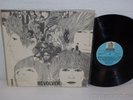
THE BEATLES: REVOLVER (LTD. OUT-OF-PRINT JAPANESE LP)
$
33


Favourite Auctions
To save auctions to your favourites, please login
If you don't have an account, please register
Description
PLEASE VISIT ALL OF OUR OFFERINGS!!
Be sure to add us to your favorites list!
__________________________________________________________________________________________________
THE BEATLES: REVOLVER
Toshiba/EMI TOJP-60137
LIMITED, OUT-OF-PRINT 2004 FROM JAPAN
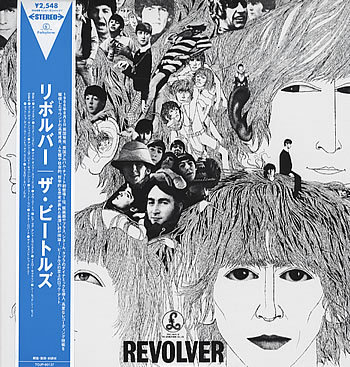
Deleted 2004 issue Japanese exclusive 14-track Limited Edition Apple label Direct Metal Mastered Vinyl Reissue Series stereo LP, picture sleeve complete with fold-out Japanese/English text lyric sheets and unique 'Odeon' retro-style blue obi-strip!
Japanese vinyl releases are premium quality pressings, much sought after by audiophiles and collectors alike.
The Beatles: Revolver
Revolver is the seventh album by English rock band The Beatles, released on 5 August 1966. The album showcased a number of new stylistic developments which would become more pronounced on later albums. Many of the tracks on Revolver are marked by an electric guitar-rock sound, in contrast with their previous, folk rock inspired Rubber Soul. It reached #1 on the UK chart for seven weeks and #1 on the U.S. chart for six weeks.
Revolver was released before the Beatles' last tour in August 1966, but they did not perform songs from the album live. Their reasoning for this was that many of the tracks on the album, for example "Tomorrow Never Knows", were too complex to perform with live instruments.
Melodic diversity and innovation in the studio
A key production technique used for the first time on this album was automatic double tracking (ADT), invented by EMI engineer Ken Townsend on 6 April 1966. This technique used two linked tape recorders to automatically create a doubled vocal track. The standard method was to double the vocal by singing the same piece twice onto a multitrack tape, a task Lennon particularly disliked. The Beatles were reportedly delighted with the invention, and used it extensively on Revolver. ADT quickly became a standard pop production technique, and led to related developments, including the artificial chorus effect.
Songs
"Eleanor Rigby"
"Eleanor Rigby", one of Paul McCartney's songs on the album, was released as a single (in a double A-side with "Yellow Submarine") concurrently with the album. The song contains McCartney's lyrical imagery and a string arrangement (scored by George Martin under McCartney's direction), which was inspired by the Bernard Herrmann score for François Truffaut's film Fahrenheit 451. The strings were recorded without reverberation, and compressed, giving a stark, urgent sound. The song is perhaps unique amongst Beatles' songs for having a lyric idea contributed by each Beatle. Ringo Starr contributed the line "Father Mackenzie, reading a sermon that no-one will hear." It was originally written as "Father McCartney" but was changed as it was thought that listeners would assume that it referred to Paul's father. So, after looking through a local phone book, he found the name McKenzie. Lennon laid claim to "40 percent" of the lyrics, including "Wearing the face that she keeps in the jar by the door" (though the other Beatles and those present at the writing of the song dispute this and argue Lennon's contributions were minor). Harrison contributed the line "Ah, look at all the lonely people" used in the opening and as a bridge. The song's quirky subject matter and stark, elegiac tone marks a departure from The Beatles' prior output.
"I'm Only Sleeping"
Lennon was the main writer of "I'm Only Sleeping". He and Harrison played the notes for the lead guitar (and for the second guitar in the solo) in reverse order, then reversed the tape and mixed it in. The backwards guitar sound builds the sleepy, ominous, and weeping tone of the song.
"Tomorrow Never Knows"
The Beatles' unfolding innovation in the recording studio reaches its apex with the album's final track. Lennon's "Tomorrow Never Knows" was one of the first songs in the emerging genre of psychedelic music, and included such groundbreaking techniques as reverse guitar, processed vocals and looped tape effects. Musically, it is drone-like, with a strongly syncopated, repetitive drum-beat, and is considered to be among the earliest precursors of electronica. The lyrics were inspired by the Tibetan Book of the Dead, although the title itself came from one of Starr's inadvertently amusing turns of phrase, playfully called "Ringoisms" (another being "A Hard Day's Night").
Much of the backing track consists of a series of prepared tape loops, stemming from Lennon's and McCartney's interest in and experiments with magnetic tape and musique concrète techniques at that time. According to Beatles session chronicler Mark Lewisohn, Lennon and McCartney prepared a series of loops at home, and these then were added to the pre-recorded backing track. This was reportedly done live in a single take, with multiple tape recorders running simultaneously, some of the longer loops extending out of the control room and down the corridor.
Lennon's processed lead vocal was another innovation. Always in search of ways to enhance or alter the sound of his voice, he gave a directive to EMI engineer Geoff Emerick that he wanted to sound like he was singing from the top of a high mountain. Emerick solved the problem by splicing a line from the recording console into the studio's Leslie speaker, giving Lennon's vocal its ethereal, filtered quality (he was later reprimanded by the studio's management for doing this).
Contributions and inspirations
Lennon's other contributions included "And Your Bird Can Sing" and "She Said She Said", both of which are guitar-laden tracks with swirling melodies.
According to Lennon, some of the lyrics of "She Said She Said" were taken almost verbatim from a conversation he had with actor Peter Fonda in August 1965, while he (Lennon), Harrison and Starr were under the influence of LSD at their rented house in Benedict Canyon (in Beverly Hills, California). During a conversation, Fonda said "I know what it's like to be dead," because as a boy he had almost died from a self-inflicted gunshot wound.[citation needed]
McCartney's "Got to Get You into My Life" was influenced by the Motown Sound and used brass instrumentation extensively. Although cast in the form of a love song, Lennon claimed, as heard on The Beatles Anthology, that the song is about LSD. It was released as a single in 1976, ten years after the album.
McCartney also contributed "For No One" a melancholy song featuring him playing clavichord and a horn solo played by Alan Civil, "Here, There, and Everywhere" written in the style of The Beach Boys, and "Good Day Sunshine".
Revolver was also a breakthrough album for Harrison as a songwriter, and he contributed three songs on Revolver, including the opening track, "Taxman". The guitar solo is actually played by McCartney. The "Mr. Wilson" and "Mr. Heath" referred to in the lyrics (right after the word "taxman") are Harold Wilson and Edward Heath, who were, respectively, the British Labour Prime Minister, and Conservative Leader of the Opposition at the time. In the Anthology 2 version, "Mr. Wilson and Mr Heath" were replaced with "Anybody got a little money." The song was a protest against the high marginal rates of income tax paid by high earners like the Beatles, which were sometimes as much as 95 percent of their income.
Harrison also wrote "I Want to Tell You", about his difficulty expressing himself in words. "Love You To" marked a significant expansion of his burgeoning interest in Indian music and the sitar, which started with "Norwegian Wood (This Bird Has Flown)" on Rubber Soul. It was the intro to "Love You To" that was playing in the background when the Harrison character first appears in Yellow Submarine, the animated Beatles movie released in 1968.
Cover art and title
The cover illustration was created by German-born bassist and artist Klaus Voormann, one of the Beatles' oldest friends from their days at the Star Club in Hamburg. Voormann's illustration, part line drawing and part collage, included photographs by Robert Whitaker, who also took the back cover photographs and many other images of the group between 1964 and 1966, such as the infamous "butcher cover" for Yesterday and Today. Voormann's own photo as well as his name (Klaus O. W. Voormann) is worked into Harrison's hair on the right-hand side of the cover. In the Revolver cover appearing in his artwork for Anthology 3, he replaced this image with a more recent photo. Harrison's Revolver image was seen again on his single release of "When We Was Fab" along with an updated version of the same image.
The title "Revolver", like "Rubber Soul" before it, is a pun, referring both to a kind of handgun as well as the "revolving" motion of the record as it is played on a turntable. The Beatles had a difficult time coming up with this title. According to Barry Miles in his book Paul McCartney: Many Years from Now, the title that the four had originally wanted was Abracadabra, until they discovered that another band had already used it. After that, opinion split: Lennon wanted to call it Four Sides of the Eternal Triangle and Starr jokingly suggested After Geography, playing on The Rolling Stones' recently released Aftermath LP. Other suggestions included Magical Circles, Beatles on Safari, Pendulum, and, finally, Revolver, whose wordplay was the one that all four agreed upon. The title was chosen while the band were on tour in Japan in June–July 1966. Due to security measures, they spent much of their time in their Tokyo Hilton hotel room; the name Revolver was selected as all four collaborated on a large psychedelic painting.
Tracks:
All songs written and composed by Lennon/McCartney, except where noted.
Side one
1. Taxman (George Harrison) 2:39
2. Eleanor Rigby 2:07
3. I'm Only Sleeping 3:01
4. Love You To (Harrison) 3:01
5. Here, There and Everywhere 2:25
6. Yellow Submarine 2:40
7. She Said She Said 2:37
Side two
1. Good Day Sunshine 2:09
2. And Your Bird Can Sing 2:01
3. For No One 2:01
4. Doctor Robert 2:15
5. I Want to Tell You (Harrison) 2:29
6. Got to Get You into My Life 2:30
7. Tomorrow Never Knows 2:57
Check out our other items!
SHIPPING COSTS ARE PER EBAY ESTIMATES – PLEASE FEEL FREE TO DISCUSS OTHER OPTIONS.
INSURANCE IS ALWAYS OPTIONAL – HOWEVER WE ARE NOT RESPONSIBLE FOR ITEMS SHIPPED WITHOUT IT.
WORLDWIDE PURCHASES ARE MOST WELCOMED!
THANKS AND GOOD LUCK!
price rating