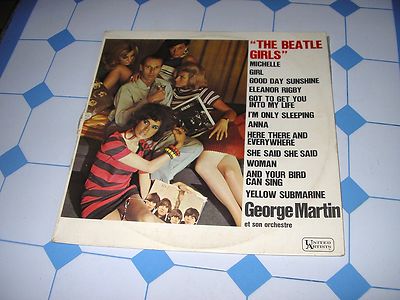
THE BEATLES GIRLS RARE GEORGE MARTIN ORCHESTRA 1966 FRENCH LP POP ROCK JERK 60S
€
39
$
46


Favourite Auctions
To save auctions to your favourites, please login
If you don't have an account, please register
Description
RARE BON ETAT DISQUE ET POCHETTE GEORGE MARTIN instrumentally salutes "THE BEATLE GIRLS" 37001 UAL UNITED ARTITS 1 GIRL 2 ELEANOR RIGBY 3 SHE SAID SHE SAID 4 I'M ONLY SLEEPING 5 ANNA (Go To Him) 6 MICHELLE 7 GOT TO GET YOU INTO MY LIFE 8 WOMAN 9 YELLOW SUBMARINE 10 HERE, THERE AND EVERYWHERE 11 AND YOUR BIRD CAN SING 12 GOOD DAY SUNSHINE Sir George Henry Martin CBE (born 3 January 1926) is an English record producer, arranger, composer, conductor, audio engineer and musician. He is sometimes referred to as "the Fifth Beatle"—a title that he has described as "nonsense"—in reference to his extensive involvement on each of The Beatles' original albums.[1] He is considered one of the greatest record producers of all time, with 30 number one hit singles in the UK and 23 number one hits in the USA. Influenced by a range of musical styles, encompassing Cole Porter and Johnny Dankworth, he attended the Guildhall School of Music and Drama from 1947 to 1950, studying piano and oboe. Following his graduation, he worked for the BBC's classical music department, then joined EMI in 1950. Martin produced comedy and novelty records in the early 1950s, working with the likes of Peter Sellers and Spike Milligan. In a career spanning over six decades, Martin has worked in music, film, television and live performance. He has also held a number of senior executive roles at media companies and contributes to a wide range of charitable causes, including his work for the Prince's Trust and the Caribbean island of Montserrat. In recognition of his services to the music industry and popular culture, he was awarded as Knight Bachelor in 1996.When he was six, Martin's family acquired a piano that sparked his interest in music.[2] At eight years of age, Martin persuaded his parents that he should take piano lessons, but those ended after only eight lessons because of a disagreement between his mother and the teacher. After that, Martin explained that he had just picked it up by himself.[3] As a child he attended several schools, including a "convent school in Holloway", St. Joseph's elementary school in Highgate, and St Ignatius' College in Stamford Hill, to which he won a scholarship.[4] When war broke out and St. Ignatius College students were evacuated to Welwyn Garden City, his family left London and he was enrolled at Bromley Grammar School.[4] “ I remember well the very first time I heard a symphony orchestra. I was just in my teens when Sir Adrian Boult brought the BBC Symphony Orchestra to my school for a public concert. It was absolutely magical. Hearing such glorious sounds I found it difficult to connect them with ninety men and women blowing into brass and wooden instruments or scraping away at strings with horsehair bows.[5] ” Despite Martin's continued interest in music, and "fantasies about being the next Rachmaninov", he did not initially choose music as a career.[6] He worked briefly as a quantity surveyor and then for the War Office as a Temporary Clerk (Grade Three) which meant filing paperwork and making tea.[7] In 1943, when he was seventeen, he joined the Fleet Air Arm of the Royal Navy and became a pilot and a commissioned officer. The war ended before Martin was involved in any combat, and he left the service in 1947.[8] Encouraged by Sidney Harrison (a member of the Committee for the Promotion of New Music) Martin used his veteran's grant to attend the Guildhall School of Music and Drama from 1947 to 1950, where he studied piano and oboe, and was interested in the music of Rachmaninov and Ravel, as well as Porter and Dankworth. Martin's oboe teacher was Margaret Eliot (the mother of Jane Asher, who would later have a relationship with Paul McCartney).[9][10][11] On 3 January 1948—while still at the Academy—Martin married Sheena Chisholm, with whom he had two children, Alexis and Gregory. He later married Judy Lockhart-Smith on 24 June 1966, and they also had two children, Lucy and Giles.[12] [edit]Parlophone The Beatles’ first LP—produced by Martin. Following his graduation, he worked for the BBC's classical music department, then joined EMI in 1950, as an assistant to Oscar Preuss, the head of EMI's Parlophone Records from 1950 to 1955. Although having been regarded by EMI as a vital German imprint in the past, it was then seen as a joke and only used for EMI's insignificant acts.[9][13] After taking over Parlophone when Preuss retired in 1955, Martin spent his first years with the record label recording classical and Baroque music, original cast recordings of hit plays, and regional music from around the British Isles.[14][15] Martin also produced numerous comedy and novelty records. Martin scored his first hit for Parlophone in 1952 with the Peter Ustinov single "Mock Mozart" - a record reluctantly released by EMI only after Preuss insisted they give his young assistant, Martin, a chance. Later that decade Martin worked with Sellers, and thus came to know Milligan, with whom he became a firm friend, and best man at Milligan's second marriage: "I loved the Goon Show, and issued an album of it on my label Parlophone, which is how I got to know Spike."[16] The album was Bridge On The River Wye. It was a spoof of the film The Bridge on the River Kwai, being based on the 1957 Goon Show An African Incident. It was intended to have the same name as the film, but shortly before its release, the film company threatened legal action if the name was used. Martin edited out the 'K' every time the word 'Kwai' was spoken, with Bridge on the River Wye being the result. The album included Milligan, Sellers, Jonathan Miller and Peter Cook, playing various characters.[17][18] Other comedians Martin worked with included Joan Sims, Rolf Harris, Flanders and Swann and Shirley Abicair.[19] Martin worked with the Vipers Skiffle Group, with whom he had a number of hits. In early 1962, under the pseudonym "Ray Cathode", Martin released an early electronic dance single, "Time Beat"—recorded at the BBC Radiophonic Workshop—in much the same style as the Doctor Who theme tune. As Martin wanted to add rock and roll to Parlophone's repertoire, he struggled to find a "fireproof" hit-making pop artist or group.[20] As a producer Martin recorded the two-man show featuring Michael Flanders and Donald Swann called At the Drop of a Hat, which sold steadily for twenty-five years, although Martin's breakthrough as a producer came with the Beyond the Fringe show, which starred Peter Cook, Dudley Moore, Alan Bennett and Jonathan Miller. Martin's work transformed the profile of Parlophone from a "sad little company" to a very profitable business.[21] [edit]The Beatles Martin previewing a song by Lennon and McCartney in 1963. Martin was contacted by Sid Coleman of Ardmore & Beechwood, who told him about Brian Epstein, the manager of a band he had met. He thought Martin might be interested in the group, even though they had been turned down by Decca Records among other major British labels. Until that time, although he'd had considerable success with the comedy records and a number 1 hit with the Temperance Seven, Martin had had only minor success with pop music, such as "Who Could Be Bluer" by Jerry Lordan, and singles with Shane Fenton and Matt Monro. After the telephone call by Coleman, Martin arranged a meeting on 13 February 1962 with Brian Epstein.[22] Martin listened to a tape recorded at Decca, and thought that Epstein's group was "rather unpromising", but liked the sound of Lennon and McCartney's vocals.[23] After another meeting with Epstein on 9 May at the Abbey Road studios, Martin was impressed with Epstein's enthusiasm and agreed to sign the unknown Beatles to a recording contract without having met them or seen them play live.[24] The contract was not what it seemed, however, as Martin would not sign it himself until he had heard an audition, and later said that EMI had "nothing to lose," as it offered one penny for each record sold, which was split amongst the four members.[25] Martin suggested to EMI (after the release of "From Me to You") that the royalty rate should be doubled without asking for anything in return, which led to Martin being thought of as a "traitor in EMI".[26] The Beatles auditioned for Martin on 6 June 1962, in studio three at the Abbey Road studios.[27] Ron Richards and his engineer Norman Smith recorded four songs, which Martin (who was not present during the recording) listened to at the end of the session. The verdict was not promising, however, as Richards complained about Pete Best's drumming, and Martin thought their original songs were simply not good enough.[24] Martin asked the individual Beatles if there was anything they personally did not like, to which George Harrison replied, "Well, there's your tie, for a start." That was the turning point, according to Smith, as John Lennon and Paul McCartney joined in with jokes and comic wordplay that made Martin think that he should sign them to a contract for their wit alone.[28] The Beatles' first recording session with Martin was on 4 September, when they recorded "How Do You Do It", which Martin thought was a sure-fire hit even though Lennon and McCartney did not want to release it, not being one of their own compositions.[29] Martin was correct: Gerry & the Pacemakers' version, which Martin produced, spent three weeks at No. 1 in April 1963 before being displaced by "From Me to You". On 11 September 1962, the Beatles re-recorded "Love Me Do" with Andy White playing drums. Andy was hired as a sessions drummer, which was normal in those days. Starr was asked to play tambourine and maracas, and although he complied, he was definitely "not pleased".[30] Martin would later praise Starr's drumming, calling him "probably ... the finest rock drummer in the world today".[31] "Love Me Do" peaked at number 17 in the British charts, so on 26 November 1962 Martin recorded "Please Please Me", which he only did after Lennon and McCartney had almost begged him to record another of their original songs. Martin's crucial contribution to the song was to tell them to speed up what was initially a slow ballad. After the recording Martin looked over the mixing desk and said, "Gentlemen, you have just made your first number one record".[32][33] Martin directed Epstein to find a good publisher, as Ardmore & Beechwood had done nothing to promote "Love Me Do", informing Epstein of three publishers who, in Martin's opinion, would be fair and honest, which led them to Dick James.[34] [edit]As arranger Abbey Road Studios, where Martin recorded Parlophone's artists. Martin's musical expertise helped fill the gaps between the Beatles' raw talent and the sound they wanted to achieve. Most of the Beatles' orchestral arrangements and instrumentation (as well as frequent keyboard parts on the early records) were written or performed by Martin in collaboration with the band.[35] It was Martin's idea to put a string quartet on "Yesterday", against McCartney's initial reluctance.[35][36] Martin played the song in the style of Bach to show McCartney the voicings that were available.[37] Another example is the song "Penny Lane", which featured a piccolo trumpet solo. McCartney hummed the melody he wanted, and Martin wrote it down in music notation for David Mason, the classically trained trumpeter.[38] Martin's distinctive arranging work appears on many Beatles recordings. For "Eleanor Rigby" he scored and conducted a strings-only accompaniment inspired by Bernard Herrmann. On a Canadian speaking tour in 2007, Martin said his "Eleanor Rigby" score was influenced by Herrmann's score for the Alfred Hitchcock thriller, Psycho.[39] For "Strawberry Fields Forever", he and recording engineer Geoff Emerick turned two very different takes into a single master through careful use of vari-speed and editing.[40] For "I Am the Walrus", he provided a quirky and original arrangement for brass, violins, cellos, and the Mike Sammes Singers vocal ensemble.[41][42][43] On "In My Life", he played a speeded-up baroque harpsichord solo.[44] He worked with McCartney to implement the orchestral 'climax' in "A Day in the Life" and he and McCartney shared conducting duties the day it was recorded.[45] He contributed less-noted but integral parts to other songs, including the piano in "Lovely Rita",[46] the organs and tape loop arrangement that create the Pablo Fanque circus atmosphere that Lennon requested on "Being for the Benefit of Mr. Kite!" (both Martin and Lennon played organ parts for this song), and the orchestration in "Good Night".[47][48][49] The first song that Martin did not arrange was "She's Leaving Home", as he had a prior engagement to produce a Cilla Black session, so McCartney contacted arranger Mike Leander to do it. Martin was reportedly hurt by this, but still produced the recording and conducted the orchestra himself.[50] Martin was in demand as an independent arranger and producer by the time of The White Album, so the Beatles were left to produce various tracks by themselves.[51] Martin arranged the score for the Beatles' film Yellow Submarine[52] and the James Bond film Live and Let Die, for which Paul McCartney wrote and sang the title song.[53] Paul McCartney once commended Martin by saying: "George Martin [was] quite experimental for who he was, a grown-up."[54] [edit]As composer Martin has composed film scores since the early 1960s, including the instrumental scores of the films Yellow Submarine and Live and Let Die, as well as being a producer and arranger. He also composed Adagietto for Harmonica & Strings for Tommy Reilly, Theme One for BBC Radio 1, and Magic Carpet for The Dakotas. [edit]The Beatles Anthology Martin oversaw post-production on The Beatles Anthology (which was originally entitled "The Long and Winding Road") in 1994 and 1995, working again with Geoff Emerick.[55] Martin decided to use an old 8-track analogue deck to mix the songs for the project—which EMI found out an engineer still had—instead of a modern digital deck. He explained this by saying that the old deck created a completely different sound, which a new deck could not recreate.[55] He also said the whole project was a strange experience for him (with which McCartney agreed) as they had to listen to themselves chatting in the studio, 25–30 years previously.[55] Martin stepped down when it came to producing the two new singles reuniting McCartney, Harrison and Starr, who wanted to overdub two old Lennon demos. Martin had suffered a hearing loss, and left the work to writer/producer Jeff Lynne of ELO fame.[56][57]
Créé par eBay Turbo Lister
L'outil de mise en vente gratuit. Mettez vos objets en vente rapidement et en toute simplicité, et gérez vos annonces en cours.
price rating


![STUDIO ONE/DOOR PEEPER - BURNING SPEAR [ROOTS REGGAE] 7](https://www.popsike.com/php/thumbnail.php?url=https://www.popsike.pics/pix/20160409/291733088862.jpg)






![Howlin' Wolf - Howlin' Wolf [New Vinyl LP] Spain - Import](https://www.popsike.com/php/thumbnail.php?url=https://www.popsike.pics/pix/20190314/293006360813.jpg)