Spontaneous Music Ensemble / Challenge / UK Original
£
398
$
527


Favourite Auctions
To save auctions to your favourites, please login
If you don't have an account, please register
Description
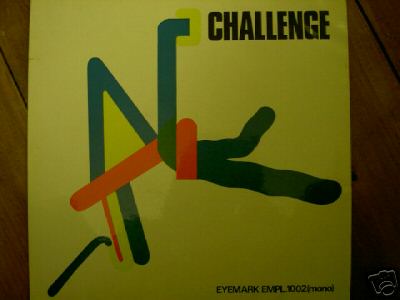
Spontaneous Music Ensemble: “Challenge”. Eyemark Records, EMPL.1002(mono). Chance to bid on this exceptionally rare and important British free jazz LP. This is the first and only pressing from 1966 on the obscure Eyemark Records label. Bruce Cale - Bass, Jeff Clyne - Bass, Paul Rutherford - Trombone, John Stevens - Drums, Trevor Watts - Alto/Sop Sax, Kenny Wheeler - Flugel Horn. Condition: The cover is near mint. There are the usual signs of wear for a record from this period, lamination is intact, there is a very slight scar in the lamination on the left hand side, 1 cm long. Top right there is a slight bubble in the lamination in two places - this I would put down the the strange way that this LP sleeve is constructed, as this is no normal flip back sleeve. It seems like the back of the sleeve was printed with a blank front sleeve, and then the already laminated front cover was stuck onto this blank front, its edges then folded around and glued along the seams. There is minute corner wear, bottom right and bottom left, I’d put this down to storage. The vinyl is in amazing condition. It looks clean and almost unplayed. However, I have played this LP through on both sides, side one track three there is a slight tick towards the end. There is also very very slight background noise in a few of the silent passages, but I’ve examined this side closely and to me it just needs a professional clean which I will be getting done before the LP is shipped. Side B is immaculate. The label, again of strange “Eyemark” design and construction really shows that this LP has been rarely played. Some would grade this overall as NM / NM, to be on the safe side I’d say M- or NM+/EX++ because I know how fussy buyers at this top end can be. Remember this is practically a private pressing, and as well all know, these tend to be a bit different in terms of pressing and vinyl quality. You may think I am going on a bit, but this is an important, rare and dare I say it, a trophy LP, and I want to let all prospective bidders know everything I can about it. There is a sensible reserve on this LP. I will ship anywhere, buyer pays postage and I’d also suggest recorded delivery with such a rare LP. I except UK cash, paypal and international money orders. Any questions please email me. Here is some further information about the recording...
The Spontaneous Music Ensemble began in the mid-'60s exploring free improvisation, and over three decades, with varying personnel but under the leadership of the late drummer John Stevens, became one of the pivotal ensembles in all of contemporary jazz. CHALLENGE was its premiere recording, and it's an exciting slice of rediscovered history. The band acknowledged its debt to Ornette Coleman and Eric Dolphy with the floating, open-ended 2.B. Ornette and the brisk, leaping E.D.'s Message respectively, but Travelling Together, a multi-tempo improvisation where the horns poke and pummel each other in group polyphony, and End to a Beginning, which starts with an ingenious theme that splinters off into spirited solos, give a clearer view of the ambitious, unorthodox directions the band would ultimately take. The soloists give off sparks - Trevor Watts' biting alto sax, Kenny Wheeler's probing trumpet and Paul Rutherford's bruising trombone - with Stevens' fluid drumming holding everything together. "
"Throw on CHALLENGE in a blindfold test for even the most ardent fan of European free improvisation. Few would guess that this was the first document of the Spontaneous Music Ensemble. Yes, there are tunes here with dedications to Eric Dolphy and Ornette Coleman and some of the most burning free jazz ensemble playing going! Make no mistake about it. This is music with clear ties to the free jazz developments of the mid-'60s. By the end of '66 they would go on to evolve a unique and personal approach to improvisation that would leave the influences of free jazz behind. But this document catches the musicians at a critical juncture. Here, they are grappling with the balance of swing and freedom; torrid solos and collective interplay; thematic improvisation and spontaneous invention. They tear into this set of thematic free exploration and deliver music that is imbued with hints of what was to come. Though there are a string of memorable heads and fervid solos, it is the collective interplay that stands out. Intros to tunes swirl around the shifting sense of time as the horn players duck and bob around each other before settling on the driving free swing that ensues. Rutherford's gruff trombone edges in on Watts' keening alto and Wheeler's clarion sweet tone cuts through the ensemble with a conceptual clarity. And underneath it all, Stevens propels things along with an elastic approach to time that stretches out into freedom without ever loosing a sense of pulse. But listening to pieces like Travelling Together, Little Red Head, and the closing End to a Beginning makes it clear that these are musicians who are on the brink of a discovery."
"For the world of free improvisation, CHALLENGE marks a major milestone. It represents the first recording of the Spontaneous Music Ensemble, long-time standard-bearers of British free improv. One can view CHALLENGE as a launching point for a free-spirited group with a revolving door of personnel, but an ever-expanding sense of musical freedom. "These recordings are of historical importance. More importantly, they are a good listen. They are the earliest available recordings of the Spontaneous Music Ensemble. The recordings capture free improvisation at the point in time when it was diverging from free jazz but when the two were still close enough to be obviously related. Over the next two years, largely because of nightly musical explorations and experiments at the Little Theatre Club in central London, SME's music evolved rapidly. (Compare this release with KARYOBIN, recorded in 1968, for evidence.) In 1966, SME were still playing compositions credited to individual members, rather than free improvisations credited to all those involved. The rhythm section was still relatively conventional. John Stevens was still playing a standard drum kit, rather than the small SME kit he would soon adopt. As the 1966 sleeve notes proudly proclaimed of the music, 'It swings'. This music clearly shows the influence of Americans like Coltrane, Coleman and Dolphy. There are also hints of the future, though. On Little Red Head and End to a Beginning that there are early signs of the SME's later, freer music but they still have a clearly agreed structure. Over the next quarter of a century, SME would radically alter the face of improvised music, making it into something distinct from jazz and into a recognisably European form. This LP marks the start of that process. It makes fascinating listening."