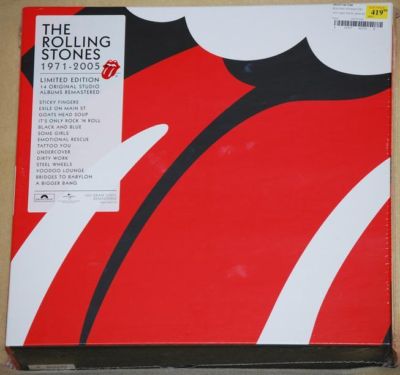
Rolling Stones: The Rolling Stones 1971-2005
Sealed Vinyl Box Set - Limited Edition # 002093 (180-gram virgin heavyweight vinyl)
Format: 180-gram virgin heavyweight vinyl
Record Company/Release Number: Polydor/Universal Music Group: 06025 2746710 8
Bar Code: 602527467108
Original release date: 2010
Country: U.S.A.
Condition of the cover: Mint (small tear on the shrink wrap on the back of the cover, does not affect the cover)
Condition of the record: Factory Sealed
Shipping Weight: 17 pounds, 0 ounces
Inventory number: 209851
Notes: Limited edition #000592
Please contact me if you have any difficulty viewing the photos.
Songs:
Sticky Fingers
- Brown Sugar
- Sway
- Wild Horses
- Can't You Hear Me Knocking
- You Gotta Move
- Bitch
- I Got The Blues
- Sister Morphine
- Dead Flowers
- Moonlight Mile
Exile On Main St.
- Rocks Off
- Rip This Joint
- Shake Your Hips
- Casino Boogie
- Tumbling Dice
- Sweet Virginia
- Torn And Frayed
- Sweet Black Angel
- Loving Cup
- HappyTurd
- On The Run
- Ventilator Blues
- I Just Want To See His Face
- Let It Loose
- All Down The Line
- Stop Breaking Down
- Shine A Light
- Soul Survivor
Goats Head Soup
- Dancing With Mr. D.
- 10 Years Ago
- Coming Down Again
- Doo Doo Doo Doo Doo (Heartbreaker)
- Angie
- Silver Train
- Hide Your Love
- Winter
- Can You Hear The Music
- Star Star
It's Only Rock 'N Roll
- If You Can't Rock Me
- Ain't Too Proud To Beg
- It's Only Rock 'N Roll (But I Like It)
- Till The Next Goodbye
- Time Waits For No One
- Luxury
- Dance Little Sister
- If You Really Want To Be My Friend
- Short And Curlies
- Fingerprint File
Black And Blue
- Hot Stuff
- Hand Of Fate
- Cherry Oh Baby
- Memory Motel
- Hey Negrita
- Melody
- Fool To Cry
- Crazy Mama
Some Girls
- Miss You
- When The Whip Comes Down
- Just My Imagination (Runing Away With Me)
- Some Girls
- Lies
- Far Away Eyes
- Respectable
- Before They Make Me Run
- Beast Of Burden
- Shattered
Emotional Rescue
- Dance
- Summer Romance
- Send It To Me
- Let Me Go
- Indian Girl
- Where The Boys Go
- Down In The Hole
- Emotional Rescue
- She's So Cold
- All About You
Tattoo You
- Start Me Up
- Hang Fire
- Slave
- Little T & A
- Black Limousine
- NeighboursWorried
- About You
- Tops
- Heaven
- No Use In Crying
- Waiting On A Friend
Undercover
- Undercover Of The Night
- She Was Hot
- Tie You Up (The Pain Of Love)
- Wanna Hold You
- Feel On Baby
- Too Much Blood
- Pretty Beat Up
- Too Tough
- All The Way Down
- It Must Be Hell
Dirty Work
- One Hit (To The Body)
- Fight
- Harlem Shuffle
- Hold Back
- Too Rude
- Winning Ugly
- Back To Zero
- Dirty Work
- Had It With You
- Sleep Tonight
Steel Wheels
- Sad Sad Sad
- Mixed Emotions
- Terrifying
- Hold On To Your Hat
- Hearts For Sale
- Blinded By Love
- Rock And A Hard Place
- Can't Be Seen
- Almost Hear You Sigh
- Continental Drift
- Break The Spell
- Slipping Away
Voodoo Lounge
- Love Is Strong
- You Got Me Rocking
- Sparks Will Fly
- The Worst
- New Faces
- Moon Is Up
- Out Of Tears
- I Go Wild
- Brand New Car
- Sweethearts Together
- Suck On The Jugular
- Blinded By Rainbows
- Baby Break It Down
- Thru And Thru
Bridges To Babylon
- Flip The Switch
- Anybody Seen My Baby?
- Low Down
- Already Over Me
- Gunface
- You Don't Have To Mean It
- Out Of Control
- Saint Of Me
- Might As Well Get Juiced
- Always Suffering
- Too Tight
- Thief In The Night
- How Can I Stop
A Bigger Bang
- Rough Justice
- Let Me Down Slow
- It Won't Take Long
- Rain Fall Down
- Streets Of Love
- Back Of My Hand
- She Saw Me Coming
- Biggest Mistake
- This Place Is Empty
- Oh No Not You Again
- Dangerous Beauty
- Laugh, I Nearly Died
- Sweet Neocon
- Look What The Cat Dragged In
- Driving Too Fast
- Infamy
Credits:
Album Review:
The following review is about the two box sets. This auction is only for the 1971-2005 box set.
For the very first time in the history of the “World’s Greatest Rock ‘n’ Roll Band” The Rolling Stones, ABKCO Records and Universal Music Group have joined forces to offer two vinyl box set collections spanning over 40 years of The Rolling Stones’ career. The box sets include 23 original studio albums, two “Big Hits” collections as well as two rare EPs. They will be released on November 22 worldwide (and November 23 in the U.S.). The Rolling Stones 1964-1969 and The Rolling Stones 1971-2005 Vinyl Box Sets offer the consumer a wealth of great Rolling Stones music, much of which hasn’t been available on vinyl for a considerable period of time.
The limited edition numbered box sets chronologically kick off with The Rolling Stones 1964-1969 Vinyl Box Set, a collection that encompasses the Stones’ early U.K. releases. The set includes nine re-mastered Rolling Stones studio albums, two remastered EPs, plus two “Big Hits” collections. It's the first vinyl reissue in decades for The Rolling Stones (EP), The Rolling Stones, Five by Five (EP), The Rolling Stones No. 2, Big Hits (High Tide and Green Grass) and Through the Past, Darkly (Big Hits Vol. 2).
The first five titles in the set are presented in their original mono format affording, for the first time in years, an opportunity for Stones fans to enjoy re-mastered versions of the tracks “I Can’t Be Satisfied,” “Time Is On My Side” (Version 2) and “Down the Road Apiece” as originally released. Through the Past, Darkly (Big Hits Vol. 2) is included with its original octagonal cover and artwork intact. Metamorphosis is also included in the set; the album was first released in 1975 but is wholly comprised of tracks recorded from the early-to-late sixties. The inclusion of the band’s original two “Big Hits” collections was mandated by the fact that U.K. album releases in that era most often did not include contemporaneously released hit singles.
The world really was The Rolling Stones’ oyster in the seventies, as their escapades made headlines around the world from the French Riviera to Switzerland and via the U.S. and Canada. They performed groundbreaking concerts in arenas and moved effortlessly into open-air stadiums. They stuck their collective tongue out at the British establishment and became citizens of the world.
They set up their own label and made the most of their new-found artistic freedom and, most importantly, they issued a series of definitive studio albums: Sticky Fingers, Exile On Main Street, Goats Head Soup, It’s Only Rock ’n’ Roll, Black And Blue and Some Girls. They partied at Studio 54, came up with dance-floor hits “Miss You” and “Emotional Rescue,” and recorded in Paris, Nassau, Jamaica and New York.
The eighties saw the band stretch the envelope further still, working with jazz great Sonny Rollins, film directors Julien Temple and Michael Lindsay-Hogg, and producers Chris Kimsey and Steve Lillywhite on classics such as Emotional Rescue, Tattoo You, Undercover, Dirty Work and Steel Wheels.
Throughout the next two decades they filmed with Scorsese, recorded with Don Was and released further groundbreaking albums--Voodoo Lounge and Bridges To Babylon, right up to 2005’s triumphant A Bigger Bang.
Fans now get a chance to rediscover many of their past favorites and unearth some forgotten gems along the way too …all re-mastered and sounding better than ever.
The two volumes, a compendium of the band’s U.K.-released studio recordings, will be marketed jointly by ABKCO and UMG and span the band’s output from the dawn of their recording career in early 1964 with the release of their debut LP The Rolling Stones, through to A Bigger Bang, originally released in 2005. Pressings in The Rolling Stones 1964-1969 and The Rolling Stones 1971-2005 Vinyl Box Sets are 180-gram virgin heavyweight vinyl and are part of the much lauded Back-to-Black classic vinyl reissue series.
Biography:
Rolling Stones biography by Stephen Thomas Erlewine, All Music Guide
By the time the Rolling Stones began calling themselves the World's Greatest Rock & Roll Band in the late '60s, they had already staked out an impressive claim on the title. As the self-consciously dangerous alternative to the bouncy Merseybeat of the Beatles in the British Invasion, the Stones had pioneered the gritty, hard-driving blues-based rock & roll that came to define hard rock. With his preening machismo and latent maliciousness, Mick Jagger became the prototypical rock frontman, tempering his macho showmanship with a detached, campy irony while Keith Richards and Brian Jones wrote the blueprint for sinewy, interlocking rhythm guitars. Backed by the strong yet subtly swinging rhythm section of bassist Bill Wyman and drummer Charlie Watts, the Stones became the breakout band of the British blues scene, eclipsing such contemporaries as the Animals and Them. Over the course of their career, the Stones never really abandoned blues, but as soon as they reached popularity in the U.K., they began experimenting musically, incorporating the British pop of contemporaries like the Beatles, Kinks, and Who into their sound. After a brief dalliance with psychedelia, the Stones re-emerged in the late '60s as a jaded, blues-soaked hard rock quintet. The Stones always flirted with the seedy side of rock & roll, but as the hippie dream began to break apart, they exposed and reveled in the new rock culture. It wasn't without difficulty, of course. Shortly after he was fired from the group, Jones was found dead in a swimming pool, while at a 1969 free concert at Altamont, a concertgoer was brutally killed during the Stones' show. But the Stones never stopped going. For the next 30 years, they continued to record and perform, and while their records weren't always blockbusters, they were never less than the most visible band of their era -- certainly, none of their British peers continued to be as popular or productive as the Stones. And no band since has proven to have such a broad fan base or far-reaching popularity, and it is impossible to hear any of the groups that followed them without detecting some sort of influence, whether it was musical or aesthetic. Throughout their career, Mick Jagger (vocals) and Keith Richards (guitar, vocals) remained at the core of the Rolling Stones. The pair initially met as children at Dartford Maypole County Primary School. They drifted apart over the next ten years, eventually making each other's acquaintance again in 1960, when they met through a mutual friend, Dick Taylor, who was attending Sidcup Art School with Richards. At the time, Jagger was studying at the London School of Economics and playing with Taylor in the blues band Little Boy Blue and the Blue Boys. Shortly afterward, Richards joined the band. Within a year, they had met Brian Jones (guitar, vocals), a Cheltenham native who had dropped out of school to play saxophone and clarinet. By the time he became a fixture on the British blues scene, Jones had already had a wild life. He ran away to Scandinavia when he was 16; by that time, he had already fathered two illegitimate children. He returned to Cheltenham after a few months, where he began playing with the Ramrods. Shortly afterward, he moved to London, where he played in Alexis Korner's group, Blues Inc. Jones quickly decided he wanted to form his own group and advertised for members; among those he recruited was the heavyset blues pianist Ian Stewart. As he played with his group, Jones also moonlighted under the name Elmo Jones at the Ealing Blues Club. At the pub, he became reacquainted with Blues, Inc., which now featured drummer Charlie Watts, and, on occasion, cameos by Jagger and Richards. Jones became friends with Jagger and Richards, and they soon began playing together with Taylor and Stewart; during this time, Mick was elevated to the status of Blues, Inc.'s lead singer. With the assistance of drummer Tony Chapman, the fledgling band recorded a demo tape. After the tape was rejected by EMI, Taylor left the band to attend the Royal College of Art; he would later form the Pretty Things. Before Taylor's departure, the group named itself the Rolling Stones, borrowing the moniker from a Muddy Waters song. The Rolling Stones gave their first performance at the Marquee Club in London on July 12, 1962. At the time, the group consisted of Jagger, Richards, Jones, pianist Ian Stewart, drummer Mick Avory, and Dick Taylor, who had briefly returned to the fold. Weeks after the concert, Taylor left again and was replaced by Bill Wyman, formerly of the Cliftons. Avory also left the group -- he would later join the Kinks -- and the Stones hired Tony Chapman, who proved to be unsatisfactory. After a few months of persuasion, the band recruited Charlie Watts, who had quit Blues, Inc. to work at an advertising agency once the group's schedule became too hectic. By 1963, the band's lineup had been set, and the Stones began an eight-month residency at the Crawdaddy Club, which proved to substantially increase their fan base. It also attracted the attention of Andrew Loog Oldham, who became the Stones' manager, signing them from underneath Crawdaddy's Giorgio Gomelsky. Although Oldham didn't know much about music, he was gifted at promotion, and he latched upon the idea of fashioning the Stones as the bad-boy opposition to the clean-cut Beatles. At his insistence, the large yet meek Stewart was forced out of the group, since his appearance contrasted with the rest of the group. Stewart didn't disappear from the Stones; he became one of their key roadies and played on their albums and tours until his death in 1985. With Oldham's help, the Rolling Stones signed with Decca Records, and that June, they released their debut single, a cover of Chuck Berry's "Come On." The single became a minor hit, reaching number 21, and the group supported it with appearances on festivals and package tours. At the end of the year, they released a version of Lennon-McCartney's "I Wanna Be Your Man" that soared into the Top 15. Early in 1964, they released a cover of Buddy Holly's "Not Fade Away," which shot to number three. "Not Fade Away" became their first American hit, reaching number 48 that spring. By that time, the Stones were notorious in their homeland. Considerably rougher and sexier than the Beatles, the Stones were the subject of numerous sensationalistic articles in the British press, culminating in a story about the band urinating in public. All of these stories cemented the Stones as a dangerous, rebellious band in the minds of the public, and had the effect of beginning a manufactured rivalry between them and the Beatles, which helped the group rocket to popularity in the U.S. In the spring of 1964, the Stones released their eponymous debut album, which was followed by "It's All Over Now," their first U.K. number one. That summer, they toured America to riotous crowds, recording the Five by Five EP at Chess Records in Chicago in the midst of the tour. By the time it was over, they had another number one U.K. single with Howlin' Wolf's "Little Red Rooster." Although the Stones had achieved massive popularity, Oldham decided to push Jagger and Richards into composing their own songs, since they -- and his publishing company -- would receive more money that away. In June of 1964, the group released their first original single, "Tell Me (You're Coming Back)," which became their first American Top 40 hit. Shortly afterward, a version of Irma Thomas' "Time Is on My Side" became their first U.S. Top Ten. It was followed by "The Last Time" in early 1965, a number one U.K. and Top Ten U.S. hit that began a virtually uninterrupted string of Jagger-Richards hit singles. Still, it wasn't until the group released "(I Can't Get No) Satisfaction" in the summer of 1965 that they were elevated to superstars. Driven by a fuzz-guitar riff designed to replicate the sound of a horn section, "Satisfaction" signaled that Jagger and Richards had come into their own as songwriters, breaking away from their blues roots and developing a signature style of big, bluesy riffs and wry, sardonic lyrics. It stayed at number one for four weeks and began a string of Top Ten singles that ran for the next two years, including such classics as "Get off My Cloud," "19th Nervous Breakdown," "As Tears Go By," and "Have You Seen Your Mother, Baby, Standing in the Shadow?" By 1966, the Stones had decided to respond to the Beatles' increasingly complex albums with their first album of all-original material, Aftermath. Due to Brian Jones' increasingly exotic musical tastes, the record boasted a wide range of influences, from the sitar-drenched "Paint It, Black" to the Eastern drones of "I'm Going Home." These eclectic influences continued to blossom on Between the Buttons (1967), the most pop-oriented album the group ever made. Ironically, the album's release was bookended by two of the most notorious incidents in the band's history. Before the record was released, the Stones performed the suggestive "Let's Spend the Night Together," the B-side to the medieval ballad "Ruby Tuesday," on The Ed Sullivan Show, which forced Jagger to alter the song's title to an incomprehensible mumble, or else face being banned. In February of 1967, Jagger and Richards were arrested for drug possession, and within three months, Jones was arrested on the same charge. All three were given suspended jail sentences, and the group backed away from the spotlight as the summer of love kicked into gear in 1967. Jagger, along with his then-girlfriend Marianne Faithfull, went with the Beatles to meet the Maharishi Mahesh Yogi; they were also prominent in the international broadcast of the Beatles' "All You Need Is Love." Appropriately, the Stones' next single, "Dandelion"/"We Love You," was a psychedelic pop effort, and it was followed by their response to Sgt. Pepper, Their Satanic Majesties Request, which was greeted with lukewarm reviews. The Stones' infatuation with psychedelia was brief. By early 1968, they had fired Andrew Loog Oldham and hired Allen Klein as their manager. The move coincided with their return to driving rock & roll, which happened to coincide with Richards' discovery of open tunings, a move that gave the Stones their distinctively fat, powerful sound. The revitalized Stones were showcased on the malevolent single "Jumpin' Jack Flash," which climbed to number three in May 1968. Their next album, Beggar's Banquet, was finally released in the fall, after being delayed for five months due its controversial cover art of a dirty, graffiti-laden restroom. An edgy record filled with detours into straight blues and campy country, Beggar's Banquet was hailed as a masterpiece among the fledgling rock press. Although it was seen as a return to form, few realized that while it opened a new chapter of the Stones' history, it also was the closing of their time with Brian Jones. Throughout the recording of Beggar's Banquet, Jones was on the sidelines due to his deepening drug addiction and his resentment of the dominance of Jagger and Richards. Jones left the band on June 9, 1969, claiming to be suffering from artistic differences between himself and the rest of the band. On July 3, 1969 -- less than a month after his departure -- Jones was found dead in his swimming pool. The coroner ruled that it was "death by misadventure," yet his passing was the subject of countless rumors over the next two years. By the time of his death, the Stones had already replaced Brian Jones with Mick Taylor, a former guitarist for John Mayall's Bluesbreakers. He wasn't featured on "Honky Tonk Women," a number one single released days after Jones' funeral, and he contributed only a handful of leads on their next album, Let It Bleed. Released in the fall of 1969, Let It Bleed was comprised of sessions with Jones and Taylor, yet it continued the direction of Beggar's Banquet, signaling that a new era in the Stones' career had begun, one marked by ragged music and an increasingly wasted sensibility. Following Jagger's filming of Ned Kelly in Australia during the first part of 1969, the group launched its first American tour in three years. Throughout the tour -- the first where they were billed as the World's Greatest Rock & Roll Band -- the group broke attendance records, but it was given a sour note when the group staged a free concert at Altamont Speedway. On the advice of the Grateful Dead, the Stones hired Hell's Angels as security, but that plan backfired tragically. The entire show was unorganized and in shambles, yet it turned tragic when the Angels killed a young black man, Meredith Hunter, during the Stones' performance. In the wake of the public outcry, the Stones again retreated from the spotlight and dropped "Sympathy for the Devil," which some critics ignorantly claimed incited the violence, from their set. As the group entered hiatus, they released the live Get Yer Ya-Ya's Out! in the fall of 1970. It was their last album for Decca/London, and they formed Rolling Stones Records, which became a subsidiary of Atlantic Records. During 1970, Jagger starred in Nicolas Roeg's cult film Performance and married Nicaraguan model Bianca Perez Morena de Macias, and the couple quickly entered high society. As Jagger was jet-setting, Richards was slumming, hanging out with country-rock pioneer Gram Parsons. Keith wound up having more musical influence on 1971's Sticky Fingers, the first album the Stones released though their new label. Following its release, the band retreated to France on tax exile, where they shared a house and recorded a double album, Exile on Main St. Upon its May 1972 release, Exile on Main St. was widely panned, but over time it came to be considered one of the group's defining moments. Following Exile, the Stones began to splinter in two, as Jagger concentrated on being a celebrity and Richards sank into drug addiction. The band remained popular throughout the '70s, but their critical support waned. Goats Head Soup, released in 1973, reached number one, as did 1974's It's Only Rock 'n' Roll, but neither record was particularly well received. Taylor left the band after It's Only Rock 'n' Roll, and the group recorded their next album as they auditioned new lead guitarists, including Jeff Beck. They finally settled on Ron Wood, former lead guitarist for the Faces and Rod Stewart, in 1976, the same year they released Black n' Blue, which only featured Wood on a handful of cuts. During the mid- and late '70s, all the Stones pursued side projects, with both Wyman and Wood releasing solo albums with regularity. Richards was arrested in Canada in 1977 with his common-law wife Anita Pallenberg for heroin possession. After his arrest, he cleaned up and was given a suspended sentence the following year. The band reconvened in 1978 to record Some Girls, an energetic response to punk, new wave, and disco. The record and its first single, the thumping disco-rocker "Miss You," both reached number one, and the album restored the group's image. However, the group squandered that goodwill with the follow-up, Emotional Rescue, a number one record that nevertheless received lukewarm reviews upon its 1980 release. Tattoo You, released the following year, fared better both critically and commercially, as the singles "Start Me Up" and "Waiting on a Friend" helped the album spend nine weeks at number one. The Stones supported Tattoo You with an extensive stadium tour captured in Hal Ashby's movie Let's Spend the Night Together and the 1982 live album Still Life. Tattoo You proved to be the last time the Stones completely dominated the charts and the stadiums. Although the group continued to sell out concerts in the '80s and '90s, their records didn't sell as well as previous efforts, partially because the albums suffered due to Jagger and Richards' notorious mid-'80s feud. Starting with 1983's Undercover, the duo conflicted about which way the band should go, with Jagger wanting the Stones to follow contemporary trends and Richards wanting them to stay true to their rock roots. As a result, Undercover was a mean-spirited, unfocused record that received relatively weak sales and mixed reviews. Released in 1986, Dirty Work suffered a worse fate, since Jagger was preoccupied with his fledgling solo career. Once Jagger decided that the Stones would not support Dirty Work with a tour, Richards decided to make his own solo record with 1988's Talk Is Cheap. Appearing a year after Jagger's failed second solo album, Talk Is Cheap received good reviews and went gold, prompting Jagger and Richards to reunite late in 1988. The following year, the Stones released Steel Wheels, which was received with good reviews, but the record was overshadowed by its supporting tour, which grossed over 140 million dollars and broke many box office records. In 1991, the live album Flashpoint, which was culled from the Steel Wheels shows, was released. Following the release of Flashpoint, Bill Wyman left the band; he published a memoir, Stone Alone, within a few years of leaving. The Stones didn't immediately replace Wyman, since they were all working on solo projects; this time, there was none of the animosity surrounding their mid-'80s projects. The group reconvened in 1994 with bassist Darryl Jones, who had previously played with Miles Davis and Sting, to record and release the Don Was-produced Voodoo Lounge. The album received the band's strongest reviews in years, and its accompanying tour was even more successful than the Steel Wheels tour. On top of being more successful than its predecessor, Voodoo Lounge also won the Stones their first Grammy for Best Rock Album. Upon the completion of the Voodoo Lounge tour, the Stones released the live, "unplugged" album Stripped in the fall of 1995. Similarly, after wrapping up their tour in support of 1997's Bridges to Babylon, the group issued yet another live set, No Security, the following year. A high-profile greatest-hits tour in 2002 was launched despite the lack of a studio album to support, and its album document Live Licks appeared in 2004. A year later, the group issued A Bigger Bang, their third effort with producer Don Was. - All sealed albums are being sold as collector's items and cannot be returned due to manufacturer's defects. It may be almost impossible to replace many of the sealed albums that I am selling.
- All pictures are of the exact item being sold.
- I always leave feedback before your item ships. Please consider leaving feedback for me after you have had a chance to inspect and enjoy your purchase.
- Please avoid questions on the last day of the auction. I might not have enough time to give you an answer before the auction ends.
- All album reviews, credits and artist biographies are from All Music Guide. If you haven't been to their web site, you have to check it out. It's one of the most comprehensive music references on the internet. In some cases, credits may include reissue (CD) information. Obviously any credits referenced to CDs do not apply to this album release.
- I DO NOT END ANY OF MY AUCTIONS EARLY. PLEASE DON'T ASK (unless you are willing to offer enough to pay off my mortgage).
Shipping and pick-up
Shipping is calculated by the weight of your package. I do not charge a handling fee.
All uninsured and underinsured shipments are the responsibility of the buyer.
Your item(s) will be shipped within 1business day after I receive your cleared payment.
If you have any special shipping requirements (extra padding, oversized boxes, etc., you must let me know BEFORE making your payment. The pre-calculated cost of your shipping is based my standard packaging (new boxes, padded envelopes, etc.). DOMESTIC
- Pick-up is fine with me, but be prepared to pay by cash. E-mail me to setup a time that is convenient for the both of us.
INTERNATIONAL
- If you purchase multiple items, please wait until after all the auctions end for me to send an invoice.
- The buyer is responsible for all customs regulations and fees in their own country. I will value all items at $5 each on the Customs Form. Please let me know if you want the actual winning bid price listed on the Customs Form.
- If the total weight of your package is 4 pounds or more, it is required to shipped by International Priority Mail.
I collect Grand Funk Railroad's music and memorabilia. If you think you might have something to trade for this item, let me know well before the auction ends. I normally do not end an auction early, but I will make an exception if we can work out some sort of trade for something that I can add to my Grand Funk collection.
If you also collect Grand Funk, let me know if you have anything that you might want to sell or trade. I am always looking to add something new to my collection.