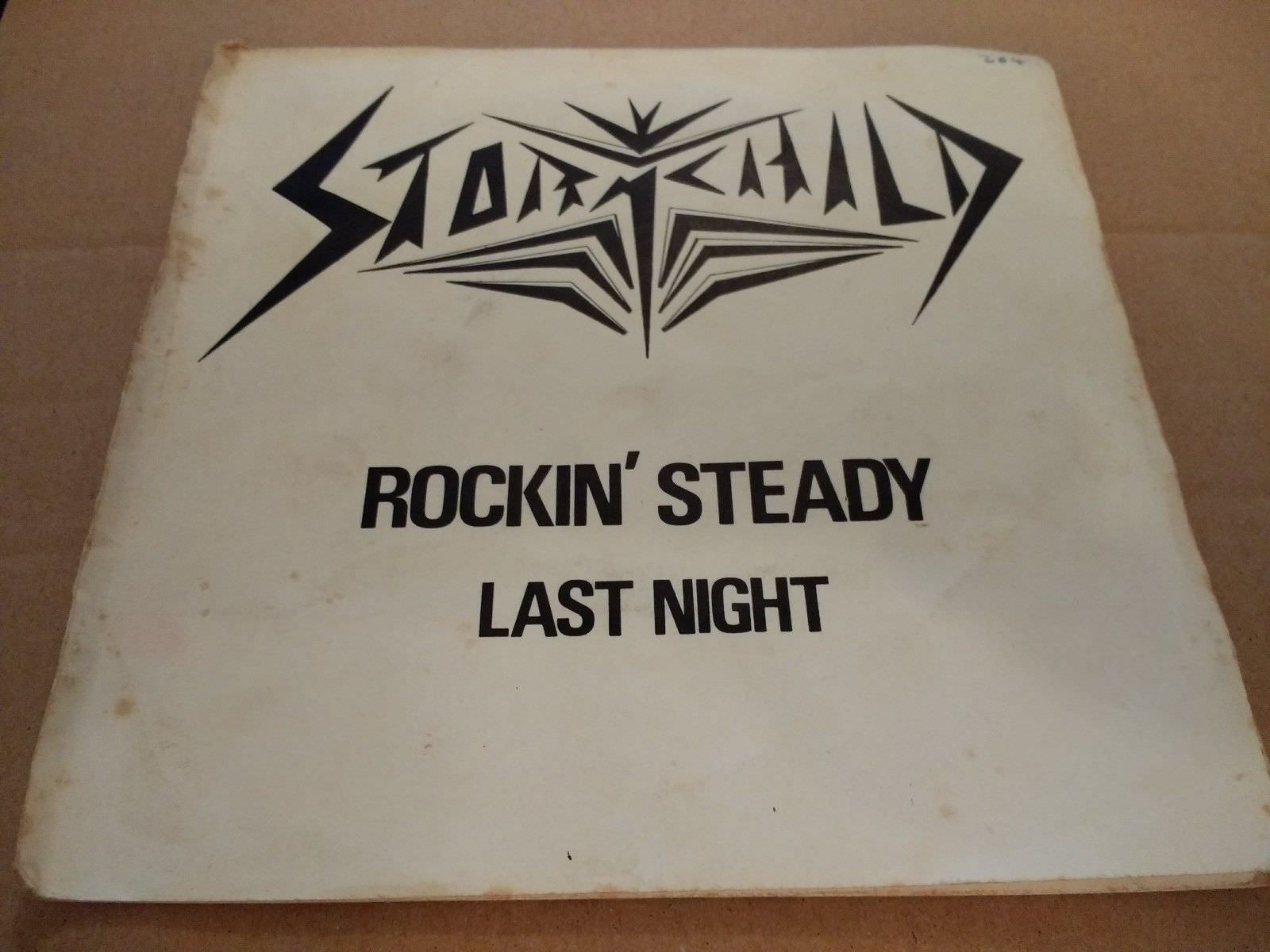
STORMCHILD " ROCKIN STEADY " 7" WHITE LABEL NWOBHM 1982 VERY RARE EX/VG DEMO
£
1,100
$
1,458


Favourite Auctions
To save auctions to your favourites, please login
If you don't have an account, please register
Description
YOU ARE BIDDING ON A FABULOUS SOUGHT AFTER VERY RARE 7" WHITE LABEL DEMO FROM 1982
FROM THE GENRE CLASSED AS NEW WAVE OF BRITISH HEAVY METAL ( NWOBHM )
THIS IS ONE OF ONLY 50 EVER PRESSED AND IS LISTED ELSEWEHERE AT OVER £4000
THIS IS THE ULTIMATE IN RARE SINGLES AND IS HARDLY EVER AVAILABLE SO GRAB THIS ONE!!!!
STORMCHILD
" ROCKIN' STEADY "
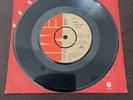
Tracklist A1 Rockin' Steady B1 Last Night Notes ’Rockin’ Steady’ was only ever published as a white label test-pressing in a limited quantity of 50 copies.
LABEL: SERPENT 001
YEAR: 1982
VINYL CONDITION: EXCELLENT PLAYED THROUGH BOTH SIDES PLAYS VERY WELL
SLEEVE CONDITION: VERY GOOD A SMALL WRITTEN NUMBER IN TOP RIGHT CORNER SOME YELLOWING TO LEFT SIDE
One of the pioneers of the New wave of British heavy metal. Their single Rockin steady is the most collectible and highest valued of the genre.
Well, nowadays the adjective “rare” or even “ultra-rare” is attached to a lot of N.W.O.B.H.M. singles with a circulation of anything between 500 and 1,000 copies (or even more). If you look at it, in most cases the number of singles pressed was more or less adequate to the (initial) demand. In the case of Stormchild (from Bolton in Lancashire), however, we are talking about a different scenario. Their one and only 7" single called “Rockin’ Steady“ (with “Last Night“ on the B-Side) must really be one of the Top 3 N.W.O.B.H.M. rarities of all time! And there’s a very simple reason for that! It was actually never released commercially at all! Stormchild founder Chris Mitchell explains: “’Rockin’ Steady’ was only ever published as a white label test-pressing. There were exactly 50 copies pressed by Kilo to attract a producer. The name Serpent was used as an anonymous label so nobody would know who was behind the band. The sleeve is also a new concept that was to be glued not stapled as in the white label pressings. Nobody had ever done a sleeve like this with a fold-over cover.” So surely, this must be the holy grail for all serious N.W.O.B.H.M. collectors! As already mentioned, ’Rockin’ Steady’ was not made available commercially to the public at all. Chris explains: “No, ‘Rockin’ Steady’ was not released. It was used as a band taster to attract a producer for the band. The record company was going to put out all the recordings on various rock compilations to recoup the money they had spent on us, but I had kept the tapes and Nigel Mason left Kilo who was the main driving force, so nothing happened.” Kilo was the label Stormchild was signed to, an offshoot of K-Tel. Chris explains Kilo/K-Tel’s motivation behind signing Stormchild: “K-Tel were a large record company in their day who were used to putting out compilation albums and selections of hit songs recorded by cover artists. Kilo was a way of breaking new rock talent without the association with K-Tel who were not considered mainstream when it came to recording artists, especially rock bands. Kilo was the vehicle for them breaking away from their traditional markets.” Obviously, Kilo’s aim was to break Stormchild by recording an album. Therefore, the band was briefly in contact with ace producer Chris Tsangarides. Chris Mitchell explains: “The record company told us that they were in conversation with Chris Tsangarides who we all admired for his production work, but we split up at the end of 1982 before we got a chance to work with him. I still can’t believe the reasons for our split. We were to be launched to the UK music press on a Thames river boat and flown to America to tour as support for Bob Seger, but we were kids who couldn’t see what potential we had, and the scale of what was planned for us.” The roots of Stormchild go way back to the year 1979: “The band initially started as a group of friends who decided to put a band together. The line up changed after a handful of gigs and we recruited Joe and Geoff to complete the line up. We wanted to look and sound different from the usual bands at the time and worked on our stage show with bombs and pyrotechnics. We wrote our own stuff from the start and were really ambitious. Stormchild built up their following and fan base by playing live. We played all over and were known for being good live musicians. Music was our life back then, and still is.“ As Stormchild was appearing live quite frequently, the music press surely took notice of the band: “Yes, we got good reviews in Kerrang!, and I remember reviews in Melody Maker and Sounds. Unfortunately, none of those reviews survived, I would love to get hold of them to go on the website. We also had some crap reviews from the early gigs we did with our other guitarist and bass player but we were all aged around 16 and 17 and learning our trade. The way we were playing after we got the record deal was amazing. When you get to play all the time because that is your job, it makes a huge difference to how proficient and tight the band becomes.” As mentioned earlier, Stormchild formed in 1979, the year Iron Maiden released their legendary “Soundhouse Tapes” single, so did the band ever feel as being part of the N.W.O.B.H.M. movement at all? Chris Mitchell denies: “Not really, at the time I never remembered that being the label. There was a new style of rock and metal emerging after punk, and we were out at the same time as Def Leppard, Maiden, Saxon, Magnum etc but never felt that we were N.W.O.B.H.M. We knew we had a unique sound and to us it was more like melodic metal. Looking back, we were at the start of it all, I suppose. We had so many influences ranging from UFO, Sweet, Rainbow, Ozzy, Van Halen. The list is endless, and there is a mix of all those influences in our playing.” After Stormchild split up in 1982, Chris Mitchell never stopped playing – music is his life: “I have played in bands all my life and done session work also. I have always had a good job which stopped me pursuing a full time career in music, but I have played gigs every week until the last two years I have been in Dubai. Music is my life and I listen to it all the time. commercial potential. We wanted to be known for a more progressive heavy sound but the record company wanted those tracks for the album. They knew best I suppose?” The seven standard condition categories, and a description of what each one means, are listed below:
MINT: The record itself is in brand new condition with no surface marks or deterioration in sound quality. The cover and any extra items such as the lyric sheet, booklet or poster are in perfect condition. Records advertised as Sealed or Unplayed should be Mint.
EXCELLENT: The record shows some signs of having been played, but there is very little lessening in sound quality. The cover and packaging might have slight wear and/or creasing.
VERY GOOD: The record has obviously been played many times, but displays no major deterioration in sound quality, despite noticeable surface marks and the occasional light scratch. Normal wear and tear on the cover or extra items, without any major defects, is acceptable.
GOOD: The record has been played so much that the sound quality has noticeably deteriorated, perhaps with some distortion and mild scratches. The cover and contents suffer from folding, scuffing of edges, spine splits, discoloration, etc.
FAIR: The record is still just playable but has not been cared for properly and displays considerable surface noise; it may even jump. The cover and contents will be torn, stained and/or defaced.
POOR: The record will not play properly due to scratches, bad surface noise, etc. The cover and contents will be badly damaged or partly missing.
BAD: The record is unplayable or might even be broken, and is only of use as a collection-filler.
THANKS FOR LOOKING!!!!!!!!!!!!!!!!!!!!!!!!!!!!
price rating









![TROJAN/THINGS OF THE PAST-PHYLLIS DILLON [R/STEADY] 7](https://www.popsike.com/php/thumbnail.php?url=https://www.popsike.pics/pix/20050421/4722009391.jpg)