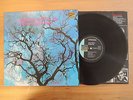
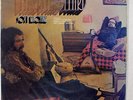
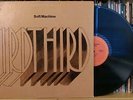
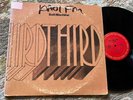
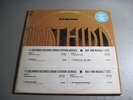
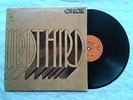
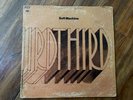
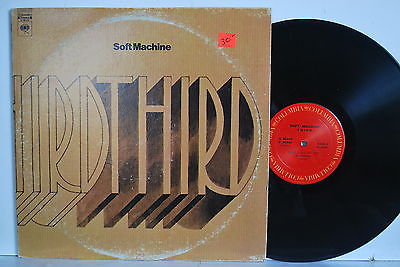
SOFT MACHINE "THIRD" LP COLUMBIA 1970 2XLPS GATEFOLD PROG PSYCH ROCK
$
28


Favourite Auctions
To save auctions to your favourites, please login
If you don't have an account, please register
Description
WE HAVE LOTS OF VINYL FOR SALE CHECK US OUT. GET A FEW THINGS PAY LESS FOR SHIPPING. IF YOU ARE LOOKING AT THIS WE ARE SURE YOU WILL FIND SOMETHING ELSE YOU LIKE. WE WILL PUT IT ALL TOGETHER FOR THE CHEAPEST OPTION FOR YOU!!!
all vinyl graded on the Goldmine scale (Mint/sealed , nm , vg++ , vg+ ,vn, vg , vg- , unless something is in demand , we will not sell something below the vg- grade)
Soft Machine were an English rock band from Canterbury, named after the book The Soft Machine by William S. Burroughs. They were one of the central bands in the Canterbury scene, and helped pioneer the progressive rock genre. Though they achieved little commercial success, they are considered by Allmusic to be "one of the more influential bands of their era, and certainly one of the most influential underground ones."
History[edit]
Beginnings, psychedelic, jazz fusion[edit]
Soft Machine (billed as The Soft Machine up to 1969 or 1970[1]) were formed in mid-1966 by Robert Wyatt (drums, vocals), Kevin Ayers (bass, guitar, vocals), Daevid Allen(guitar) and Mike Ratledge (organ) plus, for the first few gigs only, American guitarist Larry Nowlin.[2] Allen, Wyatt and future bassist Hugh Hopper had first played together in the Daevid Allen Trio in 1963, occasionally accompanied by Ratledge. Wyatt, Ayers and Hopper had been founding members of the Wilde Flowers, later incarnations of which would include future members of another Canterbury band, Caravan.
This first Soft Machine line-up became involved in the early UK underground, featuring prominently at the UFO Club, and subsequently other London clubs like the Speakeasy Club and Middle Earth. Their first single 'Love Makes Sweet Music' (recorded 5 February 1967, produced by Chas Chandler), backed with 'Feelin' Reelin' Squeelin' (January 1967, produced by Kim Fowley—rumored to have Jimi Hendrix playing rhythm guitar, who was recording "Hey Joe" in the same studio).[3] In April 1967 they recorded seven demo songs with producer Giorgio Gomelsky in De Lane Lea Studios that remained un-released until 1971 in a dispute over studio costs.[4] They also played in the Netherlands, Germany and on the French Riviera. During July and August 1967, Gomelsky booked shows all along the Côte d'Azur with the band's most famous early gig taking place in the village square of Saint-Tropez. This led to an invitation to perform at producer Eddie Barclay's trendy "Nuit Psychédélique[fr]", performing a forty-minute rendering of "We Did It Again", singing the refrain over and over, achieving a Zen-like quality. This made them instant darlings of the Parisian "in" crowd, resulting in invitations to appear on leading television shows and at the Paris Biennale in October 1967. Upon their return from their sojourn in France, Allen (an Australian) was denied re-entry to the United Kingdom, so the group continued as a trio, while he returned to Paris to form Gong.
Sharing the same management team as Jimi Hendrix, the band were rewarded with a support slot on the Jimi Hendrix Experience's North America tour throughout 1968.[2] Soft Machine's first album – a psychedelic rock/proto-prog classic – was recorded in New York in April at the end of the first leg. Back in London, eventually guitarist Andy Summers, later of The Police, joined the group, fresh from his stint with Dantalian's Chariot (previously Zoot Money's Big Roll Band). After a few weeks of rehearsals, the new quartet began a tour of the USA with some solo shows before reuniting with Hendrix for a final string of dates in August–September 1968. Summers, however, had in the meantime been fired at the insistence of Ayers,[5] who departed amicably as well after the final tour date at the Hollywood Bowl, and for the remainder of 1968 Soft Machine were no more. Wyatt stayed in the US to record solo demos, while Ratledge returned to London and began composing in earnest. One of Wyatt's demos, Slow Walkin' Talk, allowed Wyatt to make use of his multi-instrumentalist skills (Hammond organ, piano, drums and vocals) and featured Jimi Hendrix on bass guitar.[6]
In January 1969, in order to fulfil contractual obligations, Soft Machine reformed with former road manager and composer Hugh Hopper on bass added to Wyatt and Ratledge, and set about recording their second album, Volume Two, which launched a transition towards a purely instrumental sound resembling what would be later called jazz fusion. In May 1969, this lineup acted as the uncredited backup band on two tracks of Syd Barrett's solo debut album, The Madcap Laughs. The base trio was late in 1969 expanded to a septet with the addition of four horn players, though only saxophonist Elton Dean remained beyond a few months, the resulting Soft Machine quartet (Wyatt, Hopper, Ratledge and Dean) running through Third (1970) and Fourth (1971), with various guests, mostly jazz players (Lyn Dobson, Nick Evans, Mark Charig, Jimmy Hastings, Roy Babbington,Rab Spall). Fourth was the first of their fully instrumental albums, and the last one featuring Wyatt.
Their propensity for building extended suites from regular sized compositions, both live and in the studio (already in the Ayers suite in their first album), reaches its maximum in the 1970 album Third, unusual for its time in each of the four sides featuring one suite. Third was also unusual for remaining in print for more than ten years in the United States, and is the best-selling Soft Machine recording.[7]
This period saw them gaining unprecedented acclaim across Europe, and they made history by becoming the first 'rock band' invited to play at London's Proms in August 1970, a show which was broadcast live and later appeared as a live album.
Post-Wyatt era[edit]
After differences over the group's musical direction, Wyatt left (or was fired from[8]) the band in August 1971 and formed Matching Mole (a pun on machine molle, French for soft machine; also said at the time to have been taken from some stage lighting equipment "Matching Mole"). He was briefly replaced by Australian drummer Phil Howard. This line-up toured extensively in Europe during the end of 1971 (attested by the "Drop" 2008 release) and attended the recording of their next album, but further musical disagreements led to Howard's dismissal after the recording of the first LP side of Fifth before the end of 1971 and, some months later, to Dean's departure. They were replaced respectively byJohn Marshall (drums) and, for the recording of Six (1973), Karl Jenkins (reeds, keyboards), both former members of Ian Carr's Nucleus, and The Softs' sound developed even more towards jazz fusion.
Jenkins era[edit]
In 1973, after the release of Six, Hopper left and was replaced by Roy Babbington, another former Nucleus member, who had already contributed with double bass on Fourth andFifth and took up (6-string) electric bass successfully, while Karl Jenkins progressively took over the role of band-leader and main composer. After they released Seven (1973) without additional musicians, the band switched record labels from Columbia to Harvest. On their 1975 album Bundles, a significant musical change occurred with fusion guitaristAllan Holdsworth adding guitar as a very prominent melody instrument to the band's sound, sometimes reminiscent of John McLaughlin's Mahavishnu Orchestra, setting the album apart from previous Soft Machine releases, which had rarely featured guitars. On the last official studio album Softs (1976), he was replaced by John Etheridge. Ratledge, the last remaining original member of the band, had left during the early stages of recording. Other musicians in the band during the later period were bassists Percy Jones (ofBrand X) and Steve Cook,[9] saxophonists Alan Wakeman and Ray Warleigh, and violinist Ric Sanders. Their 1977 performances and record (titled Alive and Well, ironically) were among the last for Soft Machine as a working band. The Soft Machine name was used for the 1981 record Land of Cockayne (with Jack Bruce and, again, Allan Holdsworth, plusRay Warleigh and Dick Morrissey on saxes and John Taylor on electric piano), and for a final series of dates at London's Ronnie Scott's Jazz Club in the summer of 1984, featuring Jenkins and Marshall leading an ad hoc lineup of Etheridge, Warleigh, pianist Dave MacRae and bassist Paul Carmichael.
Soft Machine Legacy[edit]
Since 1988, many live recordings of Soft Machine have been issued on CD. In 2002, four former Soft Machine members – Hugh Hopper, Elton Dean, John Marshall and Allan Holdsworth – toured and recorded under the name Soft Works[10] (initially called 'Soft Ware', debuting at the 2002 Progman Cometh Festival).
From late 2004 onwards, with John Etheridge replacing Holdsworth, they toured and recorded as Soft Machine Legacy.[11] They released three albums: Live in Zaandam[12](2005), the studio album Soft Machine Legacy[13] (2006) and Live at the New Morning[14] (2006). After Elton Dean died in February 2006, the band continued with British saxophonist and flautist Theo Travis, formerly of Gong and The Tangent.
In December 2006, the new Legacy line-up recorded the album Steam[15][16][17] in Jon Hiseman's studio, which was released by Moonjune Records in August 2007, before a European tour in autumn. In 2008, Hopper was sidelined by leukemia and the band continued live performances with Fred Baker.
Following Hopper's death in 2009, the band announced that they would continue with Babbington once again stepping into the role formerly held by Hopper.[18]
In February 2013, founding Soft Machine bassist Kevin Ayers died, aged 68.[19][20] On 13 March 2015, following a short battle with cancer, Ayers' fellow Soft Machine co-founder Daevid Allen died, aged 77.[21][22]
In 2013, the Legacy band released a new studio album, titled Burden of Proof.[23] In an early 2013 interview, Travis stated that, "legally we could actually be called Soft Machine but for various reasons it was decided to be one step removed."[24]
In March 2015 Gary Husband stepped in for drummer John Stanley Marshall performing with the Legacy for a short tour of Japan, along with guest artist Keith Tippett.
Personnel[edit]
Members[edit]
- Mike Ratledge – keyboards, flute (1966–1968, 1969–1976)
- Robert Wyatt – drums, vocals, keyboards, bass (1966–1968, 1969–1971)
- Kevin Ayers – bass, vocals, guitar, keyboards (1966–1968; died 2013)
- Daevid Allen – guitar, vocals, bass (1966–1967; died 2015)
- Larry Nowlin – guitar (1966)
- Andy Summers – guitar (1968)
- Hugh Hopper – bass, saxophone, guitar (1968–1973; died 2009)
- Elton Dean – saxophone, keyboards (1969–1972; died 2006)
- Lyn Dobson – flute, saxophone (1969–1970)
- Mark Charig – cornet (1969)
- Nick Evans – trombone (1969)
- Phil Howard – drums (1971)
- John Marshall – drums, percussion (1971–1984)
- Karl Jenkins – oboe, saxophone, keyboards, synthesisers (1972–1984)
- Roy Babbington – bass (1973–1976)
- Allan Holdsworth – guitar (1973–1975)
- John Etheridge – guitar (1975–1978)
- Alan Wakeman – saxophone (1976)
- Ray Warleigh – saxophone (1976)
- Ric Sanders – violin (1976–1978)
- Percy Jones – bass (1976–1977)
- Steve Cook – bass (1977–1978)
The winning bidder of this auction will have the item described in the title above shipped to them as depicted in the provided photo(s). You will receive no less than what is seen in the provided image(s), as all images are of the actual item(s) being bid upon. As such, items will not be represented by a stock image unless otherwise informed in the title or description!!! Questions??? Ask all you like! Answers are free and typically result in a well informed purchase. This in turn makes for an all around great experience for both consumer and seller alike... . . All items will be safely packaged in such a way I would expect them to arrive if I were the buyer. Shipment is typically made through the USPS & occasionally other services if the need should arise. In most cases shipment will take place within the same or next business day, but please allow up to 3 business days. Business days should be recognized as Mon. - Fri. excluding Holidays. Payment: Please send or initiate payment within 3 consecutive days via a verified paypal account as this will enable prompt shipment of your item(s), and allow me to earn your positive feedback & 5 star rating! As always, thank you for visiting and have a great day!
price rating