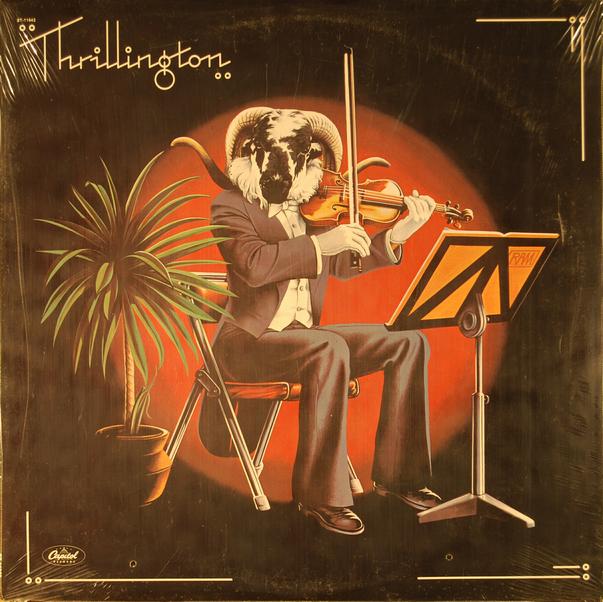
SEALED LP: PAUL McCARTNEY; THRILLINGTON
$
125


$ 125
Sold For
Nov 5, 2009
Sold Date
Oct 29, 2009
Start Date
15
Number Of Bids
USA
Country Of Seller
eBay
Auctioned at
Favourite Auctions
To save auctions to your favourites, please login
If you don't have an account, please register
Description
PAUL McCARTNEY: THRILLINGTON
Factory Sealed Album
Format: Album Release Number: Capitol: ST-11652 Condition - Cover: Still SealedCondition - Record: Still Sealed - Assumed mint
Shipping weight: 1 pounds, 0 ounces Year: 1977 Country: USA The photos of the covers might show what appears to be some scratches on the cover. Unless noted, they are marks on the shrink wrap and do not affect the cover of the record. Due to the lighting and angle of the lights that I used, the marks are more noticable in the pictures than they actually are. I wanted to get the best image of the covers with the least amount of glare.
Album Cover - Front
Album Cover - Rear
Black magic marker on the bar code, where the corner of the shrink wrap was cut off at an angle
Sticker on the shrink wrap Songs:
- Too Many People
- 3 Legs
- Ram On
- Dear Boy
- Uncle Albert/Admiral Halsey
- Smile Away
- Heart of the Country
- Monkberry Moon Delight
- Eat at Home
- Long Haired Lady
- Back Seat of My Car
- Clem Cattini: Drums
- Tony Clark: Engineer
- Jeff Cummins: Artwork, Cover Art
- Vic Flick: Guitar (Acoustic), Guitar (Electric), Spanish Guitar
- Herbie Flowers: Bass
- Steve Grey: Piano
- Clint Harrigan: Liner Notes, Sleeve Notes
- Richard Hewson: Arranger, Conductor, Orchestral Arrangements
- Hipgnosis [Design Group]: Artwork, Cover Art
- Chris Karan: Guica
- Jim Lawless: Percussion
- Paul McCartney
- Phil Smee: Design, Package Design
- The Swingle Singers: Vocals
- Percy Thrillington: Arranger, Leader, Producer
- The Thrillington album is one of the few genuinely rare, legitimate commercial LP releases in Paul McCartney's output, mostly a result of its never having been officially credited to McCartney or publicized as one of his releases. An orchestral/instrumental version of Paul & Linda McCartney's Ram album, Thrillington is a very potent work in its own right. Arranged and conducted by Richard Hewson, it avoids the temptation to deliver flaccid elevator music, in favor of very precise playing and finely detailed arrangements. The orchestrations incorporate elements of big-band swing and very elegantly realized pop music, with occasional backing by scatted and vamped choruses, courtesy of the Swingle Singers, who call up memories of the Hi-Los at various points here. "Three Legs" swings like a latter-day Count Basie cut, while "Dear Boy" comes off as light, Swingle Singers-style jazz; "Heart of the Country" is a scat vocal feast by the Swingles; "Eat at Home" is done as a big-band reggae instrumental that would have delighted big-band ska king Byron Lee; and "Monkberry Moon Delight" is a treat for fans of luscious trumpet and trombone work. "Uncle Albert/Admiral Halsey," not surprisingly, is the most complicated cut on the album, two distinct halves, a pop/rock combo augmented by recorder flutes augmented by trumpets and strings handling the principal melody in the first half, and then a second half highlighted by a harpsichord. What makes these and the other cuts a special pleasure for fans of the original album is that they all retain their beat, even as Hewson's arrangements carry them in some surprising directions. The tragedy is that almost no one has heard this most interesting of McCartney's albums -- cut during June of 1971, it was forgotten amid the burgeoning activity surrounding Wings; the album sat on the shelf for six years until Paul and Linda McCartney started playing with the name Percy Thrillington, spreading phony stories to the gossip pages and taking out ads announcing his social and musical activities in London; and then it came out as Thrillington, appearing in England (and later America) with no explanation or publicity, sandwiched in between the releases of Wings Over America and London Town. Virtually ignored at the time of its release, the LP version of Thrillington can easily command prices of well over 100 dollars, and the CD -- released in 1995 and deleted within a couple of years -- sells for between 25 and 80 dollars.
- Out of all the former Beatles, Paul McCartney by far had the most successful solo career, maintaining a constant presence in the British and American charts during the '70s and '80s. In America alone, he had nine number one singles and seven number one albums during the first 12 years of his solo career. Although he sold records, McCartney never attained much critical respect, especially when compared to his former partner John Lennon. Then again, he pursued a different path than Lennon, deciding early on that he wanted to be in a rock band. Little more than a year after the Beatles' breakup, McCartney had formed Wings with his wife, Linda, and the group remained active for the next ten years, racking up a string of hit albums, singles, and tours in the meantime. By the late '70s, many critics were taking potshots at McCartney's effortlessly melodic songcraft, but that didn't stop the public from buying his records. His sales didn't slow considerably until the late '80s, and he retaliated with his first full-scale tour since the '70s, which was a considerable success. During the '90s, McCartney recorded less frequently, concentrating on projects like his first classical recording, a techno album, and the Beatles' Anthology.
- Like Lennon and George Harrison, Paul McCartney began exploring creative avenues outside the Beatles during the late '60s, but where his bandmates released their own experimental records, McCartney confined himself to writing and production for other artists, with the exception of his 1966 soundtrack to The Family Way. Following his marriage to Linda Eastman on March 12, 1969, McCartney began working at his home studio on his first solo album. He released the record, McCartney, in April 1970, two weeks before the Beatles' Let It Be was scheduled to hit the stores. Prior to the album's release, he announced that the Beatles were breaking up, which was against the wishes of the other members. As a result, the tensions between him and the other three members, particularly Harrison and Lennon, increased and he earned the ill will of many critics. Nevertheless, McCartney became a hit, spending three weeks at the top of the American charts. Early in 1971, he returned with "Another Day," which became his first hit single as a solo artist. It was followed several months later by Ram, another homemade collection, this time featuring the contributions of his wife, Linda.
- By the end of 1971, the McCartneys had formed Wings, which was intended to be a full-fledged recording and touring band. Former Moody Blues guitarist Denny Laine and drummer Denny Seiwell became the group's other members, and Wings released their first album, Wild Life, in December 1971. Wild Life was greeted with poor reviews and was a relative flop. McCartney and Wings, which now featured former Grease Band guitarist Henry McCullough, spent 1972 as a working band, releasing three singles -- the protest "Give Ireland Back to the Irish," the reggae-fied "Mary Had a Little Lamb," and the rocking "Hi Hi Hi." Red Rose Speedway followed in the spring of 1973, and while it received weak reviews, it became his second American number one album. Later in 1973, Wings embarked on their first British tour, at the conclusion of which McCullough and Seiwell left the band. Prior to their departure, McCartney's theme to the James Bond movie Live and Let Die became a Top Ten hit in the U.S. and U.K. That summer, the remaining Wings proceeded to record a new album in Nigeria. Released late in 1973, Band on the Run was simultaneously McCartney's best-reviewed album and his most successful, spending four weeks at the top of the U.S. charts and eventually going triple platinum.
- Following the success of Band on the Run, McCartney formed a new version of Wings with guitarist Jimmy McCulloch and drummer Geoff Britton. The new lineup was showcased on the 1974 British single "Junior's Farm" and the 1975 hit album Venus and Mars. At the Speed of Sound followed in 1976, and it was the first Wings record to feature songwriting contributions by the other bandmembers. Nevertheless, the album became a monster success on the basis of two McCartney songs, "Silly Love Songs" and "Let 'Em In." Wings supported the album with their first international tour, which broke many attendance records and was captured on the live triple album Wings Over America (1976). After the tour was completed, Wings rested a bit during 1977, as McCartney released an instrumental version of Ram under the name Thrillington and produced Denny Laine's solo album Holly Days. Later that year, Wings released "Mull of Kintyre," which became the biggest-selling British single of all time, selling over two million copies. Wings followed "Mull of Kintyre" with London Town in 1978, which became another platinum record. After its release, McCulloch left the band to join the re-formed Small Faces and Wings released Back to the Egg in 1979. Though the record went platinum, it failed to produce any big hits. Early in 1980, McCartney was arrested for marijuana possession at the beginning of a Japanese tour; he was imprisoned for ten days and then released, without any charges being pressed.
- Wings effectively broke up in the wake of McCartney's Japanese bust, although its official dissolution was not announced until April 27, 1981, when Denny Laine left the band. Back in England, McCartney recorded McCartney II, which was a one-man band effort like his solo debut. Ironically, the hit single associated with the album was a live take of the song "Coming Up" that had been recorded in Glasgow with Wings in December 1979 and was intended to be the B-side of the 45, with the solo studio recording as the A-side. DJs preferred the live version, however, and it went on to hit number one. Later in 1980, McCartney entered the studio with Beatles producer George Martin to make Tug of War.
- Released in the spring of 1982, Tug of War received the best reviews of any McCartney record since Band on the Run and spawned the number one single "Ebony and Ivory," a duet with Stevie Wonder that became McCartney's biggest American hit. In 1983, McCartney sang on "The Girl Is Mine," the first single from Michael Jackson's blockbuster album Thriller. In return, Jackson dueted with McCartney on "Say Say Say," the first single from Paul's 1983 album Pipes of Peace and the last number one single of his career. The relationship between Jackson and McCartney soured considerably when Jackson bought the publishing rights to the Beatles songs from underneath McCartney in 1985.
- McCartney directed his first feature film in 1984 with Give My Regards to Broad Street. While the soundtrack, which featured new songs and re-recorded Beatles tunes, was a hit, generating the hit single "No More Lonely Nights," the film was a flop, earning terrible reviews. The following year he had his last American Top Ten with the theme to the Chevy Chase/Dan Aykroyd comedy Spies Like Us. Press to Play (1986) received some strong reviews but the album was a flop. In 1988, he recorded a collection of rock & roll oldies called Choba B CCCP for release in the U.S.S.R.; it was given official release in the U.S. and U.K. in 1991. For 1989's Flowers in the Dirt, McCartney co-wrote several songs with Elvis Costello; the pair also wrote songs for Costello's Spike, including the hit "Veronica." Flowers in the Dirt received the strongest reviews of any McCartney release since Tug of War and was supported by an extensive international tour, which was captured on the live double album Tripping the Live Fantastic (1990). For the tour, McCartney hired guitarist Robbie McIntosh and bassist Hamish Stuart, who would form the core of his band through the remainder of the '90s.
- Early in 1991, McCartney released another live album in the form of Unplugged, which was taken from his appearance on MTV's acoustic concert program of the same name; it was the first Unplugged album to be released. Later that year, he unveiled Liverpool Oratorio, his first classical work. Another pop album, Off the Ground, followed in 1993, but the album failed to generate any big hits, despite McCartney's successful supporting tour. Following the completion of the New World tour, he released another live album, Paul Is Live, in December 1993. In 1994, he released an ambient techno album under the pseudonym the Fireman. McCartney premiered his second classical piece, "The Leaf," early in 1995 and then began hosting a Westwood One radio series called Oobu Joobu. But his primary activity in 1995, as well as 1996, was the Beatles' Anthology, which encompassed a lengthy video documentary of the band and the multi-volume release of Beatles outtakes and rarities. After Anthology was completed, he released Flaming Pie in summer 1997. A low-key, largely acoustic affair that had the some of the same charm of his debut, Flaming Pie was given the strongest reviews McCartney had received in years and was a modest commercial success, debuting at number two on the U.S. and U.K. charts; it was his highest American chart placing since he left the Beatles. Flaming Pie certainly benefited from the success of Anthology, as did McCartney himself -- only a few months before the release of the album in 1997, he received a Knightship.
- On April 17, 1998, Linda McCartney died after a three-year struggle with breast cancer. A grieving Paul kept a low profile in the months to follow, but finally returned in fall 1999 with Run Devil Run, a collection primarily including cover songs. The electronica-based Liverpool Sound Collage followed a year later, and the pop album Driving Rain -- a successor, of sorts, to Flaming Pie -- came a year after that. The live album Back in the U.S. appeared in America in 2002 with the slightly different international edition, Back in the World, following soon after. McCartney's next studio project included sessions with super-producer Nigel Godrich, the results of which appeared on the mellow Chaos and Creation in the Back Yard, released in late 2005. McCartney performed every instrument (not including the strings) on 2007's David Kahne-produced Memory Almost Full, a bold but whimsical collection of new songs, some of which were recorded before the Chaos and Creation in the Back Yard sessions.
Stuff to mull over:
- All pictures are of the exact item being sold. Some of the pictures might show a reflection of my camera and tripod. Feel free to email me if you need any better pictures.
- All album reviews and artist biographies are from All Music Guide. If you haven't been to their web site, you have to check it out. It's one of the most comprehensive music references on the internet.
- Album credits are also from All Music Guide. In some cases, credits also include reissue (CD) information. Obviously any credits referenced to CDs do not apply to these album releases.
- This record is from a store called "Phantasmagoria" that was located in Allentown, Pennsylvania. Phantasmagoria went out of business in 1978. I purchased their leftover inventory some years later when I owned a new & used record store in Catasauqua called "Music Madness". Music Madness is still listed in the phone book if you want to try to contact me.
- Phantasmagoria used round colored stickers to indicate the price of the albums. They had a sign on the wall with the color sticker combinations for the customers to use so they knew the price of the albums. Most of the albums still have these stickers on them, and in some rare cases, the stickers are written on.
- All sealed albums are being sold as collector's items and cannot be returned due to manufacturer's defects. It may be virtually impossible to replace many of the sealed albums that I am selling.
- Pick-up is fine with me. Just be prepared to pay by cash. No shipping fees apply.
- Your item(s) will be shipped the next business day after I receive your payment.
- Feedback will be left before your item ships.
- Please avoid questions on the last day of the auction. I might not have enough time to give you an answer before the auction ends.
- Payment by PayPal (except for items when local pick-up has been arranged).
- Domestic packages sent by Priority Mail or Media Mail. Delivery confirmation is included. Insurance is recommended but optional.
- Foreign buyers must pay with US dollars through PayPal only. Please do not send cash - it's too risky.
- SHIPPING: I will send an invoice with options for the cost of shipping after the auction ends. I will give you the option of the following three choices:
-
- USPS Priority Mail International: Estimated delivery time to most countries is about 6-10 days.
- USPS Express Mail International: Estimated delivery time to most countries is 6-10 days.
- First-Class Mail International: Estimated delivery time to most countries is 3-6 weeks. Keep in mind that insurance is not available.
- All uninsured and underinsured shipments are the responsibility of the customer.
- The buyer is responsible for all customs regulations and payments in their own country.
Counter by AuctionTamer
price rating