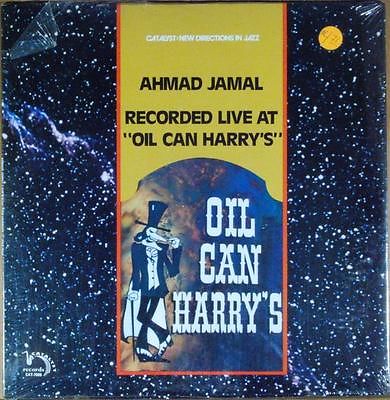
SEALED LP: AHMAD JAMAL: LIVE AT OIL CAN HARRY'S
$
25


$ 25
Sold For
Aug 31, 2015
Sold Date
Aug 24, 2015
Start Date
1
Number Of Bids
USA
Country Of Seller
eBay
Sold at
Favourite Auctions
To save auctions to your favourites, please login
If you don't have an account, please register
Description
Ahmad Jamal: Live at Oil Can Harry's
FACTORY SEALED LP
Format: Sealed LPCountry: U.S.A.
Record Company & Release Number: Catalyst: CAT-766
Original release date/year: 1976
Bar Code: NONE
Condition of the cover: Near Mint
Condition of the record: Sealed - Assumed Mint
Shipping Weight: 1 pounds, 3 ounces
My inventory number: 207061B
Notes: The shrink wrap is torn away at the upper left corner of the cover, with minor wear to the cover.
Please contact me if you have any difficulty viewing the photos. Songs
- Effendi
- Poinciana
- Folklore
- Bellows
- Ahmad Jamal: Piano, Main Performer
- It is a pity that this LP is long out of print (and that the Catalyst label went out of business quite awhile ago), for it gives listeners an excellent example of the playing of pianist Ahmad Jamal in the mid-197s. His group (comprised of guitarist Calvin Keys, bassist John Heard, drummer Frank Gant and Seldon Newton on conga) was temporarily larger than usual, and Jamal stretches out on three originals (including "Effendi") and a lengthy remake of his biggest hit, "Poinciana." ~ Scott Yanow, All Music Guide
Ahmad Jamal biography by Steve Huey, All Music Guide
- A sorely underexposed figure and a major influence on Miles Davis, pianist Ahmad Jamal isn't generally ranked among the all-time giants of jazz, but he impressed fellow musicians and record buyers alike with his innovative, minimalist approach. Jamal's manipulations of space and silence, tension and release, and dynamics all broke new ground, and had an impact far beyond Jamal's favored piano trio format. As an arranger, Jamal made the most of his small-group settings by thinking of them in orchestral terms: using his trademark devices to create contrast and dramatic effect, and allowing the rhythm section a great deal of independence in its interplay. Nonetheless, his ensembles were always tightly focused as well, following their leader through sudden changes in tempo or time signature, and often carrying the main riff of a tune.
- Jamal's own playing was a model of economy; because he didn't overwhelm listeners with his technique, his flashes of virtuosity had significantly more impact. His lines were spare and light, yet melodically and harmonically inventive, and driven by complex left-hand chord voicings that broke with Bud Powell's right-hand emphasis. A chamber-like sensibility and a classical formality permeated much of his playing, yet he swung like a jazzman without fail. Miles Davis greatly admired him, borrowing liberally from his repertoire and arrangements, and encouraging his pianist Red Garland to imitate Jamal's playing as closely as possible; additionally, Jamal's concepts of space and subtlety greatly affected Davis in his own right, both as a soloist and as a bandleader who (as it's often put) let the music breathe.
- Ahmad Jamal was born in Pittsburgh, PA, on July 2, 1930. He first started playing the piano at age three, began his formal training at age seven, and was performing professionally by 11. By his teenage years, he had completed studies equivalent to a master's degree, and he had also taken up jazz, inspired by the likes of Erroll Garner, Art Tatum, Teddy Wilson, Count Basie, and Nat King Cole. After graduating from high school, he toured in a supporting role, and caught on with George Hudson's orchestra in 1949. Later that year, he joined swing violinist Joe Kennedy's group the Four Strings, where he served as pianist and arranger.
- In 1950, Jamal formed his own group, the Three Strings, which also included bassist Eddie Calhoun and the highly percussive guitarist Ray Crawford. They were discovered by Columbia executive and talent scout John Hammond in 1951, and signed to the label's OKeh subsidiary. Calhoun was later replaced briefly by Richard Davis, and then by Israel Crosby in 1955. Over that period, the group -- eventually renamed the Ahmad Jamal Trio -- recorded two albums, which included the classic original "Ahmad's Blues" and a version of "Pavanne" that likely provided the basis for Miles Davis' legendary "So What," not to mention the note-for-note melody of John Coltrane's "Impressions" (years before either had composed those respective pieces).
- Later in 1955, Jamal switched over to the Chess label's Argo subsidiary, where his trio cut the groundbreaking Chamber Music of New Jazz. It was here that he first drew Davis' enthusiastic approval, and over the next few years, arranger Gil Evans would base some of his seminal work for Davis on Jamal's interpretations. In 1956, Jamal elected to replace guitarist Crawford with a drummer, Walter Perkins; he in turn was replaced by Vernell Fournier in 1958, which cemented the classic Jamal Trio lineup. The group took up residency in the lounge of the Pershing Hotel in Chicago, where its gigs were greeted with excitement and frequented by many local jazz musicians. These shows resulted in the classic live album Ahmad Jamal at the Pershing: But Not for Me, which became a left-field smash in 1958, climbing all the way to number three on the pop charts; its hit version of "Poinciana" remains Jamal's signature tune. Some jazz critics never forgave Jamal for this crossover success, though his championing by other musicians has largely muted their derision over time.
- In the wake of But Not for Me's success, Jamal opened his own club, the Alhambra, and recorded prolifically for Argo during the '60s. Some of his albums continued to enjoy crossover success, including 1958's Ahmad Jamal Trio, Vol. 4 and 1960's Ahmad Jamal at the Penthouse, the latter of which teamed the trio with a 15-piece string section masterminded by Joe Kennedy. Two live albums, Alhambra and All of You, documented the group's 1961 performances at Jamal's club, though unfortunately it would not exist for much longer. Neither would Jamal's trio, which disbanded in 1962; Crosby joined George Shearing's group, but was felled by a heart attack not long after. With arranger Richard Evans, Jamal recorded another jazz-with-strings session, Macanudo, that year, and subsequently formed a new trio with bassist Jamil Nasser (aka Jamil Sulieman) and drummer Chuck Lampkin. Lampkin departed in 1965 and was briefly replaced by Fournier (on the LP Extensions) before Frank Gant was brought in on a permanent basis the following year.
- Jamal experienced a minor resurgence in popularity during the late '60s thanks to albums like 1967's Standard Eyes and 1968's Cry Young, the latter of which returned him to the pop charts for the first time in eight years. Later that year, he moved from Cadet (the renamed Argo) to Impulse!, and recorded five albums over the next four years, including the live Montreux Jazz Festival set Freeflight (1971) and Outertimeinnerspace (1972), both of which found him experimenting with the Fender Rhodes electric piano in addition to his standard sound. Additionally, in 1970, he performed an oft-heard version of the theme from the film M.A.S.H. that was included on the soundtrack.
- Jamal moved to 20th Century in 1973 for a series of decent-selling albums that kicked off with Ahmad Jamal '73, another session with arranger Richard Evans. Others included 1974's Jamalca, 1975's Jamal Plays Jamal, 1976's Steppin' Out with a Dream, 1979's One, and 1980's Intervals and Genetic Walk; of those, the former two and Intervals all made the R&B charts, while Genetic Walk was Jamal's fifth and final album to reach the pop charts. Nasser left the trio in the mid-'70s and was replaced by John Hurd, and the lineup was also expanded to include guitarist Calvin Keys for the 1976 concert set Live at Oil Can Harry's (a one-off for the short-lived Catalyst label).
- Night Song, recorded for Motown and released in 1980, found Jamal working with an atypically large group; elsewhere, he assembled a new trio of bassist Sabu Adeyola and drummer Payton Crossley. In the early '80s, Jamal toured and recorded in tandem with vibraphonist Gary Burton, and returned to a major label when he signed with Atlantic in 1985. Digital Works, Rossiter Road, Crystal, and Pittsburgh all made the jazz album charts over the next five years. He recorded for Telarc in the early '90s, including the well-received Chicago Revisited: Live at Joe Segal's Jazz Showcase (1992) and I Remember Duke, Hoagy & Strayhorn (1994). Also in 1994, Jamal was awarded the American Jazz Master Fellowship by the National Endowment for the Arts.
- Jamal subsequently signed with the French Birdology label, signaling the start of a full creative renaissance; his recordings were initially distributed in the U.S. by Verve and Atlantic, and later by the smaller Dreyfus Jazz label. His first effort, The Essence of Ahmad Jamal, Pt. 1, was rapturously received in France, and marked the first time he'd recorded in a small-group format with a saxophonist (tenor man George Coleman). He followed it with Big Byrd: The Essence, Pt. 2 (1997) and Nature: The Essence, Pt. 3 (1998), as well as the acclaimed 70th-birthday concert L'Olympia 2000. The 2003 set In Search of Momentum was also critically well-received. The live trio session After Fair, which combined standards and Jamal originals, was released on Birdology/Dreyfus Jazz in 2005, one year after it was recorded in France.
- This record came from a record store called "Phantasmagoria" which was located in Allentown, Pennsylvania. Phantasmagoria went out of business in 1978. I purchased most of their unsold inventory some years later when I owned "Music Madness" - a new & used record store in Catasauqua, Pennsylvania.
- Phantasmagoria used round colored stickers to indicate the price of the albums. They had a sign on the wall with the color sticker combinations for the customers to use so they knew the price of the albums. Most of the albums still have these stickers on them, and in some rare cases, the stickers are written on. Some of the records have prices on them. This is the price you would have paid for the record in 1978 if you would have bought it at Phantasmagoria. Please don't confuse these prices with their current value.
- All sealed albums are being sold as collector's items and cannot be returned due to manufacturer's defects. It may be almost impossible to replace many of the sealed albums that I am selling.
- All pictures are of the exact item being sold.
- I always leave feedback before your item ships. Please consider leaving feedback for me after you have had a chance to inspect and enjoy your purchase.
- Please avoid questions on the last day of the auction. I might not have enough time to give you an answer before the auction ends.
- All album reviews, credits and artist biographies are from All Music Guide. If you haven't been to their web site, you have to check it out. It's one of the most comprehensive music references on the internet. In some cases, credits may include reissue (CD) information. Obviously any credits referenced to CDs do not apply to this album release.
- I DO NOT END ANY OF MY AUCTIONS EARLY. PLEASE DON'T ASK (unless you are willing to offer enough to pay off my mortgage.
Shipping and pick-up
Your item(s) will be shipped within 2 business days after I receive your cleared payment. If possible, if payments are made by 2 PM Eastern time, I will try to send your package the same day if the Post Office is open.
I photograph all packages before taking them to the Post Office to confirm the condition they were shipped. Damage to your package after being handed over to the Post Office will not be my responsibility.
If you have any special shipping requirements (extra padding, oversized boxes, etc., you must let me know BEFORE making your payment. The pre-calculated cost of your shipping is based my standard packaging (new boxes, padded envelopes, etc.).
WITHIN U.S.A.
- Price includes free Media Mail to any address in the USA.
- Priority Mail is optional, and includes free insurance, The Post Office tends to deliver your package considerably faster.
- If you purchase 4 or more items to be shipped together, I will upgrade to Priority Mail for free.
- Pick-up is fine with me, but be prepared to pay by cash. E-mail me to setup a time and place that is convenient for the both of us. I will offer reasonable discount for the shipping fees that I will be saving.
OUTSIDE U.S.A.
- International Shipping is calculated by the weight of your package.
- If you purchase multiple items, please wait until after all the auctions end for eBay to send an invoice.
- The buyer is responsible for all customs regulations and fees in their own country. I will value all items at $5 each on the Customs Form. Please let me know if you want the actual winning bid price listed on the Customs Form.
- If the total weight of your package is 4 pounds or more, it is required by the Post Office to shipped by International Priority Mail.
If you also collect Grand Funk, let me know if you have anything that you might want to sell or trade. I am always looking to add something new to my collection.
Counter by AuctionTamer
price rating