Roscoe Mitchell Sound LP Delmark 1966 original VG+
$
31


Favourite Auctions
To save auctions to your favourites, please login
If you don't have an account, please register
Description
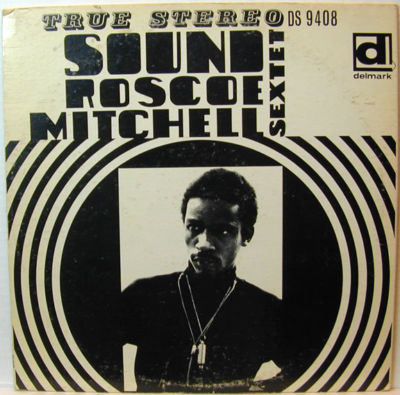
Roscoe Mitchell Sound LP Delmark 1966
Delmark LP DS-9408 - original pressing, not a reissue
VG cover w light wear / VG+ vinyl
Roscoe Mitchell is the rare jazz musician who also moves comfortably within the realm of contemporary classical music. It might even be said that Mitchell is a more convincing artist when working in European-influenced forms. When relying on structural and formal jazz conventions, Mitchell can often come off as stilted and unswinging. On the other hand, his forays into free-time, nontonal improvisation (both structured and unstructured) are as spontaneous and as emotionally satisfying as the best jazz. Mitchell's improvisations exercise extraordinary discipline and intellectual rigor. He's at once a patient and impulsive improviser, prone to alternating episodes of order and chaos, clarity and complexity. Mitchell is a technically superb -- if idiosyncratic -- saxophonist. His tone on alto and soprano tends to be edgy and brittle. At his most lyrical, Mitchell's saxophone lines exploit the instrument's strength as an interval-making machine; his improvised melodies often bear similarity to works by the classical composer Morton Feldman, though Mitchell's music is more overtly emotional. At his most energetic, Mitchell takes advantage of the saxophone's timbral flexibility and the horn's natural tendencies, which allow a player to play fast, scalar lines. Whether playing soft or loud, slow or fast, Mitchell's playing is invariably suffused with passion and intensity.
Mitchell played saxophone and clarinet as a teenager. While stationed in Germany as a member of the Army, Mitchell played in a band with tenor saxophone innovator Albert Ayler. Upon returning to the U.S. in 1961, Mitchell played bop with a group of Wilson Junior College students which included bassist Malachi Favors and saxophonists Joseph Jarman, Henry Threadgill, and Anthony Braxton. Mitchell began listening to the recordings of Ornette Coleman and John Coltrane. He studied with pianist/composer Muhal Richard Abrams. In 1962, he began playing in Abrams' newly organized Experimental Band, a rehearsal group which explored many of the contemporary alternatives to conventional jazz improvisation and composition. In 1965, he became one of the first members of the Association for the Advancement of Creative Musicians (AACM), a nonprofit organization established by Abrams, pianist Jodie Christian, drummer Steve McCall, and composer Phil Cohran. The AACM were devoted to the same principles as the Experimental Band. In 1966, Mitchell's sextet (with trumpeter Lester Bowie, tenor saxophonist Kalaparusha Maurice McIntyre, bassist Favors, trombonist Lester Lashley, and drummer Alvin Fiedler) became the first AACM group to record. Abstract in concept and execution, the album, Sound (Delmark), was an in-depth examination of the interaction between sound and silence, utilizing such unorthodox devices as spontaneous collective improvisation, toy instruments, and non-musical noise. A departure from the more extroverted work of the New York-based free jazz players, Sound pointed the way to a new manner of playing jazz-based music. Around this time, Mitchell also performed and recorded as a solo saxophonist. By 1967, the Roscoe Mitchell Art Ensemble consisted of the leader, Favors, trumpeter Lester Bowie, and drummer Phillip Wilson. That combination did not record; Wilson was replaced by Jarman, and in 1969 the group traveled to Europe. The sojourn was very successful. The band -- renamed the Art Ensemble of Chicago -- recorded extensively, particularly in France. The resulting albums formed the initial basis of their reputation.
Sound, Roscoe Mitchell's debut as a leader, was an early free jazz landmark and an enormously groundbreaking album in many respects. Historically, it marked the very first time that members of Chicago's seminal AACM community appeared on record; it also showcased the early chemistry between future Art Ensemble of Chicago members Mitchell, Lester Bowie, and Malachi Favors. Arrangement-wise, it employed a number of instruments largely foreign to avant-garde jazz -- not just cello and clarinet, but the AEC's notorious "little instruments," like recorder, whistle, harmonica, and assorted small percussion devices (gourds, maracas, bells, etc.), heard to best effect on the playful "Little Suite." Structurally, Sound heralded a whole new approach to free improvisation; where most previous free jazz prized an unrelenting fever pitch of emotion, Sound was full of wide-open spaces between instruments, an agreeably rambling pace in between the high-energy climaxes, and a more abstract quality to its solos. Steady rhythmic pulses were mostly discarded in favor of collective, spontaneous dialogues and novel textures (especially with the less orthodox instruments, which had tremendous potential for flat-out weird noises). Simply put, it's an exploration of pure sound. It didn't so much break the rules as ignore them and make up its own, allowing the musicians' imaginations to run wild (which is why it still sounds fresh today). Sound's concepts of texture, space, and interaction would shortly be expanded upon in classic recordings by Anthony Braxton, Muhal Richard Abrams, the Art Ensemble of Chicago, and others; the repercussions from its expansion of free jazz's tonal and emotional palettes are still being felt.
– All Music Guide
Check my other auctions this week for more original jazz, rock and avant LPs.
Please read: items are visually graded.
Shipping: $4 Media Mail/US
$7 Priority Mail/US
$9.50/Canada
$15/All other countries
Additional LPs: add $1 per record US, $2 per record other countries. You will be invoiced at the end of the auction.
Method of payment: Paypal only
price rating