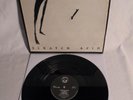
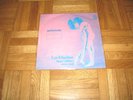
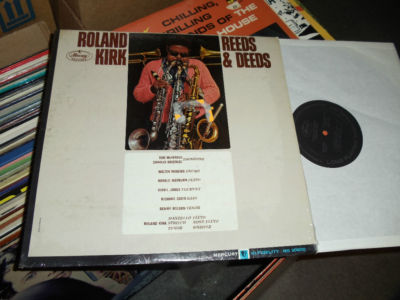
Reeds & Deeds - Rahsaan Roland Kirk LP MONO IN SHRINK Mercury
$
30


Favourite Auctions
To save auctions to your favourites, please login
If you don't have an account, please register
Description
LP NM-
Jacket NM-
Biography
Arguably the most exciting saxophone soloist in jazz history, Kirk was a post-modernist before that term even existed. Kirk played the continuum of jazz tradition as an instrument unto itself; he felt little compunction about mixing and matching elements from the music's history, and his concoctions usually seemed natural, if not inevitable. When discussing Kirk, a great deal of attention is always paid to his eccentricities -- playing several horns at once, making his own instruments, clowning on stage. However, Kirk was an immensely creative artist; perhaps no improvising saxophonist has ever possessed a more comprehensive technique -- one that covered every aspect of jazz, from Dixieland to free -- and perhaps no other jazz musician has ever been more spontaneously inventive. His skills in constructing a solo are of particular note. Kirk had the ability to pace, shape, and elevate his improvisations to an extraordinary degree. During any given Kirk solo, just at the point in the course of his performance when it appeared he could not raise the intensity level any higher, he always seemed able to turn it up yet another notch.
Kirk was born with sight, but became blind at the age of two. He started playing the bugle and trumpet, then learned the clarinet and C-melody sax. Kirk began playing tenor sax professionally in R&B bands at the age of 15. While a teenager, he discovered the "manzello" and "stritch" -- the former, a modified version of the saxello, which was itself a slightly curved variant of the B flat soprano sax; the latter, a modified straight E flat alto. To these and other instruments, Kirk began making his own improvements. He reshaped all three of his saxes so that they could be played simultaneously; he'd play tenor with his left hand, finger the manzello with his right, and sound a drone on the stritch, for instance. Kirk's self-invented technique was in evidence from his first recording, a 1956 R&B record called Triple Threat. By 1960 he had begun to incorporate a siren whistle into his solos, and by '63 he had mastered circular breathing, a technique that enabled him to play without pause for breath.
In his early 20s, Kirk worked in Louisville before moving to Chicago in 1960. That year he made his second album, Introducing Roland Kirk, which featured saxophonist/trumpeter Ira Sullivan. In 1961, Kirk toured Germany and spent three months with Charles Mingus. From that point onward, Kirk mostly led his own group, the Vibration Society, recording prolifically with a range of sidemen. In the early '70s, Kirk became something of an activist; he led the "Jazz and People's Movement," a group devoted to opening up new opportunities for jazz musicians. The group adopted the tactic of interrupting tapings and broadcasts of television and radio programs in protest of the small number of African-American musicians employed by the networks and recording studios. In the course of his career, Kirk brought many hitherto unused instruments to jazz. In addition to the saxes, Kirk played the nose whistle, the piccolo, and the harmonica; instruments of his own design included the "trumpophone" (a trumpet with a soprano sax mouthpiece), and the "slidesophone" (a small trombone or slide trumpet, also with a sax mouthpiece). Kirk suffered a paralyzing stroke in 1975, losing movement on one side of his body, but his homemade saxophone technique allowed him to continue to play; beginning in 1976 and lasting until his death a year later, Kirk played one-handed.
Note: All Lps are sight graded
Note: I Do Not Grade inner sleeves, If these are Important to you then you may e-mail me)
RECORD GRADING Based On Goldmine Grading Standards:
Near Mint (NM): A nearly perfect record. There may be one or two small inaudible defects. The record should show no obvious signs of wear. A 45 RPM or EP sleeve should have no more than the most minor defects, such as almost invisible ring wear or other sights of slight handling. An LP jacket should have no creases, folds, seam splits or any other noticeable similar defect. No cut-out holes, either.
Near Mint Minus (NM-): A record that should play mint but has a few slight visible marks. The album will have as much luster as an NM, there just may be some superficial scuffs from the sleeve or very light hairlines that shouldn't be audible. An NM- album cover subjectively fits somewhere in between VG+ and NM.
Very Good Plus (VG+): A Very Good Plus record will show some signs that it was played and otherwise handled by a previous owner who took good care of it. Record surfaces may show some slight signs of wear and may have slight scuffs or very light scratches that don t significantly affect play. Slight warps that do not affect the sound are OK. The label may have some ring wear or discoloration, but it should be barely noticeable. The center hole will not have been misshapen by repeated play. 45 Picture sleeves will have some slight wear, lightly turned-up corners, or a slight seam-split. An LP jacket may have slight signs of wear also and may be marred by a cut-out hole, indentation or corner indicating it was taken out of print and sold at a discount.
Very Good (VG): Many of the defects found in a VG+ record will be more pronounced in a VG disc. Surface noise will be evident upon playing, especially in soft passages and during a song s intro and fade, but will not overpower the music otherwise. Groove wear will start to be noticeable, as will light scratches (deep enough to feel with a fingernail) that will affect the sound. Labels may be marred by writing, or have tape or stickers (or their residue) attached. The same will be true of picture sleeves or LP covers. However, it will not have all of these problems at the same time, just two or three of them.
Good (G), Good Plus (G+): Good does not mean Bad! A record in Good or Good Plus condition can be put onto a turntable and will play though without skipping. But it will have significant surface noise and scratches and visible groove wear. A jacket or sleeve will have seam splits, especially at the bottom or on the spine. Tape, writing, ring wear or other defects will start to overwhelm the subject.
Poor (P), Fair (F): Below good. imperfections will be described.
Please check out my other items for sale. (I offer shipping discounts) I'll Be adding More Daily except for Friday and Saturday.
ALL SHIPPING PRICES ARE FINAL
additional items are 1.50 per item up to 6 within USA (if you are bidding on multiple items lots I have in one listing. you pay each shipping total added together)
Priorty shipping is available e-mail for total
NOTE: Gatefold Lps Count as 2 Lps when shipping out of the country
CANADA Multiple LP Shipping Rates In USD
1 LP 7.75
2. Lps 9.25
3 Lps 12.50
4 Lps 15.50
5 Lps 16.50
6 Lps 18.00
Multiple Shipping Rates Rest Of The World Outside USA in USD
Note: Gatefold Lps Count as 2 Lps
1 LP 14.00
2 LP 17.00
3. Lps 22.50
4 Lps 25.25
5 Lps 28.00
6 Lps 33.00
7 Lps 39.00
8 LPs 42.00
9 Lps 45.00
10 Lps 48.00
11 Lps 51.00
12 Lps 54.00
The MAN has to get his cut so Texas residents must add 8.25 % Sales Tax
If you are unsure about shipping costs please do not hesitate to e-mail me.
QUESTIONS:? Please ask. That is what I am here for. (I may not get to them if you wait close to an item's ending.)
MORE PICTURES? Just ask and I'll send them to you
MEDIA MAIL: is not recommended for rare items. Priority mail is faster and safer.
I leave feedback after item arrives and it is left for me. (It's easier to keep up with that way) Please limit your feedback comments to things within the realm of my responsibility.
Thank you for reading all of this :-)
price rating