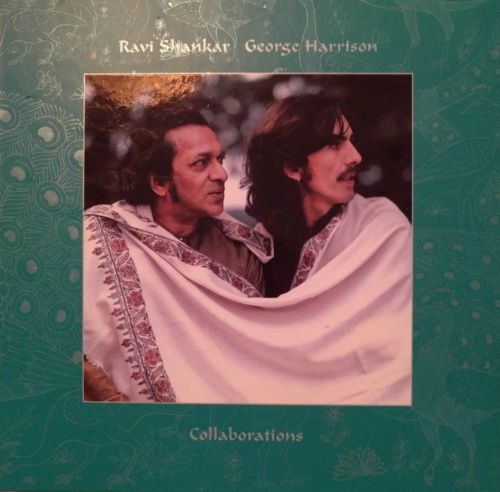
Ravi Shankar and George Harrison Collaborations Box Set
$
65


Favourite Auctions
To save auctions to your favourites, please login
If you don't have an account, please register
Description
Collaborations (Ravi Shankar and George Harrison album)
Collaborations?Box set by Ravi Shankar and George HarrisonReleased18 October 2010Recorded1973–74, 1996GenreIndian classical music, jazz, world musicLength2:39:52 (CDs)
1:05:56 (DVD feature)
1:36:49 (DVD audio)LabelDark HorseProducerGeorge HarrisonCompilerOlivia HarrisonGeorge Harrison chronologyLet It Roll: Songs by George Harrison
(2009)Collaborations (with Ravi Shankar)
(2010)Early Takes: Volume 1
(2012)
Collaborations is a four-disc compilation box set by Indian classical musician Ravi Shankar and former Beatle George Harrison. Released in October 2010 on Dark Horse Records, it compiles two studio albums originally issued on that label – the long-unavailable Shankar Family & Friends (1974) and Ravi Shankar's Music Festival from India (1976) – and Chants of India, first issued on Angel Records in 1997. Although all three albums were originally Shankar releases, for which Harrison served in the role of music producer and guest musician, both Shankar and Harrison are credited as artists on the box set. Each of the collaborative projects represents a departure from Shankar's more typical work as a sitarist and performer of Hindustani classical ragas, with the box set showcasing his forays into, variously, jazz and rock, Indian folk and orchestral ensembles, and devotional music.
The fourth disc of Collaborations is a DVD containing previously unissued film of a performance by the Music Festival from India, recorded at London's Royal Albert Hall in September 1974. Filmed by director Stuart Cooper, the footage required substantial restoration for its 2010 release. An audio-only track on the DVD, prepared by Anoushka Shankar and Paul Hicks, provides a more complete record of the concert.
Issued nine years after Harrison's death, the limited-edition release coincided with celebrations for Shankar's 90th birthday and was overseen by Harrison's widow, Olivia. Among the lavish packaging for the compilation, each disc appears inside enlarged, 8½-inch sleeves, and each copy of the set is individually numbered. An accompanying book contains a foreword by American composer Philip Glass, rare photographs documenting Shankar and Harrison's 35-year friendship, and commentary from both artists on the projects featured in the box set. While Collaborations presents only a portion of Shankar and Harrison's work together, music critics have recognised it as a successful representation of the far-reaching cultural legacy of their partnership.
Background
Musical contentEdit
The 2010 box set Collaborations was one of several reissue projects celebrating Shankar's 90th birthday. It compiles three studio albums that he and Harrison worked on together between 1973 and 1996:[21]Shankar Family & Friends (1974), Ravi Shankar's Music Festival from India (1976) and Chants of India (1997).[22] The first two of these albums had long been out of print, and their inclusion in the box set marked the debut CD release for both titles.[22] Disc four contains a previously unissued concert film from 1974, titled Music Festival from India – Live at the Royal Albert Hall.[23]
Harrison's role on the three studio albums was mainly confined to that of a record producer,[24] although his name appeared prominently on the front cover of Chants of India, and the latter was marketed as a collaborative work between Shankar and Harrison.[25]Collaborations presents the albums in reverse chronological order, with Chants of India appearing on disc one.[26]
Chants of IndiaEdit
Main article: Chants of India
Chants of India is the most vivid in my mind. It was fascinating to witness the creation of that album ... The priority was to maintain the integrity of the mantras and verses, while setting them to music as timeless as the words.[27]
– Olivia Harrison, compilation producer, 2010
Shankar and Harrison recorded the album between January and August 1996,[28] with sessions taking place in the southern India city of Madras, and at Harrison's English home, Friar Park, in Henley-on-Thames.[29] The majority of the selections consist of Vedic prayers and other Sanskrit-worded, Hindu religious texts that Shankar set to music.[30] He also wrote new pieces in a similarly sacred vein,[31]including "Prabhujee", the only song on the album to contain Hindi lyrics.[32] Among the many musicians and singers on Chants of India were Shankar's daughter Anoushka,[30] tablist Bikram Ghosh and santoor player Tarun Bhattacharya.[33]
The album's creation resulted from Shankar and Harrison having renewed their close friendship in recent years; this following a period when, by his own admission, Shankar had partially withdrawal from his Western-musician friends in the late 1970s, stung by persistent criticism from the Indian press that he was "diluting" Indian classical music.[34] Other projects that the pair undertook together in the mid 1990s include Ravi Shankar: In Celebration (1996), a four-disc career retrospective compiled by Harrison,[35]and Raga Mala, Shankar's second autobiography, for which Harrison served as editor.[30][nb 2]
Shankar considered Chants of India to be among his best works,[30] and he praised Harrison's contributions as a musician and producer on the album.[39] Released on Angel Records in May 1997,[40]the album was critically well received.[41] In his book The Dawn of Indian Music in the West, Peter Lavezzoli describes it as "a quiet masterpiece, one of the most uplifting and musically engaging recordings of scared music",[42] while AllMusic critic Jim Brenholts writes: "Among records of this nature, this one is special."[43]Chants of India was the last official musical collaboration between the two artists,[44] after Harrison was diagnosed with cancer in August that year.[45]
Ravi Shankar's Music Festival from IndiaEdit
Main article: Ravi Shankar's Music Festival from India
?
The entrance to Harrison's property Friar Park, where two of the albums featured in the box set were recorded; photo by Don Cload
The Music Festival from India was something I've been planning since about '67. It was inspired by an incredible orchestral composition Ravi created around 1964 for All India Radio.[46]
– George Harrison, 1974
Harrison first got the idea to stage what became the 1974 Music Festival from India during the Bombay sessions for his debut solo album, the 1968 film soundtrack Wonderwall Music,[47] after hearing Shankar's orchestral work Nava Rasa Ranga.[27] While in India in early 1974, Shankar and Harrison planned the venture, which consisted of a European tour by Shankar's hand-picked orchestra of Indian classical musicians,[47] after which the ensemble would tour North America with Harrison and his band of Western musicians.[48][49] For his orchestra, Shankar selected regular accompanists[50] such as tabla player Alla Rakha and singers Lakshmi Shankar and Kamala Chakravarty;[51] other established players including Shivkumar Sharma (santoor), Hariprasad Chaurasia (flute), Rijram Desad (percussion) and Kamalesh Maitra (tabla tarang);[52] and musicians that went on to establish themselves internationally as a result of their participation, such as violinist L. Subramaniam[53][54] and sarangi player Sultan Khan.[55]
Before the European tour began in September 1974, Shankar and Harrison recorded a studio album with the sixteen Music Festival musicians at Friar Park.[56]Using the facilities from his upstairs studio, FPSHOT, Harrison recorded the album in Friar Park's drawing room, overlooking the property's expansive gardens.[57][nb 3] Shankar wrote the pieces in a variety of traditional Indian folk and classical styles,[58] often composing on his way to Henley from his London hotel, while travelling along the M4 motorway.[59]Harrison later recalled his fear that Shankar's directions to the assembled musicians would create a musical "catastrophe", yet the result each time was "the most amazing thing".[47] Among the tracks on Ravi Shankar's Music Festival from India, "Raga Jait" is Shankar's interpretation of that raga for an orchestral ensemble,[56] and the ten-minute "Dehati" features extended interplay between the various percussionists.[26] The album was released on Harrison's Dark Horse record label in February 1976.[13]
Shankar Family & FriendsEdit
Main article: Shankar Family & Friends
The album contains almost every possible style that you can think of … we have Western instruments like sax, guitar, bass … a few classical musicians from the Los Angeles Symphony Orchestra, and I had three musicians flown in from Bombay.[60]
– Ravi Shankar, 2010
Shankar and Harrison began recording Shankar Family & Friends in Los Angeles in April 1973.[56][61] In a marked departure from Shankar's more familiar work in the Hindustani classical style, the album was a fusion of several musical genres,[62] particularly Indian classical, jazz and Western pop.[60] The contributors ranged from American jazz proponents Tom Scott and Emil Richards to Indian players such as Rakha, Sharma, Chaurasia, Subramaniam, sarodyaAashish Khan and, a former student and longtime associate of Shankar's, multi-instrumentalist Harihar Rao.[63][64] Adopting the pseudonym "Hari Georgeson", since he was still contracted to EMI-affiliated Apple Records,[65] Harrison contributed on electric and acoustic guitars, and autoharp. Shankar played sitar, surbahar and Moog synthesizer,[66] and otherwise served as director and conductor at the sessions.[67] Other participants included guitarist David Bromberg,[68] members of the Los Angeles Symphony Orchestra,[60] and electronic music artists Paul Beaver and Robert Margouleff.[66]
One side of the original LP consisted of music that Shankar had composed for a ballet,[69] titled Dream, Nightmare & Dawn,[27] while among the album's other songs and bhajans[68] was a rare English-language pop composition by Shankar, "I Am Missing You".[60][70] Harrison arranged the latter track in a rock-music setting,[56] with backing from Western musicians such as Scott, Billy Preston, Ringo Starr and Jim Keltner;[37][69] sung by Lakshmi Shankar,[70]this version of "I Am Missing You" was the first single released on Dark Horse Records, in September 1974.[71] Music from Shankar Family & Friends featured in the setlist for the Harrison–Shankar North American tour later that year,[62][72] during which the Music Festival personnel were accompanied on stage by Harrison and members of his touring band, such as Scott and Richards.[73]
Music Festival from India – Live at the Royal Albert HallEdit
Harrison sponsored Shankar's Music Festival from India concerts through his Material World Charitable Foundation,[27] for which the European tour was its debut event.[47][74] The DVD issued on Collaborations is from the Music Festival's concert at the Royal Albert Hall, London, on 23 September 1974,[24] the first date of the tour.[75] The footage was shot by director Stuart Cooper,[76] whose film Little Malcolm, made early the previous year,[77] marked Harrison's first foray into film production.[78]
After Harrison introduces Shankar to the London audience, Shankar conducts the musicians during the performance.[26] He plays sitar on the twenty-minute "Raga Yaman Kalyan", however,[79] accompanied by Rakha.[80] Author Simon Leng recognises the Music Festival from India as the first Indian orchestra to have played in Europe,[81][nb 4] while Harrison's widow Olivia, in her role as producer of the compilation,[84]notes singer and mridangam player T.V. Gopalkrishnan among the musicians who went on to have "incredible careers of their own".[27]
Considerable restoration was required to prepare Live at the Royal Albert Hall for release in 2010,[85] since much of Cooper's footage had been lost during the ensuing decades[74] or damaged.[86] Olivia Harrison explained: "We laid music where we had picture and we cheated a little bit with picture where only sound existed to create over an hour of the concert …"[27] A separate selection on the DVD presents the audio for a more complete version of the performance, lasting over 90 minutes.[24] Also included is a short segment where Anoushka Shankar and Paul Hicks, as remaster producers,[87] work on the concert audio in a San Diego studio and are visited by Shankar and Olivia.[74]
price rating