ROLLING STONES 'SATANIC MAJESTIES' 1ST PRESS 3-D STEREO BELL LONDON US PRESSING
$
28
Favourite Auctions
To save auctions to your favourites, please login
If you don't have an account, please register
Description
ROLLING STONES 'SATANIC MAJESTIES' 1ST PRESS 3-D STEREO BELL LONDON US PRESSING
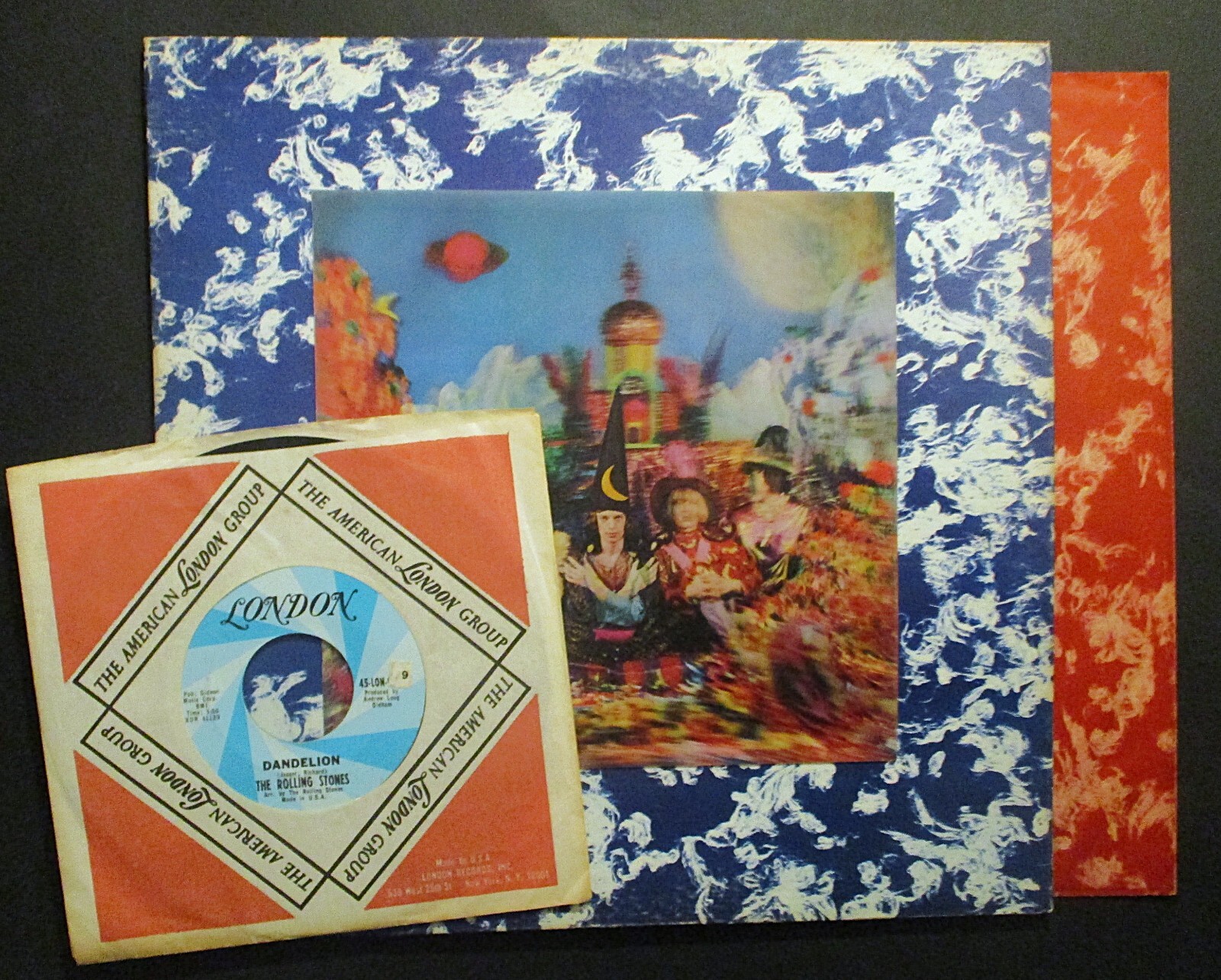
THE ROLLING STONES "THEIR SATANIC MAJESTIES REQUEST" LABEL: LONDON RECORDS NPS-2 RELEASED: DECEMBER 8, 1967 U.S. FIRST PRESSING ~ "BELL SOUND" ~ STEREO 3-D LENTICULAR COVER ~ GATEFOLD ~ RED INNER SLEEVE RECORDED: OLYMPIC STUDIOS ~ LONDON ~ FEBRUARY 9TH - OCTOBER 23RD 1967 RECORDING ENGINEER: GLYN JOHNS MASTERING/LACQUERS: SAM FELDMAN at 'BELL SOUND' STUDIOS PRESSED BY COLUMBIA RECORDS ~ TERRE HAUTE (1T/1U IN MATRIX) PRODUCERS: THE ROLLING STONES ALBUM DESIGN & CONCEPT: MICHAEL COOPER BACK COVER ARTWORK: TONY MEEVIWIFFEN MATRIX (SIDE A): (Stamped) ZAL 8126-1T Bell Sound MATRIX (SIDE B): (Stamped) ZAL 8127-1U Bell Sound
CONDITION: VINYL: VG+ JACKET: VG++ SLEEVE: VG++ ~~~~~~~~~~~~~~~~~~~~~~
I've been going thru my massive vinyl record collection this winter and pulling out some LPs that I thought that someone else would want for their collection. I've been collecting records for over 40 years and it's time to pass some of them on to the next generation of collectors.
After all, we are just temporary 'caretakers' of these musical gems until the next owner and next collection takes them in.
This week on EBay I am offering up this fantastic, clean copy of the classic Rolling Stones album 'Their Satanic Majesties Request'.
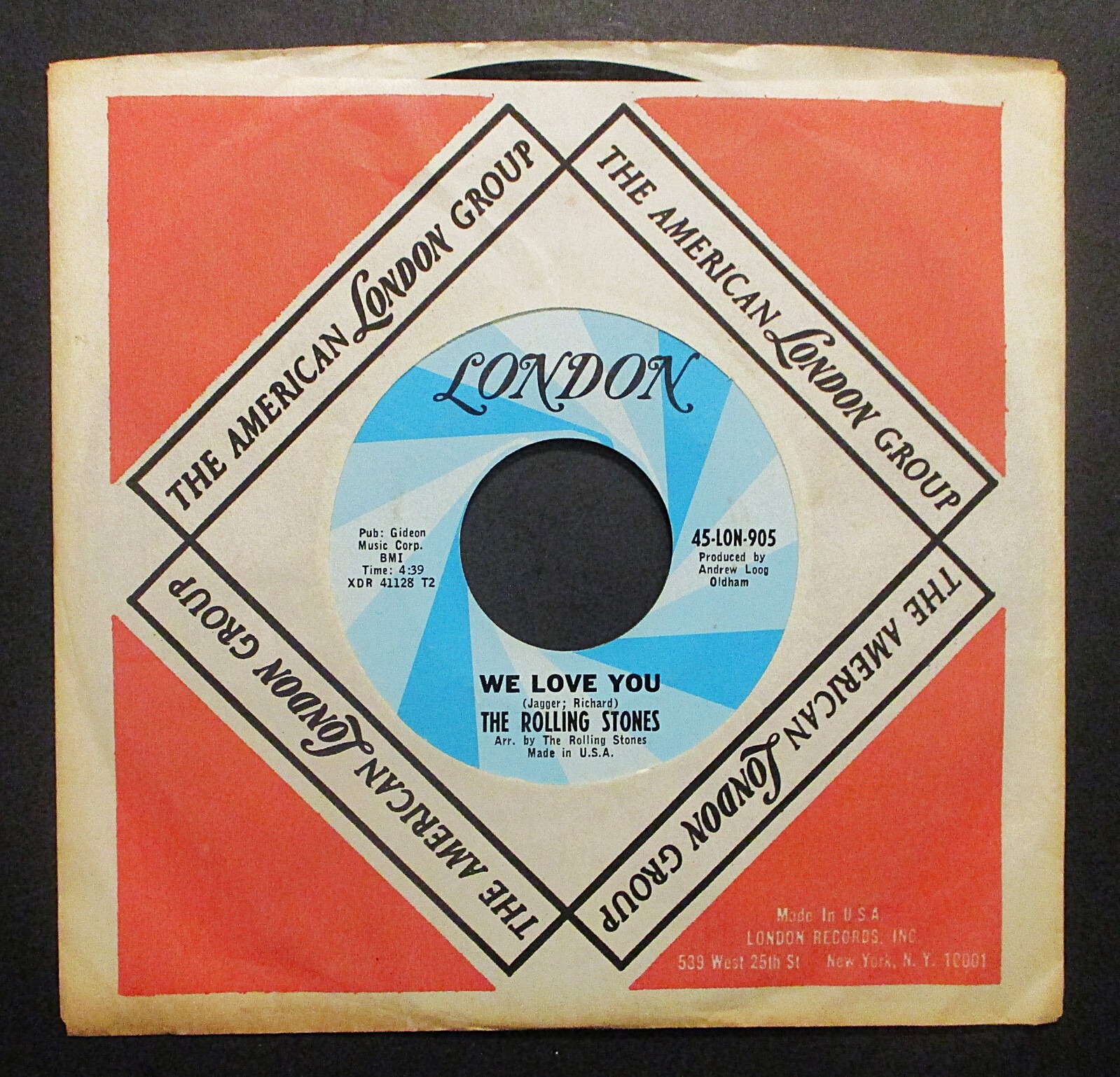
I'll also include a clean copy of the 'We Love You'/'Dandelion' non-LP double A-side single as well, for reasons discussed below.
This is my original 1967 First Pressing copy that I purchased back over 40 years ago and that I've taken great care of for many years.
See the full description of the jacket and vinyl condition below.
'Their Satanic Majesties Request' was the 6th British, and 8th American studio album by The Rolling Stones, released in December 1967 by Decca in the UK and London Records in America.
'Satanic' was the first Rolling Stones album to feature the same track listings in both its UK and US versions.
Recorded at London’s legendary Olympic Studios during the heady days of the ‘Summer of Love,’ in a landscape of fervent creativity.
Recording sessions started in February 1967 but were interrupted by Mick Jagger and Keith Richard's legendary drug bust and trial. Recording sessions picked up soon afterwards and ran thru the summer of 1967, finishing up in late October.
The recording sessions saw the band experimenting widely with a new, psychedelic sound in the studio, incorporating unconventional instruments and sounds, including the Mellotron, theremin, African rhythms, guitar loops, radio static and string arrangements from future Led Zeppelin bassist John Paul Jones.
The recording sessions were informal, loose, social gatherings, attended by the different Musician's vast 'entourage' of friends.
On this album, the core band; Mick Jagger, Keith Richards, Charlie Watts, Bill Wyman, and Brian Jones, are joined at various times by musicians like Nicky Hopkins, John Lennon, Paul McCartney, John Paul Jones, Eddie Kramer, Ronnie Lane, Steve Marriott, and others. ~~~~~~~~~~~~~~~~~~~~~~~~~~~~~~~~~~~~~~~~
RECORD SPECIFICS
This American First pressing has a rather simple, early, stamped matrix number and also has the "Bell Sound" stamp in the dead wax.
New York's Bell Sound was a 'state of the art', all-vacuum tube, mastering lab at the time, and their mastering and lacquers sound fantastic. This record was mastered at Bell Sound by Sam Feldman.
Although it's not obvious, I believe this original US Stereo First Pressing release was pressed by Columbia at Terre Haute, based on the "1T/1U" in the short matrix numbers of the runout. ~~~
This is an American Stereo First pressing. Most vinyl collectors seek out first pressings from the band's country of origin, thinking the master tapes are fresher and lower generation, which makes sense, but, in this case, the UK stereo first pressings sound 'bright' and the midrange is lacking, making them inferior to the US 'Bell Sound' stereo first pressings.
The US Stereo 'Bell Sound' pressings are truly amazing. They were either mastered at higher volume, or had some kind of bass and percussion boosting, or something 'magical'. They are livelier, airy, and sound 'natural' ~ wide, deep, punchy & powerful, the stereo separation is superb, and they sound great. ~~~~~~~~~~
LABELS
This pressing has lighter blue London labels, marked in 'Made in USA', with 'dull' silver lettering, and the song titles are left-justified.
Later 70's pressings had deep navy blue labels, reflective silver lettering and 'stereophonic' banner, no 'made in USA', a larger text font, and the song titles were centered.
The labels have the side indicators as "front side" and 'back side", printed under, not over, the catalog number 'NPS-2' on the right side of the spindle hole.
Later on, the side indicators were switched to 'Side 1/Side 2' and the early 'Bell sound' stamp in the matrix disappeared, shifting first to 'Sterling', then simply just mastering engineer Sam Feldman's 'sf' initials, then no mastering marks at all.
This label has the early short rim text 'Unauthorized public performance...' printed around the perimeter, which became longer, then gone altogether on later pressings.
There's also no small numbers on the left side of label, which started to appear on later pressings. ~~~~~~~~~~~~~~~~~~~~~~~
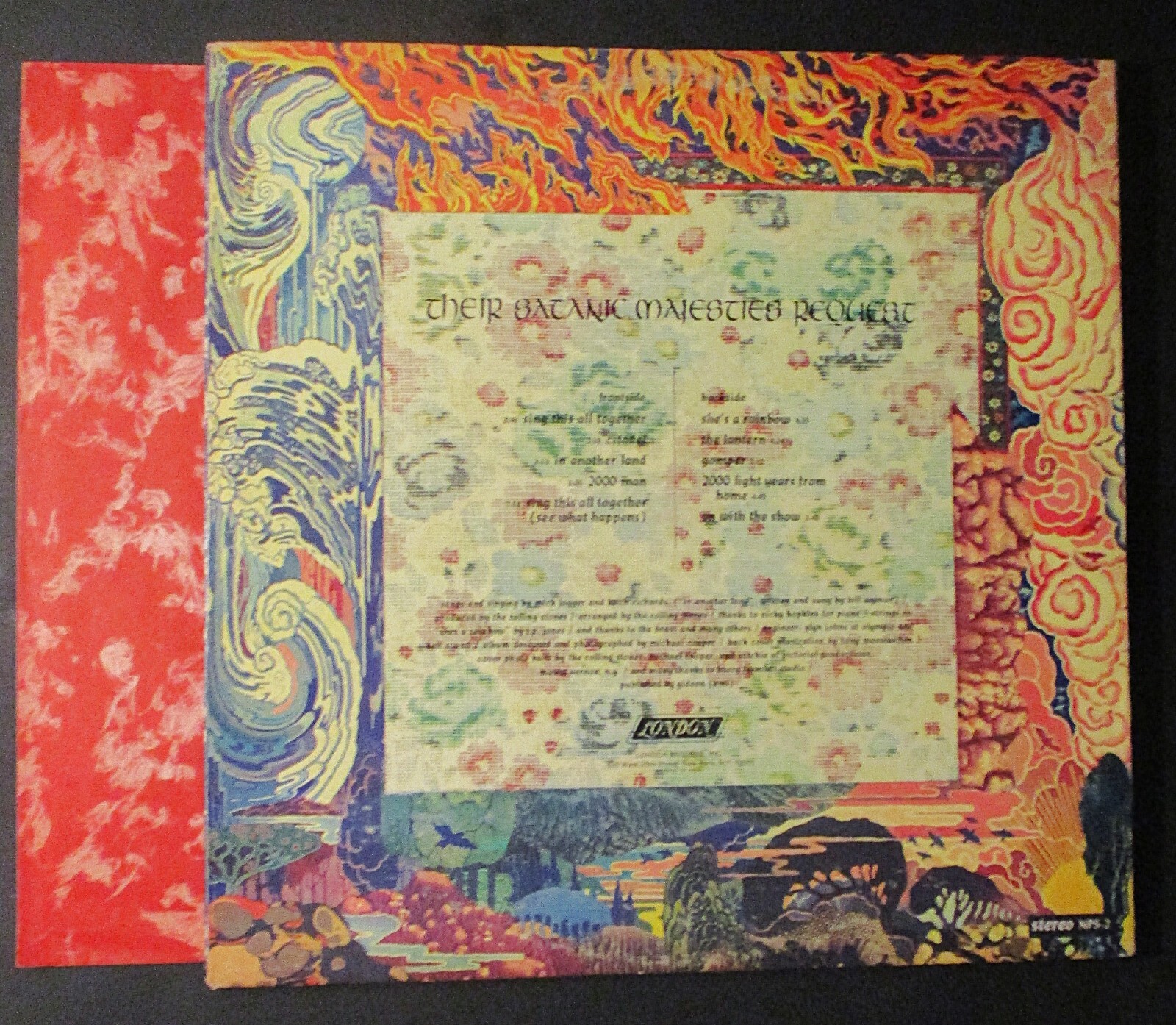
This copy comes complete with its original printed red/white 'clouds' inner sleeve, which was later replaced by a standard London company sleeve. ~~~~~~~~~~~~~~~~~~~~~~~~~~~
Although most Psych records sound better in Stereo, some Stones collectors and fans prefer the Mono version of this album.
There's a clear difference in the mixes on the true, dedicated Mono mix and some of the songs sound slightly different. The mix differences in "Citadel", "She's A Rainbow" and "The Lantern" are obvious on a true Mono pressing.
Sometimes the Mono's sound 'better', punchy and more pronounced, but this album is so dense, thick and layered in places, that the instruments sometimes get 'buried' on the Mono mix. On the stereo mix, things are obviously more spacious and opened up.
It's really a matter of preference, but one must be careful with Mono pressings as many are 'fold-downs', not dedicated Mono mixes. The fold-downs tend to bury a lot of the music.
It's sometimes hard to tell 'true' Monos from the fold-downs. As a long time Stones collector, I've learned that the easiest way to tell a 'dedicated' true Mono mix from a 'fold-down' is by the beginning of the song 'The Lantern'. Three bells at the beginning, it is the true mono mix. With two bells only, it's the fold-down.
Again, this copy is a First Pressing, Stereo, 'Bell Sound', American London pressing. ~~~~~~~~~~~
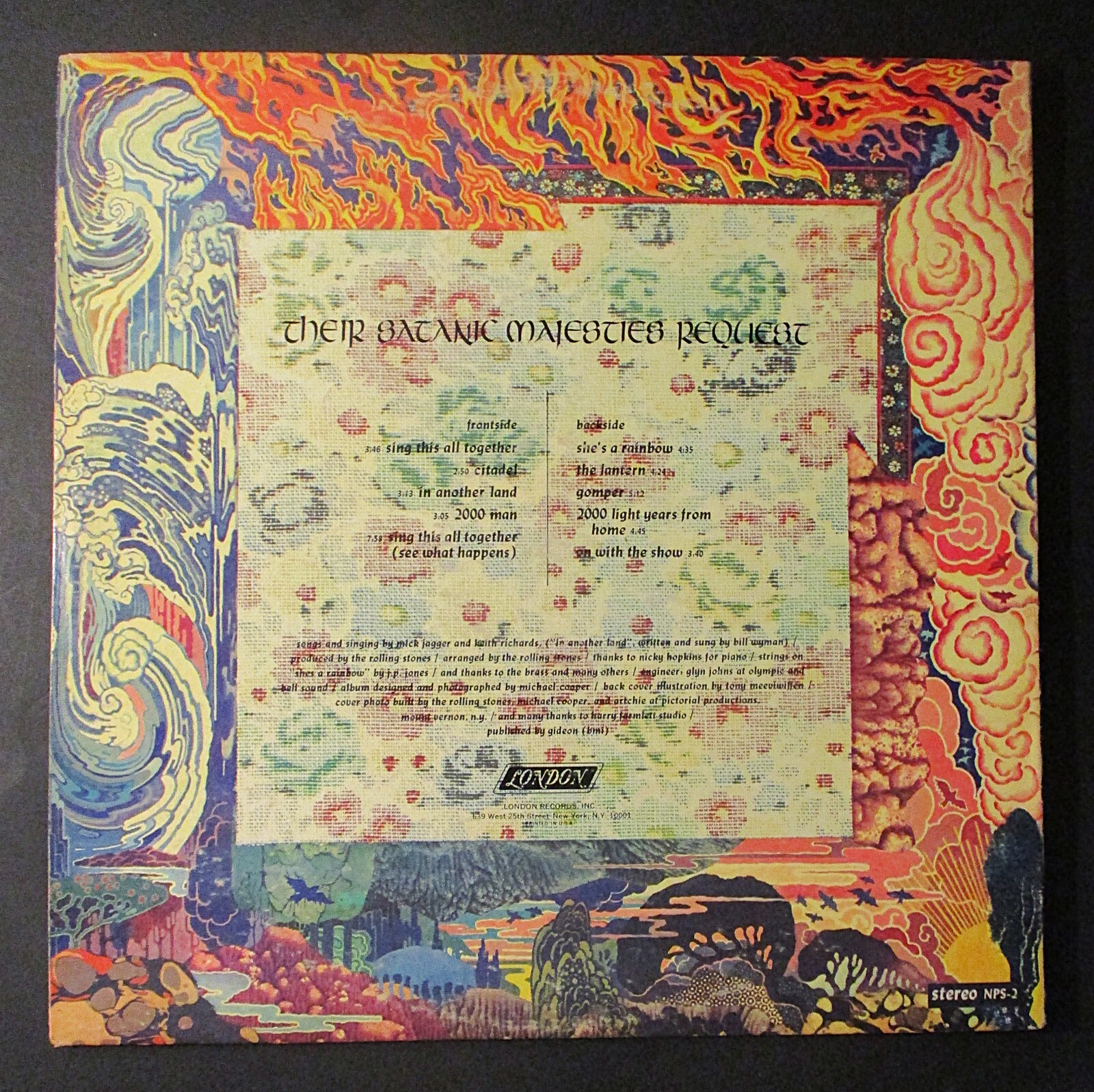
This album jacket has the original early address printed on the back cover: "London Records, Inc. ~ 639 West 25th Street, New York, N.Y. 10001 ~ Printed in U.S.A." ~~~~~~~~~~~~~~~~~~~~~~~
COSMIC CHRISTMAS
Since the album was scheduled for release just before Christmas, 1967, the Stones briefly considered calling this album "The Rolling Stones Cosmic Christmas". This pressing has the "hidden" track, 'Cosmic Christmas' tacked on to the end of side one, appearing about 8 minutes into “Sing This All Together"
The barely recognizable 'Cosmic Christmas', credited to Bill, is a wobbly, electronic/percussion version of several seconds of “We Wish You a Merry Christmas” that was psychedelicized by running it thru an audio oscillator. Pretty cool, but very weird.
I remember when this album came out, the rumor was that there was a 'hidden track' that could only be heard by playing the record at 45-rpm. I checked it out, and although 'Cosmic Christmas' isn't that 'hidden', I must agree that it certainly does sound better at 45. ~~~~~~~~~~~~~~~~~~~~~~~~~~~~~~~~
MUSICIANSHIP ON 'SATANIC MAJESTIES'
On this album, despite it's loose, 'out there', psychedelic sounds, the individual band members demonstrate their amazing skills and their serious musicianship.
The Stones always enjoyed pushing the boundaries of what they could achieve in the studio, and what they could do, both as a band, and as individual musicians.
The Stones were all skilled musicians, masters of their individual instruments. They knew they did their 'thing' better than anyone else, and were determined to make this album with an eye beyond simple rock and pop sounds. They set out to lay down something new and exciting, something far more artistic and enduring.
For this one album, the Stones mostly, abandoned their tight, bluesy, R&B-based music, which they had built their music and reputation on for the last four years, and decided to make an album of 'psychedelic art' instead.
Musically, Satanic Majesties is unique among Rolling Stones albums in that it is almost entirely dominated by keyboards, although there's still plenty of Keith's guitars. ~~~
The Stones bandmember that made the most important contribution to 'Satanic' is none other than Brian Jones. If there is one secret weapon behind this album, it’s Brian. Many Stones fans and collectors perceive 'Satanic Majesties' as almost a 'Brian Jones & Friends' album and one of his finest efforts.
Brian Jones is a musical dynamo throughout this record, playing all kinds of instruments to add whatever sounds he felt 'fit' the songs. Brian's virtuosity and versatility always brought something special to every tune he ever played on.
Brian Jones oddly does not play any electric guitar, his instrument of choice, on this album. Instead, he plays just about every other instrument including: lots of Mellotron, acoustic guitar, vibraphone, theremin, flute, percussion, saxophone, organ, electric dulcimer, recorder, sarod, harp, and lots of sound effects.
Brian primarily plays the Mellotron, the textural and sonic possibilities of which fascinated him. Mellotron is all over this album, and Brian's mastery of the instrument sounds fantastic. He even brings a slight Moroccan/Middle Eastern influence and baroque pop feeling to several of the songs on this album.
In addition to fantastic Mellotron, Brian plays an amazing range of instruments; Electric dulcimer, guitar, recorder, saxophone, trumpet, flute and a variety of Brass Instruments.
His use of saxophone on ‘Sing This All Together’ & 'Citadel', harp on ‘On With The Show’, and strings on '2000 Light Years from Home' all add amazing touches to those songs and the entire project.
Brian started out the Satanic sessions with amazing drive and enthusiasm, but throughout the summer of 1967 he started to lose control of both himself and the direction of the band that he founded.
Brian's 1967 drug bust, the grueling trial and public scrutiny, the loss of his girlfriend Anita Pallenberg, who was swiped away by his bandmate Keith, Mick's rise as the leader of the group, and his increasing drug use, all took a heavy toll on Brian.
By the time this album was finished and released in December 1967, Brian had distanced himself from the band. He was spent, exhausted and spiraling.
In many ways, 'Satanic Majesties' marks the end of the Brian Jones era, although he would have a few more sparks left in him, like his fantastic lead guitar on 'No Expectations', bluesy riffs on 'Stray Cat Blues', and his great, but limited, acoustic guitar and harp playing on "Beggar's Banquet". ~~
The second major musical contributor to 'Satanic Majesties' wasn’t a band member at all, but session man Nicky Hopkins, who would go on to work closely with the Stones on many future albums.
Hopkins splashes his virtuoso piano and organ work all over 'Satanic Majesties' and and even plays some terrific Harpsichord on 'Citadel'.
Nicky was able to fuse hip modern psychedelic sounds with English baroque, barrelhouse and folk traditions, which gives a unique sound to songs like 'She’s A Rainbow', 'Citadel', 'The Lantern' and others. The band's old friend and unofficial member Ian Stewart even stepped in to play organ when Nicky was on other keyboards. ~~~~~~~~
Charlie Watts is fantastic, as always, on this album, holding everything together. No matter what strangeness and experimentation is going on around him, Charlie keeps it all pulled together, tight, on track, and keeps the drive and momentum going forward.
Charlie not only plays drums, but incorporates a wonderful array of percussion instruments including Tablas, Congas, tambourine, cymbals, bells, claves and maracas.
Charlie's another 'secret weapon' on this album. ~~~~~~~~
Keith Richards plays some fantastic guitar on 'Satanic Majesties', just not a lot of it. Keith mostly abandons his previous chugging, Chuck Berry-ish guitar riffing style on this album. Instead, ‘Keef’ takes the opportunity to experiment with different styles of rock guitar, adding different textures, expanding and filling out the sound.
Keith plays an extremely effective psychedelic 'heavy metal' guitar workout on 'Citadel' and throughout this album Keith plays various electric and acoustic 6 & 12 string guitars. This album is where Keith started to find and develop his famous, 5-string approach, his classic open tunings & other styles that would appear on "Beggars Banquet" and become his signature 'sound',
Even Mick Jagger goes above and beyond on this album, and, in addition to singing, he adds some percussion; glockenspiels, congas, maracas & tambourine.
Bassist Bill Wyman also expands his musical skills, playing some organ & piano, and Bill oddly plays Mellotron during the album's 'Cosmic Christmas' section.
Bill even sings his first lead vocal on a Stones song with his own composition 'In Another Land'. In his book, Bill explains how "In Another Land" came about:
"In early July (1967), I sat at home playing the Thomas organ and wrote "Acid in the Grass" ("In Another Land"), which was a bit spacey, but interesting. I made a demo on my home recorder.
On July 13, nobody but Charlie, Nicky Hopkins and I turned up at the studio. We were thinking of leaving when Glyn said, "Do you have a song we can do?". I sat at the piano and played "In Another Land" and they all liked it.
We put a basic track together and got a good master on tape. I was worried when it came to adding vocals. In the end, I suggested tremolo on my voice. The Small Faces were recording next door and Glyn asked Steve Marriott (and Ronnie Lane) to come in and help. We sang it together and it turned out good. The track was given the working title of "Acid In The Grass".
Apparently, while Charlie, Bill and Nicky were waiting long into the night for the others to show up, Bill fell asleep, drifting off 'to another land' and began snoring loudly.
Regrouping the next day, the rest of the band heard the results and were impressed. They layered on some additional music, some new vocals (Bill's singing voice was notoriously horrible), and oddly overdubbed Bill's snoring into the mix. They called the result 'In Another Land'.
(The Stones were so impressed they allowed Wyman to release his song as a rare single under his own name.) ~~~~~~~~~~~~~~~~~~~~~~~~~
THE STORY OF MAKING 'THEIR SATANIC MAJESTIES REQUEST'
By late 1966 London's music, art, literature, clothing, and culture was becoming Psychedelicized; It was a time of great musical imagination and experimentation with great records by Pink Floyd, Jimi Hendrix, Cream, Soft Machine and the Beatles.
In early 1967, the Rolling Stones decided join these bands, dip their toes into the psychedelic pool, and they got right to work.
Less than a month after the release of 'Between The Buttons' in January 1967, The Stones booked studio time at the brand new, state of the art, Olympic Recording Studios in London, which just opened a few months earlier in November, to start laying down some ideas and begin working on their next album, what eventually became 'Their Satanic Majesties Request'.
By early 1967, there was already an 'us' versus 'them' undercurrent well established in London between the hip 'turned on' youth and their musical heroes, and the old 'straight' British establishment.
This came to a head in early 1967, when Mick Jagger brought a lawsuit against the conservative 'News of the World' newspaper for libel over a series of articles they printed reporting on drug use by Pop bands, including the Rolling Stones.
Mick's lawsuit fueled an outright public battle between London's 'establishment' and the younger generation, with the Rolling Stones in the middle of it all.
With that tension in the air, on February 9th, 1967, the Stones entered Olympic studios, to begin preliminary recording sessions for their next album. The band quickly laid down working versions of '2000 Light Years' and 'She's a Rainbow' and were off to a great start.
3 days later, Mick Jagger made his fateful decision to spend the weekend at Keith Richards’ Redlands estate in Sussex.
On February 12, 1967, tipped of by the 'News of the World' press, Mick Jagger, Keith Richards, Marianne Faithfull, and art dealer Robert Fraser were arrested on drug charges after a raid at Redlands.
Mick Jagger and Keith Richards were imprisoned, charged with serious drug related crimes, and eventually released on bail.
Much of England's youth saw the Stones as scapegoats for the Establishment's hatred of the new generation.
The drug bust and legal proceedings clearly interrupted making the new album. A few basic tracks and other ideas were laid down during the earlier February sessions, but the band returned to Olympic studios intermittently and continued work on the album in earnest. The drug bust stirred their songwriting and creativity.
In June 1967, in the time between their bust and their trial, the Rolling Stones went back into Olympic to record a new song, 'We Love You', conceived by Jagger & Richards while they sat in a prison cell. The song was written in response to the huge wave of support the band felt from their fans, friends, and fellow pop stars.
On June 13th, the basic track and arrangements for 'We Love You' were laid down at Olympic. Around the same time, Keith, while sitting in prison with thoughts of powdery drugs on his mind, also came up with 'Dandelion' ('Dandy Lines'). 'Dandelion' contains some clever 'dual meaning' lyrics, some amazing acoustic guitar by Keith, and fantastic musical interplay between the harpsichord and organ.
Recording sessions for the new material were going well, but suddenly, in the middle of the sessions, Brian Jones just 'disappeared', running off to California to attend the Monterey International Pop Festival.
After returning to London in late June, Brian suffered a 'nervous breakdown' and was hospitalized in Richmond for 3 weeks, missing further sessions for the new songs, which the rest of the band continued to work on.
In Brian's physical and mental 'absence', Keith and Brian's girlfriend Anita Pallenberg grew closer, causing stress and inner divisions with the band.
When he was released, Brian joined his bandmates at Olympic Studios for a recording session, late at night on July 19, adding a fantastic, inspired, swirling, Moroccan-tinged mellotron part to the recording of 'We Love You'.
Also in attendance that night were John Lennon, Paul McCartney and the poet Allen Ginsberg. Some percussion and finishing touches were added to 'We Love You' and 'Dandelion', and Lennon and McCartney ended up overdubbing some angelic backing vocals onto the songs.
The gesture by the two Beatles, a show of solidarity with their friends, was a measure of the general outrage felt about Jagger and Richards’ arrest, imprisonment and trial.
After the final outcome of the Redlands trial in late July, in which both Keith and Mick, initially sentenced to long jail terms, were eventually freed, and after enduring months of police & public persecution, “We Love You”, their first new release of the summer of 1967, was issued as a single on August 18, 1967, in the UK, and shortly later in the US.
There was no doubt what the powerful new song was about. It features overdubs of a prison warden's footsteps and the sound of prison doors slamming shut at the beginning.
The double A-side single spent most of September in the British Top 10. 'We Love You' was promoted in the UK, while the flip side, 'Dandelion' was promoted as the A-side in America, where it reached the top 20.
'Dandelion' is many Stones fan's favorite track from that period and a 'lost' psychedelic classic of the 60s.
The final, multi-layered song 'We Love You' was a brilliant masterpiece; a dark, menacing, psychedelic freakout, built around Nicky Hopkins' intense piano riff, Brian's slinky mellotron lines, and held together by Charlie's great drumming and Bill's angry bass rhythm. Plus it had the added touch of two of the Beatles voices overdubbed onto it.
The defiant, sarcastic Jagger-Richards lyrics show both appreciation for their fans support during their ordeal, as well as strong disdain and hostility for the police and the 'establishment'.
It was considered one of the Rolling Stones' most 'experimental' songs at the time, and a hint at what kind of music would be coming on the next album.
Original pressings of this somewhat obscure 45 release, like this copy, contain a brief coda in the dead-wax of both sides that includes a brief faded-in section of the song on the other side. A faded-in portion of "Dandelion" appears at the end of "We Love You", and vice-versa. Nobody's quite sure why. It does nicely link the songs to each other, encouraging you to flip the single over. Mick Jagger has always claimed that 'We Love You' and 'Dandelion' were "just a bit of fun".
Strangely, neither song, 'We Love You' nor 'Dandelion' was released on 'Their Satanic Majesties Request', although they would have fit on the album well. Since then, the double A side single of 2 non-album tracks has become a somewhat forgotten 'rarity' and true gem among us Stones collectors.
Most Stones fans and collectors feel that these 2 songs are an essential missing part of 'Satanic Majesties' and deserve to be on the album, so I'll include a spare, rare, clean copy of the original 1967 single as a 'bonus'. Two fantastic songs that 'missed' the album and became lost in the vast Rolling Stones catalog.
~~~~~~~~~~~~ At the start of 1967, there were worsening tensions between the band and their manager/producer Andrew Loog Oldham.
The band were unhappy with the sound and production of their previous album 'Between the Buttons' released that January, and blamed Andrew for his poor attention to recording, mixing, and post-production work.
Oldham was getting very highly paid to 'manage' the band and being given Producer’s credit on all of the band's music, despite contributing little to nothing in return.
Andrew was critical to the band early on, helping create their success on the London club scene. He also negotiated an extremely forward-thinking contract with Decca in 1964, who were in a desperate panic over having blown their chance to sign The Beatles. Not wanting to screw up again, Decca wanted eagerly to sign the Stones, and Oldham convinced Decca to allow the Stones to retain complete ownership of all of their studio master-tapes, while Decca would only 'lease' them. This move made the Stones very rich and gave them immense leverage over Decca.
By 1967, the Stones were wealthy, had a great recording contract, and access to the best studios in London. They had developed confidence in their songwriting and playing, knew what they were doing in the studio, had written hit singles on their own, and no longer needed Andrew in their way.
The Stones felt they would be richer, have more creative freedom, and better off on their own.
Early on in the recording sessions for 'Satanic Majesties', the Stones squeezed Andrew Loog Oldham out of the producer’s chair by essentially 'going on strike' in the studio. As part of his contract with the Stones, Andrew was personally responsible for all studio and recording costs, so the band purposely wasted hours of precious, expensive, studio time, refusing to record any new material when Oldham was around. Instead, they just fooled around, taping one loose, meandering blues jam after another, in the hopes that he would lose money and quit in frustration.
The scheme worked and Andrew quit. In the words of Ian Stewart: "We went in and played a lot of blues just as badly as we could. Andrew just walked out.”
The August 1967 'We Love You' single turned out to be the last Stones recording to include Andrew's involvement. ~~
Meanwhile, the Stones had a plan. The infamous Allen Klein was looming in the wings. Klein had introduced himself to Jagger while the band was on tour in America in 1965.
Impressed with Klein’s business acumen, and his promise that he could wrangle a much better American deal with London for the band than what Oldham had gotten them, Jagger persuaded the others to agree to Klein’s appointment as the band's 'co-manager.'
In 1966, Klein made the band pressure Oldham into selling his remaining share of the Rolling Stones’ management to him, with Klein promising Andrew that he could remain in place as their 'Producer'. Less than a year later, Oldham was gone.
The Stones were so happy to get rid of Andrew that they weren't watching what Klein was actually doing behind the scenes. which would bite them, hard, a few years later.
In 1971, Jagger and Richards unwittingly signed the rights to the band’s ‘60s Decca master tapes over to Allen Klein's Abkco label in a legendary swindle. You can't always get what you want! ~~~~~~~~~~~~~~~~~~~~~~~~~~~~~~~
'Satanic Majesties' was the first album the Rolling Stones ever made without having to juggle their recording sessions around their hectic touring schedule.
The band had basically been touring continuously since 1963, and by the end of 1966 they were burned out and took a break from touring. Similar to what the Beatles did in 1966, the Stones stopped touring and just focused on making their next record.
Keith recalled "it was the first album we ever made off the road. We finished 'Between The Buttons' and the 'Ruby Tuesday'/'Let's Spend the Night Together' single, and then boom, we stopped working for like a year and a half". "It was the first time we took a breath and distanced ourselves a little from the madness of touring and all, so in a way, to us it felt like a bit of a new beginning… - KEITH ~~~
The summer of 1967 was truly a new beginning for the Stones. They were free of Andrew Oldham's control, Free from their recent drug arrest, and free from the madness of touring. ~~~
Andrew Oldham's departure left the Stones to their own devices in the studio without any supervision. The Stones were forced to make 'Their Satanic Majesties Request' on their own, with no producer, no real direction, and few external forces to steer and guide them to find their own voice and sound.
Fortunately, the fantastic recording engineer Glyn Johns was always on hand to ensure that the chaos was at least very well recorded.
Their recent drug busts, their newfound notoriety, and the timely 'We Love You' single all elevated the Rolling Stones to anti-establishment "hippie heroes" and the Stones took that honorary title to heart, shifting their approach to making music at the time.
Throughout the summer of 1967, further recording sessions for 'Satanic Majesties' took place, but the 'Hippie Hero' Stones took a loose, laid back, somewhat aimless approach.
Mick and Keith, getting off rather lightly from their drug charges, felt that new-found freedom gave them permission to continue to party on as usual, and the recording sessions often broke down into drug-fueled madness. ~~
The recording sessions at Olympic were already booked, scheduled and paid for in advance, all on Andrew's & Decca's tab. Since they weren't paying for studio time, the Stones mostly just let the tapes roll as they worked up different new ideas, and experimented with different sounds.
Other than the songs ('2,000 Light Years...'/'She's a Rainbow') that they already worked up back in February, the Stones wrote and developed the rest of the new album spontaneously, 'on the spot', live in the studio.
The Stones spent the summer of 1967 at Olympic Studios indulged in endless hours of partying, creating, experimenting, writing and recording all sorts of informal 'songs' and 'sounds'.
During the sporadic sessions, the entire band was rarely present in the studio at the same time, making recording of the album a slow, lengthy and disjointed process.
In his book 'Rolling with the Stones', Wyman describes the situations in the studio: "Every day at the studio it was a lottery as to who would turn up and what – if any – positive contribution they would make when they did. Keith would arrive with anywhere up to ten people, Brian with another half-a-dozen and it was the same for Mick."
When they did bother to show up, band members frequently arrived with a large entourage and a load of dope, further interfering with productivity of the sessions.
Unless one of the members brought in a new idea, a new snippet, or a new sound, they generally just jammed and experimented live in the studio, recording everything. This basic approach went on all summer.
When something did develop out of the jams,, or caught their ear, they would then work that song or sound image up, save it to tape, and move on to something else.
The band soon became fascinated with capturing and recording individual 'sounds' and 'textures' outside the construct of an actual 'song'.
As mentioned, the sessions did not have the benefit of a 'producer' focusing or steering the band towards making any 'formal' songs. The process of making the new album would likely have been more productive and focused if they put the bongs, pills and needles away, but their indulgence in drugs allowed for some unique boundary-free musical explorations, and it unleashed unbridled creativity.
They just let the tapes roll and recorded all of their musical 'experiments'.
~~ Hearing what they came up with and hearing them play 'without a net' is thrilling. There are many hours of 'Satanic Sessions' tapes and recordings out there circulating among us Stones collectors. They show the band developing the album's songs over multiple takes as well as some of the experimentation that went into the recording of the album. Some of the songs appear radically different from the final versions and some of the album's songs were recorded under various working titles:
"In Another Land" was called "Acid in the Grass" "She's a Rainbow" was called "Flowers in Your Bonnet" "2000 Light Years from Home" was called "Toffee Apple" and "The Lantern" was called "Fly My Kite" ~~
The Stones enjoyed pushing the boundaries of what they could achieve in the studio and what they could 'create' as a band.
The recording sessions saw the band experiment and expand their musical language by the use of many different unconventional instruments; Mellotron, theremin, dulcimer, harpsichord, odd brass instruments and odd percussion instruments.
Brian Jones was the mastermind behind introducing these instruments, but Brian slowly self-disintegrated as the sessions continued.
Mick Jagger summed it all up nicely; "The first thing we did was 'She's a Rainbow', then '2000 Light Years from Home', then 'Citadel' and it just got freakier as we went along...It took almost a whole year to make, not because it's so fantastically complex that we needed a whole year but because we were strung out...We never knew if we would be in jail or what....We just made that album for what it is."
"I think we were just taking too much acid. We were just getting carried away...The whole thing we were on acid.." "Just too much time on our hands, too many drugs, no producer to tell us, enough already....Anyone let loose in the studio will produce stuff like that. There was simply too much hanging around. It's like believing everything you do is great and not having any editing - and Andrew had gone by that point." - Mick Jagger 1968 ~~
After a summer of loose recording sessions, by October 1967, the band started doing longer, more formal, fully attended, multi-day recording sessions where they would take all their tapes and ideas from over the summer, and work with engineer Glyn Johns to weave, layer, overdub, and piece together all the 'best bits' into actual songs.
By the end of October, the band finally had the new album, a multi-layered tapestry of amazing songs, sounds and psychedelia, compiled, woven together, and ready for final mixing and editing. The unfocused chaotic nature of the band’s recording sessions was reflected in the music. The resulting album 'Their Satanic Majesties Request', has a sprawling experimental charm and a fascinating, layered and weaved, collage of songs that could never have come about from a more focused approach. ~~~~~~~~~~~~~~
RELEASE AND RECEPTION
No Rolling Stones album split people's critical opinion at the time it was released more that this one, the Stones' first and only psychedelic record.
Released in December 1967, 'Their Satanic Majesties Request' reached No. 3 in the UK and No. 2 in the US, but it's early strong sales dropped off rapidly.
Many people felt that 'Satanic Majesties' was an obvious, pretentious, poorly conceived, loose, drug-fueled, attempt to copy or rip-off the Beatles 'Sgt. Pepper', released a few months earlier in June.
'Satanic Majesties' and 'Peppers' clearly had some similarities; The jackets were similar; gatefolds with 'smoky' red paper inner sleeves, similar psychedelic covers with pictures taken by the same photographer, Michael Cooper.
The music also had some similarities; songs of varying styles with use of horns, brass and strings, songs that 'blend' into each other, creating a flowing tapestry, strong psychedelic themes, and heavy use of tape & studio effects.
Yes, there were similarities, but to anyone who listens, 'Peppers' and 'Satanic Majesties' are clearly two very different albums and both are just reflections, like mirrors, of the hip psychedelic scene, and cultural landscape going on at the time.
People who claim that 'Satanic Majesties' is a Beatles 'rip-off' also tend to ignore the fact that the Stones started working on 'Satanic' in February, and already had working versions of '2000 Light Years' and 'She's a Rainbow', two very psychedelic songs, on tape 4 months before the June release of 'Peppers'. The Stones were clearly blazing a new psychedelic trail of their own before, or at least with, the Beatles. ~~
Another part of people's initial disapproval of 'Satanic Majesties' when it was first released was how uncharacteristically 'different' and un-Stones-like it was.
Many critics and casual Stones fans felt that 'Satanic Majesties' was a sudden, severe, drastic change in sound and style. In a way, it was, but if you only knew the band by their pop hit singles and what you heard on the radio, you were clearly caught 'off guard' and 'startled' by the sudden 'change' in the band's style of music. But, if you were a true fan and followed the band more closely, 'Satanic' was more of a natural progression of what the band were doing on their previous album 'Between the Buttons'; quieter, 'softer' songs with a British folk feel, ('Ruby Tuesday') less guitar, and use of odd instruments.
Although 'Satanic' had a new and different sound, the songs are still hard and heavy, and the songs are as good as anything they did previously.
Sure, like almost any album, it has its weaknesses, but it's nowhere near the 'failure' many people made it out to be and it certainly didn't deserve all of the criticism that it received when it was first released.
If this album was released by a no-name psych band from Nebraska, it would be hailed as an amazing Psych masterpiece. The fact that it's by the Rolling Stones, it automatically gets dismissed. ~~
'Satanic Majesties' is actually a much better record than most people give it credit for being.
I personally think it’s the most highly overlooked, underrated and under-appreciated Stones album, and if you listen to this album on it's own merits, it's a remarkably well-produced, fantastic sounding record.
This album has great songs, inventive arrangements, quality musicianship, fantastic Mellotron work, many complex psychedelic touches, and adventurous sounds and textures.
While there are deep psychedelic undercurrents to some songs, the Stones never lose their bluesy flair throughout the project. Even in the midst of their drug/legal troubles and Brian's decline in the summer of 1967, the Stones were still able to create some great music.
'Satanic Majesties' is a testament to how good and how tight of a band the Stones actually were, and showed how confident and fantastic they could be, while working completely outside of their natural comfort zone.
'Their Satanic Majesties Request' captures the feel of psychedelic 1967 better than many other albums of the time, but the album also makes it clear that despite the drugs, excesses and demon life, the psychedelic thing just wasn’t the Stones' style and they were never meant to be a Psych band. ~~~~
After the poor public reception to "Satanic Majesties", the Stones regrouped, shifted direction, and found a new producer, Jimmy Miller, who was recommended by Glyn Johns. With the guidance and fresh ear of a new producer, the band re-evaluated their vast 'Satanic' session tapes, picked out the excellent 'Child of the Moon', and re-recorded it in March 1968, in a cleaner, tighter version. Those March sessions also got them back to their bluesy R&B roots and led to a rough version of what would become 'Jumping Jack Flash'.
In early 1968, as psychedelia was fading, and angry, rebellious, politicized youth were beginning to emerge, the Stones released their 'Jumping Jack Flash'/'Child of the Moon' single, became much more focused, returned to their rock roots and went on to record the "Beggar's Banquet" album. That album led off their four-album streak ('Beggar's Banquet', 'Let It Bleed', 'Sticky Fingers', 'Exile on Main Street'), some of the most famous, classic, rock albums of all time that would define the classic Stones sound, and their greatness. ~~~~~~~~~~~~~~
The Stones didn't tour behind this album and never played any songs from it in concerts for nearly 30 years. There are only two songs from the album which the Stones performed live.
They played "She's A Rainbow", with it's great piano sound, a few times on the 'Bridges to Babylon' Tour and They played "2000 Light Years from Home" during the 'Steel Wheels' tour, with Jagger slow dancing and 'acting' out front by himself, backed by a fantastic swirly trippy lighting effect. ~~~~~~~~~~~~~~~~~
This album's reputation has significantly improved ever since it's December 1967 release.
'Satanic Majesties' has aged extremely well, like a good bourbon, receiving more praise, recognition and credit over time. Today, it's revered as an absolute psych masterpiece and a cool 'cult classic'.
It's an excellent album with an eerie, mysterious vibe, an intensely dark, trippy, druggy feel, and there's nothing else that sounds quite like it, before or since.
It's easily one of my favorite 'early' Brian-era albums by the Rolling Stones and every time I play this album it grows on me, sounds better than ever, and I hear something new, or discover something that I didn't notice before.
Their Satanic Majesties Request stands as a bold and ambitious project that sought to challenge norms and push boundaries in rock music.
The band took chances, followed cultural trends and made some adventurous, timely music. The instrumentation is creative, and it's their most musically diverse album, yet, somehow, they still managed to remain themselves. It's something really special and part of the Stones' rich tapestry of music.
Mick Jagger summed it up nicely: "It's just another album. It's different from the others we've done and it's different from the next we will do. But it's still just an album. All we have tried is make an album we like, with some sounds that haven't been done before." - Mick Jagger, 1967
It's a strange, wonderful listening experience and you either 'get it' or you don't, but it's clearly best appreciated when 'chemically altered' as the band were when they created and recorded it. ~~~~~~
REMIXING REMAKES
Another new innovation or direction that the Stones introduced on 'Satanic Majesties' was abandoning the standard, short 3-minute 'pop' song structure, and instead, composing long, loose, group improvisations.
That long 'loose jam' style appears on the songs 'Sing This All Together' and 'On With The Show', that occupy large chunks on both sides of this album.
Those long tracks are decent, strange and wonderful tunes, but not appreciated by every Stones fan. One of the biggest complaints about this record is that these 2 long songs contain much weaker songwriting and un-Stones-like looseness, which makes them sound odd, out of date, and they interrupt the 'flow' and vibe of the album.
Many Stones fans clearly don't care for 'Sing This All Together', the long, endless, noodle-ly, instrumental freakout jam that closes out side one and starts with Mick asking the all important musical question "Where's that joint?".
True Stones fans also don't like the self-indulgent, pure camp silliness of the album's closer 'On With The show'.
As a result, many Stones fans feel that the large space that these songs occupy on the album could have been better used by replacing them with other, better, 1967 'Satanic'-era material that, for one reason or another, wasn't originally included on the album. ~~~~~~~~~~~~~~~~~~~~
Many Stones fans have created their own 'remix' of 'Satanic Majesties', burning a CD-R of their own 'improved' version of the album, leaving off songs like 'Sing This All Together'/'On With The show', and adding the classic 'missing' songs 'We Love You', 'Dandelion', 'Child of the Moon' and sometimes 'Have you seen your Mother...
'We Love You' (with Nicky on piano and John and Paul singing background), and 'Dandelion' (with Brian on mellotron/sax, Nicky on harpsichord, and John and Paul again singing background) was the August 1967 45-rpm single, recorded during the 'Satanic' sessions, but for unclear reasons, left off of the 'Satanic Majesties' album.
'Child of the Moon' was initially recorded during the summer '67 'Satanic' sessions, but also didn't make the final cut for the album. The song is terrific and appears on many of the 'Satanic Majesties' bootleg albums, but not on the 'official' album.
'Child of the Moon' was re-recorded from scratch for the UK B-Side of 'Jumping Jack Flash' in March 1968. Thematically, stylistically, and musically, it shares a lot with 'We Love You' and most Rolling Stones collectors feel it belongs on 'Satanic Majesties'.
Many Stones collectors also feel that 'Have You Seen Your Mother Baby...', with its dark distorted guitars, brass, and horns, and recorded in late 1966, fits better on 'Satanic Majesties' than it does as a free-standing single. The song has since appeared on various compilations, but really belongs on 'Satanic'. ~~
Many Rolling Stones collectors feel that if 'Satanic Majesties' was reshuffled and remixed, adding, at least, 'We Love You', 'Dandelion', 'Child of The Moon', and 'Have You Seen Your Mother...', it would have been a much better Stones album, sold better, and hailed as a classic masterpiece.
My own personal CD-R 'remix' also adds "Please Go Home" from the odd June 1967 Abkco "Flowers" LP. The song is very psychedelic and goes off the rails, with it's swirling sounds, fuzzy guitars, odd phasing, and use of theremin. It also really fits well with the songs on 'Satanic'.
As mentioned, I'll include a clean copy of the 'We Love You'/'Dandelion" 7-inch 45 from August 1967 along with this LP. These songs are an important part of the 'Satanic Majesties' story and recording sessions, and these songs should have been included on the album, but weren't. ~~~~~~~~~~~~~~~~~~~~~~~~~~~~~~~~~~
COMING UP WITH A TITLE FOR THE NEW ALBUM
As recording sessions were progressing over the summer of 1967, the band started thinking about what the new album would be called and what the album cover would look like.
After Mick was arrested in February '67 and released pending trial, he took a deep look at his life, his situation and his options. He started considering places to 'escape' to, to get out of town if necessary.
The British courts were thinking along the same lines. Realizing the Stones had fame, money, passports, and were an obvious flight risk, they confiscated Mick and Keith's passports until the court case was resolved.
When Mick got his passport back in July, loaded with official stamps and marks from all the band's prior travels, he studied it carefully. He was clearly worried about how his, Keith's and Brian's arrest would affect the band's ability to travel, perform and make a living.
Thinking about his passport, the band's freedom that might be in jeopardy, and the evil British government that arrested him, Mick came up with 'Her Satanic Majesties Request' as a working title for the album.
The title is a play on the phrase "Her Britannic Majesty Requests and Requires..." which is part of the standard text printed inside every British passport.
Allen Klein, an American, was OK with that title, but Decca immediately said no way. Too proactive. The Queen, 'Her Britannic Majesty' was off limits.
The title was subsequently changed to the less controversial "Their Satanic Majesties Request". The title suggested that you were being invited into the Stones' grand and somewhat sinister gathering.
The Stones always enjoyed pushing the boundaries and the album's title really showed the Stones' audacity and was quite proactive for the time.
As an indication of how shocking the title was in 1967, the album's title doesn't even appear on the front cover or on the spine of original pressings. The only thing printed on the spine of this pressing is a small catalog number 'NPS-2' at the bottom. The title appears in small strange font on the back of the jacket.
Oddly, First pressings, like this one, also don't show the name of the band anywhere on the jacket. People who purchased this album in 1967 didn't need to be told; they knew what it was, who it was by, and what it represented. ~~~~~~~~~~~~~~~~~~~~
ALBUM JACKET AND 3-D LENTICULAR COVER
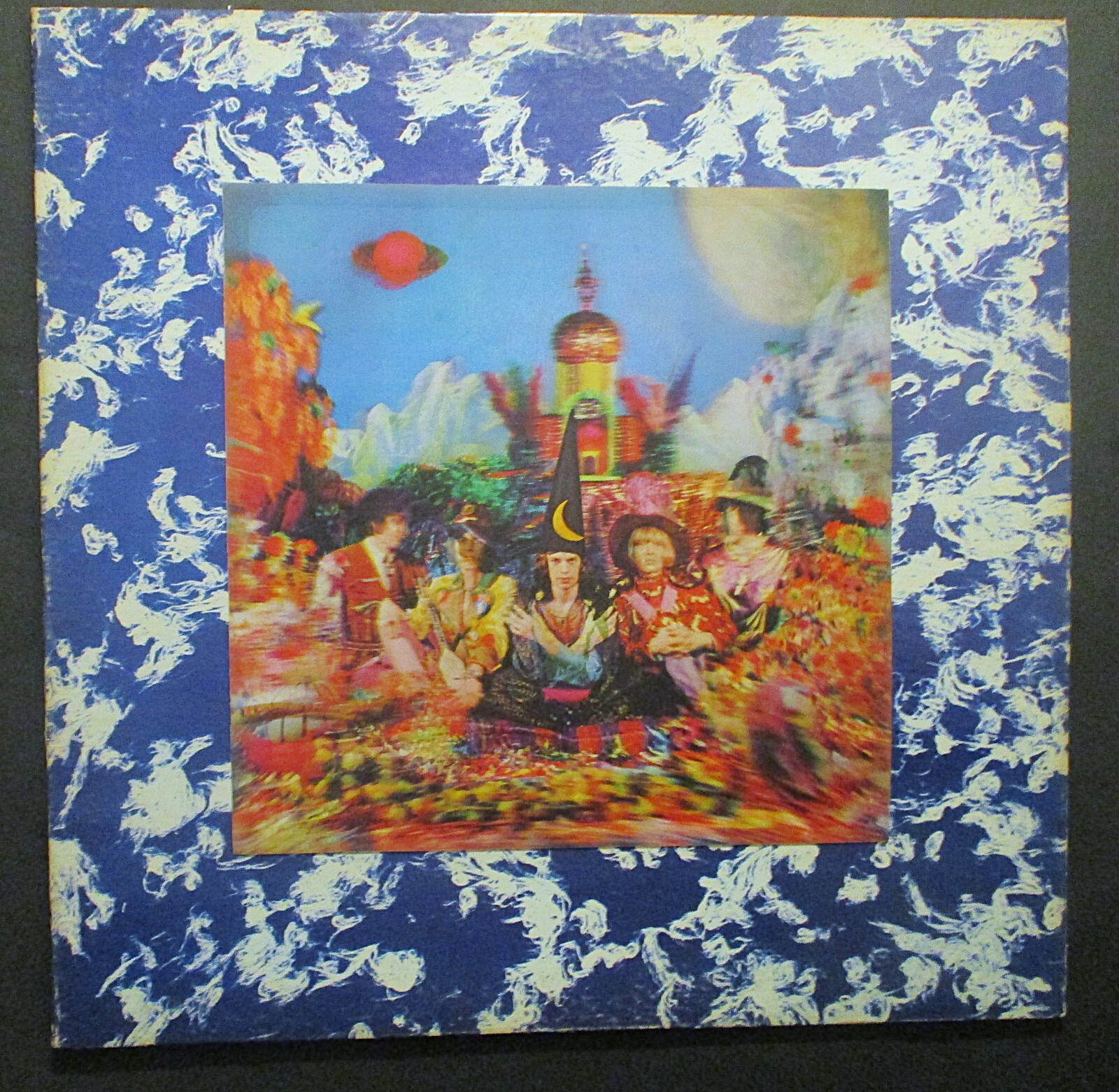
This early American London first pressing comes in a very thick sturdy gatefold jacket with the 3D-style Lenticular cover featuring Michael Cooper's famous image of the band.
The entire album jacket design is very elaborate and this was revolutionary pioneering packaging at the time.
It was literally 'Mind Boggling', easy to get lost in, and this classic album cover captured and trapped the minds and imaginations of chemically altered Rolling Stones fans for hours at a time. ~~~~~~~~~~~~~~~~~~~~~~~
ALBUM JACKET DESIGN
Once the title was decided, the band went thru several different ideas for the album cover.
Their initial idea was to use a picture of Mick, sitting defiantly alone in his jail cell after his drug bust. Apparently, some photos for a potential cover were taken, but the police confiscated the film.
Mick and Keith were seen as martyrs, so the next idea for an album cover was to use an image of Mick Jagger’s nude body nailed to a cross, in a religious martyr style like Christ. That idea was quickly squashed by Decca.
The next idea was to create a cover in the same style as the Beatles Sgt. Pepper but with their own twist and satire
The Beatles Sgt. Pepper had just been released 3 months earlier and there was talk about that album's cover, how elaborate and complex it was and how innovative it was.
The Stones decided to do a similar cover but out-Pepper the Beatles.
The Stones hooked up with UK artist Michael Cooper and put him in charge of the whole project of designing and creating the cover for this album.
Keith, who had an interest in Photography had met Cooper years earlier and the 2 hit it off well. Cooper was then allowed into the Rolling Stones inner circle and took many great images of the band over the years.
In 1967, Michael Cooper was a well known London photographer, known for his spontaneous, 'fly on the wall', unplanned pictures of artists, writers and musicians.
Cooper was the inspiration for the photographer character in Michelangelo Antonioni’s classic 60's music film 'Blow-Up'.
Cooper had famously shot the amazing cover of the Beatles’ Sgt. Pepper’s Lonely Hearts Club Band album just 3 months earlier, so the Stones wanted him to help design their new album cover.
Cooper was proud of his Peppers cover which contained amazing complexity and details, but lamented that the detail was 'limited' by the 2-D format of the picture. Imagine how much more detail could be seen if you looked at the Pepper images from different angles?
He then convinced the Stones that a '3-D picture' for their next album would be a cool, innovative idea, so they decided to go for it.
Cooper knew some Japanese photographers who were experimenting with 3-D photographic imaging using 'layered' negatives, and he knew that one of the few 'professional' 3-D cameras in the world was owned by a Japanese photographer in New York City.
He was also familiar with the 'Vari-Vue' company in Mt. Vernon, NY who had coined the term 'lenticular' and held the patents for creating the lenses and technology that created the 3-D images used on postcards and 'flikker' buttons around that time.
Cooper arranged to connect all these resources together for a photo session at 'Pictorial Productions', a photo studio in Mount Vernon, NY, which was an affluent suburban town just north of New York City. Keith recalls: "We went to New York with Michael Cooper and met a Japanese guy who had a camera that could produce a 3-D effect."
The photo shoot was scheduled for Monday September 18, 1967 but the photo session would take a lot of preparation and planning, so Cooper, his assistants, the band, and their small entourage all flew to New Yok several days earlier to have the long weekend to prepare.
Part of the reason they flew to New York early is that they were uncertain if they would get thru immigration and customs since Keith, Brian and Mick were all recently convicted of drug related crimes.
They purposely flew to New York separately, Brian and Keith, the rest of the team, and Mick separately. In case some of them didn't get thru, the photo shoot could still happen.
Keith, no stranger to the law, had significant issues getting thru, but was finally cleared. Brian, the one who everyone thought was likely going to be a problem, slid thru easily. Mick faced some long questioning as well, but had it easier getting thru than Keith.
The band all regrouped in NYC to prepare for the weekend and the photo shoot. The Stones faced a monumental task as they had to plan, create and literally build their own album cover.
The Beatle's famous backdrop/stage for 'Peppers' took over 2 months to design, an army of people to build, and was already completed before the shoot. The Beatles had an easy 3 hour photo session for 'Peppers'.
The Stones and Michael Cooper had to make their backdrop from scratch, by themselves, by hand, and had barely 2 days to complete it. It was going to be a long weekend.
For three days, the band themselves literally hand-built the outlandishly exotic set in a Mt. Vernon, NY photo Studio.
One of the many stories in Rolling Stones lore about that psychedelicized weekend involves the story of the chemically enhanced Stones and their entourage bursting upon a theatrical costume and prop supply warehouse in the Bronx that weekend. They found that the shop was 'closed' and the shop, even if open, was technically not allowed to sell clothing that day, due to the state's weekend 'Blue Laws' at the time.
The owner was eventually found, some 'persuasion' was done, and the Stones had the vast theater supply store all to themselves.
While Cooper and his assistants picked out ribbon, fabric, paper and other supplies to make the backdrop, the Stones each personally chose their own clothing, costumes, and hats, plus a few 'props', such as a Camel, for the photo shoot. The clothing they chose was a bit flashy and unusual, making them appear like psychedelic medieval pranksters.
Retreating back to the photo studio, they set about creating their 'stage' or backdrop for the photo shoot. There are some great outtake photos of Keith, grinning fiendishly, armed with a cigarette and a saw, sitting on the floor making the backdrop.
Keith Richards recalled: “We made that set ourselves. We built the set on acid, went all round New York getting the flowers and the rest of the props; we were painting it, spraying it. We were just loony...we went to the studios with spray cans and made the whole thing ourselves and we made our own set for the album cover...like two or three days of handicrafts".
Mick Jagger recalls: “We were on acid...It was like being at school, you know, sticking on the bits of colored paper and things. It was really silly, but we enjoyed it.”
“We were on acid doing the cover picture...I can remember virtually nothing of those sessions. It's a total blank. We were pretty much the way we look on the cover!" ~ Mick
The set included two planets; a giant red Saturn, and an even larger Moon, hanging in the sky over the Himalayan mountains, a Taj Mahal-like structure, a camel, various trees full of exotic birds, a long-tailed bird, peacock feathers, and other 'treasures', all made from Styrofoam, colored foil, scraps of paper, ribbons, beads, glitter, and all manner of decorative paraphernalia, all held together with quarts of glue.
Real plants and flowers were blended in, then Michael Cooper added the 4 Beatles faces, well hidden amongst the flowers. ~~~~~~~~~~~~~~~~~~
With the album cover photo shoot done, the new album cover image was created.
The image used Vari-Vue's lenticular technology, which created amazing 3-dimensional depth and allowed the image to appear to change and move as it is viewed from different angles. ~~~
In the image, the Stones are all dressed as psychedelic medieval hippies and are all seated cross-legged. When the image is tilted appropriately, the various band members appear to turn their heads and look at each other. Mick's face and pointed, crescent mooned wizard’s hat, as the central image, does not move at all, and serves to stabilize your eyes and give you a frame of reference.
Although Mick's face never moves, his arms alternate between being crossed over his chest and reaching outward.
Looking closely on the cover, one can see the faces of each of the four Beatles. The hidden faces of the Beatles were included as a wink and a nod to their friends who similarly acknowledged the Stones on the cover of their Sgt. Pepper album with a Shirley Temple doll in the lower right-hand corner wearing a sweater with the message “Welcome the Rolling Stones”
The motion is somewhat 'regional' and it's hard to get all of the action, all of the time. For example, you can only see two Beatles at a time, depending on how you tilt it, John/George on the left or Ringo/Paul on the right. You have to spend a lot of time playing with this album's 3-D cover to reveal all it has to offer. ~~~
The original plan was to make the entire 12" x 12" front cover of the album one big lenticular image, but realizing that would be prohibitively expensive to reproduce thousands of times, it was decided to scale down the size of the photo by a third to 8" x 8" and surround the image with a blue-and-white wispy smoke graphic design.
Those same wispy smoke graphics were carried over onto the album's inner sleeve which reproduced the same design in red. ~~~
Despite building the set themselves, the 'Satanic Majesties' cover cost $25,000 to make in 1967.
The Beatles Sgt Peppers cover, made just several months earlier, cost £2,867 in 1967.
The high costs of hiring 'Pictorial Productions' studios, renting the special 3D camera, hiring the Vari-Vue team, plus high costs of using their technical staff, ran the bill to over $25,000. Decca usually paid around $75 for an album cover photo in those days.
Decca complained that, even with the modified smaller lenticular image on the front, the cost of manufacturing the albums was more than the actual retail price of the record, so Decca/London actually lost money on every copy they sold. ~~~~~~~~~
Due to excessive costs, the expensive, glued on, lenticular cover for 'Satanic Majesties' was phased out early on, replacing the 3-D cover with a simple photograph. That photo is slightly different than the originals, with the most obvious differences being Mick's hat tilted awkwardly to the viewer's left, and a quite different sky behind them.
The 3-D image resurfaced briefly for a select few mid-80's limited edition pressings, then it was claimed that the master materials for reprinting the 3D cover were intentionally destroyed, preventing them from ever being used again.
Some later re-pressings still came out with a lenticular cover, such as a 50th anniversary edition, and Record Store Day edition, but these were made from an inferior reproduction and the quality and 3-d effect was not as good as originals. ~~~~~~~~~~~~~~~~~~~~~~~~~~~
Clean, bright original first pressings, like this nice example, are becoming rarer and hard to find for a variety of reasons.
The image was glued onto the jacket and over time the glue has seeped thru the image, darkening it and ruining the 3-d effect.
Also if the image got scratched or worn over time, the image lost much of it's 3-D effect.
The gatefold was often used for 'recreational' purposes and often shows scratches, bong water stains, and damage.
Most older copies of this record also have pen or pencil 'marks' on the maze inside the gatefold, from people trying to solve it over the years.
So, for a variety of reasons, original first pressings with a clean 3-D image, a very clean gatefold, a clean, bright, and mark free Maze, and a clean jacket are becoming quite rare, hard to find and getting rarer.
This copy has one of the nicest Jackets I've seen in quite some time. A beautiful clean example inside and out.
Another good reason to get your hands on a nice early stereo American pressing of 'Their Satanic Majesties Request' is that, over time, the last 58 years, the master tapes haven't aged very well and have developed issues, like a glitch on 'She's a Rainbow' at 0:44 on the word 'everywhere', and a glitch on the first note of 'Gomper'.
You can hear these 'defects' on the Stones' 2016 Mono box remaster.
This is a nice original full wide stereo 'Bell sound' pressing from 1967 when the master tapes were still fresh and fully revealing, and doesn't have those issues. ~~~~~~~~~~~~~~~~~~~~~~~~
GATEFOLD
The inner gatefold of this album is amazing. One of the most bizarre, dense, psychedelic and complex I've ever seen.
On the inside of the gatefold is a dense, bizarre, Hieronomous Bosch-like photo collage that fills the right side and bleeds over onto the left.
The inner-cover collage contains seemingly hundreds of images, all collected from paintings by the old masters (Da Vinci, Raphael), sculptures, religious relics, Indian mandalas, Roman emperors, old maps, astronomical and celestial works, and nature. Flowers are prominently featured, scattered throughout the collage.
On the left side of the gatefold is a large red maze with it's center destination labeled “It’s Here”.
The Maze is taken from the floor plans of the catacombs of the Gothic 'Our Lady of Reims Cathedral', in France, the traditional location for the coronation of the Kings of France.
The maze sits on various pieces of old maps. I personally love the fact that the map in the top left corner shows the coastline of Maryland, my home state. Other sections of map show details of the coasts of Africa, South America, and parts of China.
One fascinating and frustrating note is that the maze has no solution and can't be completed, although many have tried. An intentional wall on the left side means one can never arrive at the "It's Here" goal in the center. ~~~~~~~~~~
The back cover of the 'Satanic Majesties' album jacket is a painting by Tony Meeviwissen depicting the four basic elements that made up the ancient world; Earth, Water, Fire, and Air. Along the bottom there is a beautiful Earth scene. In the bottom left corner, a stream enters and passes thru a landscape filled with trippy trees, rocks, vegetation and 9 exotic winged birds, towards a glowing sunrise on the far right.
The left side of the rear cover represents water. Layers of trippy, powerful water twist, swirl and peak into waves. The water on the left cascades down to the earth below, and dips behind a hill, forming the stream.
The top panel represents Fire. Leaping, flickering tongues of flame make up the top edge of the back cover, while 7 colorful birds make their way thru the flames. At the top left, flickers of flames are extinguished by a layered sphere of water that suggests a marble, planet or portal to another dimension occupied by 2 black birds.
At the top right, the flickering flames give rise to billowing clouds of swirling smoke with hints of the blue skies of Air in the background. Nine more pale blue birds fly thu the air.
In the middle of the back cover, the album title, set list, production credits and thanks are printed in a pale blue space that appears to be a piece of cross stitch fabric. The cloth has faint images of various flowers that appear to bleed thru the weave of the cross-stitch.
In the top right corner of this patch of cloth, there is a large arrow pointing towards the top right corner.
The arrow point is surrounded by a narrow green garden of white flowers. I've always felt this red-edged arrow is pointing at, or suggesting that there is more too see and hear inside. There is.
This back cover is one of the most bizarre and psychedelic that I'm aware of, and that's just the back of the jacket. The many small psychedelic details of this entire album jacket occupied the drug-filled minds of Stones fans for hours at a time back in the day.
There are many birds hidden and scattered throughout this psychedelic world of Earth, Water, Fire, and Air. I remember reading an article, about 40 years ago, mentioning that there are something like 40 birds on this album cover and how to find them, but I suspect you have to be properly chemically altered to find them all.
I wish I still had that article, but I do have instructions how to easily find all 4 of the Beatles faces, and I'll include a copy of those instructions with this record. It's a cool 'party trick' to show your record collecting friends, especially if they weren't aware that the Beatles were deeply buried in there, or have never seen them. ~~~~~~~~~~~~~ SONGS
The songs on this album include:
Sing This All Together Citadel In Another Land 2000 Man Sing This All Together (See What Happens) She's A Rainbow The Lantern Gomper 2000 Light Years From Home On With The Show ~~~
'Their Satanic Majesties Request', self produced by the band and beautifully recorded and engineered by Glyn Johns, has moments of unquestionable brilliance and the album's strange and wonderful psychedelia burrows deep into your brain and mind.
Brian Jones' use of mellotron, brass instruments, and harp, combined with Nicky Hopkins' virtuoso splashes of suitably psychedelic piano, organ and harpsichord to bring an unusual but terrific baroque pop/psych feeling to the entire 'Satanic Majesties' project.
This album features some of their most imaginative soundscapes, which include mellotrons, light orchestration, North African Moroccan rhythms, acoustic instruments, unusual percussion, electronics, ‘found' noises & voices, and so much more, all mixed, layered and weaved into an amazing recording that captures the psychedelic feel of the summer of 1967.
The album's "hits", '2000 Light Years', 'She's a Rainbow' and 'Citadel' immediately connect and resonate with the listener, and are as good, catchy, and well-written as any other of their mid ’60s singles, just a little 'different'. They still rank among some of the Rolling Stones best music.
While some of the other songs; like ‘In Another Land’, 'The Lantern' and 'Gomper' are a little 'out there' and have deep psychedelic undercurrents, they are also terrific, strange and wonderful songs that still retain the classic Rolling Stones sound and bluesy flair. ~~~~~~~~~~~~~~~~~~~~~~~~~~
This album, like every Rolling Stones album, contains several great songs. I've always loved '2000 Light Years From Home' and 'She's A Rainbow.'
'2000 Light Years From Home' is an all-time psych great.
It's a classic, majestically dark, doomy, cosmic rocker about a guy travelling through space & time, and the loneliness that emerges as the miles between him, his home, and his friends gets longer and longer and further away.
The musicianship is fantastic, and the band is tight & cohesive.
The intro is very cosmic with choppy, Pink Floyd 'Piper'-like, backwards piano chords. Charlie's drumming is driving and spot-on, Keith's 'solo' is dark, heavy & fuzzy, and Brian Jones lays down some of the creepiest, most sinister, and most psychedelic mellotron effects ever to grace a late 60's rock record. A great, thick and layered Psych song!, just way too short.
Being placed near the end of this record, I think it's Mick's comment about how far 'out there' their music, and the Stones themselves, had become by the end of the summer of '67. ~~~~~~~~~~~~~~~~~~
The beautiful, glorious 'She's a Rainbow' is a real example of the band firing on all cylinders, and really showcases everyone’s talents.
It follows the carnival barker's voice from the end of 'Sing This All Together', blowing a whistle and saying "Are you ready?...
The song opens with Nicky Hopkins' perfectly compressed and gated, baroque, music-box-esque piano playing, then it expands into beautiful harmonies, piano, and strings as Mick sings about the girl that "comes in colors."
The background strings, written and arranged by future Led Zeppelin bassist John Paul Jones, are precisely played by Brian. He plays the strings in a beautiful classical style at the beginning, but adds some aggressive, avant garde style strokes later on. Perfect contrast as the song develops.
When you think of the Rolling Stones music, strings don't come to mind, but the strings on 'She's a Rainbow' are some of the most tasteful of the entire Stones’ career. ~~~~~~~~~~~~~~~~~~~~~~~~~~~~~~~~~~~~~
While the Stones never intended songs like 'The Lantern' to be a hit, it's a haunting, stunningly beautiful, folksy, atmospheric track and a perfect example of 60's psychedelia with its lead-off tolling bell and complex interplay between acoustic guitar, piano, and drums and those spooky brass choruses.
Despite being very 'different' and atmospheric, it still has an identifiable Stones sound and style, with Charlie's insistent beat and some signature slide guitar licks.
'Citadel' is another example of a song that is a little 'out there' but still retains the Rolling Stones attitude, sound and feel.
The song is a powerful, piercing, riff-driven showcase for Keith, with a nice hook to the 'Candy and Taffy' chorus, and great lyrics about urban blight and strife that are still relevant today.
In several places in the song, Keef plays a shrill metallic "Ping" with his guitar, thru his Vox amp, with the gain turned all the way up to 'kill'. Many claim that it's one of the very first 'heavy metal' songs to appear on an album.
That 'ping' is literally a 'heavy metal' sound that is quite startling, and interrupts your buzz, especially if you're not expecting it.
Meanwhile, Brian is playing some faint, but great, eerie, echoey jazz saxophone lines in the background.
The catchy 'Candy & Taffy' chorus is fantastic wordplay and writing. On the one hand, Jagger is wishing that the tasty confectionary 'treats' of his youth come revisit him and relieve him of the bleakness of his adult urban squalor, but the 'Candy & Taffy' of hip 1967 London were actually Candy Darling and Taffy Terrific, two drag queens from the Andy Warhol scene. A whole different type of tasty treat.
'Citadel' is an awesome Stones song, a real 'ear-worm' once you get it in your head, and one of my favorite 'deep tracks' on the album.
'2000 Man' is another deep hidden gem. It starts off with Brian playing some unusual droning strings, but then. like so many songs on this album, opens up and reveals many complex and outlandish layers of sounds and music.
Bill Wyman's 'In Another Land' (aka "Acid in the Grass") is another very hazy, dreamlike, psychedelic song. ~~~~~~~~~~~~~~~~~~~~~~
Although a 'different', innovative, and experimental piece, this is a record that deserves to be in any rock vinyl record collection.
Even if the music isn't totally your 'thing', the amazing album jacket is a 'must have' for your collection.
The amazing back-story, the folklore, the legendary controversy surrounding this album, and the mind-blowing record jacket art, are big reasons why people want, seek out, and collect vinyl record albums and why physical records are always much cooler and better than CDs or digital releases. Long live vinyl! ~~~~~~~~~~~~~~~~~~~~~~~~~~~~~~~~~~~~~~~~~
CONDITION: I tried to show good hi-resolution photos of the cover, labels and vinyl in my pictures.
VINYL: The vinyl is still quite nice. There are some hairlines and signs of play, but still nice. No deep or palpable scratches. I'll call it VG+, to keep everyone happy, but you can see from my photos how terrific it looks.
LABELS. The labels are clean and bright and the spindle holes are clean, suggesting my infrequent or very careful play.
JACKET: The jacket is excellent. Clean and bright. As you can see it still looks fantastic. I've owned this record for decades. It's been sleeved and stored properly for around 40 years now.
Add this rare. classic, Rolling Stones record to your collection. ~~~~~~~~~~~~~~~~~~~
** NOTE: I'm selling this rare 'Stones' record "AS IS" and "NO RETURN". It's rare and as described and I'm sure you'll be very happy with it. A great copy. ~~~~~~~~~~~~~~~
I’m recently retired and downsizing and letting go some gems and rarities from nearly 45 years of vinyl record collecting. Check out the many other fantastic 45s and 33s coming soon to my page!
All records have been carefully evaluated and graded by me. I visually inspect all records under bright light, personally gently clean them with a soft cloth and then, if unsure, play them on a modern high-end turntable to get a true picture of condition.
Please look at all the high-resolution pictures I added. They are all my own and are of the actual record being sold. The pictures are part of the description and can show small details, label variations, and condition better than I can put into words.
My grading is fair and honest. I have had over 3,600 happy and satisfied EBay customers over the years, with 100% positive feedback, and I have been buying/selling on EBay for nearly 30 years, so please bid with confidence!
I'm a One-man operation, this is a hobby, not my job. I do this for fun. I do this because I love music, love collecting vinyl and want others to share in that same experience. I take my time listening, researching, grading, listing and packaging. I will NOT sell any record that I personally would not want in my collection.
As you well know, packing and shipping rare records requires special care and attention, therefore, shipping cost within the lower 48 states is $5.00 on this item. If you would like insurance, or anything faster than Media/Economy Mail, please let me know and I can arrange it for you. I’ll work with you to make sure you’re happy!
I will gladly combine multiple records, or other items on my page, and make the shipping much less for you. I don’t inflate the shipping costs; they are what they are. I strive to keep them as low as possible. See my feedback for comments on my quality packing and shipping.
All items are packaged with sturdy cardboard mailers and appropriate padding. I take pride in my packaging and shipping and package all my records as if I were sending them to myself. I refuse to use cheap flimsy packaging material when sending my vinyl. I treat them as if they were my own and mail them the same way.
All orders are processed and shipped within 2 business days of receipt. We package and ship our vinyl records with the greatest care, using proper packaging to ensure that your rare and collectible vinyl records arrive in pristine condition.
Payments can be made by any of the multiple options that Ebay offers.
I will be happy to exchange feedback with anyone I complete a transaction with.
THANK YOU for looking and reading if you got this far. I know I rambled on a bit, but can't help it. I have a passion for records, especially the Rolling Stones. I hope this listing was entertaining and informative. -- JOHN
price rating