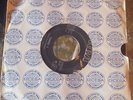
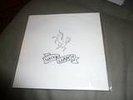
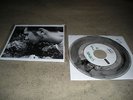
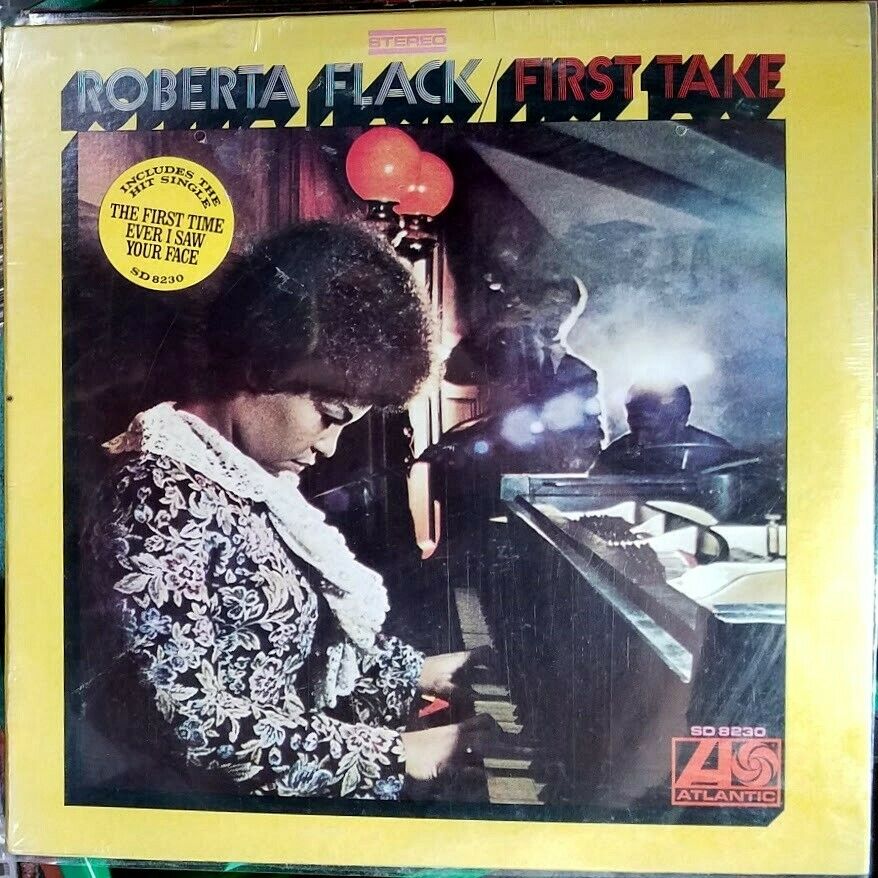
ROBERTA FLACK First Take LP Original 1969 SEALED w/ Hype Sticker MINT
$
48


Favourite Auctions
To save auctions to your favourites, please login
If you don't have an account, please register
Description
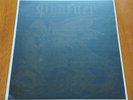
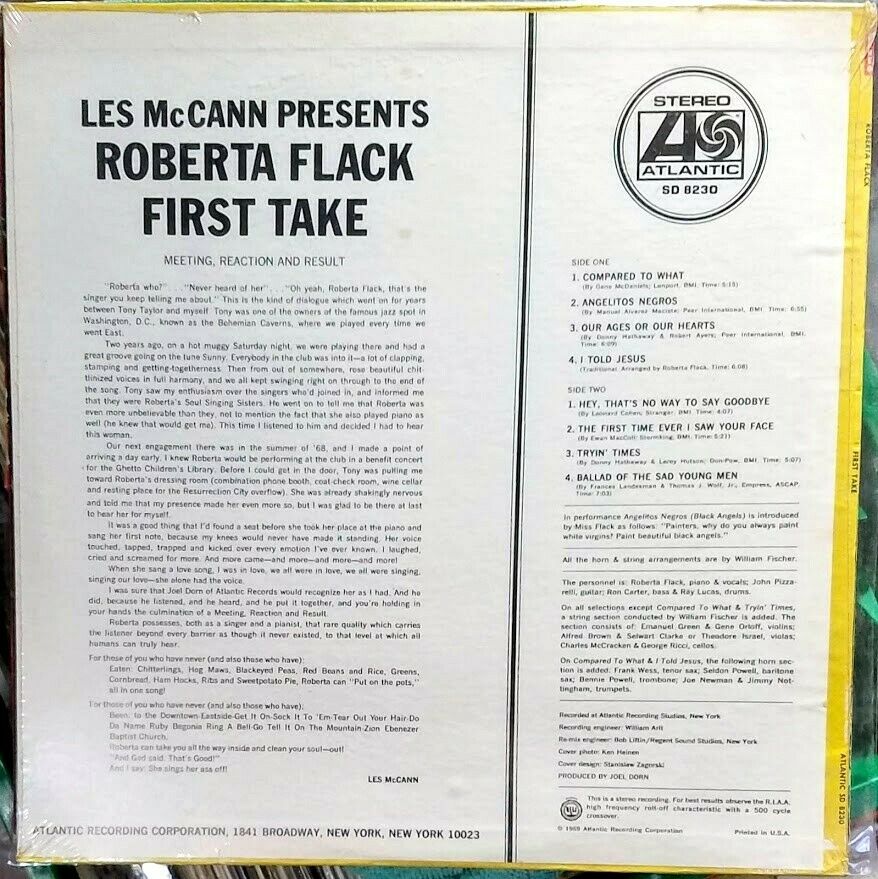
Record: Mint (M) Still Sealed! Cover: Generic NO cut-out marks,No splits,NO stickers,NO writing Labels: Clean! Roberta Flack First Take 1969 United States Atlantic SD 8230 12" Stereo LP SB-59600
Roberta Flack
First Take
1969 United States Atlantic 12" LP
Near New Still Sealed with Hype Sticker
Condition
Vinyl: Mint (M) Still Sealed!
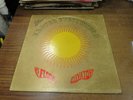
Sleeve: Generic near sharp corners, a couple of age spots, see photos NO cut-out marks,No splits,NO stickers,NO writing
Please see item specifics section above for more details
Tracks:
Roberta Flack ?– First Take Label: Atlantic ?– SD 8230 Format: Vinyl, LP, Album, Stereo, Country: US Released: 1969 Genre: Jazz, Funk / Soul Style: Soul Tracklist Hide Credits A1 Compared To What Written-By – Gene McDaniels* 5:15 A2 Angelitos Negros Written-By – Manuel Alvarez Maciste 6:55 A3 Our Ages Or Our Hearts Written-By – Donny Hathaway, Robert Ayers 6:09 A4 I Told Jesus Arranged By – Roberta FlackWritten-By – Traditional 6:08 B1 Hey, That's No Way To Say Goodbye Written-By – Leonard Cohen 4:07 B2 The First Time Ever I Saw Your Face Written-By – Ewan MacColl 5:21 B3 Tryin' Times Written-By – Donny Hathaway, Leroy Hutson 5:07 B4 Ballad Of The Sad Young Men Written-By – Frances Landesman*, Thomas J. Wolf Jr.* 7:03 Companies, etc. Manufactured For – Atlantic Recording Corporation Copyright (c) – Atlantic Recording Corporation Published By – Lonport Published By – Peer International Published By – Stranger Published By – Stormking Published By – Don-Pow Published By – Empress (3) Recorded At – Atlantic Studios Lacquer Cut At – Atlantic Studios Credits Arranged By [Horns, Strings] – William Fischer* Baritone Saxophone – Seldon Powell (tracks: A1, A4) Bass – Ron Carter Cello – Charles McCracken (tracks: A2 to B2, B4), George Ricci (tracks: A2 to B2, B4) Conductor [Strings] – William Fischer* (tracks: A2 to B2, B4) Design [Cover] – Stanislaw Zagorski Drums – Ray Lucas Engineer [Re-mix] – Bob Liftin Engineer [Recording] – William Arlt Guitar – John Pizzarelli* Lacquer Cut By – GP* Liner Notes – Les McCann Photography By – Ken Heinen Piano, Vocals – Roberta Flack Producer – Joel Dorn Tenor Saxophone – Frank Wess (tracks: A1, A4) Trombone – Bennie Powell* (tracks: A1, A4) Trumpet – Jimmy Nottingham (tracks: A1, A4), Joe Newman (tracks: A1, A4) Viola – Alfred Brown (tracks: A2 to B2, B4), Selwart Clarke (tracks: A2 to B2, B4), Theodore Israel (tracks: A2 to B2, B4) Violin – Emanuel Green (tracks: A2 to B2, B4), Gene Orloff (tracks: A2 to B2, B4)
ROBERTA FLACK First Take LP Original 1969 SEALED w/ Hype Sticker MINT Roberta Cleopatra Flack (born February 10, 1937)[2][3] is an American singer. She is known for her No. 1 singles "The First Time Ever I Saw Your Face", "Killing Me Softly with His Song", "Feel Like Makin' Love"; and "Where Is the Love" and "The Closer I Get to You", two of her many duets with Donny Hathaway. Flack is the only solo artist to win the Grammy Award for Record of the Year on two consecutive years: "The First Time Ever I Saw Your Face" won at the 1973 Grammys and "Killing Me Softly with His Song" won at the 1974 Grammys. Contents Early life Flack lived with a musical family, born in Black Mountain, North Carolina to parents Laron Flack, a Veterans Administration draftsman,[4] and Irene Council[5] Flack[6] a church organist,[7] on February 10, 1937[8][2] (some sources also say 1939 - 1940 Census states Roberta was 3 years old)[9][10] and raised in Arlington, Virginia.[11] Growing up she often accompanied the choir of Lomax African Methodist Episcopal Zion Church by playing hymns and spirituals on piano, but she also enjoyed going to the "Baptist church down the street" to listen to contemporary gospel music, such as that performed by Mahalia Jackson and Sam Cooke.[12] When Flack was nine, she started taking an interest in playing the piano,[6] and during her early teens, Flack so excelled at classical piano that Howard University awarded her a full music scholarship.[13] By age 15, she entered Howard University, making her one of the youngest students ever to enroll there. She eventually changed her major from piano to voice, and became an assistant conductor of the university choir. Her direction of a production of Aida received a standing ovation from the Howard University faculty. Flack is a member of Delta Sigma Theta sorority and was made an honorary member of Tau Beta Sigma by the Eta Delta Chapter at Howard University for her outstanding work in promoting music education. Roberta Flack became a student teacher at a school near Chevy Chase, Maryland. She graduated from Howard University at 19 and began graduate studies in music, but the sudden death of her father forced her to take a job teaching music and English in Farmville, North Carolina.[14] Career Early career Before becoming a professional singer-songwriter, Flack returned to Washington, D.C. and taught at Banneker, Browne, and Rabaut Junior High Schools. She also taught private piano lessons out of her home on Euclid St. NW. During this period, her music career began to take shape on evenings and weekends in Washington, D.C. area night spots. At the Tivoli Club, she accompanied opera singers at the piano. During intermissions, she would sing blues, folk, and pop standards in a back room, accompanying herself on the piano. Later, she performed several nights a week at the 1520 Club, again providing her own piano accompaniment. Around this time, her voice teacher, Frederick "Wilkie" Wilkerson, told her that he saw a brighter future for her in pop music than in the classics. She modified her repertoire accordingly and her reputation spread.[citation needed] Flack began singing professionally after being hired to perform regularly at Mr. Henry's Restaurant, on Capitol Hill, Washington, DC in 1968.[15][16] The atmosphere in Mr. Henry's was welcoming and the club turned into a showcase for the young music teacher. Her voice mesmerized locals and word spread. A-list entertainers who were appearing in town would come in late at night to hear her sing (frequent visitors included Woody Allen, Bill Cosby, Ramsey Lewis and others). As restaurant owner Henry Yaffe recalled, "She told me if I could give her work there three nights a week, she would quit teaching." He did and she did. To meet Roberta's exacting standards, Yaffe transformed the apartment above the bar into the Roberta Flack Room. "I got the oak paneling from the old Dodge Hotel near Union Station. I put in heavy upholstered chairs, sort of a conservative style from the 50s and an acoustical system designed especially for Roberta. She was very demanding. She was a perfectionist." 1970s Roberta Flack 1971 Les McCann discovered Flack singing and playing jazz in a Washington nightclub.[6] He later said on the liner notes of what would be her first album First Take noted below, "Her voice touched, tapped, trapped, and kicked every emotion I've ever known. I laughed, cried, and screamed for more...she alone had the voice." Very quickly, he arranged an audition for her with Atlantic Records, during which she played 42 songs in 3 hours for producer Joel Dorn. In November 1968, she recorded 39 song demos in less than 10 hours. Three months later, Atlantic reportedly recorded Flack's debut album, First Take, in a mere 10 hours.[11] Flack later spoke of those studio sessions as a "very naive and beautiful approach... I was comfortable with the music because I had worked on all these songs for all the years I had worked at Mr. Henry's." In 1971, Flack participated in the legendary Soul to Soul concert film by Denis Sanders, which was headlined by Wilson Pickett, along with Ike & Tina Turner, Santana, The Staple Singers, Les McCann, Eddie Harris, The Voices of Harlem, and others. The U.S. delegation of musical artists was invited to perform for 14th anniversary of African independence in Ghana.[17] The film was digitally reissued on DVD and CD in 2004 but Flack declined permission for her image and recording to be included for unknown reasons. Her a cappella performance of the traditional spiritual "Oh Freedom" retitled "Freedom Song" on the original Soul to Soul LP soundtrack is only available in the VHS version of the film.[18] Flack's cover version of "Will You Love Me Tomorrow" hit number 76 on the Billboard Hot 100 in 1972. Her Atlantic recordings did not sell particularly well, until actor/director Clint Eastwood chose a song from First Take, "The First Time Ever I Saw Your Face" written by Ewan MacColl, for the sound track of his directorial debut Play Misty for Me; it became the biggest hit of the year for 1972 – spending six consecutive weeks at #1 and earning Flack a million-selling Gold disc.[19] It finished the year as Billboard's top song of 1972. The First Take album also went to #1 and eventually sold 1.9 million copies in the United States. Eastwood, who paid $2,000 for the use of the song in the film,[20] has remained an admirer and friend of Flack's ever since. It was awarded the Grammy Award for Record of the Year in 1973. In 1983, she recorded the end music to the Dirty Harry film Sudden Impact at Eastwood's request.[11] In 1972, Flack began recording regularly with Donny Hathaway, scoring hits such as the Grammy-winning "Where Is the Love" (1972) and later "The Closer I Get to You" (1978) – both million-selling gold singles.[19] Flack and Hathaway recorded several duets together, including two LPs, until Hathaway's 1979 death. On her own, Flack scored her second #1 hit in 1973, "Killing Me Softly with His Song" written by Charles Fox, Norman Gimbel and Lori Lieberman.[21] It was awarded both Record of the Year and Best Pop Vocal Performance, Female at the 1974 Grammy Awards. Its parent album was Flack's biggest-selling disc, eventually earning double platinum certification. In 1974, Flack released "Feel Like Makin' Love," which became her third and final #1 hit to date on the Hot 100. That same year, Flack sang the lead on a Sherman Brothers song called "Freedom", which featured prominently at the opening and closing of the movie Huckleberry Finn. Also in that same year, she performed "When We Grow Up" with a teenage Michael Jackson on the 1974 television special, Free to Be... You and Me. Then, in her only film role, she served as the narrator for The Legend of John Henry. 1980s Roberta Flack had a 1982 hit single with "Making Love", written by Burt Bacharach (the title track of the 1982 film of the same name), which reached #13. She began working with Peabo Bryson with more limited success, charting as high as #5 on the R&B chart (plus #16 Pop and #4 Adult Contemporary) with "Tonight, I Celebrate My Love" in 1983. Her next two singles with Bryson, "You're Looking Like Love To Me" and "I Just Came Here To Dance," fared better on adult contemporary (AC) radio than on pop or R&B radio. Flack performing in Boston, Mass., on August 28, 2013 In 1986, Flack sang the theme song entitled "Together Through the Years" for the NBC television series Valerie, later known as The Hogan Family. The song was used throughout the show's six seasons. In 1987 Flack supplied the voice of Michael Jackson's mother in the 18-minute short film for Bad[22]. Oasis was released in 1988 and failed to make an impact with pop audiences, though the title track reached #1 on the R&B chart and a remix of "Uh-Uh Ooh-Ooh Look Out (Here It Comes)" topped the dance chart in 1989. Flack found herself again in the US Top 10 with the hit song "Set the Night to Music", a 1991 duet with Jamaican vocalist Maxi Priest that peaked at #6 on the Billboard Hot 100 charts and #2 AC. Flack's smooth R&B sound lent itself easily to Easy Listening airplay during the 1970s, and she has had four #1 AC hits. Later career In 1999, a star with Flack's name was placed on the Hollywood Walk of Fame.[13] That same year, she gave a concert tour in South Africa; the final performance was attended by President Nelson Mandela. In 2010, she appeared on the 52nd Annual Grammy Awards, singing a duet of "Where Is The Love" with Maxwell. In February 2012, Flack released Let it Be Roberta, an album of Beatles covers including "Hey Jude" and "Let It Be". It was her first recording in over eight years.[23] Flack knew John Lennon and Yoko Ono, as both households moved in 1975 into The Dakota apartment building in New York City, and had apartments across the hall from each other. Flack has stated that she has already been asked to do a second album of Beatles covers.[24] She is currently involved in an interpretative album of the Beatles' classics.[25] At age 80, Flack made her most recent recording, Running, the closing credits song of the 2018 feature documentary 3100: Run and Become with music and lyrics by Michael A. Levine. [26] R&B & Soul 1960s,Classic R&B,Soul Still Sealed 33 RPM Roberta Flack First Take 1969 United States Atlantic SD 8230 12" LP Cover: Generic NO cut-out marks,No splits,NO stickers,NO writing near sharp corners, a couple of age spots, see photos Record: Mint (M) Still Sealed! Labels: Clean! SB-59600
This exquisite slice of retro music history is a vinyl sound recording (not a CD). Please reference Item Specifics above for additional detail. Strict Goldmine grading -- Over 22 years on Ebay! Combine Items to Save $$$!
©A Sound Deal
price rating