R&B CHARTMAKERS STATESIDE MIRACLES MARVELETTES SOUL
£
50
$
66


Favourite Auctions
To save auctions to your favourites, please login
If you don't have an account, please register
Description
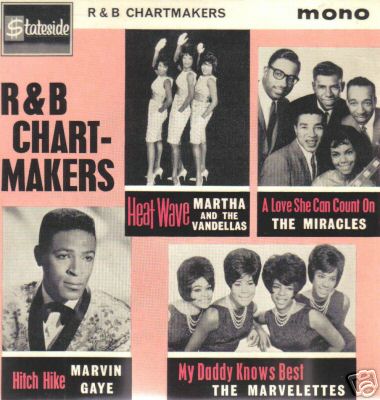
YOU ARE BIDDING ON A MEGA RARE EXCELLENT CONDITION EP
R&B CHARTMAKERS
RELEASED ON STATESIDE SE 1009
TRACKS ARE
MARTHA REEVES & THE VANDELLAS
HEAT WAVE
THE MIRACLES
A LOVE SHE CAN COUNT ON
MARVIN GAYE
HITCH HIKE
THE MARVELETTES
MY DADDY KNOWS BEST
MARVELETTES
Probably the most pop-oriented of Motown's major female acts, the Marvelettes didn't project as strong an identity as the Supremes, Mary Wells, or Martha Reeves, but recorded quite a few hits, including Motown's first number one single, "Please Mr. Postman" (1961). "Postman," as well as other chirpy early-'60s hits like "Playboy," "Twistin' Postman," and "Beechwood 4-5789," were the label's purest girl group efforts. Featuring two strong lead singers, Gladys Horton and Wanda Young, the Marvelettes went through five different lineups, but maintained a high standard on their recordings. After a few years, they moved from girl group sounds to up-tempo and mid-tempo numbers that were more characteristic of Motown's production line. They received no small help from Smokey Robinson, who produced and wrote many of their singles; Holland-Dozier-Holland, Berry Gordy, Mickey Stevenson, Marvin Gaye, and Ashford-Simpson also got involved with the songwriting and production at various points. After the mid-'60s Wanda Young assumed most of the lead vocal duties; Gladys Horton departed from the group in the late '60s. While the Marvelettes didn't cut as many monster smashes as most of their Motown peers after the early '60s, they did periodically surface with classic hits like "Too Many Fish in the Sea," "Don't Mess With Bill," and "The Hunter Gets Captured by the Game." There were also plenty of fine minor hits and misses, like 1965's "I'll Keep Holding On," which is just as memorable as the well-known Motown chart-toppers of the era. The group quietly disbanded in the early '70s after several years without a major hit.
MIRACLES
Scoring over 40 hits on the R&B Top 40 charts, the Miracles started out as the Five Chimes in the mid-'50s while the members were still in high school. The Detroit vocal group consisted of William "Smokey" Robinson, Warren "Pete" Moore, Clarence "Humble" Dawson, Donald Wicker, and James "Rat" Grice. Not too long after the group formed, Wicker and Grice left and were replaced by cousins Emerson "Sonny" Rogers and Bobby Rogers, who both sang tenor, and baritonist Ronnie White was in Dawson's place. The vocal quintet then changed its name to the Matadors and in 1956 Claudette Rogers joined the band after her brother Sonny was drafted. The Matadors auditioned for Jackie Wilson's manager, Nat Tarnopol, in 1956. Although Tarnopol wasn't interested, finding the group too similar to the Platters, one of Wilson's songwriters, Berry Gordy, Jr., was and he soon began producing the band, who now went by the name the Miracles. Gordy produced their first single, "Got a Job," (an answer to the Silhouettes' "Get a Job") which was issued by the New York label End Records in 1958.
After one more release on this label, the Miracles recorded their first song for Gordy's new Motown/Tamla label, 1959's "Bad Girl" (which was issued nationally on the Chess label). Next came the first hit for both the group and the label, 1960's "Shop Around," which reached number one on the R&B charts and number two pop. The next song by the Miracles to hit the number one R&B spot and reach the pop Top Ten came two years later with "You've Really Got a Hold on Me." Robinson and Claudette Rogers were married in 1963 and she retired from the group a year later. The band's last big hit before they changed their name from the Miracles was "Going to a Go-Go" (1966), which climbed into the Top Five on the R&B charts and the pop Top 20. Later that year, "I'm the One You Need" reached the Top 20. After this, the group's name changed to Smokey Robinson & the Miracles and they scored two more number one songs: "I Second That Emotion" (1967) and "The Tears of a Clown" (1970). Robinson left the group to pursue a solo career in 1972 and 20-year-old Billy Griffin was brought in to replace the lead singer. Once again the Miracles, the band scored several more hits, including "Do It Baby" and "Don't Cha Love It," which both reached the R&B Top Ten. The Miracles experienced a big success in early 1976 with "Love Machine (Part 1)," which reached number one on the pop charts. The multi-million selling single came off of their second album without Robinson, 1975's City of Angels, and stayed on the charts for over six months, making it the longest-running hit the band ever had. Their final album on the Motown label, Power of Music, followed. After this, the Miracles added a new member, Griffin's brother Don, and the band switched over to Columbia Records. Their first CBS release was Love Crazy (1977), which contained a single, "Spy for the Brotherhood," that was pulled off the record after complaints from the FBI. The group's last charting single, "Mean Machine," made the R&B Top 100 in 1978. Griffin pursued a solo career and Moore became a record producer in Detroit. In the late '80s, Bobby Rogers started the New Miracles, and in 1990 the Miracles (including Griffin and Claudette Robinson) reunited to re-record "Love Machine" for the U.K. Motorcity label.
MARTHA REEVES & THE VANDELLAS
Along with the Supremes, Martha & the Vandellas defined the distaff side of the Motown sound in the 1960s; their biggest hits, including "Heat Wave," "Dancing in the Street," and "Nowhere to Run," remain among the most potent and enduring dance records of the era. The vocal group was led by Martha Reeves who, along with fellow Detroit natives Annette Sterling Beard, Gloria Williams, and Rosalind Ashford, founded the Del-Phis in 1960. After Reeves landed a secretarial position at the offices of Motown Records, the Del-Phis were tapped to record a one-off single for the label's Melody imprint, which they cut under the name the Vels.
The single fizzled, and Williams exited, reducing the group to a trio. After backing Marvin Gaye on the superb 1962 record "Stubborn Kind of Fellow," they were renamed Martha & the Vandellas, taking inspiration from Detroit's Van Dyke Street and Reeves' heroine Della Reese. When singer Mary Wells failed to show up for a recording date, musicians' union rules demanded that a vocalist be found to fulfill contractual obligations; as a result, Reeves was yanked from the secretarial pool and laid down what would become Martha & the Vandellas' first record, 1963's "I'll Have to Let Him Go."
The Top 30 success of the ballad "Come and Get These Memories" brought the group the attention of Motown's hit-making production team Holland-Dozier-Holland, who crafted their next smash, the galvanizing Top Five classic "Heat Wave," which perfected the mix of impassioned call-and-response vocals, pulsing rhythms, and full-bodied horns that became the trio's trademark. Following another Top Ten hit, "Quicksand," Beard retired, and was replaced by former Velvelette Betty Kelly. After singer Kim Weston turned down the Marvin Gaye/Ivy Jo Hunter/Mickey Stevenson composition "Dancing in the Street," the song was shuttled to Martha & the Vandellas; refashioned by Holland-Dozier-Holland to fit the group's formula, the anthem became their biggest hit and definitive statement, reaching number two in the summer of 1964. A year later, they returned with another smash, the savage "Nowhere to Run," followed by "I'm Ready for Love."
In 1967, Kelly exited, and was replaced by Reeves' younger sister Lois; on subsequent releases, the group was billed as Martha Reeves & the Vandellas. 1967's "Jimmy Mack" and "Honey Chile" were the last records overseen by the Holland-Dozier-Holland team before their defection from Motown, and were also the final significant Vandellas hits; in 1968, Martha Reeves fell seriously ill, and in 1969 Ashford departed, with another former Velvelette, Sandra Tilley, assuming her position. The trio continued unsuccessfully for a few more years before breaking up in the wake of a December, 1972, farewell performance at Detroit's Cobo Hall. After Motown relocated its corporate offices to Los Angeles (a move Reeves denied she was privy to), the singer, who had begun a solo career, sued to have her contract with the label annulled; in her 1994 autobiography, Dancing in the Street, she charged that the Vandellas' career, though highly successful in its own right, could have been even greater had Motown founder Berry Gordy, Jr. given their music the same obsessive attention he afforded to Diana Ross & the Supremes.
Reeves recorded her debut solo effort, Martha Reeves: Produced by Richard Perry, for MCA in 1974; though a few more LPs followed, including 1976's The Rest of My Life and 1978's We Meet Again, she received little notice on her own, and eventually suffered a pair of nervous breakdowns that led to a brief period of institutionalization. Lois Reeves, meanwhile, went on to work with Al Green, while Sandra Tilley retired from music; she died in 1982 following surgery on a brain tumor. In 1989, Martha Reeves, Annette Beard, and Rosalind Ashford successfully sued Motown for back royalties, and occasionally reunited for performances in the 1990s. Reeves also continued as a solo artist, and in addition performed with a Vandellas unit consisting of Lois and a third sister, Delphine.
MARVIN GAYE
One of the most gifted, visionary, and enduring talents ever launched into orbit by the Motown hit machine, Marvin Gaye blazed the trail for the continued evolution of popular black music. Moving from lean, powerful R&B to stylish, sophisticated soul to finally arrive at an intensely political and personal form of artistic self-expression, his work not only redefined soul music as a creative force but also expanded its impact as an agent for social change.
Marvin Pentz Gay, Jr. (in the style of his hero Sam Cooke, he added the "e" to his surname as an adult) was born April 2, 1939, in Washington, D.C. The second of three children born to the Reverend Marvin Gay, Sr., an ordained minister in the House of God — a conservative Christian sect that fuses elements of orthodox Judaism and Pentecostalism, imposes strict codes of conduct, and observes no holidays — he began singing in church at the age of three, quickly becoming a soloist in the choir. Gaye later took up piano and drums, and music became his escape from the nightmarish realities of his home life — throughout his childhood, his father beat him on an almost daily basis.
After graduating from high school, Gaye enlisted in the U.S. Air Force; upon his discharge, he returned to Washington and began singing in a number of street-corner doo wop groups, eventually joining the Rainbows, a top local attraction. With the help of mentor Bo Diddley, the Rainbows cut "Wyatt Earp," a single for the OKeh label that brought them to the attention of singer Harvey Fuqua, who in 1958 recruited the group to become the latest edition of his backing ensemble, the Moonglows. After relocating to Chicago, the Moonglows recorded a series of singles for Chess, including 1959's "Mama Loocie." While touring the Midwest, the group performed in Detroit, where Gaye's graceful tenor and three-octave vocal range won the interest of fledgling impresario Berry Gordy, Jr., who signed him to the Motown label in 1961.
While first working at Motown as a session drummer and playing on early hits by Smokey Robinson & the Miracles, he met Gordy's sister Anna, and married her in late 1961. Upon mounting a solo career, Gaye struggled to find his voice, and early singles failed. Finally, his fourth effort, "Stubborn Kind of Fellow," became a minor hit in 1962, and his next two singles — the 1963 dance efforts "Hitch Hike" and "Can I Get a Witness" — both reached the Top 30. With 1963's "Pride and Joy," Gaye scored his first Top Ten smash, but often found his role as a hitmaker stifling — his desire to become a crooner of lush romantic ballads ran in direct opposition to Motown's all-important emphasis on chart success, and the ongoing battle between his artistic ambitions and the label's demands for commercial product continued throughout Gaye's long tenure with the company.
With 1964's Together, a collection of duets with Mary Wells, Gaye scored his first charting album; the duo also notched a number of hit singles together, including "Once Upon a Time" and "What's the Matter With You, Baby?" As a solo performer, Gaye continued to enjoy great success, scoring three superb Top Ten hits — "Ain't That Peculiar," "I'll Be Doggone," and "How Sweet It Is (To Be Loved by You)" — in 1965. In total, he scored some 39 Top 40 singles for Motown, many of which he also wrote and arranged. With Kim Weston, the second of his crucial vocal partners, he also established himself as one of the era's dominant duet singers with the stunning "It Takes Two."
However, Gaye's greatest duets were with Tammi Terrell, with whom he scored a series of massive hits penned by the team of Nickolas Ashford and Valerie Simpson, including 1967's "Ain't No Mountain High Enough" and "Your Precious Love," followed by 1968's "Ain't Nothing Like the Real Thing" and "You're All I Need to Get By." The team's success was tragically cut short in 1967 when, during a concert appearance in Virginia, Terrell collapsed into Gaye's arms on-stage, the first evidence of a brain tumor that abruptly ended her performing career and finally killed her on March 16, 1970. Her illness and eventual loss left Gaye deeply shaken, marring the chart-topping 1968 success of "I Heard It Through the Grapevine," his biggest hit and arguably the pinnacle of the Motown sound.
At the same time, Gaye was forced to cope with a number of other personal problems, not the least of which was his crumbling marriage. He also found the material he recorded for Motown to be increasingly irrelevant in the face of the tremendous social changes sweeping the nation, and after scoring a pair of 1969 Top Ten hits with "Too Busy Thinking About My Baby" and "That's the Way Love Is," he spent the majority of 1970 in seclusion, resurfacing early the next year with the self-produced What's Going On, a landmark effort heralding a dramatic shift in both content and style that forever altered the face of black music. A highly percussive album that incorporated jazz and classical elements to forge a remarkably sophisticated and fluid soul sound, What's Going On was a conceptual masterpiece that brought Gaye's deeply held spiritual beliefs to the fore to explore issues ranging from poverty and discrimination to the environment, drug abuse, and political corruption; chief among the record's concerns was the conflict in Vietnam, as Gaye structured the songs around the point of view of his brother Frankie, himself a soldier recently returned from combat.
The ambitions and complexity of What's Going On baffled Berry Gordy, who initially refused to release the LP; he finally relented, although he maintained that he never understood the record's full scope. Gaye was vindicated when the majestic title track reached the number two spot in 1971, and both of the follow-ups, "Mercy Mercy Me (The Ecology)" and "Inner City Blues (Make Me Wanna Holler)," also reached the Top Ten. The album's success guaranteed Gaye continued artistic control over his work and helped loosen the reins for other Motown artists, most notably Stevie Wonder, to also take command of their own destinies. Consequently, in 1972, Gaye changed directions again, agreeing to score the blaxploitation thriller Trouble Man; the resulting soundtrack was a primarily instrumental effort showcasing his increasing interest in jazz, although a vocal turn on the moody, minimalist title track scored another Top Ten smash.
The long-simmering eroticism implicit in much of Gaye's work reached its boiling point with 1973's Let's Get It On, one of the most sexually charged albums ever recorded; a work of intense lust and longing, it became the most commercially successful effort of his career, and the title cut became his second number one hit. Let's Get It On also marked another significant shift in Gaye's lyrical outlook, moving him from the political arena to a deeply personal, even insular stance that continued to define his subsequent work. After teaming with Diana Ross for the 1973 duet collection Marvin and Diana, he returned to work on his next solo effort, I Want You; however, the record's completion was delayed by his 1975 divorce from Anna Gordy. The dissolution of his marriage threw Gaye into a tailspin, and he spent much of the mid-'70s in divorce court. To combat Gaye's absence from the studio, Motown released the 1977 stopgap Live at the London Palladium, which spawned the single "Got to Give It Up, Pt. 1," his final number one hit.
As a result of a 1976 court settlement, Gaye was ordered to make good on missed alimony payments by recording a new album, with the intention that all royalties earned from its sales would then be awarded to his ex-wife. The 1978 record, a two-LP set sardonically titled Here, My Dear, bitterly explored the couple's relationship in such intimate detail that Anna Gordy briefly considered suing Gaye for invasion of privacy. In the interim, he had remarried and begun work on another album, Lover Man, but scrapped the project when the "Ego Tripping Out" lead single — a telling personal commentary presented as a duet between the spiritual and sexual halves of his identity, which biographer David Ritz later dubbed the singer's "divided soul" — failed to chart. As his drug problems increased and his marriage to new wife Janis also began to fail, he relocated to Hawaii in an attempt to sort out his personal affairs.
In 1981, longstanding tax difficulties and renewed pressures from the IRS forced Gaye to flee to Europe, where he began work on the ambitious In Our Lifetime, a deeply philosophical record that ultimately severed his longstanding relationship with Motown after he claimed the label had remixed and edited the album without his consent. Additionally, Gaye stated that the finished artwork parodied his original intent, and that even the title had been changed to drop an all-important question mark. Upon signing with Columbia in 1982, he battled stories of erratic behavior and a consuming addiction to cocaine to emerge triumphant with Midnight Love, an assured comeback highlighted by the luminous Top Three hit "Sexual Healing." The record made Gaye a star yet again, and in 1983 he made peace with Berry Gordy by appearing on a television special celebrating Motown's silver anniversary. That same year, he also sang a soulful and idiosyncratic rendition of "The Star-Spangled Banner" at the NBA All-Star Game; it instantly became one of the most controversial and legendary interpretations of the anthem ever performed. And it was to be his final public appearance.
Gaye's career resurgence brought with it an increased reliance on cocaine; finally, his personal demons forced him back to the U.S., where he moved in with his parents in an attempt to regain control of his life. Tragically, the return home only exacerbated his spiral into depression; he and his father quarrelled bitterly, and Gaye threatened suicide on a number of occasions. Finally, on the afternoon of April 1, 1984 — one day before his 45th birthday — Gaye was shot and killed by Marvin Sr. in the aftermath of a heated argument. In the wake of his death, Motown and Columbia teamed up to issue two 1985 collections of outtakes, Dream of a Lifetime — a compilation of erotic funk workouts teamed with spiritual ballads — and the big band-inspired Romantically Yours. (Vulnerable, a collection of ballads that took over 12 years to complete, finally saw release in 1996.) With Gaye's death also came a critical re-evaluation of his work, which deemed What's Going On to be one of the landmark albums in pop history, and his 1987 induction into the Rock & Roll Hall of Fame permanently enshrined him among the pantheon of musical greats.
On 25-Jul-05 at 08:46:10 BST, seller added the following information: Pay instantly with your debit or credit card through PayPal.
price rating