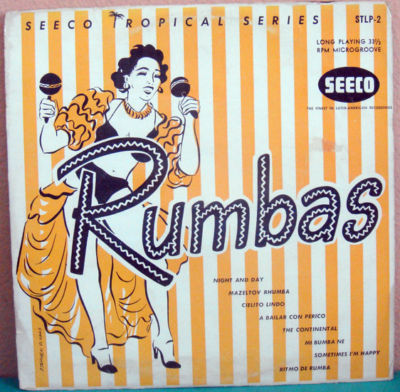
RARE SEECO 10"1950: Carlos (Charlie) Palmieri "RUMBAS"
$
103


Favourite Auctions
To save auctions to your favourites, please login
If you don't have an account, please register
Description
ARTIST : SEE BELOW!
TITLE : RUMBA
LABEL & RECORD #: SEECO-STLP #2 (1950) VINYL CONDITION: HEAR !! : Strong VG (some light noise) to VG+!!!! To Be Sold As Is! LABELS CONDITIONS: SEE SCAN : NM!!!! COVER CONDITION : SEE SCAN :Light Wear, No Splits, Some Edge wear! Well 60 years old!!!REMARKS: THIS IS A TRULY RARE COLLECTOR ITEM....
1- According to the Web This Was Seeco 2nd LP on their 10" series....the 1st was a Noro Morales STLP#1
2- In 1950 a young Charlie Palmieri (born in Ponce, Puerto Rico) was knew as Carlos, as Eddie his younger bro was Eduardo....but when they "migrated" to New York they became Charlie And Eddie!!!!
I did not have the time to find out who were some of the lesser known bands and singers on this recording!
But 1st WHAT IS A RUMBA (RHUMBA):
RHUMBA
El son, an infectious music based on a five-beat rhythm pattern, was developed in the Cuban countryside during the late 19th century. By the 1920s, it had migrated to Havana and formed the basis of rhumba, a style of music and dance that grew out of neighborhood street festivals. While initially taken up by impoverished Cuban city dwellers, the rhumba gradually became popular in polite society. Seven-piece musical ensembles formed to play this new music; one of the most popular was Septeto Nacional, led by composer and guitarist Ignacio Pineiro. Pineiro and his group cut a critically acclaimed album for Seeco in 1958. Americans vacationing in Cuba acquired a taste for this exotic new sound and brought it home with them. Rhumba also reached the United States via the great Cuban composer Ernesto Lecuona, in songs such as "Say Sí Sí" (known in Spanish as "Para Vigo Me Voy") and "Malagueña."
Among those principally responsible for the introduction and popularity of rhumba music in the USA were Noro Morales, Trío Matamoros, Miguelito Valdés, Machito and especially Xavier Cugat, the Rhumba King. More than any other Latin bandleader, Cugat understood the importance of image and marketing. His shows featured beautiful girl singers in Spanish mantillas, flashy tango and flamenco dancers, virile and handsome conga drummers, musicians in ruffled pink sleeves, stage sets decorated with potted palms, and more often than not. . . Chihuahuas! The colorful and flamboyant image he created for himself and his music captured the American public's fancy, and opened the door for other Latin artists to follow in his wake. Follow they did: Just as Cugat's popularity was peaking in the late '40s, Morales, Valdés and Trío Matamoros began laying down their classic Seeco sides. Machito waited just a little longer, signing with the label in the early '50s.
Miguel Matamoros founded his Trío in 1925 with Rafael Cueto and Siro Rodríguez. Trío Matamoros was one of the earliest Cuban groups to record in the United States (1927), and also one of the earliest to join the Seeco roster (1945). The Trío's touring band included the legendary Beny Moré on guitar; in the late '40s, Moré left the group to begin his celebrated singing career. Practically all of Trío Matamoros' songs are considered standards today, and their Seeco sides include the much-recorded "Coco Seco," about as primitive an example of rhumba as you could ever hope to hear. The product of a Cuban/Mexican cross-cultural marriage, Miguelito Valdés was arguably the Ricky Martin of his day. His impassioned conga-drumming and his handsome Latin looks brought him many ladies' telephone numbers scrawled on cocktail napkins, not to mention numerous offers to appear in Hollywood films. He helped himself to both the women and the movie exposure, starring with the likes of Rita Hayworth and Fred Astaire. His fame was consolidated in the 1950's when he toured the world his own band. Ironically, though, Valdés was eclipsed in popularity by Desi Arnáz, who admittedly copied his stage persona and much of his repertoire. Miguelito Valdés recorded the hit single version of Arnáz's signature tune "Babalú" in 1944, backed by Xavier Cugat's orchestra. One year later, he was in the studio with Noro Morales cutting tracks for Miguelito Valdés Sings, one of the finest and most collectible Seeco albums. With excellent selections like "Se Formo El Rhumbón" and "Amor Sagrado", this is an essential record for connoisseurs of vintage rhumba and bolero music.
The undulating "Tremendo Cumban" by Machito and his Afro-Cubans is probably the most frequently licensed track in the Seeco catalogue. Machito, whose true name was Francisco Pérez Grillo, came to New York from Cuba in 1937 to seek his fortune as a singer. He worked briefly with the Xavier Cugat orchestra before joining brother-in-law Mario Bauzá to form his own band in 1940. The Afro-Cubans quickly became the most popular Latin dance music ensemble in New York. In 1943, Machito was drafted for service in World War II, and Bauzá sent to Cuba for his talented sister, Graciela Pérez, who fronted the band in his absence. She remained with the band following her brother's return, and their wry duet vocal style became a hit with both audiences and record buyers. Graciela became famous throughout Latin-America for her quivering performances of ballads like "Novio Mio", but she was no slouch in the rhythm department, as her energetic Seeco recording of "Adivinanza" clearly demonstrates. The siblings joined forces on sizzling tracks like "Mambo Infierno" and other successful marriages of hot jazz and raw rhumba captured at Seeco recording sessions.
2- MAZELTOV RHUMBA: Arturo Chaite & His Orchestra
3- CIELITO LINDO: Carlos Palmieri His Piano & Rhythm
4- A BAILAR CON PERICO: Canelina With The Carlos Varela Orquesta
TRACKS SIDE B:
1- THE CONTINENTAL : Carlos Palmieri His Piano & Rhythm
2- MI BUMBA NO: Pupi Campo & Orchestra (Misspelling Bumba for Rumba)
3- SOMETIMES I'M HAPPY: Carlos Palmieri His Piano & Rhythm
4- RITMO DE RUMBA: Carlos Vega Quintet
PERSONNEL:
See Above!
WEB REMARKS: THE GREAT SEECO RECORD LABEL:
Seeco Records was devoted to the kind of Latin music that Sydney Siegel loved. Rival labels would spring up in later years (most notably, Tico Records in 1948) which tended to specialize in the "New York Latin" sound of the most popular mambo bands. Seeco and its sister label Tropical created a niche for itself by seeking out (no pun intended) and recording only the most authentic sounds; and if that meant traveling to some far-flung locale to record, so be it. Seeco's catalogue included not only Afro-Cuban music (the foundation of mambo), but also native music from the French Antilles, South America, Western Europe, the Caribbean and all over the Latin diaspora. Over the next 25 years, Sidney Siegel would aggressively pursue distribution deals and fresh talent in Cuba, Puerto Rico, Colombia, Haiti, The Dominican Republic, Mexico, Spain and Argentina. His upstart independent label became famous both inside and outside the United States due to the pedigree of its product. The sleeve of each new release proclaimed in bold letters "The Finest In Latin-American Recordings." While a fair amount of dross was issued by his label, Siegel did his best to make the claim ring true.
Please Follow The Shipping Rates Below:
LPs
1 Item
Xtra Item
Air Mail Media U.S.A
$4.00 (Delivery Confirmation Included)
Add $0.25
Air Mail Priority U.S.A
$7.50 (Delivery Confirmation Included)
Add $1.00
Air Mail Canada
$6.75
Add $2.00
Air Mail Europe
$13.50
Add $2.50
Air Mail Asia
$13.50
Add $3.00
Air Mail Caribbean
$12.00
Add $2.00
Air Mail South America
$12.50
Add $2.50
If Buying More Than 3 Records We Will Inform You The Shipping & Handling....We do combine shipping for multiple purchases.
Insurance Available If Requested - Domestic Only:
$1.75 ................ $0.01 to $50
$2.25 ................ $50.01 to $100
$2.75 ................ $100.01 to $200
* We offer a money back + shipping costs guarantee on our records (unless otherwise noted) if you feel the LP was not graded properly (in Grading “disputes” Return Shipping Not Included). We will issue a full refund upon its return, once our mistake has been verified.
Record Grading: Standard guidelines for grading records comes down to a subjective judgment that may vary from person to person. We grade records and LP covers visually AND (when possible) play-tested. We make every effort to give full disclosure (remember that the LP has at least 12 tracks and the grading may vary between each other) and your satisfaction is guaranteed. Don't assume that our vinyl determination of "Very Good+" is the same as yours!
RECORD OR COVER GRADED VG or LESS WILL BE "SOLD AS IS"
MINT: Unplayed, still sealed.
NM RECORDS: are shiny, with no visible defects, they might have one or 2 minor superficial scuff and they should play without any noise. Writing, stickers or other markings cannot appear on the label, nor can any “spindle marks” from someone trying to blindly put the record on the turntable. Major factory defects also must not be present; a record and label obviously pressed off center is not Near Mint. If played, it will do so with no surface noise. (NM records don’t have to be “never played”; a record used on an excellent turntable can remain NM after many plays if the disc is properly cared for.)
NM COVERS:
have no creases, ring wear or seam splits of any kind.
Picture Sleeves: should look as if they never housed a record. This is a great reason to remove your 45s from their picture sleeves and keep them separate. Just keeping the 45 inside the sleeve will cause damage than can reduce the grade of the sleeve.
VG++ (Excellent) RECORDS:
Barely noticeable play wear and background noise. May have surface scuffs and/or superficial marks, which will be inaudible or indiscernible from the background, no scratches. Very nice, flaws noted.
VG++ COVERS:
Artwork is still as close to perfect as can be. Some impression to the cover (minor outer ring wear) but no ink wear! Some slight creases to the corners, but not wrinkled and obtrusive to the eye. The corners can show white (where the artwork pasted slick was) meaning, slight wear. No seam splits or writing on the cover or taped repairs can make this grade.
VG+ RECORDS:
may show some slight signs of wear, including light scuffs or very light scratches that do not affect the listening experience. Slight warps that do not affect the sound are OK. Minor signs of handling are OK, too, such as telltale marks around the center hole, but repeated playing has not misshapen the hole. There may be some very light ring wear or discoloration, but it should be barely noticeable.
VG+ COVERS:
should have only minor wear. A VG+ cover might have some very minor seam wear or a split (less than one inch long) at the bottom, the most vulnerable location. Also, a VG+ cover may have some defacing, such as a cut-out marking. Covers with cut-out markings can never be considered Near Mint.
VG+ PICTURE SLEEVES:
might show some very light creasing where it is obvious that a record once resided (or still does reside). A VG+ picture sleeve might have some very minor seam wear or a split (less than one inch long) at the bottom, the sleeve’s most vulnerable location.
VG RECORDS:
They have more obvious flaws than their counterparts in better shape. They lack most of the original gloss found on factory-fresh records. Groove wear is evident on sight, as are light scratches deep enough to feel with a fingernail. When played, a VG record has surface noise, and some scratches may be audible, especially in soft passages and during a song’s intro and ending. But the noise will not overpower the music otherwise. Minor writing, tape, or a sticker can detract from the label. Many collectors who have jukeboxes will use VG records in them and not think twice. They remain a fine listening experience, just not the same as if it were in better shape.
VG COVERS and PICTURE SLEEVES:
will have many signs of human handling. Ring wear in the middle or along the edges of the cover where the edge of a record would reside, is obvious, though not overwhelming. Some more creases might be visible. Seam splitting will be more obvious; it may appear on all three sides, though it won’t be obvious upon looking. Someone might have written or stamped a price tag on it, too.
RECORDS GRADED VG OR BELOW WILL BE "SOLD AS IS"
Items are to be paid within 7 days (if not paid by that time it will be subject for relisting) of auction close and will be shipped within 48 hours of receipt of payment. Paypal is the preferred method of payment.
Carlos A. Flores 25830 Crippen Dr. Land O' Lakes, FL 34639